Specifications
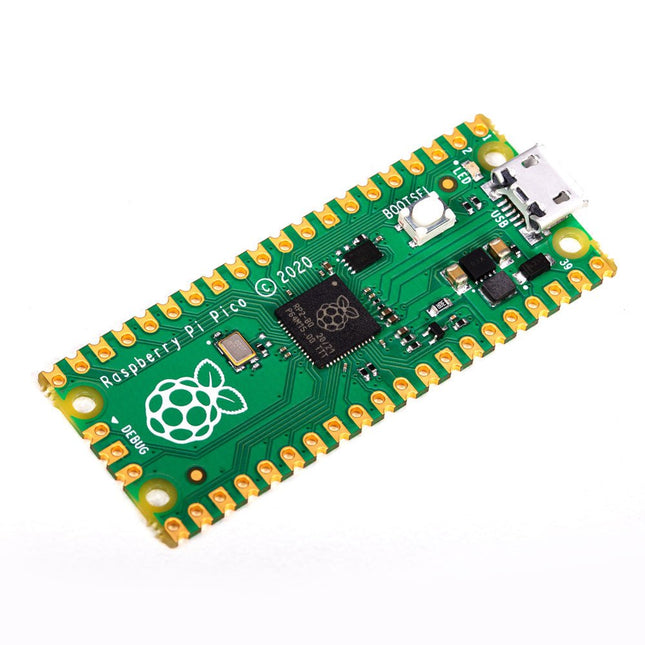
RP2040 microcontroller chip designed by Raspberry Pi in the UK
Dual-core ARM Cortex M0+ processor, with a flexible clock running up to 133 MHz
264 kB SRAM, and 2 MB on-board Flash memory
Castellated module allows soldering directly to carrier boards
USB 1.1 host and device support
Energy-efficient sleep and dormant modes
Drag and drop programming using mass storage via USB
26x multifunction GPIO pins
2x SPI, 2x I²C, 2x UART, 3x 12-bit ADC, 16x controllable PWM channels
On-chip accurate clock and timer
Temperature sensor
On-chip accelerated floating point libraries
8x programmable IO (PIO) state machines for custom peripherals
Why a Raspberry Pi Pico?
Designing your own microcontroller instead of buying an existing one brings a number of advantages. According to Raspberry Pi itself, not one of the existing products available for this comes close to their price/performance ratio.
This Raspberry Pi Pico has also given Raspberry Pi the ability to add some innovative and powerful features of their own. These features are not available anywhere else.
A third reason is that the Raspberry Pi Pico has given Raspberry Pi the ability to create powerful software around the product. Surrounding this software stack is an extensive documentation set. The software and documentation meet the high standard of Raspberry Pi's core products (such as the Raspberry Pi 400, Pi 4 Model B and Pi 3 Model A+).
Who is this microcontroller for?
The Raspberry Pi Pico is suitable for both advanced and novice users. From controlling a display to controlling many different devices that you use every day. Automating everyday operations is made possible by this technology.
Beginner users
The Raspberry Pi Pico is programmable in the C and MicroPython languages and is customizable for a wide range of devices. In addition, the Pico is as easy to use as dragging and dropping files. This makes this microcontroller ideally suited for the novice user.
Advanced users
For advanced users, it is possible to take advantage of the Pico's extensive peripherals. The peripherals include the SPI, I²C, and eight programmable I/O (PIO)-state machines.
What makes the Raspberry Pi Pico unique?
What's unique about the Pico is that it was developed by Raspberry Pi itself. The RP2040 features a dual-core Arm Cortex-M0+ processor with 264 KB of internal RAM and support for up to 16 MB of off-chip Flash.
The Raspberry Pi Pico is unique for several reasons:
The product has the highest price/quality ratio in the microcontroller board market.
The Raspberry Pi Pico has been developed by Raspberry Pi itself.
The software stack surrounding this product is of high quality and comes paired with a comprehensive documentation set.
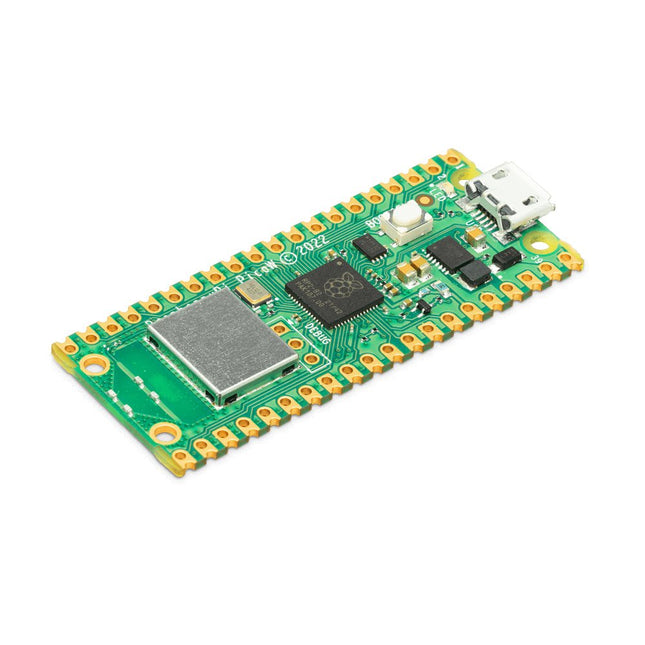
Raspberry Pi Pico W is a microcontroller board based on the Raspberry Pi RP2040 microcontroller chip.
The RP2040 microcontroller chip ('Raspberry Silicon') offers a dual-core ARM Cortex-M0+ processor (133 MHz), 256 KB RAM, 30 GPIO pins, and many other interface options. In addition, there is 2 MB of on-board QSPI flash memory for code and data storage.
Raspberry Pi Pico W has been designed to be a low cost yet flexible development platform for RP2040 with a 2.4 GHz wireless interface using an Infineon CYW43439. The wireless interface is connected via SPI to the RP2040.
Features of Pico W
RP2040 microcontroller with 2 MB of flash memory
On-board single-band 2.4 GHz wireless interfaces (802.11n)
Micro USB B port for power and data (and for reprogramming the flash)
40 pin 21 x 51 mm 'DIP' style 1 mm thick PCB with 0.1' through-hole pins also with edge castellations
Exposes 26 multi-function 3.3 V general purpose I/O (GPIO)
23 GPIO are digital-only, with three also being ADC capable
Can be surface mounted as a module
3-pin ARM serial wire debug (SWD) port
Simple yet highly flexible power supply architecture
Various options for easily powering the unit from micro USB, external supplies or batteries
High quality, low cost, high availability
Comprehensive SDK, software examples and documentation
Features of the RP2040 microcontroller
Dual-core cortex M0+ at up to 133 MHz
On-chip PLL allows variable core frequency
264 kByte multi-bank high performance SRAM
External Quad-SPI Flash with eXecute In Place (XIP) and 16 kByte on-chip cache
High performance full-crossbar bus fabric
On-board USB1.1 (device or host)
30 multi-function general purpose I/O (four can be used for ADC)
1.8-3.3 V I/O voltage
12-bit 500 ksps analogue to digital converter (ADC)
Various digital peripherals
2x UART, 2x I²C, 2x SPI, 16x PWM channels
1x timer with 4 alarms, 1x real time clock
2x programmable I/O (PIO) blocks, 8 state machines in total
Flexible, user-programmable high-speed I/O
Can emulate interfaces such as SD card and VGA
Note: Raspberry Pi Pico W I/O voltage is fixed at 3.3 V.
Downloads
Datasheet
Specifications of 3-pin Debug Connector
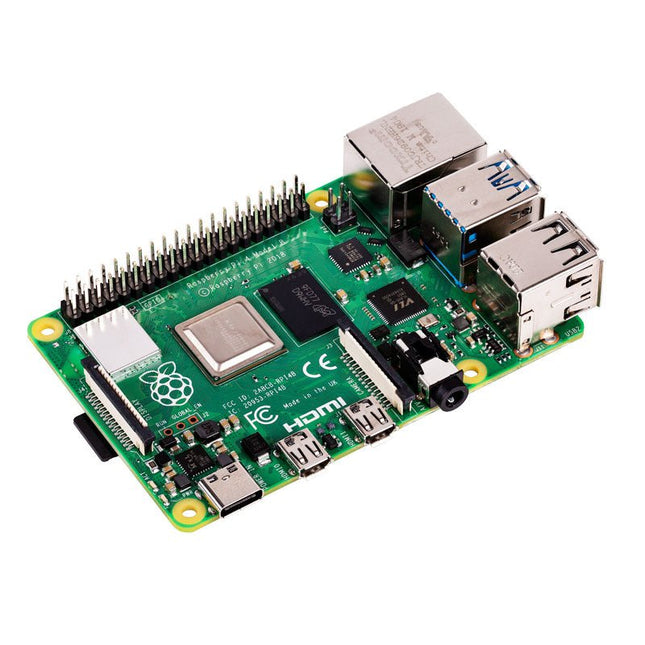
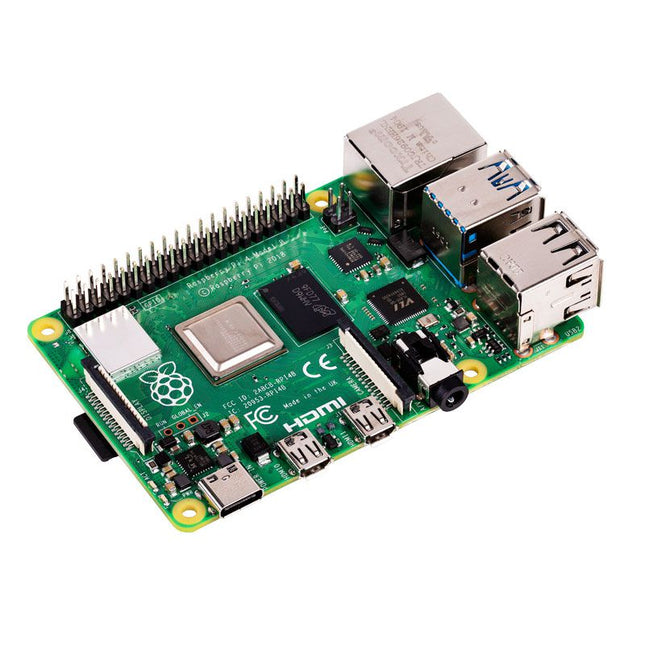
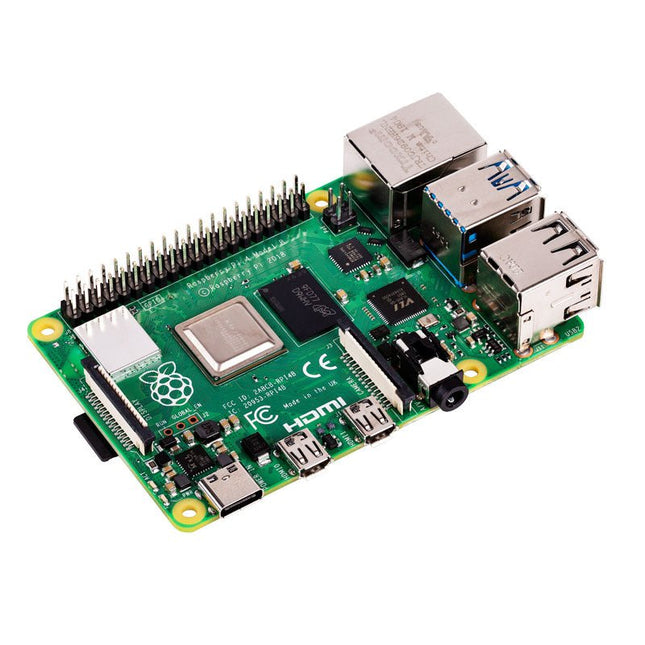
The Raspberry Pi 4 B is 3x faster than its 3 B+ predecessor and offers 4x faster multimedia performance (comparable to the desktop performance of an entry-level x86-based PC).
Features
High-performance 64-bit quad-core processor
Dual-display support at resolutions up to 4K via a pair of micro-HDMI ports
Hardware video decode at up to 4Kp60
Up to 8 GB of RAM
Dual-band 2.4/5 GHz wireless LAN
Bluetooth 5.0
Gigabit Ethernet
USB 3.0
PoE capability (via a separate PoE HAT add-on)
Specifications
SoC
Broadcom BCM2711
CPU
64-bit ARM Cortex-A72 (4x 1.5 GHz)
GPU
Broadcom VideoCore VI
RAM
Up to 8 GB LPDDR4
Wireless LAN
2.4 GHz and 5 GHz IEEE 802.11b/g/n/ac wireless LAN
Bluetooth
Bluetooth 5.0, BLE
Ethernet
Gigabit Ethernet
USB
2x USB-A 3.02x USB-A 2.0
GPIO
Standard 40-pin GPIO header (fully backwards-compatible with previous boards)
Video
2x micro-HDMI ports (up to 4Kp60 supported)2-lane MIPI DSI port (display)2-lane MIPI CSI port (camera)
Audio
4-pole stereo audio and composite video port
Multimedia
H.265 (4Kp60 decode)H.264 (1080p60 decode, 1080p30 encode)OpenGL ES, 3.0 graphics
SD card
microSD (for operating system and storage)
Power
5 V | 3 A (via USB-C)5 V | 3 A (via GPIO)Power over Ethernet (PoE) enabled – (requires separate PoE HAT)
Raspberry Pi 4 B
1 GB RAM
2 GB RAM
8 GB RAM
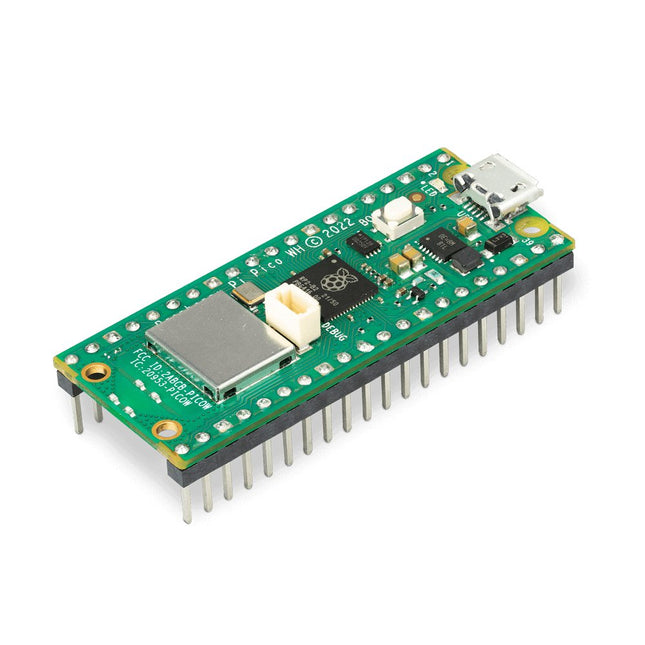
Raspberry Pi Pico WH is a microcontroller board based on the Raspberry Pi RP2040 microcontroller chip.
The RP2040 microcontroller chip ('Raspberry Silicon') offers a dual-core ARM Cortex-M0+ processor (133 MHz), 256 KB RAM, 30 GPIO pins, and many other interface options. In addition, there is 2 MB of on-board QSPI flash memory for code and data storage.
Raspberry Pi Pico WH has been designed to be a low cost yet flexible development platform for RP2040 with a 2.4 GHz wireless interface using an Infineon CYW43439. The wireless interface is connected via SPI to the RP2040.
Features of Pico WH
RP2040 microcontroller with 2 MB of flash memory
On-board single-band 2.4 GHz wireless interfaces (802.11n)
Micro USB B port for power and data (and for reprogramming the flash)
40 pin 21 x 51 mm 'DIP' style 1 mm thick PCB with 0.1' through-hole pins also with edge castellations
Exposes 26 multi-function 3.3 V general purpose I/O (GPIO)
23 GPIO are digital-only, with three also being ADC capable
Can be surface mounted as a module
3-pin ARM serial wire debug (SWD) port
Simple yet highly flexible power supply architecture
Various options for easily powering the unit from micro USB, external supplies or batteries
High quality, low cost, high availability
Comprehensive SDK, software examples and documentation
Pre-populated headers and 3-pin debug connector
Features of the RP2040 microcontroller
Dual-core cortex M0+ at up to 133 MHz
On-chip PLL allows variable core frequency
264 kByte multi-bank high performance SRAM
External Quad-SPI Flash with eXecute In Place (XIP) and 16 kByte on-chip cache
High performance full-crossbar bus fabric
On-board USB1.1 (device or host)
30 multi-function general purpose I/O (four can be used for ADC)
1.8-3.3 V I/O voltage
12-bit 500 ksps analogue to digital converter (ADC)
Various digital peripherals
2x UART, 2x I²C, 2x SPI, 16x PWM channels
1x timer with 4 alarms, 1x real time clock
2x programmable I/O (PIO) blocks, 8 state machines in total
Flexible, user-programmable high-speed I/O
Can emulate interfaces such as SD card and VGA
Note: Raspberry Pi Pico W I/O voltage is fixed at 3.3 V.
Downloads
Datasheet
Specifications of 3-pin Debug Connector
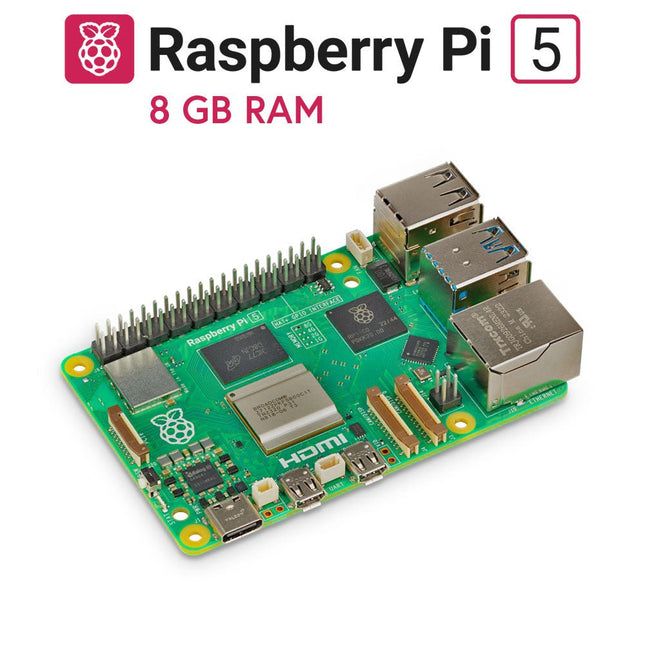
The Raspberry Pi 5 delivers more performance than ever before. Thanks to the faster CPU, GPU and RAM, Raspberry Pi 5 is up to 3x faster than its already fast predecessor. In addition to the speed boost, the Raspberry Pi 5 (which features the new Raspberry Pi RP1 silicon for advanced I/O capabilities) also offers the following features for the first time ever: RTC, an on/off button and a PCIe interface.
Features
64-bit quad-core ARM Cortex-A76 processor (2.4 GHz)
VideoCore VII GPU (800 MHz)
8 GB of LPDDR4X RAM (4267 MHz)
Raspberry Pi silicon RP1 I/O controller chip
Real-time clock
On/off button
PCIe 2.0
UART connector
Fan connector
Specifications
SoC
Broadcom BCM2712
CPU
ARM Cortex-A76 (ARM v8) 64-bit
Clock speed
4x 2.4 GHz
GPU
VideoCore VII (800 MHz)
RAM
8 GB LPDDR4X (4267 MHz)
WiFi
IEEE 802.11b/g/n/ac (2.4 GHz/5 GHz)
Bluetooth
Bluetooth 5.0, BLE
Ethernet
Gigabit Ethernet (with PoE+ support)
USB
2x USB-A 3.0 (5 GBit/s)2x USB-A 2.0
PCI Express
1x PCIe 2.0
GPIO
Standard 40-pin GPIO header
Video
2x micro-HDMI ports (4K60)2x 4-lane MIPI (DSI/CSI)
Multimedia
H.265 (4K60 decode)OpenGL ES 3.1, Vulkan 1.2
SD card
microSD
Power
5 V/5 A (via USB-C)Power over Ethernet (PoE+)
Raspberry Pi 4 vs Raspberry Pi 5
Raspberry Pi 4
Raspberry Pi 5
SoC
Broadcom BCM2711
Broadcom BCM2712
CPU
ARM Cortex-A72 (ARM v8) 64-bit
ARM Cortex-A76 (ARM v8) 64-bit
Clock speed
4x 1.5 GHz
4x 2.4 GHz
L2 cache
1 MByte shared
4x 512 KByte
L3 cache
N/A
2 MByte shared
GPU
VideoCore VI (500 MHz)
VideoCore VII (800 MHz)
RAM
8 GB LPDDR4 (3200 MHz)
8 GB LPDDR4X (4267 MHz)
WiFi
IEEE 802.11b/g/n/ac (2.4 GHz/5 GHz)
IEEE 802.11b/g/n/ac (2.4 GHz/5 GHz)
Bluetooth
Bluetooth 5.0, BLE
Bluetooth 5.0, BLE
Ethernet
Gigabit Ethernet (with PoE support)
Gigabit Ethernet (with PoE+ support)
USB
2x USB-A 3.02x USB-A 2.0
2x USB-A 3.0 (5 GBit/s)2x USB-A 2.0
I/O controller chip
N/A
Raspberry Pi Silicon RP1
PCI Express
N/A
1x PCIe 2.0
Real Time Clock (RTC)
N/A
RTC and RTC battery connector
On/off button
N/A
Onboard power button
Cooling
N/A
Fan connector
GPIO
Standard 40-pin GPIO header
Standard 40-pin GPIO header
UART
via GPIO
1x UART connector
SD card
microSD slot (DDR50)
microSD slot (SDR104)
Video
2x micro-HDMI ports (4K60)1x 2-lane MIPI DSI port (display)1x 2-lane MIPI CSI port (camera)
2x micro-HDMI ports (4K60)2x 4-lane MIPI (DSI/CSI)
Audio
4-pole 3.5 mm audio jack (stereo audio and composite video)
N/A
Multimedia
H.265 (4K60 decode)H.264 (1080p60 decode, 1080p30 encode)OpenGL ES, 3.0 graphics
H.265 (4K60 decode)OpenGL ES 3.1, Vulkan 1.2
Power
5 V/3 A (15 W)Power over Ethernet (PoE)
5 V/5 A (25 W), USB PDPower over Ethernet (PoE+)
Raspberry Pi 5
2 GB RAM
4 GB RAM
16 GB RAM
Downloads
Datasheet
Unboxing the Raspberry Pi 5
First Insights
The Raspberry Pi 4 B is 3x faster than its 3 B+ predecessor and offers 4x faster multimedia performance (comparable to the desktop performance of an entry-level x86-based PC).
Features
High-performance 64-bit quad-core processor
Dual-display support at resolutions up to 4K via a pair of micro-HDMI ports
Hardware video decode at up to 4Kp60
Up to 8 GB of RAM
Dual-band 2.4/5 GHz wireless LAN
Bluetooth 5.0
Gigabit Ethernet
USB 3.0
PoE capability (via a separate PoE HAT add-on)
Specifications
SoC
Broadcom BCM2711
CPU
64-bit ARM Cortex-A72 (4x 1.5 GHz)
GPU
Broadcom VideoCore VI
RAM
Up to 8 GB LPDDR4
Wireless LAN
2.4 GHz and 5 GHz IEEE 802.11b/g/n/ac wireless LAN
Bluetooth
Bluetooth 5.0, BLE
Ethernet
Gigabit Ethernet
USB
2x USB-A 3.02x USB-A 2.0
GPIO
Standard 40-pin GPIO header (fully backwards-compatible with previous boards)
Video
2x micro-HDMI ports (up to 4Kp60 supported)2-lane MIPI DSI port (display)2-lane MIPI CSI port (camera)
Audio
4-pole stereo audio and composite video port
Multimedia
H.265 (4Kp60 decode)H.264 (1080p60 decode, 1080p30 encode)OpenGL ES, 3.0 graphics
SD card
microSD (for operating system and storage)
Power
5 V | 3 A (via USB-C)5 V | 3 A (via GPIO)Power over Ethernet (PoE) enabled – (requires separate PoE HAT)
Raspberry Pi 4 B
1 GB RAM
2 GB RAM
4 GB RAM
SmartScope is a compact 2-channel USB oscilloscope with a bandwidth of 30 MHz and a sampling rate of 2x 100 MSa/s. It is compatible with all major platforms, including Windows, macOS, Linux, and Android. The operation and display of measurement signals are done via smartphone, tablet, or PC. Additionally, a logic analyzer and a signal generator are integrated.
Even more, you can get mobile with it: take the SmartScope on the road, thanks to the single-cable connectivity. Everything is going to be intuitive: pointing, pinching and swiping finally replaces the clunky interfaces of old scopes.
With the SmartScope you develop your digital interfaces using the 100 MS/s logic analyzer. With this tool you can design any signal you want using Excel, then upload it to the built-in Arbitrary Waveform Generator (AWG). At the end capture the voltage at any point of your design at 100 million times each second.
The Software for the support of Windows / macOS / Linux / Android and Export formats (Excel .csv / Matlab .mat) are given.
Features
Channel sampled at 100 MHz/s each
AC/DC coupling on analog inputs
100% silent
64 Mbit RAM: x10000 zoom
Arbitrary Waveform Generator
8 digital inputs at 100 MS/s each
4 digital outputs at 100 MS/s each
Externally power your scope in case your mobile can't supply the juice.
Specifications
Oscilloscope
Bandwidth
30 MHz (-3 dB point)
Sample rate
2x 100 MS/s
Channels
2
Max pre-trigger position
16x full scale
Max post-trigger position
Full scale
Max full voltage scale
10 V/div (±35 V input range)
Min full voltage scale
20 mV/div
Analog input range
-35 V, +35 V
Max input peak-to-peak
40 V
Signal coupling
AC / DC
Precision
8 bit
Input impedance
1 MΩ // 10 pF
Waverforms
200 waveforms/s
Data delay to host
< 10 ms
Sample depth
Up to 4 million samples per channel
External trigger
Yes
Logic Analyzer
Input channels
8
Input impedance
100 kOhm // 2 pF to GND
Sample rate
100 MS/s
Logic level
1.8 V to 5.0 V
Diode protection
Bidirectional
Input data buffer
4 million samples
Waverforms
200 waveforms/s
Data delay to host
< 10 ms
Protocol decoders
I²C, SPI, UART, I²S integrated User extensible
Wave Generator (Analog Output)
Output channels
1
Data rate
Up to 50 MS/s
Output level
0-3.3 V (Opamp driven)
Output buffer
Up to 2048 samples
Max slew rate
30 ns/V
Step
13 mV
Wave Generator (Digital Output)
Channels
4
Data rate
Up to 100 MS/s
Output level
3.3 V or 5 V (selectable)
Output buffer
Up to 2048 samples
Diode protected
Yes
Programmable Logic
USB controller
MicroChip PIC18F14K50
USB interface
PicKit3 or USB flashable
FPGA
Xilinx Spartan 6
FPGA interface
JTAG and USB flashable
Size & Weight
Dimensions (L x W x D)
110 x 64 x 24.2 mm (4.33 x 2.52 x 0.95")
Weight
158 g
Case
Aluminium
Connectivity
Device/Host
mini USB included
Record waveforms
Store Matlab (.mat) or Excel (.csv) files through Dropbox
Analog
BNC 2 probes included
Digital
8x 0.1" pitch, probes (included)
Sync
USB micro B-B
Power
USB micro B (optional)
Included
1x SmartScope USB Oscilloscope
2x Analog probes
1x Digital probe cable
1x USB cable
Downloads
Software
GitHub
Wiki
The Raspberry Pi 4 B is 3x faster than its 3 B+ predecessor and offers 4x faster multimedia performance (comparable to the desktop performance of an entry-level x86-based PC).
Features
High-performance 64-bit quad-core processor
Dual-display support at resolutions up to 4K via a pair of micro-HDMI ports
Hardware video decode at up to 4Kp60
Up to 8 GB of RAM
Dual-band 2.4/5 GHz wireless LAN
Bluetooth 5.0
Gigabit Ethernet
USB 3.0
PoE capability (via a separate PoE HAT add-on)
Specifications
SoC
Broadcom BCM2711
CPU
64-bit ARM Cortex-A72 (4x 1.5 GHz)
GPU
Broadcom VideoCore VI
RAM
Up to 8 GB LPDDR4
Wireless LAN
2.4 GHz and 5 GHz IEEE 802.11b/g/n/ac wireless LAN
Bluetooth
Bluetooth 5.0, BLE
Ethernet
Gigabit Ethernet
USB
2x USB-A 3.02x USB-A 2.0
GPIO
Standard 40-pin GPIO header (fully backwards-compatible with previous boards)
Video
2x micro-HDMI ports (up to 4Kp60 supported)2-lane MIPI DSI port (display)2-lane MIPI CSI port (camera)
Audio
4-pole stereo audio and composite video port
Multimedia
H.265 (4Kp60 decode)H.264 (1080p60 decode, 1080p30 encode)OpenGL ES, 3.0 graphics
SD card
microSD (for operating system and storage)
Power
5 V | 3 A (via USB-C)5 V | 3 A (via GPIO)Power over Ethernet (PoE) enabled – (requires separate PoE HAT)
Raspberry Pi 4 B
1 GB RAM
4 GB RAM
8 GB RAM
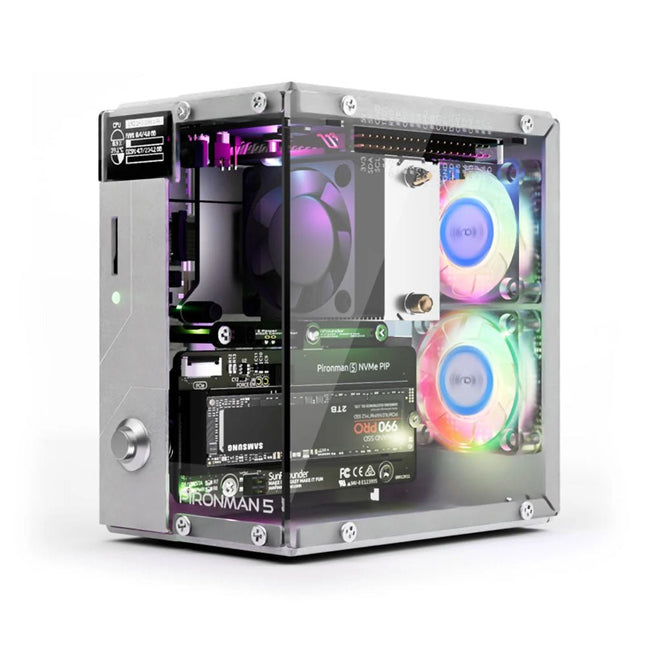
Enhance your Raspberry Pi 5 with the Pironman 5, built with sturdy aluminum, superior cooling, NVMe M.2 SSD support, OLED display, RGB lighting, standard HDMI ports x2, and a secure power switch. It is perfect for NAS, Home Assistant, Media and Game Centers. The Pironman 5 is not just a case; it’s an upgrade that transforms your Raspberry Pi 5 into a powerful, efficient, and stylish device.
The Pironman 5 includes the Pi 5 NVMe PIP (PCIe Peripheral Board), a PCIe adapter board specifically designed for NVMe solid-state drives. This board supports four sizes of NVMe SSDs: 2230, 2242, 2260, and 2280, all of which can be installed in an M.2 M key slot. The connection is certified for Gen 2.0 speeds (5 GT/sec), but can be forced to Gen 3.0 (10 GT/sec) for faster performance.
Expandable NVMe M.2 SSD Slot
Boost your Raspberry Pi 5's performance with the Pironman 5's NVMe M.2 SSD slot, supporting multiple sizes (2230, 2242, 2260, 2280) for increased storage and faster system response.
Advanced Cooling System
Keep your Raspberry Pi 5 cool and stylish with the Pironman 5's tower cooler and dual RGB fans, featuring dust filters for durable, low-maintenance operation.
OLED Display for Instant Insights
The Pironman 5 includes a 0.96" OLED display, providing immediate updates on CPU and RAM usage, temperature, IP address, and more.
Enhanced Functionality and Safety
The Pironman 5 secures your Raspberry Pi 5 with features like safe shutdown, customizable RGB LEDs, HDMI ports, an IR receiver, and an external GPIO extender, enhancing functionality and connectivity.
Features
Raspberry Pi 5 mini PC
0.96" OLED Display showing Raspberry Pi’s CPU usage, temperature, disk usage, IP address, RAM usage etc.
Tower cooler can cool a 100% CPU load Pi to 39°C at 25°C room temperature
2 RGB Fans, with GPIO control
1 PWM Fan on the Tower Cooler is controlled by the Raspberry Pi system.
Supports four (PCIe Gen 2.0 / PCIe Gen 3.0) NVMe M.2 SSD sizes: 2230, 2242, 2260, and 2280.
4 WS2812 Addressable RGB LED light up the whole case with cool light effect
IR Receiver for multi-media center like Kodi or Volumio
Retro metal power button for safe shut down
External GPIO extender with pin name label, for easy access
Equipped with a spring-loaded socket for easy card removal
Aluminum main body with clear Acrylic side panel
Features two standard HDMI ports
Downloads
Documentation
New Version available! Click here!
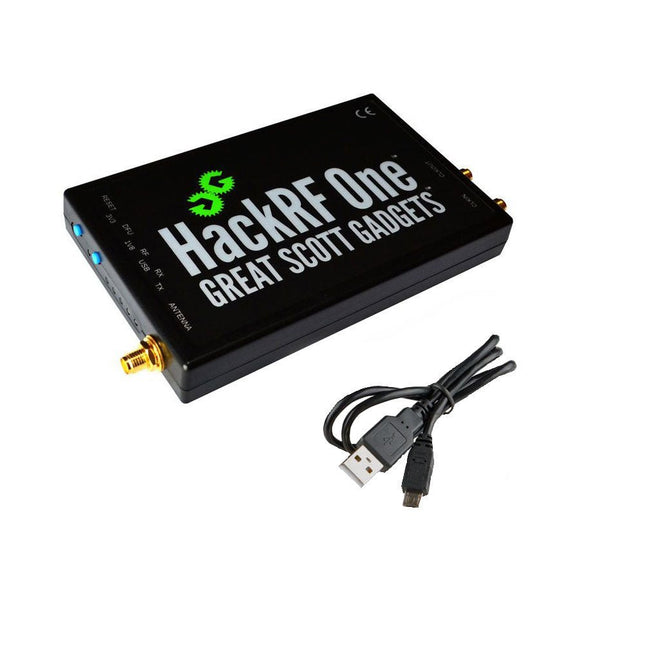
HackRF One is a Software Defined Radio (SDR) peripheral capable of transmission or reception of radio signals from 1 MHz to 6 GHz. Designed to enable test and development of modern and next generation radio technologies, HackRF One is an open source hardware platform that can be used as a USB peripheral or programmed for stand-alone operation.
Specifications
1 MHz to 6 GHz operating frequency
Half-duplex transceiver
Up to 20 million samples per second
8-bit quadrature samples (8-bit I and 8-bit Q)
Compatible with GNU Radio, SDR and more
Software-configurable RX and TX gain and baseband filter
Software-controlled antenna port power (50 mA at 3.3 V)
SMA female antenna connector
SMA female clock input and output for synchronization
Convenient buttons for programming
Internal pin headers for expansion
Hi-Speed USB 2.0
USB-powered
Open source hardware
HackRF One is test equipment for RF systems. It has not been tested for compliance with regulations governing transmission of radio signals. You are responsible for using your HackRF One legally.
Included
1x HackRF One SDR
1x Plastic enclosure
1x micro-USB cable
Note: An antenna is not included. ANT500 is recommended as a starter antenna for HackRF One.
Downloads
Documentation
GitHub
Source code and hardware design files
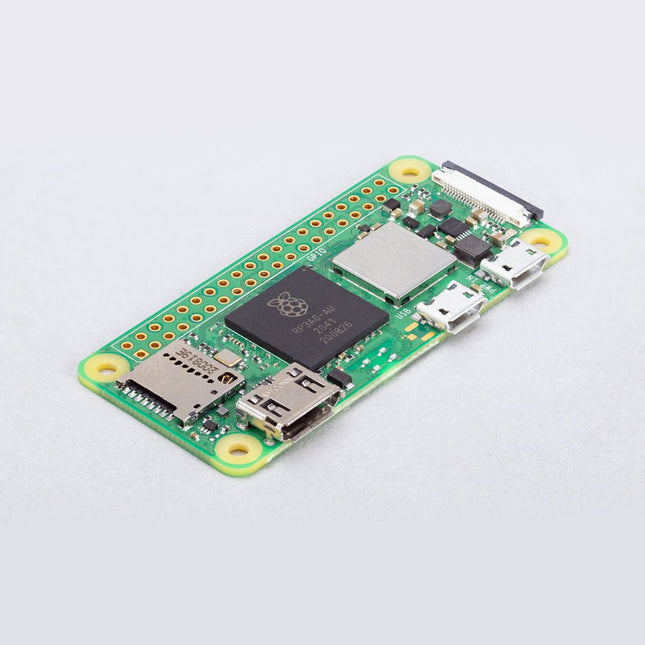
Raspberry Pi Zero 2 W is the successor to the breakthrough Raspberry Pi Zero W. The board incorporates a quad-core 64-bit Arm Cortex-A53 CPU, clocked at 1 GHz. At its heart is a Raspberry Pi RP3A0 system-in-package (SiP), integrating a Broadcom BCM2710A1 die with 512 MB of LPDDR2 SDRAM. The upgraded processor provides Raspberry Pi Zero 2 W with 40% more single-threaded performance, and five times more multi-threaded performance, than the original single-core Raspberry Pi Zero.
Features
64-bit quad-core processor
VideoCore IV GPU
512 MB LPDDR2 DRAM
802.11b/g/n wireless LAN
Bluetooth 4.2 / Bluetooth Low Energy (BLE)
MicroSD card slot
Mini HDMI and USB 2.0 OTG ports
Micro USB power
HAT-compatible 40-pin header
Composite video and reset pins via solder test points
CSI camera connector
Specifications
SoC
Broadcom BCM2710A1
CPU
64-bit ARM Cortex-A53 (4x 1 GHz)
GPU
Broadcom VideoCore VI
RAM
512 MB LPDDR2
Wireless LAN
2.4 GHz IEEE 802.11b/g/n
Bluetooth
Bluetooth 4.2, BLE
USB
1x micro USB (for data)1x micro USB (for power supply)
GPIO
HAT-compatible 40-pin GPIO header
Video & Audio
1080P HD video & stereo audio via mini-HDMI connector
SD card
microSD (for operating system and storage)
Power
5 VDC / 2.5 A (supplied via micro USB connector)
Dimensions
65 x 30 x 5 mm
Raspberry Pi Zero 2 W is footprint-compatible with earlier Zero models.
The ZD-915 is a digital desoldering station with ESD protection and digital display of both the actual and set value on an LCD screen. This desoldering station has high power in a compact and robust housing and makes desoldering easy, because it can be operated with one hand.
The ZD-915 features a soldering gun that houses a filter that catches any sucked material, so you only need to replace the filters to continue. There is also a temperature sensor in the tip so that temperature fluctuations can be quickly absorbed.
Features
The temperature is easily adjusted by simple up/down buttons.
140 W temperature controlled soldering station with adjustable range from 160°C to 480°C.
The desoldering station is designed for lead free desoldering specially.
The side of the station features a typical holder with sponge.
An illuminated power on/off is also loacted on the front.
Specifications
Station
Voltage supply
220-240 V
Power consumption
140 W
Vakuum pressure
600 mm HG
Desoldering Gun
Power consumption
24 V AC 80 WHeat up rating 130 W
Temperature
160-480 °C
Heating element
Ceramic heater
Included
1x ZD-915 Desoldering station
2x Spare soldering tip
3x Cleaning needle for desoldering tips
1x Spare filter for desoldering gun
1x Manual
The OWON SDS1102 is an affordable benchtop digital oscilloscope that combines solid performance with essential measurement features. This 2-channel oscilloscope offers a 100 MHz bandwidth, a 1 GS/s sampling rate, a 7-inch LCD display, and a 10 kpts memory depth, making it a practical choice for everyday electronics testing, troubleshooting, and education.
The SDS1102 features a simplified trigger system with level and edge triggering, making it easy to capture and analyze common signals. It is designed for applications that do not require deep memory or advanced trigger functions, offering a straightforward and cost-effective solution for basic signal analysis.
Features
Bandwidth: 100 MHz
2 channels
Sample rate: 1 GS/s
Ultra-thin body
7-inch high-res LCD
SCPI and LabVIEW supported
Specifications
Bandwidth
100 MHz
Horizontal Scale (s/div)
5 ns/div – 1000 s/div
Channel
2
Vertical Sensitivity
5 mV/div – 5 V/div (at input)
DC Gain Accuracy
3%
Vertical Resolution (A/D)
8 bits (2 channels simultaneously)
Input
Input Impedance
1 MΩ, 10 pF
Input Coupling
AC, DC, GND
Max Input Voltage
±400 V, CATI, CATII
Passive probes
х1; х10
Probe Attenuation Factor
х1; х10; х100; х1000
Trigger System
Trigger Mode
Auto, Normal, Single
Trigger Type
Edge, Video
Edge Trigger Source
CH1, CH2
Video Trigger
Sampling Type
Real-time
Sample Rate
1 GS/s
Equivalent Sample Rate
No
Wavelength
10K pts
Interpolation
sin(x)/x
Measurement and Mathematical Treatment System
Automatic Measurement
Vpp, Vavg, RMS, Frequency, Period, Vmax, Vmin, Vtop, Vbase, Width, Overshoot, Pre-shootRise time, Fall time, +Width, -Width, +Duty, -Duty, Delay A→B, Delay A→B, area, cycle area
Math Functions
Addition, Subtraction, Multiplication, Division, FFT
General Characteristics
Display type
7" color LCD
Display Resolution
800 x 480
Power
100-240 V, 45-440 Hz, <15 W
Dimensions
301 x 70 x 152 mm
Weight
1.1 kg
Included
1x OWON SDS1102 Oscilloscope
2x Oscilloscope probes
1x Probe adjust
1x Mains power cord
1x USB cable
1x CD-Rom
1x Quick guide
Downloads
Quick Guide
Manual
PC Software
SCPI Commands
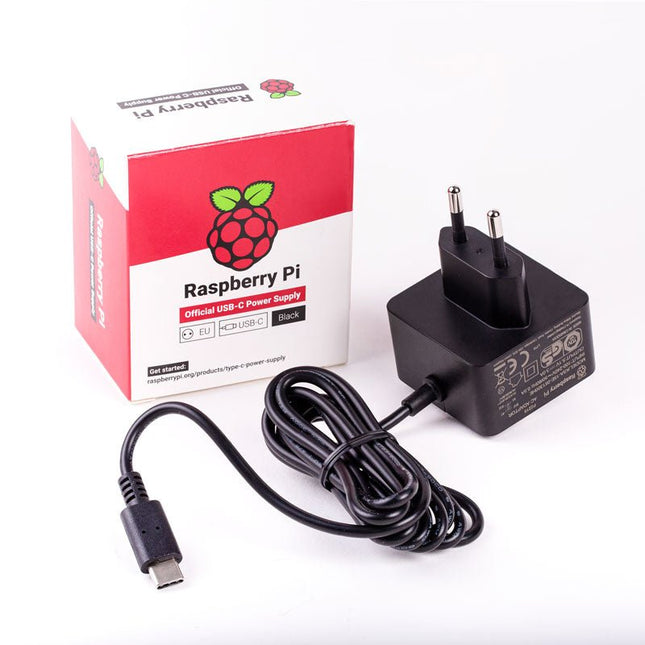
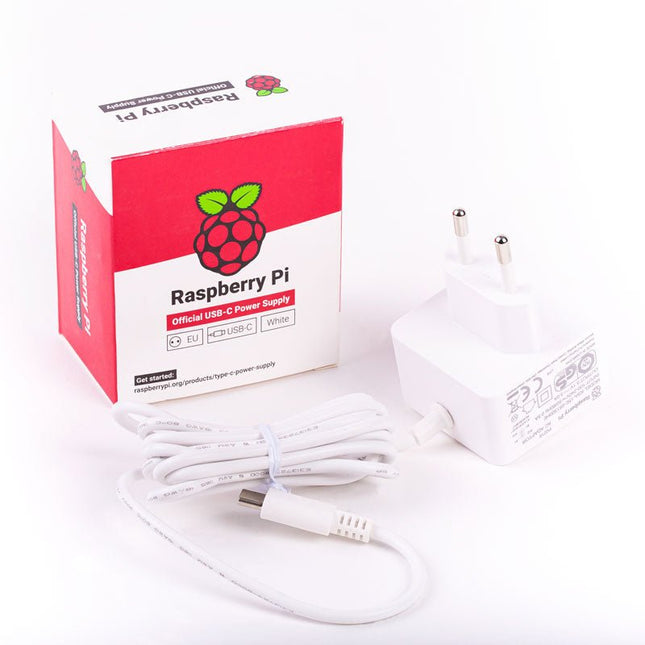
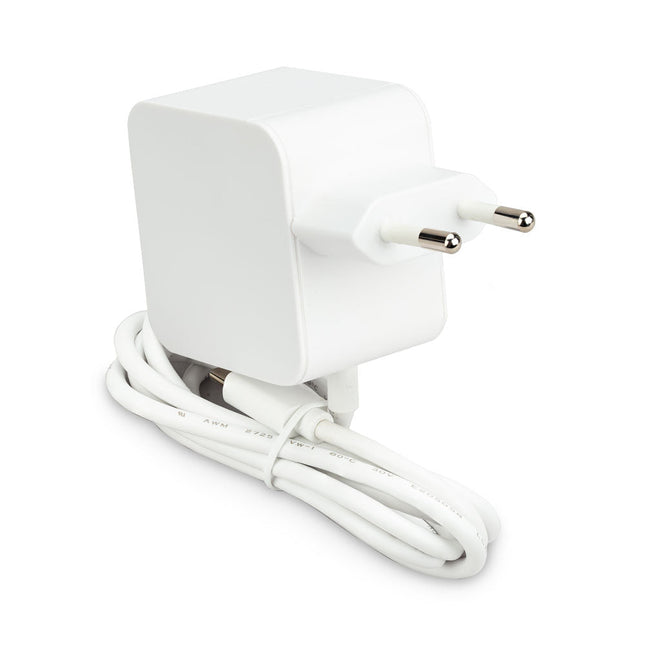
The Raspberry Pi USB-C power supply is designed specifically to power the Raspberry Pi 4.
The power supply features a USB-C cable and is available in four different models to suit different international power sockets, and in two colors.
Specifications
Output
Output voltage
+5.1 V DC
Minimum load current
0 A
Nominal load current
3.0 A
Maximum power
15.3 W
Load regulation
±5%
Line regulation
±2%
Ripple & noise
120 mVp-p
Rise time
100 ms maximum to regulation limits for DC outputs
Turn-on delay
3000 ms maximum at nominal input AC voltage and full load
Protection
Short circuit protectionOvercurrent protectionOver temperature protection
Efficiency
81% minimum (output current from 100%, 75%, 50%, 25%)72% minimum at 10% load
Output cable
1.5 m 18AWG
Output connector
USB-C
Input
Voltage range
100-240 V AC (rated)96-264 V AC (operating)
Frequency
50/60 Hz ±3 Hz
Current
0.5 A maximum
Power consumption (no load)
0.075 W maximum
Inrush current
No damage shall occur, and the input fuse shall not blow
Operating ambient temperature
0-40°C
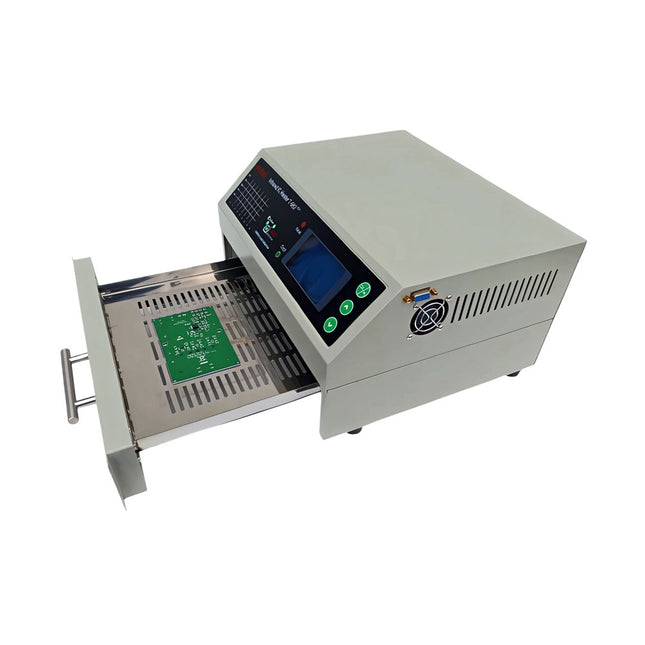
This upgraded version 2.0 (available exclusively from Elektor) contains the following improvements:
Enhanced protective earthing (PE) for furnace chassis
Extra thermal insulation layer around furnace to reduce odors
Connection to a computer, allowing curve editing on a PC
Features such as constant temperature control and timing functions
The infrared IC heater T-962 v2.0 is a microprocessor-controlled reflow oven that you can use for effectively soldering various SMD and BGA components. The whole soldering process can be completed automatically and it is very easy to use. This machine uses a powerful infrared emission and circulation of the hot air flow, so the temperature is being kept very accurate and evenly distributed.
A windowed drawer is designed to hold the work-piece, and allows safe soldering techniques and the manipulation of SMDBGA and other small electronic parts mounted on a PCB assembly. The T-962 v2.0 may be used to automatically rework solder to correct bad solder joints, remove/replace bad components and complete small engineering models or prototypes.
Features
Large infrared soldering area
Effective soldering area: 180 x 235 mm; this increases the usage range of this machine drastically and makes it an economical investment.
Choice of different soldering cycles
Parameters of eight soldering cycles are pre defined and the entire soldering process can completed automatically from Preheat, Soak and Reflow through to cool down.
Special heat up and temperature equalization with all designs
Uses up to 800 Watts of energy efficient Infrared heating and air circulation to re-flow solder.
Ergonomic design, practical and easily operated
Good build quality but at the same time light weight and a small footprint allows the T-962 v2.0 to be easily bench positioned transported or stored.
Large number of available functions
The T-962 v2.0 can solder most small parts of PCB boards, for example CHIP, SOP, PLCC, QFP, BGA etc. It is the ideal rework solution from single runs to on-demand small batch production.
Specifications
Soldering area (max)
180 x 235 mm (7.1 x 9.3")
Power (max)
800 W
Temperature range
0-280°C (32-536°F)
Heating method
Infrared
Processing time
1~8 minutes
Power supply
220 V AC/50 Hz
Display
LCD with Backlight
Control mode
8 intelligent temperature curves
Dimensions
310 x 290 x 170 mm (12.2 x 11.4 x 6.7")
Weight
6.2 kg
Included
1x T-962 v2.0 Reflow Soldering Oven (Elektor Version)
2x Fuses
1x Power cord (EU)
Downloads
Manual
The official Raspberry Pi micro HDMI to HDMI (A/M) cable (black, 1 m) designed for the Raspberry Pi 4 and 5.
19-pin HDMI Type D(M) to 19-pin HDMI Type A(M)
1 m cable (black)
Nickel-plated plugs
4Kp60 compliant
RoHS compliant
3 Mohm 300 VDC insulation, withstands 300 VDC for 0.1s
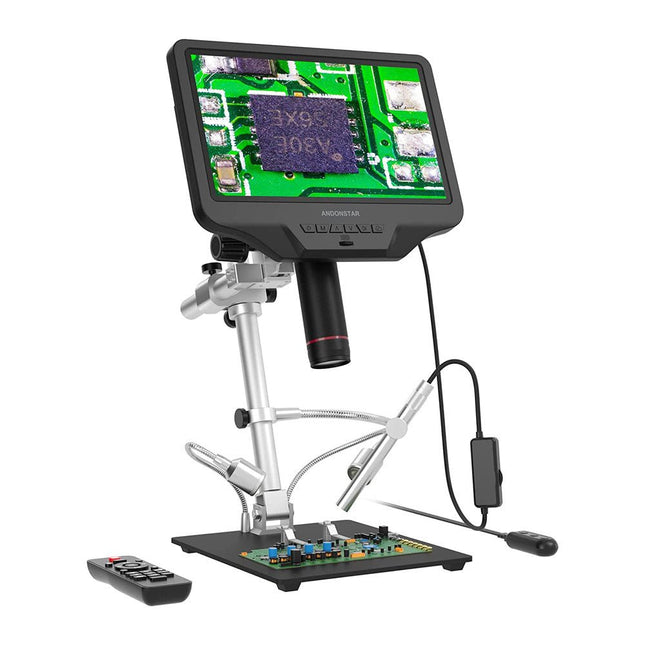
The Andonstar AD409 Pro-ES is a digital microscope with an extra-high stand that is also equipped with an endoscope. The microscope allows clear observation of the sides of components, the inside of pipes, etc., enabling 360° observation without dead angles. The microscope also has a remote control that allows you to easily switch between the following image modes: two-lens, microscope and endoscope.
Features
High-quality metal lens and focusing barrel
Professional HDMI digital microscope supports multiple output methods
Soldering Microscope with Pro Metal Stand
Unique UV filter design
8 Levels adjustable LED Lights
Convenient Wireless Remote Control
Professional Measurement Software
Specifications
Screen size
10.1 inch (25.7 cm)
Image sensor
4 MP
Video output
UHD 2880x2160 (24fps)FHD 1920x1080 (60fps/30fps)HD 1280x720 (120fps)
Video format
MP4
Magnification
Up to 300 times (27 inch HDMI monitor)
Photo resolution
Max. 12 MP (4032x3024)
Photo format
JPG
Focus range
Min. 5 cm
Frame Rate
Max. 120fps
Video interface
HDMI
Storage
microSD card (up to 64 GB)
PC support
Windows, PC software with measurement
Mobile phone, tablet terminal support
Support WiFi connection and measurement
Power source
5 V DC
Light source
2 LEDs with the stand
Endoscope
Yes
Stand size
18 x 20 x 32 cm
Included
1x Andonstar AD409 Pro-ES Digital Microscope
1x Endoscope
1x Metal stand with 2 LEDs
1x UV filter (already assembled in the lens)
1x IR remote
1x Switch cable
1x Power adapter
1x Wrench
2x Metal clips
1x HDMI cable
1x User manual
Downloads
Manual
Software
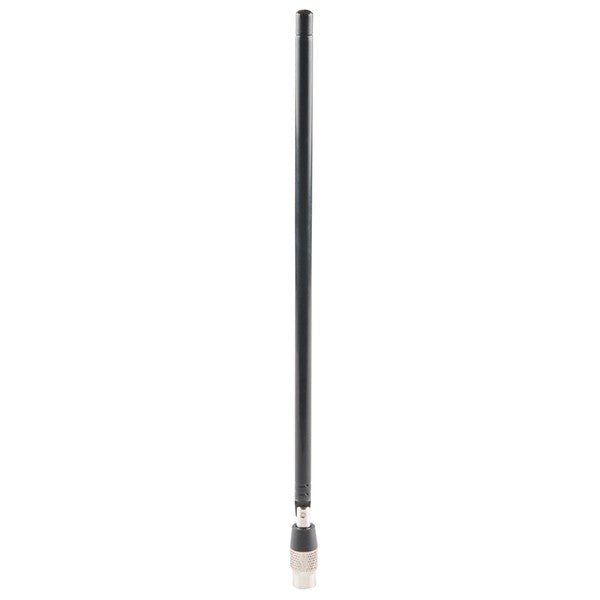
ANT500 from Great Scott Gadgets is a telescopic antenna designed for operation from 75 MHz to 1 GHz. Its total length is configurable from 20 cm to 88 cm. ANT500 is constructed of stainless steel and features an SMA male connector, rotating shaft, and adjustable elbow.
ANT500 is a 50 ohm general purpose antenna. It is the perfect first antenna for use with HackRF One/Pro.
The Raspberry Pi USB-C power supply is designed specifically to power the Raspberry Pi 4.
The power supply features a USB-C cable and is available in four different models to suit different international power sockets, and in two colors.
Specifications
Output
Output voltage
+5.1 V DC
Minimum load current
0 A
Nominal load current
3.0 A
Maximum power
15.3 W
Load regulation
±5%
Line regulation
±2%
Ripple & noise
120 mVp-p
Rise time
100 ms maximum to regulation limits for DC outputs
Turn-on delay
3000 ms maximum at nominal input AC voltage and full load
Protection
Short circuit protectionOvercurrent protectionOver temperature protection
Efficiency
81% minimum (output current from 100%, 75%, 50%, 25%)72% minimum at 10% load
Output cable
1.5 m 18AWG
Output connector
USB-C
Input
Voltage range
100-240 V AC (rated)96-264 V AC (operating)
Frequency
50/60 Hz ±3 Hz
Current
0.5 A maximum
Power consumption (no load)
0.075 W maximum
Inrush current
No damage shall occur, and the input fuse shall not blow
Operating ambient temperature
0-40°C
The official Raspberry Pi micro HDMI to HDMI (A/M) cable designed for the Raspberry Pi 4 and 5.
19-pin HDMI Type D(M) to 19-pin HDMI Type A(M)
1 m cable (white)
Nickel-plated plugs
4Kp60 compliant
RoHS compliant
3 Mohm 300 VDC insulation, withstands 300 VDC for 0.1s
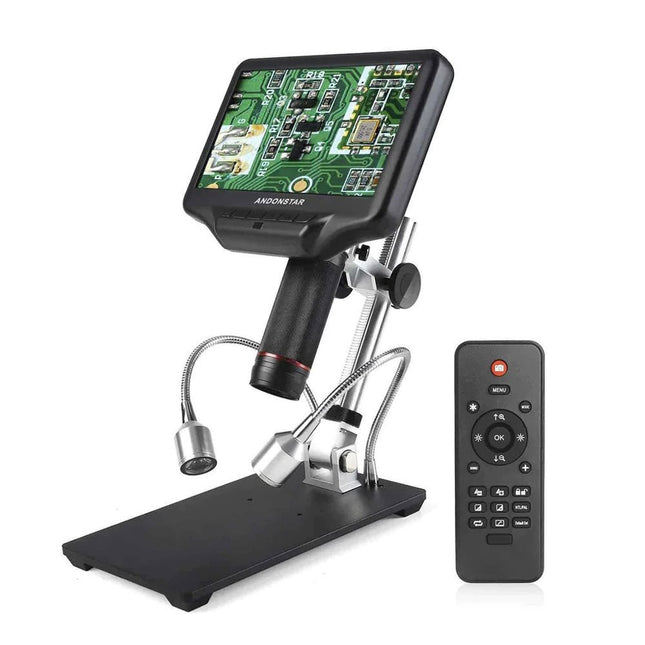
Examine your circuits with high precision and solder even the smallest SMDs and elements without any hassle.
Features
Multifunctional HDMI Digital Microscope features Full HD, comfortable headroom, improved ergonomy, multiple output signals with different resolutions.
Tilt angle of the wide LCD monitor is adjustable.
Comes with remote control.
Can be used as stand-alone.
Specifications
Screen size
7 inch (17.8 cm)
Image sensor
4 MP
Video output
UHD 2880x2160 (24fps)FHD 1920x1080 (60fps/30fps)HD 1280x720 (120fps)
Video format
MP4
Magnification
Up to 270 times (27 inch HDMI monitor)
Photo resolution
Max. 12 MP (4032x3024)
Photo format
JPG
Focus range
Min. 5 cm
Frame rate
Max. 120fps (under 600 Lux Brightness & HDP120)
Video interface
HDMI
Storage
microSD card (up to 32 GB)
Power source
5 V DC
Light source
2 LEDs with the stand
Stand size
20 x 12 x 19 cm
Included
1x Andonstar AD407 Digital Microscope
1x Metal stand with 2 LEDs
1x Optical bracket
1x UV filter
1x IR remote
1x Switch cable
1x Power adapter
1x HDMI cable
2x Screws
1x Screwdriver
1x User manual
Downloads
Manual
Model Comparison
AD407
AD407 Pro
AD409
AD409 Pro-ES
Screen size
7 inch (17.8 cm)
7 inch (17.8 cm)
10.1 inch (25.7 cm)
10.1 inch (25.7 cm)
Image sensor
4 MP
4 MP
4 MP
4 MP
Video output
2160p
2160p
2160p
2160p
Interfaces
HDMI
HDMI
USB, HDMI, WiFi
USB, HDMI, WiFi
Video format
MP4
MP4
MP4
MP4
Magnification
Up to 270x
Up to 270x
Up to 300x
Up to 300x
Photo resolution
Max. 4032x3024
Max. 4032x3024
Max. 4032x3024
Max. 4032x3024
Photo format
JPG
JPG
JPG
JPG
Focus distance
Min. 5 cm
Min. 5 cm
Min. 5 cm
Min. 5 cm
Frame rate
Max. 120f/s
Max. 120f/s
Max. 120f/s
Max. 120f/s
Storage
microSD card
microSD card
microSD card
microSD card
PC support
No
No
Windows
Windows
Mobile connection
No
No
WiFi + Measurement
WiFi + Measurement
Power source
5 V DC
5 V DC
5 V DC
5 V DC
Light source
2 LEDs with the stand
2 LEDs with the stand
2 LEDs with the stand
2 LEDs with the stand
Endoscope
No
No
No
Yes
Stand size
20 x 12 x 19 cm
20 x 18 x 32 cm
18 x 20 x 30 cm
18 x 20 x 32 cm
Weight
1.6 kg
2.1 kg
2.2 kg
2.5 kg
The Raspberry Pi 27 W PD USB-C power supply is designed specifically to power the Raspberry Pi 5. It is also capable of delivering 5 V/3 A, 9 V/3 A, 12 V/2.25 A, 15 V/1.8 A to PD-compatible products, making it a good and cost-effective power supply for many general applications, such as charging smartphones and tablets. Specifications Input 100-240 VAC Output 5 A @ 5.1 V, 3 A @ 9 V, 2.25 A @ 12 V, 1.8 A @ 15 V Connector USB-C Length 1.2 m Color White Region EU
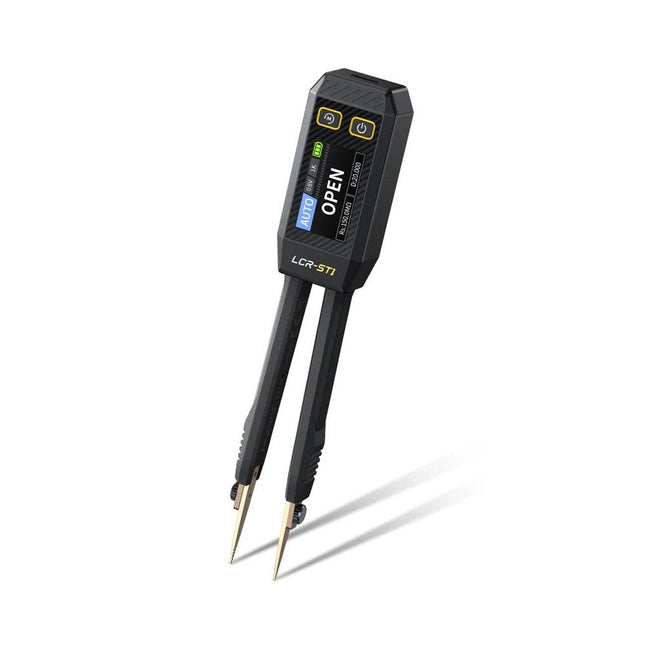
The FNIRSI LCR-ST1 is a compact, multifunctional, and smart LCR tester that supports automatic measurements of resistance, capacitance, inductance, diode testing, and continuity.
Its 1.14-inch color display combined with a convenient magnetic adsorption function enhances ease of use, while the built-in 250 mAh lithium battery ensures long-lasting performance. The device supports three frequency ranges (100 Hz, 1 kHz and 10 kHz) and offers 0.3 V and 0.6 V RMS test levels for versatile testing applications.
The unique tweezer-shaped design of the LCR-ST1 is ideal for delicate tasks in confined spaces and enables fast and accurate testing of electronic components. Its light weight and portable design make it an invaluable tool for both field and laboratory use.
Whether you are an experienced engineer or just starting out in electronics, the LCR-ST1 delivers reliable and accurate measurement results, allowing you to complete your tasks with greater efficiency and precision.
Features
Offers 3 test frequencies (100 Hz, 1 kHz, 10 kHz) and 2 test voltage levels.
Features automatic component identification for faster and more reliable measurements.
High-resolution 1.14-inch color display for clear readouts.
Supports automatic data recording and storage.
The tweezer tips are made from gold-plated brass for enhanced durability and conductivity.
Specifications
Resistance Range
10 mΩ – 10 MΩ
Capacitance Range
1 pF – 22 mF
Inductance Range
1 μh – 10 H
Diode
On voltage 0.7 V
Frequency Test
100 Hz, 1k Hz, 10 KHz
Level Test
0.3 V, 0.6 V RMS
Parameter Display
ESR, D value, Q value, Z value, X value
Display
1.14" HD color screen
Charging Interface
USB-C, 5 V/1 A
Power Supply
Built-in 250 mAh lithium battery
Auto Recognition Measurement
Yes
Replaceable Tweezer Head
Yes
Auto Shutdown
Yes
Data Hold
Yes
History Record
Connect to PC to view and export
Dimensions
28 x 19 x 150 mm
Weight
41 g
Included
1x LCR-ST1 SMD Tweezers
2x Hook Tips
1x Magnetic Patch
1x USB cable
1x Tool bag
1x Manual
Downloads
Manual
Firmware V1.6