Scrolling text display with eight 8 x 8 LED dot matrix displays (512 LEDs in total). Built around an ESP-12F Wi-Fi module (ESP8266-based) programmed in the Arduino IDE. ESP8266 web server allows control of displayed text, scroll delay and brightness with a mobile phone or other Wi-Fi-connected (portable) device. Features 10 MHz Serial Interface Individual LED Segment Control Decode/No-Decode Digit Selection 150 µA Low-Power Shutdown (Data Retained) Digital and Analog Brightness Control Display Blanked on Power-Up Drive Common-Cathode LED Display Slew-Rate Limited Segment Drivers for Lower EMI (MAX7221) SPI, QSPI, MICROWIRE Serial Interface (MAX7221) 24-Pin DIP and SO Packages
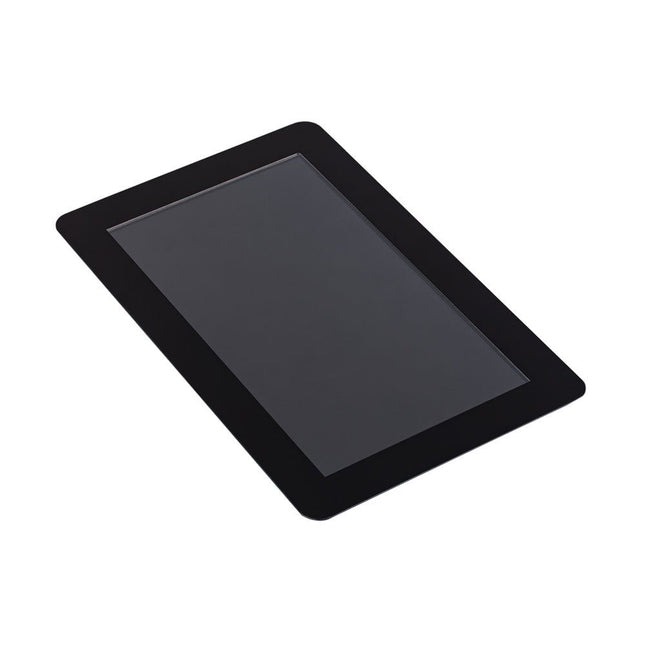
The Raspberry Pi Touch Display 2 is a 7-inch touchscreen designed for Raspberry Pi, perfect for interactive projects like tablets, entertainment systems, and information dashboards. Raspberry Pi OS includes touchscreen drivers that support five-finger touch and an on-screen keyboard, allowing complete functionality without a physical keyboard or mouse.
Connecting the 720 x 1280 display to your Raspberry Pi requires just two connections: power from the GPIO port and a ribbon cable to the DSI port, compatible with all Raspberry Pi models except the Raspberry Pi Zero line.
Specifications
Display
7 inch TFT (720 x 1280 pixels)
Active area
88 x 155 mm
Touch panel
True multi-touch capacitive touch panel, supporting five-finger touch
Surface treatment
Anti-glare
Color configuration
RGB-stripe
Backlight type
LED B/L
Included
1x Raspberry Pi Touch Display 2
1x 22-way to 15-way FFC for Raspberry Pi 5
1x 15-way to 15-way FFC for Raspberry Pi 4 and older
1x GPIO connector cable
8x M2.5 screws
Downloads
Datasheet
Add colors to your projects with this collection of red, green, yellow, blue and white LEDs. They come with various current limiting resistors in order to protect the parts and control the brightness.Included
10 mm LEDs
1x red
1x green
1x yellow
1x blue
1x white
5 mm LEDs
5x red
5x green
5x yellow
5x blue
5x white
3 mm LEDs
5x red
5x green
5x yellow
5x blue
5x white
25x 330 Ω resistors
10x 1 kΩ resistors
10x 10 kΩ resistors
10x 100 kΩ resistors
10x 1 MΩ resistors
This carrier board combines a 2.4" TFT display, six addressable LEDs, onboard voltage regulator, a 6-pin IO connector, and microSD slot with the M.2 pin connector slot so that it can be used with compatible processor boards in our MicroMod ecosystem. We've also populated this carrier board with Atmel's ATtiny84 with 8kb of programmable flash. This little guy is pre-programmed to communicate with the processor over I²C to read button presses.
Features
M.2 MicroMod Connector
240 x 320 pixel, 2.4" TFT display
6 Addressable APA102 LEDs
Magnetic Buzzer
USB-C Connector
3.3 V 1 A Voltage Regulator
Qwiic Connector
Boot/Reset Buttons
RTC Backup Battery & Charge Circuit
microSD
Phillips #0 M2.5 x 3 mm screw included
A low-power, open source, 2.7-inch IoT display powered by an ESP32-S2 module and featuring SHARP's Memory-in-Pixel (MiP) screen technology
The Newt is a battery-powered, always-on, wall-mountable display that can go online to retrieve weather, calendars, sports scores, to-do lists, quotes…really anything on the Internet! It is powered by an ESP32-S2 microcontroller that you can program with Arduino, CircuitPython, MicroPython, or ESP-IDF. It's perfect for makers:
Sharp’s Memory-in-Pixel (MiP) technology avoids the slow refresh times associated with E-Ink displays
A real-time clock (RTC) was added to support timers and alarms
The Newt was designed with battery operation in mind; every component on the board was chosen for its ability to operate at low power.
Newt was designed to operate 'untethered,' which means it can be mounted in places where a power cord would be inconvenient, for example a wall, refrigerator, mirror, or dry-erase board. With the optional stand, desks, shelves, and nightstands are also good options.
Newt is open source, and all design files and libraries are available for review, use, and modification. However, doing that is not required. Each Newt is delivered with working code with the following features:
Current weather details
Hourly and daily weather forecast
Alarm
Timer
Inspirational quotes
Air-quality forecast
Habit calendar
Pomodoro timer
Oblique Strategy cards
Only following the Wi-Fi provisioning instructions is needed to get started. No app downloads are required.
Specifications
Display
Sharp Memory LCD
Screen Size
2.7 inch
Resolution
240 x 400
Deep Sleep Current
30 uA
Refresh Rate
< 0.001 s
Periodic Screen Refresh Required
No
Input Buttons
10 capacitive pads, 1 push button
RTC included
Yes
Speaker included
Yes
Power Input
USB Type-C
Battery included
No
Programming Languages
Arduino, CircuitPython, ESP IDF, MicroPython
Dimensions
91 x 61 x 9 mm
Microcontroller
Espressif ESP32-S2-WROVER Module with 4 MB flash and 2 MB PSRAM
Wi-Fi capable
Supports Arduino, MicroPython, CircuitPython, and ESP-IDF
Deep sleep current as low as 25 μA
Display
2.7-inch, 240 x 400 pixel MiP LCD
Capable of delivering high-contrast, high-resolution, low-latency content with ultra-low power consumption
Reflective mode leverages ambient light to eliminate the need for a backlight
Time Keeping, Timers, and Alarms
Micro Crystal RV-3028-C7 RTC
Optimized for extreme low-power consumption (45 μA)
Able to simultaneously manage a periodic timer, a countdown timer, and an alarm
Hardware interrupt for timers and alarms
43 bytes of non-volatile user memory, 2 bytes of user RAM
Separate UNIX time counter
Buzzer
Speaker/buzzer with mini class-D amplifier on DAC output A0 can play tones or lo-fi audio clips
User Input
Power switch
Two programmable tactile buttons for Reset and Boot
10 capacitive touchpads
Power
Newt is designed to operate for one to two months between charges using a 500 mAH LiPo battery. The exact run time varies. (Heavy Wi-Fi use, in particular, will reduce battery charge more quickly.)
USB Type-C connector for programming, power, and charging
Low-quiescence voltage regulator (TOREX XC6220) that can output 1 A of current and operate as low as 8 μA.
JST connector for a Lithium-Ion battery
Battery-charging circuity (MCP73831)
Low-battery indicator (1 μA quiescence current)
Software
Newt hardware is compatible with open-source Arduino libraries for ESP32-S2, Adafruit GFX (fonts), Adafruit Sharp Memory Display (display writing), and RTC RV-3028-C7 (RTC)
Arduino libraries and sample programs are under development and will be available in our GitHub repository before launch
CircuitPython libraries and registration are on the roadmap, with the development of a CircuitPython library for the RV-3028 real-time clock as a key dependency
Included
Phambili Newt – Fully assembled with pre-loaded firmware
Laser-cut desktop stand
Mini-magnet feet
Required screws
Support & Documentation
Full instructions for use
GitHub: Arduino Library and Codebase
GitHub: Board schematics
Videos of prototypes or demos (build tracked on Hackaday)
Specifications Operating Voltage: 3.3 V ESP-12E MCU Display Size: 1.28 inch USB Port for Power & Data Transmission Interface Pins: 4 GPIO, 1 GND, 1 Power Driver: GC9A01 Resolution240 x 240 Pixel Color: 65 K RGB Interface: SPI Downloads STEP File Dimensions 3D File Schematic GitHub
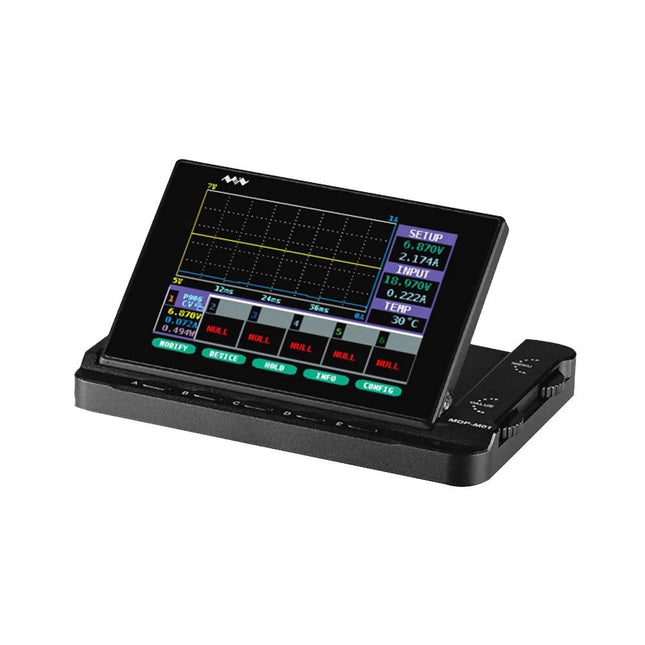
MDP-M01 is a display control module equipped with a 2.8-inch TFT display screen, the screen can be turned 90 degrees, which is convenient for users to view data and waveform. MDP-M01 can realize online display and control with MDP-P906 mini digital power supply modules and other modules of MDP system through 2.4 GHz wireless communication, and can control up to 6 sub-modules at the same time.
Specifications
Screen size
2.8" TFT
Screen resolution
240 x 320
Power
Micro USB power input, or taking power from sub-module via dedicated power cable
Input
DC 5 V/0.3 A
Other functions
Can control up to 6 sub-modulesUpgrade firmware through Micro USB
Dimensions
107 x 66 x 13.6 mm
Weight
133 g
Included
1x MDP-M01 Smart Digital Monitor
1x Cable (2.5 mm jack to Micro USB)
Downloads
User Manual v3.4
Firmware v1.32
This educational soldering kit is suitable for all kinds of applications such as model making and works with a 9 V battery (not included). You can control the flashing speed with two potentiometers.
Downloads
Manual