
Search results for "elektor OR special OR led OR s OR 1 OR pdf OR nl"
-
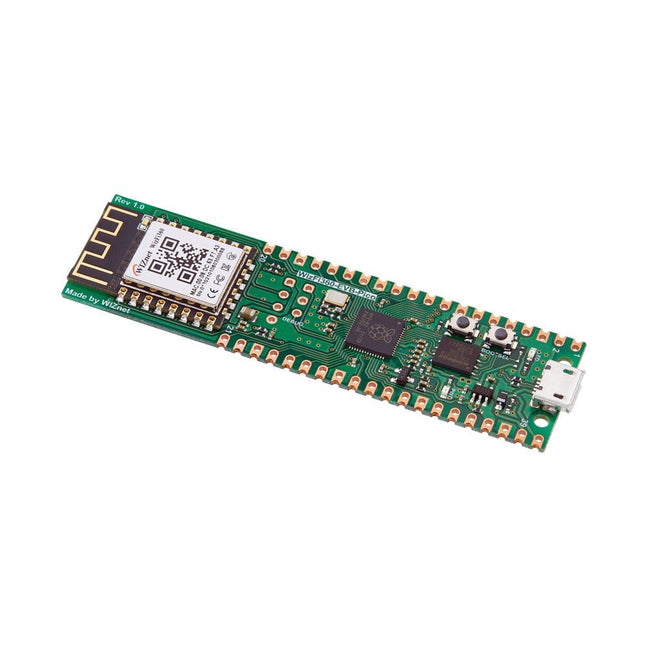
WIZnet WIZnet WizFi360-EVB-Pico
Raspberry Pi Pico EVB combined with the WizFi360-PAWizFi360-EVB-Pico is based on Raspberry Pi RP2040 and adds Wi-Fi connectivity using WizFi360. It is pin-compatible with Raspberry Pi Pico board and can be used for IoT Solution development.Specifications RP2040 microcontroller with 2 MByte Flash Dual-core cortex M0+ at up to 133 MHz 264 kByte multi-bank high performance SRAM External Quad-SPI Flash with eXecute In Place (XIP) Includes WizFi360-PA Supports Hardwired Internet Protocols: TCP, UDP, WOL over UDP, ICMP, IGMPv1/v2, IPv4, ARP, PPPoE WiFi 2.4G, 802.11 b/g/n Support Station / SoftAP / SoftAP+Station operation modes Support “Data pass-through” and “AT command data transfer” mode Support serial AT command configuration Support TCP Server / TCP Client / UDP operating mode Support configuration of operating channel 0 ~ 13 Support auto 20 MHz / 40 MHz bandwidth Support WPA_PSK / WPA2_PSK encryption Support built-in unique MAC address and user configurable Industrial grade (operating temperature range: -40°C ~ 85°C) CE, FCC certification Includes 16 Mbit Flash Memory Micro-USB B port for power and data (and for reprogramming the Flash) 40 pin 21×51 ‘DIP’ style 1mm thick PCB with 0.1' through-hole pins also with edge castellations 3-pin ARM Serial Wire Debug (SWD) port Built-in LDO DownloadsDocumentation
-
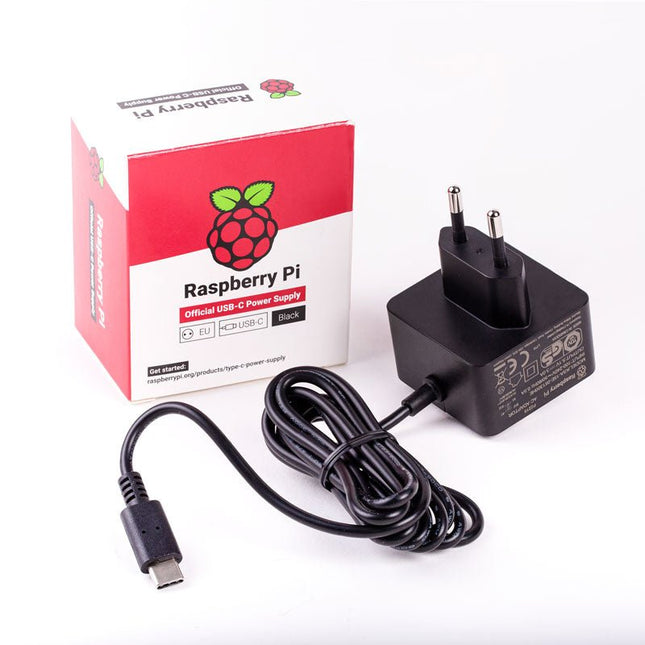
Raspberry Pi Foundation Official EU Power Supply for Raspberry Pi 4 (black)
The Raspberry Pi USB-C power supply is designed specifically to power the Raspberry Pi 4. The power supply features a USB-C cable and is available in four different models to suit different international power sockets, and in two colors. Specifications Output Output voltage +5.1 V DC Minimum load current 0 A Nominal load current 3.0 A Maximum power 15.3 W Load regulation ±5% Line regulation ±2% Ripple & noise 120 mVp-p Rise time 100 ms maximum to regulation limits for DC outputs Turn-on delay 3000 ms maximum at nominal input AC voltage and full load Protection Short circuit protectionOvercurrent protectionOver temperature protection Efficiency 81% minimum (output current from 100%, 75%, 50%, 25%)72% minimum at 10% load Output cable 1.5 m 18AWG Output connector USB-C Input Voltage range 100-240 V AC (rated)96-264 V AC (operating) Frequency 50/60 Hz ±3 Hz Current 0.5 A maximum Power consumption (no load) 0.075 W maximum Inrush current No damage shall occur, and the input fuse shall not blow Operating ambient temperature 0-40°C
-

Raspberry Pi Foundation Raspberry Pi AI HAT+ (26 TOPS)
The Raspberry Pi AI HAT+ is an expansion board designed for the Raspberry Pi 5, featuring an integrated Hailo AI accelerator. This add-on offers a cost-effective, efficient, and accessible approach to incorporating high-performance AI capabilities, with applications spanning process control, security, home automation, and robotics. Available in models offering 13 or 26 tera-operations per second (TOPS), the AI HAT+ is based on the Hailo-8L and Hailo-8 neural network accelerators. The 13 TOPS model efficiently supports neural networks for tasks like object detection, semantic and instance segmentation, pose estimation, and more. This 26 TOPS variant accommodates larger networks, enables faster processing, and is optimized for running multiple networks simultaneously. The AI HAT+ connects via the Raspberry Pi 5’s PCIe Gen3 interface. When the Raspberry Pi 5 is running a current version of the Raspberry Pi OS, it automatically detects the onboard Hailo accelerator, making the neural processing unit (NPU) available for AI tasks. Additionally, the rpicam-apps camera applications included in Raspberry Pi OS seamlessly support the AI module, automatically using the NPU for compatible post-processing functions. Included Raspberry Pi AI HAT+ (26 TOPS) Mounting hardware kit (spacers, screws) 16 mm GPIO stacking header Downloads Datasheet
-
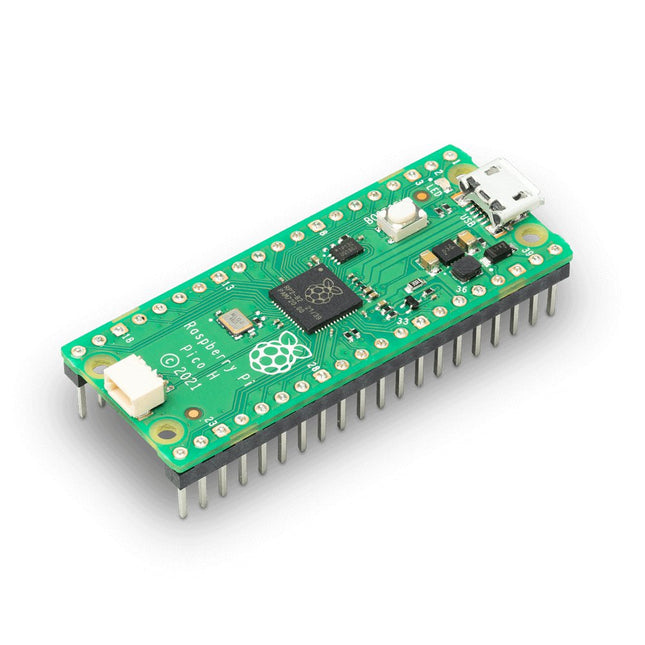
Raspberry Pi Foundation Raspberry Pi Pico H
Raspberry Pi Pico is a low-cost, high-performance microcontroller board and also the first product based on a chip developed by Raspberry Pi itself. The RP2040 microcontroller chip ('Raspberry Silicon') offers a dual-core ARM Cortex-M0+ processor (133 MHz), 256 KB RAM, 30 GPIO pins, and many other interface options. In addition, there is 2 MB of on-board QSPI flash memory for code and data storage. Specifications RP2040 microcontroller chip designed by Raspberry Pi in the UK Dual-core ARM Cortex M0+ processor, with a flexible clock running up to 133 MHz 264 kB SRAM, and 2 MB on-board Flash memory Castellated module allows soldering directly to carrier boards USB 1.1 host and device support Energy-efficient sleep and dormant modes Drag and drop programming using mass storage via USB 26x multifunction GPIO pins 2x SPI, 2x I²C, 2x UART, 3x 12-bit ADC, 16x controllable PWM channels On-chip accurate clock and timer Temperature sensor On-chip accelerated floating point libraries 8x programmable IO (PIO) state machines for custom peripherals H version of the Raspberry Pi Pico board with pre-soldered headers and 3-pin debug connector Downloads Specifications of 3-pin Debig Connector
-
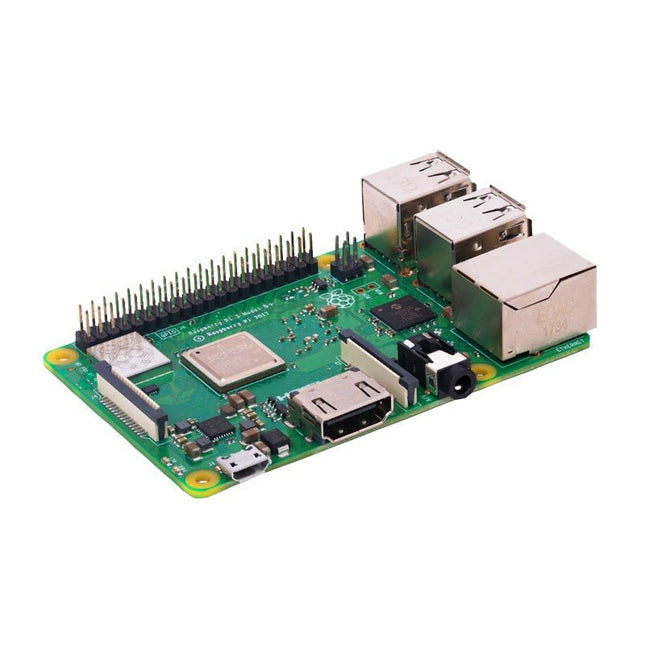
Raspberry Pi Foundation Raspberry Pi 3 B+
This Raspberry Pi 3 B+ has 15% better performance than its predecessor, the Raspberry Pi 3 B. Despite the upgrade, the Raspberry Pi 3 B+ is still compatible with the Raspberry Pi 3 B, 2 and B+. Improvements over Raspberry Pi 3 Model B: Dual band Wireless connectivity 802.11ac (2.4 GHz/5 GHz) Improved power performance Power over Ethernet (PoE) enabled New Ethernet controller Dual band Wireless connectivity 802.11ac (2.4 GHz/5 GHz) Increased connection speed and bandwidth Greater range when connected to the 5 GHz channel Backward compatibility within applications Improved streaming HD video over WiFi Increased effectiveness as a wireless access point Improved power performance Enabling the core processor to operate faster (4x 1.4 GHz) Power over Ethernet (PoE) enabled PoE operation requires the purchase of the new PoE HAT which will be available at launch. Without being tethered to an electrical outlet, the Raspberry Pi 3 B+ can be located wherever it is needed most, and repositioned easily if required up to a range of 100 m. Having power available over a network means that installation and distribution of network of Raspberry Pi’s becomes simpler and more effective. New Ethernet controller 3x Ethernet speed of the current Raspberry Pi 3 B (~300 Mbps) Faster network data transfer Specifications SoC Broadcom BCM2837B0 CPU 64-bit ARM Cortex-A53 (4x 1.4 GHz) GPU Dual-Core VideoCore IV Multimedia Co-Processor RAM 1024 MB USB 4x USB-A 2.0 GPIO 40 Pins Ethernet Gigabit Ethernet over USB 2.0 Wireless LAN 802.11b/g/n/ac (2.4 GHz/5 GHz) Bluetooth 4.2 + LE Power Micro-USB (5 V/2.5 A) Dimensions 85 x 56 x 17 mm
-

Raspberry Pi Foundation Raspberry Pi AI HAT+ (13 TOPS)
The Raspberry Pi AI HAT+ is an expansion board designed for the Raspberry Pi 5, featuring an integrated Hailo AI accelerator. This add-on offers a cost-effective, efficient, and accessible approach to incorporating high-performance AI capabilities, with applications spanning process control, security, home automation, and robotics. Available in models offering 13 or 26 tera-operations per second (TOPS), the AI HAT+ is based on the Hailo-8L and Hailo-8 neural network accelerators. This 13 TOPS model efficiently supports neural networks for tasks like object detection, semantic and instance segmentation, pose estimation, and more. The 26 TOPS variant accommodates larger networks, enables faster processing, and is optimized for running multiple networks simultaneously. The AI HAT+ connects via the Raspberry Pi 5’s PCIe Gen3 interface. When the Raspberry Pi 5 is running a current version of the Raspberry Pi OS, it automatically detects the onboard Hailo accelerator, making the neural processing unit (NPU) available for AI tasks. Additionally, the rpicam-apps camera applications included in Raspberry Pi OS seamlessly support the AI module, automatically using the NPU for compatible post-processing functions. Included Raspberry Pi AI HAT+ (13 TOPS) Mounting hardware kit (spacers, screws) 16 mm GPIO stacking header Downloads Datasheet
-
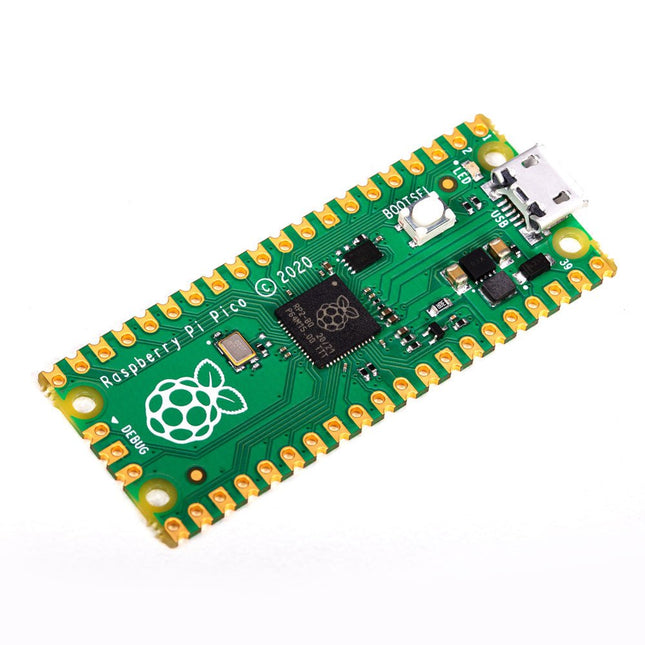
Raspberry Pi Foundation Raspberry Pi Pico
Specifications RP2040 microcontroller chip designed by Raspberry Pi in the UK Dual-core ARM Cortex M0+ processor, with a flexible clock running up to 133 MHz 264 kB SRAM, and 2 MB on-board Flash memory Castellated module allows soldering directly to carrier boards USB 1.1 host and device support Energy-efficient sleep and dormant modes Drag and drop programming using mass storage via USB 26x multifunction GPIO pins 2x SPI, 2x I²C, 2x UART, 3x 12-bit ADC, 16x controllable PWM channels On-chip accurate clock and timer Temperature sensor On-chip accelerated floating point libraries 8x programmable IO (PIO) state machines for custom peripherals Why a Raspberry Pi Pico? Designing your own microcontroller instead of buying an existing one brings a number of advantages. According to Raspberry Pi itself, not one of the existing products available for this comes close to their price/performance ratio. This Raspberry Pi Pico has also given Raspberry Pi the ability to add some innovative and powerful features of their own. These features are not available anywhere else. A third reason is that the Raspberry Pi Pico has given Raspberry Pi the ability to create powerful software around the product. Surrounding this software stack is an extensive documentation set. The software and documentation meet the high standard of Raspberry Pi's core products (such as the Raspberry Pi 400, Pi 4 Model B and Pi 3 Model A+). Who is this microcontroller for? The Raspberry Pi Pico is suitable for both advanced and novice users. From controlling a display to controlling many different devices that you use every day. Automating everyday operations is made possible by this technology. Beginner users The Raspberry Pi Pico is programmable in the C and MicroPython languages and is customizable for a wide range of devices. In addition, the Pico is as easy to use as dragging and dropping files. This makes this microcontroller ideally suited for the novice user. Advanced users For advanced users, it is possible to take advantage of the Pico's extensive peripherals. The peripherals include the SPI, I²C, and eight programmable I/O (PIO)-state machines. What makes the Raspberry Pi Pico unique? What's unique about the Pico is that it was developed by Raspberry Pi itself. The RP2040 features a dual-core Arm Cortex-M0+ processor with 264 KB of internal RAM and support for up to 16 MB of off-chip Flash. The Raspberry Pi Pico is unique for several reasons: The product has the highest price/quality ratio in the microcontroller board market. The Raspberry Pi Pico has been developed by Raspberry Pi itself. The software stack surrounding this product is of high quality and comes paired with a comprehensive documentation set.
-

Waveshare Waveshare ESP32-S3-GEEK Development Board
ESP32-S3-GEEK is a geek development board with built-in USB-A port, 1.14-inch LCD screen, TF card slot and other peripherals. It supports 2.4 GHz WiFi and BLE 5, with built-in 16 MB Flash & 2 MB PSRAM, provides I²C port, UART port and GPIO header for more possibilities for your project. Features Adopts ESP32-S3R2 chip with Xtensa 32-bit LX7 dual-core processor, capable of running at 240 MHz Built in 512 KB SRAM, 384 KB ROM, 2 MB of on-chip PSRAM, and onboard 16 MB Flash memory Onboard 1.14-inch 240x135 pixels 65K color IPS LCD display Integrated 2.4 GHz WiFi and Bluetooth LE wireless communication WiFi supports Infrastructure BSS in Station, SoftAP, and Station + SoftAP modes WiFi supports 1T1R mode with data rate up to 150 Mbps Bluetooth supports high power mode (20 dBm) Internal co-existence mechanism between Wi-Fi and Bluetooth to share the same antenna Onboard 3-pin UART port, 3-pin GPIO header and 4-pin I²C port Equipped with plastic case and cables Provides online open-source demo and resources, more convenient for learning and development Dimensions: 61.0 x 24.5 x 9.0 mm Downloads Wiki
-

Raspberry Pi Foundation Raspberry Pi Debug Probe
The Raspberry Pi Debug Probe is an all-in-one USB-to-debug kit that provides all the necessary hardware and cables for easy, solderless, plug-and-play debugging. It features both a processor serial debug interface (by default the ARM Serial Wire Debug interface, but other interfaces can be supported) and an industry-standard UART interface. Both interfaces use the Raspberry Pi 3-pin debug connector. It is designed to make it easy to debug and program Raspberry Pi Pico and RP2040 with a range of host platforms including Windows, Mac, and typical Linux computers. While designed for use with Raspberry Pi products, the Debug Probe provides standard UART and CMSIS-DAP interfaces over USB, so it can also be used with other processors, or even just as a USB-to-UART cable. It works with OpenOCD and other tools that support CMSIS-DAP. The Debug Probe is based on Raspberry Pi Pico hardware and runs the open source Raspberry Pi Pico Probe software. The firmware is updated in the same way as Raspberry Pi Pico firmware, so it is easy to keep the unit up to date with the latest firmware, or to use custom firmware. Features USB to ARM Serial Wire Debug (SWD) port USB to UART bridge Compatible with the CMSIS-DAP standard Works with OpenOCD and other tools supporting CMSIS-DAP Open source, easily upgradeable firmware Specifications Dimensions: 22 x 32 mm Nominal I/O voltage: 3.3 V Operating temperature: -20°C to +70°C Included 1x Raspberry Pi Debug Probe 1x Plastic case 1x USB cable 3x Debug cables 3-pin JST connector to 3-pin JST connector cable 3-pin JST connector to 0.1-inch header (female) 3-pin JST connector to 0.1-inch header (male) Downloads Datasheet 3-pin Debug Connector Schematics Diagram Latest Firmware
-

Raspberry Pi Foundation Raspberry Pi A2 SD Card pre-installed with Raspberry Pi OS (64 GB)
SD card quality is crucial for a good Raspberry Pi experience. Raspberry Pi's A2 microSD cards support higher bus speeds and command queuing, improving random read performance and narrowing the gap with NVMe SSDs. These cards are rigorously tested for optimal performance with Raspberry Pi models. Features Capacity: 64 GB Support for DDR50 and SDR104 bus speeds and command queueing (CQ) extension Speed Class: C10, U3, V30, A2 Random 4 KB read performance: 3,200 IOPS (Raspberry Pi 4, DDR50) 5,000 IOPS (Raspberry Pi 5, SDR104) Random 4 K write performance: 1,200 IOPS (Raspberry Pi 4, DDR50) 2,000 IOPS (Raspberry Pi 5, SDR104) Shock-proof, X-ray–proof, and magnet-proof microSDHC/microSDXC formats Downloads Datasheets
-
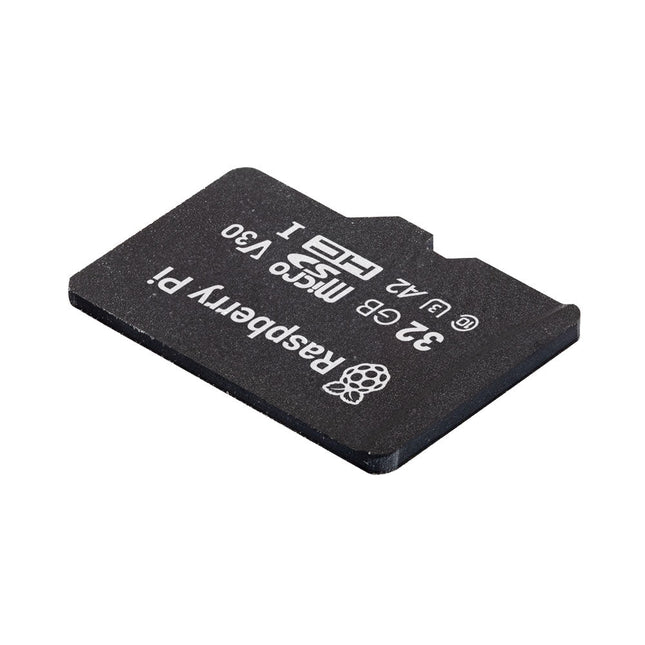
Raspberry Pi Foundation Raspberry Pi A2 SD Card pre-installed with Raspberry Pi OS (32 GB)
SD card quality is crucial for a good Raspberry Pi experience. Raspberry Pi's A2 microSD cards support higher bus speeds and command queuing, improving random read performance and narrowing the gap with NVMe SSDs. These cards are rigorously tested for optimal performance with Raspberry Pi models. Features Capacity: 32 GB Support for DDR50 and SDR104 bus speeds and command queueing (CQ) extension Speed Class: C10, U3, V30, A2 Random 4 KB read performance: 3,200 IOPS (Raspberry Pi 4, DDR50) 5,000 IOPS (Raspberry Pi 5, SDR104) Random 4 K write performance: 1,200 IOPS (Raspberry Pi 4, DDR50) 2,000 IOPS (Raspberry Pi 5, SDR104) Shock-proof, X-ray–proof, and magnet-proof microSDHC/microSDXC formats Downloads Datasheets


