
Search results for "poe OR splitter OR 5 OR v OR power OR over OR ethernet OR for OR single OR board OR computers"
-

milkV Milk-V Duo 256M RISC-V Singe-board Computer
The Milk-V Duo 256M is an ultra-compact embedded development platform based on the SG2002 chip. It can run Linux and RTOS, providing a reliable, low-cost, and high-performance platform for professionals, industrial ODMs, AIoT enthusiasts, DIY hobbyists, and creators. This board is an upgraded version of Duo with a memory boost to 256M, catering to applications demanding larger memory capacities. The SG2002 elevates computational power to 1.0 TOPS @ INT8. It enables seamless switching between RISC-V/ARM architectures and supports simultaneous operation of dual systems. Additionally, it includes an array of rich GPIO interfaces such as SPI, UART, suitable for a wide range of hardware development in edge intelligent monitoring, including IP cameras, smart peephole locks, visual doorbells, and more. SG2002 is a high-performance, low-power chip designed for various product fields such as edge intelligent surveillance IP cameras, smart door locks, visual doorbells, and home intelligence. It integrates H.264 video compression and decoding, H.265 video compression encoding, and ISP capabilities. It supports multiple image enhancement and correction algorithms such as HDR wide dynamic range, 3D noise reduction, defogging, and lens distortion correction, providing customers with professional-grade video image quality. The chip also incorporates a self-developed TPU, delivering 1.0 TOPS of computing power under 8-bit integer operations. The specially designed TPU scheduling engine efficiently provides high-bandwidth data flow for all tensor processing unit cores. Additionally, it offers users a powerful deep learning model compiler and software SDK development kit. Leading deep learning frameworks like Caffe and Tensorflow can be easily ported to its platform. Furthermore, it includes security boot, secure updates, and encryption, providing a series of security solutions from development, mass production, to product applications. The chip integrates an 8-bit MCU subsystem, replacing the typical external MCU to achieve cost-saving and power efficiency goals. Specifications SoC SG2002 RISC-V CPU C906 @ 1 Ghz + C906 @ 700 MHz Arm CPU 1x Cortex-A53 @ 1 GHz MCU 8051 @ 6 KB SRAM Memory 256 MB SIP DRAM TPU 1.0 TOPS @ INT8 Storage 1x microSD connector or 1x SD NAND on board USB 1x USB-C for power and data, USB Pads available CSI 1x 16P FPC connector (MIPI CSI 2-lane) Sensor Support 5 M @ 30 fps Ethernet 100 Mbps Ethernet with PHY Audio Via GPIO Pads GPIO Up to 26x GPIO Pads Power 5 V/1 A OS Support Linux, RTOS Dimensions 21 x 51 mm Downloads Documentation GitHub
€ 32,95€ 13,18
Members identical
-
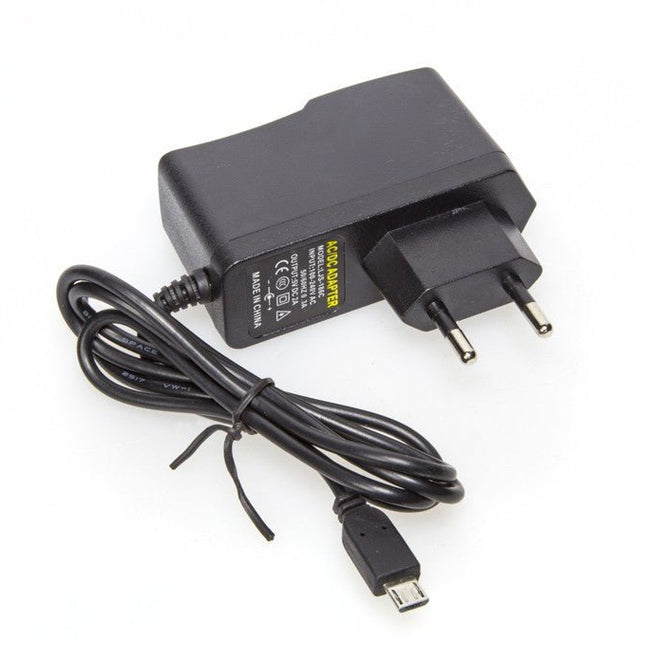
Kuongshun 5 V/2 A Micro-USB Power Supply (EU)
5 V/2 A Micro-USB Power Supply (EU)
€ 7,95€ 3,18
Members identical
-

SparkFun SparkFun Power Delivery Board – USB-C (Qwiic)
The Power Delivery Board uses a standalone controller to negotiate with the power adapters and switch to a higher voltage other than just 5V. This uses the same power adapter for different projects rather than relying on multiple power adapters to provide different output; it can deliver the board as part of SparkFun’s Qwiic connect system, so you won’t have to do any soldering to figure out how things are oriented. The SparkFun Power Delivery Board takes advantage of the power delivery standard using a standalone controller from STMicroelectronics, the STUSB4500. The STUSB4500 is a USB power delivery controller that addresses sink devices. It implements a proprietary algorithm to negotiate a power delivery contract with a source (i.e. a power delivery wall wart or power adapter) without the need for an external microcontroller. However, you will need a microcontroller to configure the board. PDO profiles are configured in an integrated non-volatile memory. The controller does all the heavy lifting of power negotiation and provides an easy way to configure over I²C. To configure the board, you will need an I²C bus. The Qwiic system makes it easy to connect the Power Delivery board to a microcontroller. Depending on your application, you can also connect to the I²C bus via the plated through SDA and SCL holes. Features Input and output voltage range of 5-20V Output current up to 5A Three configurable power delivery profiles Auto-run Type-C™ and USB PD sink controller Certified USB Type-C™ rev 1.2 and USB PD rev 2.0 (TID #1000133) Integrated VBUS voltage monitoring Integrated VBUS switch gate drivers (PMOS)
€ 34,95€ 13,98
Members identical
-
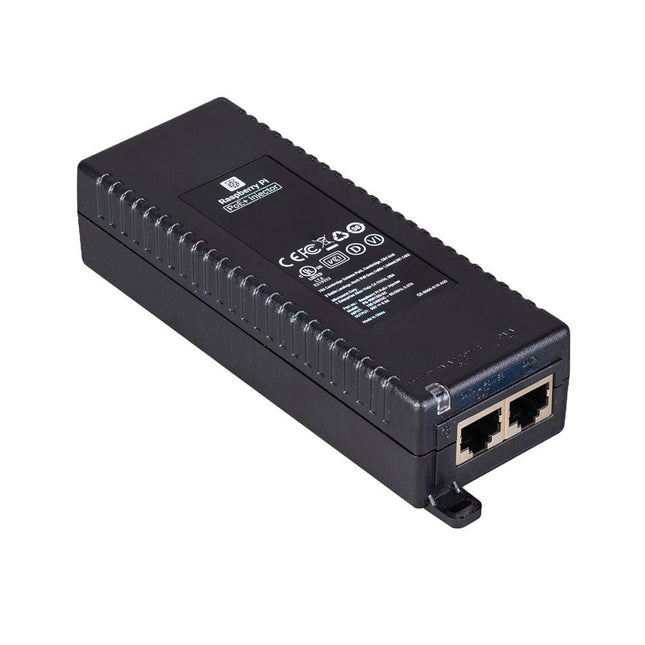
Raspberry Pi Foundation Raspberry Pi PoE+ Injector
The Raspberry Pi PoE+ Injector adds Power-over-Ethernet (PoE) functionality to a single port of a non-PoE Ethernet switch, delivering both power and data through one Ethernet cable. It provides a plug-and-play, cost-effective solution for incrementally introducing PoE capability into existing Ethernet networks. The PoE+ Injector is a single-port, 30 W device suitable for powering equipment compliant with IEEE 802.3af and 802.3at standards, including all generations of Raspberry Pi PoE HATs. It supports network pass-through speeds of 10/100/1000 Mbps. Note: A separate IEC mains cable is required for operation (not included). Specifications Data rate 10/100/1000 Mbps Input voltage 100 to 240 V AC Output power 30 W Power output on pins 4/5 (+), 7/8 (–) Nominal output voltage 55 V DC Data connectors Shielded RJ-45, EIA 568A and 568B Power connector IEC c13 mains power input (not included) Storage humidity Maximum 95%, non-condensing Operating altitude –300 m to 3000 m Operating ambient temperature 10°C to +50°C Dimensions 159 x 51.8 x 33.5 mm Downloads Datasheet
€ 29,95€ 11,98
Members identical
-
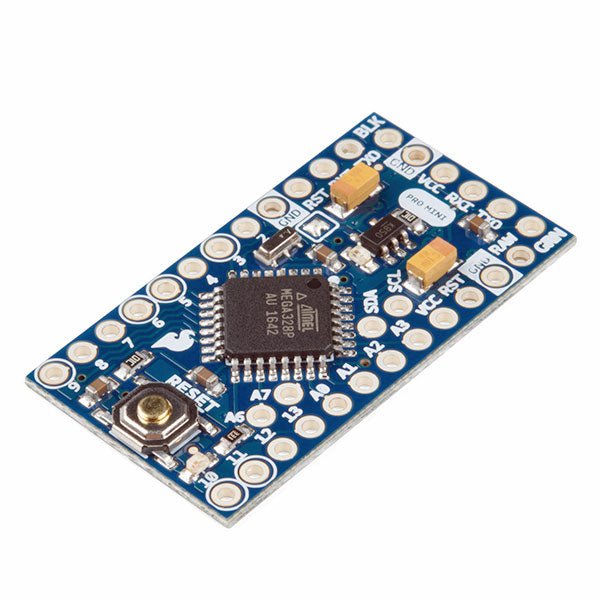
SparkFun SparkFun Arduino Pro Mini 328 (5 V, 16 MHz)
The Arduino Pro Mini is a microcontroller board based on the ATmega328P. It has 14 digital input/output pins (of which 6 can be used as PWM outputs), 6 analog inputs, an on-board resonator, a reset button, and holes for mounting pin headers. A six pin header can be connected to an FTDI cable or SparkFun breakout board to provide USB power and communication to the board. The Arduino Pro Mini is intended for semi-permanent installation in objects or exhibitions. The board comes without pre-mounted headers, allowing the use of various types of connectors or direct soldering of wires. The pin layout is compatible with the Arduino Mini. The Arduino Pro Mini was designed and is manufactured by SparkFun Electronics. Specifications Microcontroller ATmega328P Board Power Supply 5-12 V Circuit Operating Voltage 5 V Digital I/O Pins 14 PWM Pins 6 UART 1 SPI 1 I²C 1 Analog Input Pins 6 External Interrupts 2 DC Current per I/O Pin 40 mA Flash Memory 32 KB of which 2 KB used by bootloader SRAM 2 KB EEPROM 1 KB Clock Speed 16 MHz Dimensions 18 x 33.3 mm (0.7 x 1.3") Downloads Eagle files Schematics
€ 14,95€ 5,98
Members identical
-
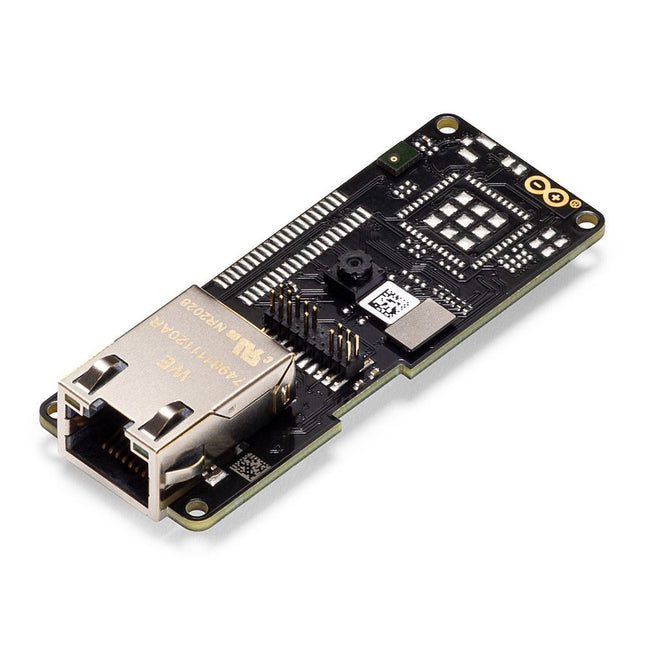
Arduino Arduino Pro Portenta Vision Shield (Ethernet)
The Arduino Pro Portenta Vision Shield brings industry-rated features to your Portenta. This hardware add-on will let you run embedded computer vision applications, connect wirelessly or via Ethernet to the Arduino Cloud or your own infrastructure, and activate your system upon the detection of sound events. Features 324x324 pixels camera sensor: use one of the cores in Portenta to run image recognition algorithms using the OpenMV for Arduino editor 100 Mbps Ethernet connector: get your Portenta H7 connected to the wired Internet 2 onboard microphones for directional sound detection: capture and analyse sound in real-time JTAG connector: perform low-level debugging of your Portenta board or special firmware updates using an external programmer SD-Card connector: store your captured data in the card, or read configuration files The Vision Shield has been designed to fit on top of the Arduino Portenta family. The Portenta boards feature multicore 32-bit ARM Cortex processors running at hundreds of megahertz, with megabytes of program memory and RAM. Portenta boards come with WiFi and Bluetooth. Embedded Computer Vision Made Easy Arduino has teamed up with OpenMV to offer you a free license to the OpenMV IDE, an easy way into computer vision using MicroPython as a programming paradigm. Download the OpenMV for Arduino Editor from our professional tutorials site and browse through the examples we have prepared for you inside the OpenMV IDE. Companies across the whole world are already building their commercial products based on this simple-yet-powerful approach to detect, filter, and classify images, QR codes, and others. Debugging With Professional Tools Connect your Portenta H7 to a professional debugger through the JTAG connector. Use professional software tools like the ones from Lauterbach or Segger on top of your board to debug your code step by step. The Vision Shield exposes the required pins for you to plug in your external JTAG. Camera Himax HM-01B0 camera module Resolution 320 x 320 active pixel resolution with support for QVGA Image sensor High sensitivity 3.6μ BrightSense pixel technology Microphone 2 x MP34DT05 Length 66 mm Width 25 mm Weight 11 gr For more information, check out the tutorials provided by Arduino here.
€ 69,95€ 27,98
Members identical
-
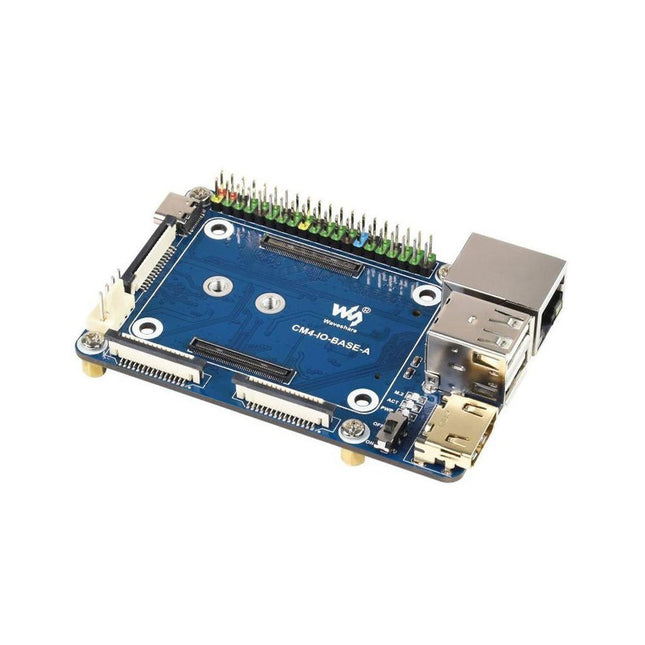
Waveshare Waveshare Mini Base Board (A) for Raspberry Pi Compute Module 4
Specifications CM4 socket Suitable for all variants of Compute Module 4 Networking Gigabit Ethernet RJ45 connectorM.2 M KEY, supports communication modules or NVME SSD Connector Raspberry Pi 40-PIN GPIO header USB 2x USB 2.0 Type A2x USB 2.0 via FFC connector Display MIPI DSI display port (15-pin 1.0 mm FPC connector) Camera 2x MIPI CSI-2 camera port (15-pin 1.0 mm FPC connector) Video 2x HDMI port (including one port via FFC connector), supports 4K 30fps output RTC N/A Storage MicroSD card socket for Compute Module 4 Lite (without eMMC) variants Fan header No fan control, 5 V Power input 5 V Dimensions 85 x 56 mm Included 1x CM4-IO-BASE-A 1x SSD mounting screw Downloads Wiki
€ 24,95€ 9,98
Members identical
-
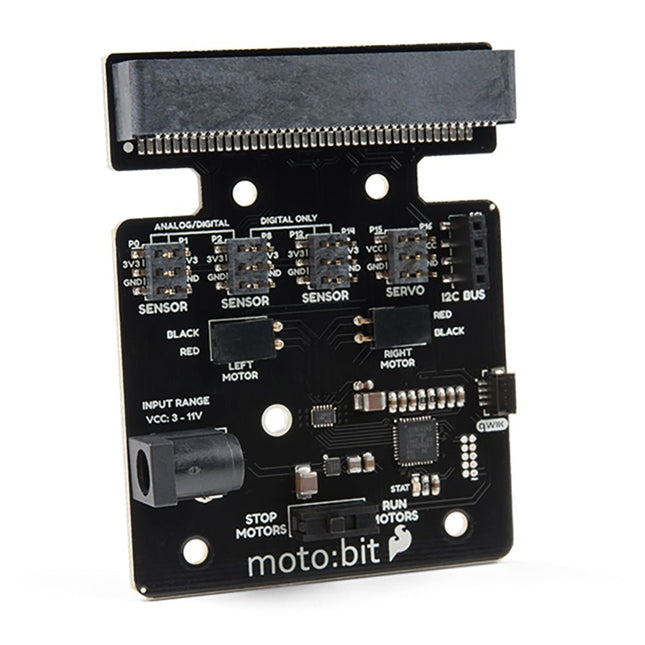
SparkFun SparkFun moto:bit - micro:bit Carrier Board (Qwiic)
Onboard each moto:bit are multiple I/O pins, as well as a vertical Qwiic connector, capable of hooking up servos, sensors and other circuits. At the flip of the switch, you can get your micro:bit moving! The moto:bit connects to the micro:bit via an updated SMD, edge connector at the top of the board, making setup easy. This creates a handy way to swap out micro:bits for programming while still providing reliable connections to all of the different pins on the micro:bit. We have also included a basic barrel jack on the moto:bit that is capable of providing power to anything you connect to the carrier board. Features More reliable Edge connector for easy use with the micro:bit Full H-Bridge for control of two motors Control servo motors Vertical Qwiic Connector I²C port for extending functionality Power and battery management onboard for the micro:bit
€ 109,95€ 43,98
Members identical
-
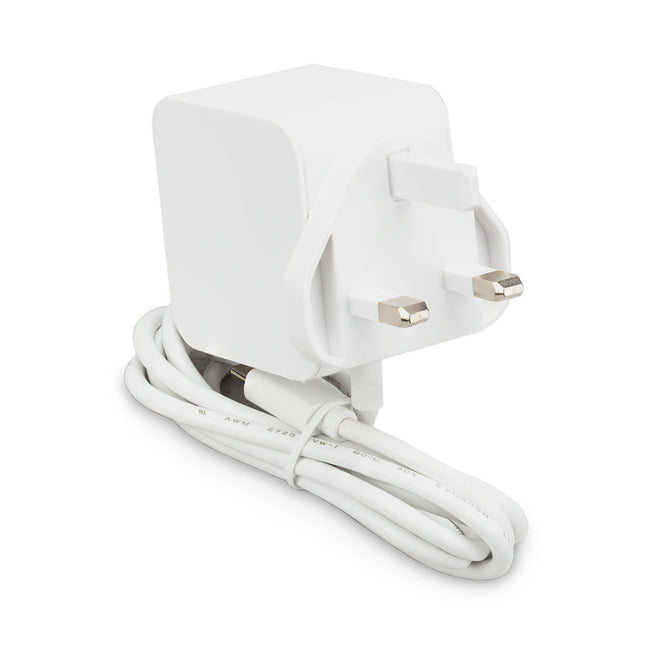
Raspberry Pi Foundation Official 27 W Power Supply for Raspberry Pi 5 (UK, white)
The Raspberry Pi 27 W PD USB-C power supply is designed specifically to power the Raspberry Pi 5. It is also capable of delivering 5 V/3 A, 9 V/3 A, 12 V/2.25 A, 15 V/1.8 A to PD-compatible products, making it a good and cost-effective power supply for many general applications, such as charging smartphones and tablets. Specifications Input 100-240 V AC Output 5 A @ 5.1 V, 3 A @ 9 V, 2.25 A @ 12 V, 1.8 A @ 15 V Connector USB-C Length 1.2 m Color White Region UK
€ 13,95€ 6,95
Members identical
-
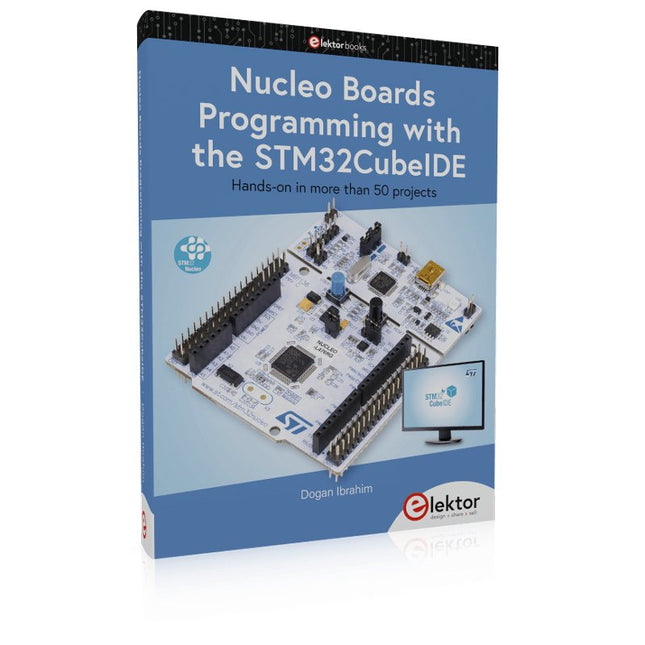
Elektor Publishing Nucleo Boards Programming with the STM32CubeIDE
Hands-on in more than 50 projects STM32 Nucleo family of processors are manufactured by STMicroelectronics. These are low-cost ARM microcontroller development boards. This book is about developing projects using the popular STM32CubeIDE software with the Nucleo-L476RG development board. In the early Chapters of the book the architecture of the Nucleo family is briefly described. The book covers many projects using most features of the Nucleo-L476RG development board where the full software listings for the STM32CubeIDE are given for each project together with extensive descriptions. The projects range from simple flashing LEDs to more complex projects using modules, devices, and libraries such as GPIO, ADC, DAC, I²C, SPI, LCD, DMA, analogue inputs, power management, X-CUBE-MEMS1 library, DEBUGGING, and others. In addition, several projects are given using the popular Nucleo Expansion Boards. These Expansion Boards plug on top of the Nucleo development boards and provide sensors, relays, accelerometers, gyroscopes, Wi-Fi, and many others. Using an expansion board together with the X-CUBE-MEMS1 library simplifies the task of project development considerably. All the projects in the book have been tested and are working. The following sub-headings are given for each project: Project Title, Description, Aim, Block Diagram, Circuit Diagram, and Program Listing for the STM32CubeIDE. In this book you will learn about STM32 microcontroller architecture; the Nucleo-L476RG development board in projects using the STM32CubeIDE integrated software development tool; external and internal interrupts and DMA; DEBUG, a program developed using the STM32CubeIDE; the MCU in Sleep, Stop, and in Standby modes; Nucleo Expansion Boards with the Nucleo development boards. What you need a PC with Internet connection and a USB port; STM32CubeIDE software (available at STMicroelectronics website free of charge) the project source files, available from the book’s webpage hosted by Elektor; Nucleo-L476RG development board; simple electronic devices such as LEDs, temperature sensor, I²C and SPI chips, and a few more; Nucleo Expansion Boards (optional).
€ 49,95
Members € 44,96
-

Luckfox LuckFox Pico Ultra Linux Micro Development Board
The LuckFox Pico Ultra is a compact single-board computer (SBC) powered by the Rockchip RV1106G3 chipset, designed for AI processing, multimedia, and low-power embedded applications. It comes equipped with a built-in 1 TOPS NPU, making it ideal for edge AI workloads. With 256 MB RAM, 8 GB onboard eMMC storage, integrated WiFi, and support for the LuckFox PoE module, the board delivers both performance and versatility across a wide range of use cases. Running Linux, the LuckFox Pico Ultra supports a variety of interfaces – including MIPI CSI, RGB LCD, GPIO, UART, SPI, I²C, and USB – providing a simple and efficient development platform for applications in smart home, industrial control, and IoT. Specifications Chip Rockchip RV1106G3 Processor Cortex-A7 1.2 GHz Neural Network Processor (NPU) 1 TOPS, supports int4, int8, int16 Image Processor (ISP) Max input 5M @30fps Memory 256 MB DDR3L WiFi + Bluetooth 2.4GHz WiFi-6 Bluetooth 5.2/BLE Camera Interface MIPI CSI 2-lane DPI Interface RGB666 PoE Interface IEEE 802.3af PoE Speaker interface MX1.25 mm USB USB 2.0 Host/Device GPIO 30 GPIO pins Ethernet 10/100M Ethernet controller and embedded PHY Default Storage Medium eMMC (8 GB) Included 1x LuckFox Pico Ultra W 1x LuckFox PoE module 1x IPX 2.4G 2 db antenna 1x USB-A to USB-C cable 1x Screws pack Downloads Wiki
€ 39,95€ 15,98
Members identical
-

Evil Mad Science Easel Board for AxiDraw (Tabloid/A3)
Extra easel boards for AxiDraw V3/A3 can be used as replacements, or for staging additional workpieces for quickly swapping to the next plot. This set consists of one 11.75 x 17 inch (29.85 x 43.18 cm) hardboard platen with rubber feet attached, plus eight micro binder clips.
€ 17,95€ 7,18
Members identical


