More than 275 Power Supply Designs for Home Construction
This USB Stick contains over 275 different power supply circuits from the volumes 2001-2025 of Elektor. The article search feature allows you to search full-text content. The results are always displayed as pre-formatted PDF documents.
Highlights
Cuk Converter
Automatic Battery Switchover
Battery Voltage LED
Digital Benchtop Power Supply
Lithium-Ion Charger
Solar Cell Charger
Electronic Fuse
High Voltage Regulator
Power Supply for USB Devices
Step-up Converter for LEDs
Battery Management
and much more...
On the Stick you will also find a folder with additional material such as PCB layouts, Gerber files and software.
Specifications
Storage
16 GB
Interfaces
1x USB-A1x USB-C
System requirements
PC with Adobe Reader 7.0 or higher
Web browser
With this 65 W USB-C PD power supply (with GaN technology) you can start using the FNIRSI HS-01 soldering iron straight away. Of course, you can also use this charger to fast charge your tablets and smartphones via USB-C and USB-A.
Included
65 W USB-C PD GaN Power Supply (EU)
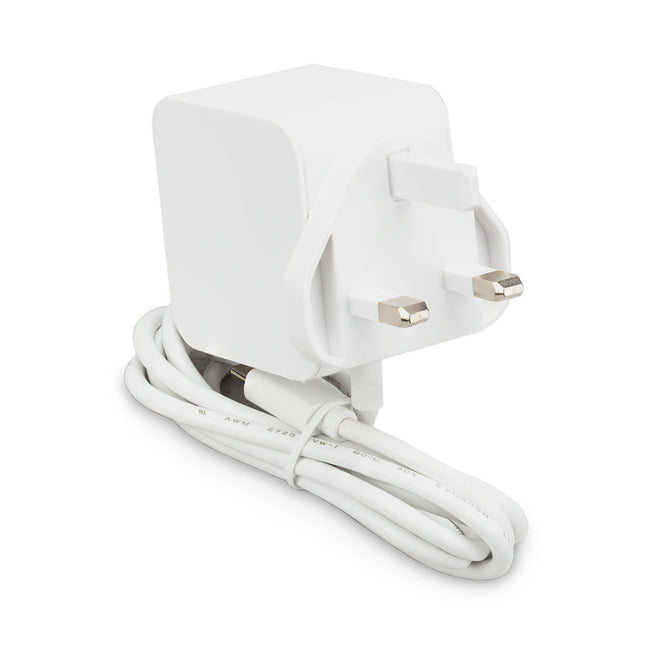
The Raspberry Pi 27 W PD USB-C power supply is designed specifically to power the Raspberry Pi 5. It is also capable of delivering 5 V/3 A, 9 V/3 A, 12 V/2.25 A, 15 V/1.8 A to PD-compatible products, making it a good and cost-effective power supply for many general applications, such as charging smartphones and tablets.
Specifications
Input
100-240 V AC
Output
5 A @ 5.1 V, 3 A @ 9 V, 2.25 A @ 12 V, 1.8 A @ 15 V
Connector
USB-C
Length
1.2 m
Color
White
Region
UK
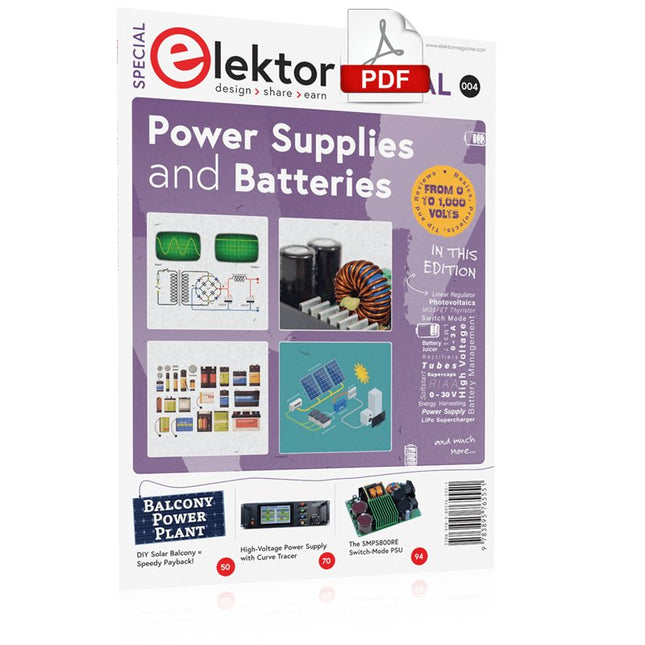
Whatever the methods or even then financial means you have to make your circuits work, the power supply should rank high if not Number One in your considerations. The design block simply called “power supply” is hugely underrated both in electronics creation and repair. Yet, the “PSU” has enormous diversity and comes in wildly differing guises like AC/DC, generator, battery (rechargeable or not), PV panel, benchtop, linear or switch-mode, to mention but a few. The output ranges are also staggering like nano-amps to kiloamps and the same for voltages.This special covers the features and design aspects of power supplies.ContentsBasics
Battery ManagementWhat to be aware of when using (Lithium) batteries.
Fixed-Voltage Power Supply using Linear RegulatorsThe best result right after batteries.
Light Energy HarvestingA small solar panel is used in an energy harvesting project to manage and charge four AAA cells.
Mains Powered Adapter DesignBasic circuits and tips for transformers, rectification, filtering and stabilization.
LM317 Soft StartThe high inrush current pulse should be avoided.
Controllable RectifiersSome suggestions to keep the power loss in the linear regulator as low as possible.
Components
Worksheet: The LM117 / LM217 / LM317 Voltage Regulators
SupercapsLow voltage but lots of current… or not?
Reviews
JOY-iT RD6006 Benchtop Power Supply Kit
Siglent SDL1020X Programmable DC Electronic Load
Projects
Balcony Power PlantDIY solar balcony = speedy payback!
DIY LiPo Supercharger KitFrom handcrafted to mass market
Dual-Anode MOSFET ThyristorFaster and less wasteful than the old SCR
Battery JuicerDo not throw away, squeeze!
High-Voltage Power Supply with Curve TracerGenerate voltages up to 400 V and trace characteristics curves for valves and transistors
High Voltage Supply for RIAAFor RIAA tube preamps and other applications.
MicroSupplyA lab power supply for connected devices
Phantom Power Supply using Switched CapacitorsVoltage tripler using three ICs
The SMPS800RE Switch-Mode Supply for the Elektor Fortissimo-100Reliable, light and affordable
Soft Start for PSUBe nice to your power supply – and its load
UniLab 20-30 V, 3 A compact switch-mode lab power supply
Tips
Soft Start for Step-Down Switching Regulators
Low Loss Current Limit
Powerbank Surprise
A Virtual Ground
Battery Maintainer
Battery Pack Discharger
Connecting Voltage Regulators in Parallel
Now you can connect your Arduino boards with the official Arduino USB cable. Through a USB-C to USB-C with a USB-A adapter connection, this data USB cable can easily connect your Arduino boards with your chosen programming device. The Arduino USB cable has a nylon braided jacket in the typical Arduino colors white and teal. The connectors have an aluminum shell that protects your cable from harm at the same time as looking cool. Length: 100 cm Aluminium shell with logo Nylon braided jacket white and teal
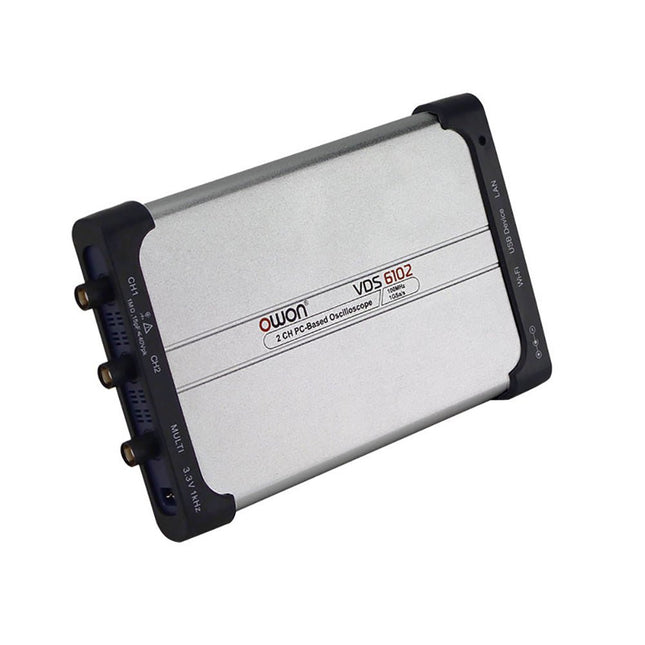
The OWON VDS6000 Series PC Oscilloscope combines powerful performance with a sleek, ultra-thin design. With 100 MHz bandwidth, 1 GSa/s real-time sampling, and up to 14-bit resolution, it delivers highly accurate measurements. The built-in 5 MHz function generator, USB-C power supply, and optional WiFi connectivity make it incredibly versatile.
Compatible with Windows, Linux, Android, and iOS, the VDS6000 is perfect for labs, fieldwork, and remote diagnostics – compact, flexible, and ready for any challenge.
Features
Bandwidth: 100 MHz
Vertical resolution: 14 bits
Rise time: ≤3.5 ns
Memory: 10 Mpts
Number of channels: 2 channels + 1 channel function generator
Horizontal scale: 5ns - 100s/div
Sample rate: Max. 1 GSa/s
Maximum voltage: 40 V (peak - peak)
Automatic measurements: Vpp, Vavg, Vamp, Vrms, Freq, Period, Vmax, Vmin, Vtop, Vbase, Overshoot, Preshoot, Rise Time,
Connectivity: USB-C, LAN, Wifi (optional)
Fall Time, Delay A→B↑, Delay A→B↓, +Width, -Width, +Duty, -Duty
Bandwidth: 5 MHz
Sample rate: 25 MSa/s
Standard waveforms: Sine (0.1 Hz - 5 MHz), Square (0.1 Hz - 200 kHz), Ramp (1 Hz - 10 kHz), Pulse (1 Hz - 10 kHz)
Resolution: 10 bits
DC offset range (AC + DC): ±2.5 V
Amplitude range: 10 mVpp - 5 Vpp
Dimensions: 190 x 120 x 18 mm
Weight: 380 g
Downloads
Manual
Quick Guide
PC Software
MacOS Software
OWON VDS1022I 2-channel USB oscilloscope (25 MHz) is a oscilloscope for use with a computer. It is powered by USB and has a small size, making it easy to take it with you. The oscilloscope is very economical. It has a shielded USB connection, reducing interference and protecting the computer against over-voltage. The multi port on the scope can be used for external triggering, trigger out or Pass / Fail output.
Features
25 MHz bandwidth, and max 1 GS/s real-time sample rate
10M record length
Friendly UI: FFT, or X-Y, and waveform 2 views displayed on the same screen
Multi-trigger option: edge, video, slope, pulse, and alternate
USB isolation – less signal inference, more PC protection
USB bus powering, and LAN remote control (optional)
Ultra-thin body design, easy portability
Specifications
Bandwidth
25 MHz
Channel
2+1 (multi)
Sample Rate
100 MSa/s
Horizontal Scale (s/div)
5 ns/div~100s/div, step by 1~2~5
Record Length
5K
Max Input Voltage
400 V (PK - PK)
(DC+AC, PK - PK)
40 V (PK - PK) (DC+AC, PK - PK)
Vertical Resolution (A/D)
8 bits (2 channels simultaneously)
Model
VDS1022I
Vertical Sensitivity
5 mV/div~5 V/div
Trigger Type
Edge, Pulse, Video, Slope, and Alternate
Trigger Mode
Auto, Normal, and Single
Acquisition Mode
Sample, Peak Detect, and Average
Waveform Math
+, -, ×, ÷, invert, FFT
Communication Interface
USB 2.0 (isolation)
Multi-function
Interface
Signal Type
Level Standard
TTL
Power Supply
5.0 V/1 A
Power Consumption
≤2.5 W
Dimensions (W × H × D)
170 x 120 x 18 mm
Weight
0.26 kg
Included
1x OWON VDS1022I oscilloscope
1x CD-ROM
1x Quick start guide
2x Oscilloscope probe
1x Probe tool
1x Power adapter
1x USB cable
1x Silicone case protectors
1x Power cable
Downloads
Datasheet
User manual
SCPI protocol
USB driver
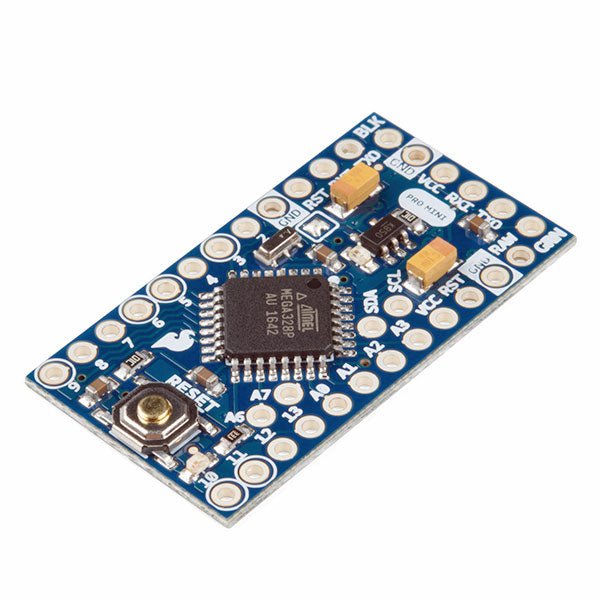
The Arduino Pro Mini is a microcontroller board based on the ATmega328P.
It has 14 digital input/output pins (of which 6 can be used as PWM outputs), 6 analog inputs, an on-board resonator, a reset button, and holes for mounting pin headers. A six pin header can be connected to an FTDI cable or SparkFun breakout board to provide USB power and communication to the board.
The Arduino Pro Mini is intended for semi-permanent installation in objects or exhibitions. The board comes without pre-mounted headers, allowing the use of various types of connectors or direct soldering of wires. The pin layout is compatible with the Arduino Mini.
The Arduino Pro Mini was designed and is manufactured by SparkFun Electronics.
Specifications
Microcontroller
ATmega328P
Board Power Supply
5-12 V
Circuit Operating Voltage
5 V
Digital I/O Pins
14
PWM Pins
6
UART
1
SPI
1
I²C
1
Analog Input Pins
6
External Interrupts
2
DC Current per I/O Pin
40 mA
Flash Memory
32 KB of which 2 KB used by bootloader
SRAM
2 KB
EEPROM
1 KB
Clock Speed
16 MHz
Dimensions
18 x 33.3 mm (0.7 x 1.3")
Downloads
Eagle files
Schematics
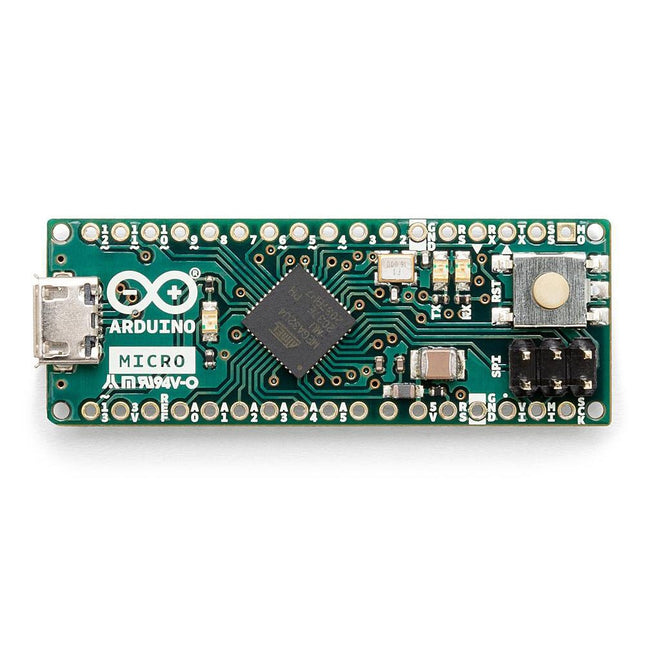
The Arduino Micro contains everything needed to support the microcontroller; simply connect it to a computer with a micro USB cable to get started. It has a form factor that enables it to be easily placed on a breadboard.
The Micro board is similar to the Arduino Leonardo in that the ATmega32U4 has built-in USB communication, eliminating the need for a secondary processor. This allows the Micro to appear to a connected computer as a mouse and keyboard, in addition to a virtual (CDC) serial / COM port.
Specifications
Microcontroller
ATmega32U4
Operating Voltage
5 V
Input Voltage
7 V - 12 V
Analog Input Pins
12
PWM Pins
7
DC I/O Pin
20
DC Current per I/O Pin
20 mA
DC Current for 3.3 V Pin
50 mA
Flash Memory
32 KB of which 4 KB used by the bootloader
SRAM
2.5 KB
EEPROM
1 KB
Clock Speed
16 MHz
LED_Builtin
13
Length
45 mm
Width
18 mm
Weight
13 g
The OWON SPE6103 is a 1-channel DC power supply (300 W) in a small body with features like over voltage and over current protection. It has a high resolution of 10 mV/1 mA. The 2.8" LCD displays the following information (constant voltage output, constant current output, cumulative running time, actual output power, channel output status, actual voltage output, actual current output).
Features
Small body for easy carry
High resolution: 10 mV/1 mA
List waveform editing output, editable 10 groups of timing output function
Low ripple/noise
Over voltage / over current protection
Output voltage and current curve monitoring function
Intelligent temperature control fan cooling
2.8-inch TFT LCD display
USB communication interface, support SCPI
Specifications
Model
SPE6102
SPE6103
Rated Output (0-40°C)
Voltage
0-60 V
0-60 V
Current
10 A
10 A
Output Power
200 W
300 W
USB Output
5 V/1 A (SPE Series) or suppout QC2.0, QC3.0, BC1.2, Apple, Huawei, Samsung fast charging protocols (optional)
Load Regulation
Voltage
≤30 mV
Current
≤20 mA
Power Regulation
Voltage
≤30 mV
Current
≤20 mA
Setting Resolution
Voltage
10 mV
Current
1 mA
Readback Resolution
Voltage
10 mV
Current
1 mA
Value Resolution (within 12 months) (25 ±5°C)
Voltage
≤0.1% ±30 mV
≤0.1% ±30 mV
Current
≤0.05% ±10 mA
Readback Value Resolution (25 ±5°C)
Voltage
≤0.1% ±30 mV
≤0.1% ±30 mV
Current
Ripple/Noise
Voltage (Vp-p)
≤50mVp-p
≤50mVp-p
Voltage (rms)
≤5mVrms
≤5mVrms
Current (rms)
≤30mAp-p
Output temperature coefficient (0-40°C)
Voltage
100ppm/°C
Current
200ppm/°C
Readback temperature coefficient
Voltage
100ppm/°C
Current
200ppm/°C
Response Time (50-100% rated load)
≤1.0ms
Storage
4 groups of data
Working Temperature
0-40°C
Included
1x OWON SPE6102
1x Power Cord
1x Quick Guide
1x USB Cable
1x Fuse
Downloads
User Manual
Programming Manual
Software
This OWON DC Power Supply has a small body and is easy to carry due to its light weight. Featuring a 3.7" TFT LCD display, it has a maximum output power of 180 W and a resolution of 1 mV/1 mA.
Features
Channel
Single Channel Output
Total Output Power
180 W
Channel Output
0 - 60 V / 0 - 3 A × 1-CH
Display
3.7' color LCD display
Dimension
117 mm(L) × 194 mm(H) × 295 mm(D)
Weight
Approx. 5.8 kg
Interface
RS232
Specifications
Rated Output (0 ℃ - 40 ℃)
Voltage
0 - 60 V
Current
3 A
Load Regulation
Voltage
≤ 0.01% + 3 mV
Current
≤ 0.01% + 3 mA
Power Regulation
Voltage
≤ 0.01% + 3 mV
Current
≤ 0.01% + 3 mA
Setting Resolution
Voltage
1 mV
Current
1 mA
Readback Resolution
Voltage
1 mV
Current
1 mA
Setpoint accuracy (within 12 months) (25 ℃ ± 5 ℃)
Voltage
≤ 0.03% + 10 mV
Current
≤ 0.1% + 5 mA
Readback Resolution (25 ℃ ± 5 ℃)
Voltage
≤ 0.03% + 10 mV
Current
≤ 0.1% + 5 mA
Ripple/Noise (20 Hz - 20 MHz)
Voltage (Vp-p)
≤ 4 mVp-p
Voltage (Vrms)
≤ 1 mVrms
Current (rms)
≤ 4 mArms
Output temperature coefficient(0 ℃ - 40 ℃)
Voltage
≤ 0.03% + 10 mV
Current
≤ 0.1% + 5 mA
Readback temperature coefficient
Voltage
≤ 0.03% + 10 mV
Current
≤ 0.1% + 5 mA
Response Time
100 μs
Storage
5 groups of data
Working Temperature
0 - 40 ℃
,
by Jean-François Simon
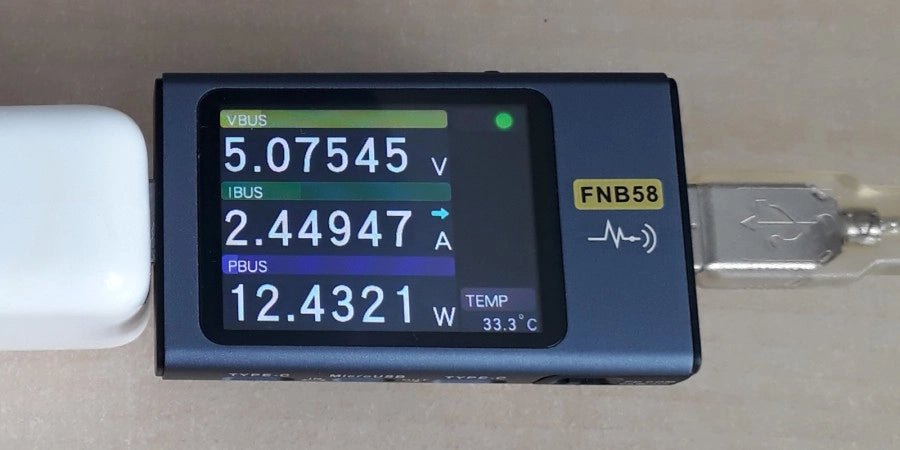
Fnirsi FNB58 USB Tester (Review)
The Fnirsi FNB58 is a versatile USB tester capable of performing a wide array of voltage, current, and energy measurements, as well as supporting numerous...