ESP32

16 products

  •  -50% ESP32 - C3 - DevKitM - 1 - Elektor

    Espressif ESP32-C3-DevKitM-1

    ESP32-C3-DevKitM-1 is an entry-level development board based on ESP32-C3-MINI-1, a module named for its small size. This board integrates complete Wi-Fi and Bluetooth LE functions. Most of the I/O pins on the ESP32-C3-MINI-1 module are broken out to the pin headers on both sides of this board for easy interfacing. Developers can either connect peripherals with jumper wires or mount ESP32-C3-DevKitM-1 on a breadboard. Specifications ESP32-C3-MINI-1 ESP32-C3-MINI-1 is a general-purpose Wi-Fi and Bluetooth LE combo module that comes with a PCB antenna. At the core of this module is ESP32-C3FN4, a chip that has an embedded flash of 4 MB. Since flash is packaged in the ESP32-C3FN4 chip, rather than integrated into the module, ESP32-C3-MINI-1 has a smaller package size. 5 V to 3.3 V LDO Power regulator that converts a 5 V supply into a 3.3 V output. 5 V Power On LED Turns on when the USB power is connected to the board. Pin Headers All available GPIO pins (except for the SPI bus for flash) are broken out to the pin headers on the board. For details, please see Header Block. Boot Button Download button. Holding down Boot and then pressing Reset initiates Firmware Download mode for downloading firmware through the serial port. Micro-USB Port USB interface. Power supply for the board as well as the communication interface between a computer and the ESP32-C3FN4 chip. Reset Button Press this button to restart the system. USB-to-UART Bridge Single USB-UART bridge chip provides transfer rates up to 3 Mbps. RGB LED Addressable RGB LED, driven by GPIO 8. Downloads ESP32-C3 Datasheet ESP32-C3-MINI-1 Datasheet ESP32-C3-DevKitM-1 Schematic ESP32-C3-DevKitM-1 PCB Layout ESP32-C3-DevKitM-1 Dimensions

    € 19,95€ 9,95

    Members identical

  •  -15% Elektor Self - Balancing Robot Kit - Elektor

    Elektor Labs Elektor Mini-Wheelie Self-Balancing Robot

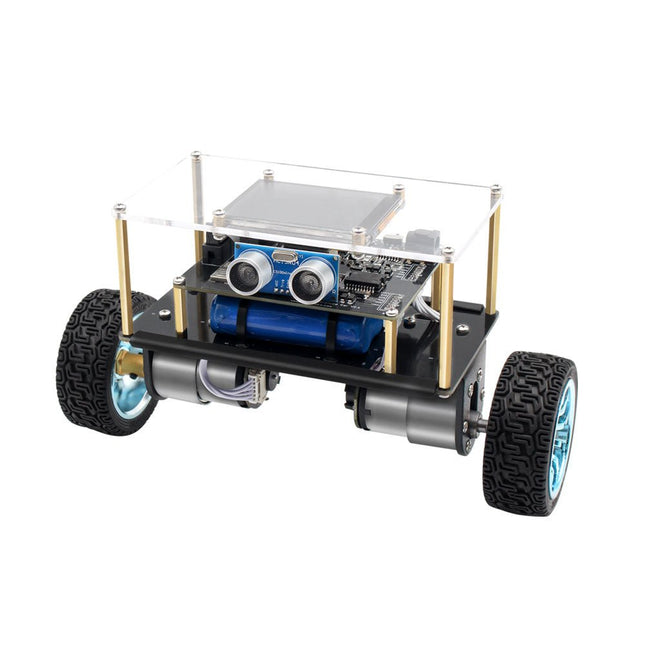
    Arduino-compatible, ESP32-controlled, 2-wheeled Balancing Robot The Elektor Mini-Wheelie is an experimental autonomous self-balancing robot platform. Based on an ESP32-S3 microcontroller, the self-balancing robot is fully programmable using the Arduino environment and open-source libraries. Its wireless capabilities allow it to be controlled remotely over Wi-Fi, Bluetooth or ESP-NOW or to communicate with a user or even another robot. An ultrasonic transducer is available for detecting obstacles. Its color display can be used for displaying cute facial expressions or, for the more down-to-earth users, cryptic debug messages. The robot comes as a neat kit of parts that you must assemble yourself. Everything is included, even a screwdriver. Note: The Mini-Wheelie is an educational development platform intended for learning, experimentation, and robotics development. It is not classified as a toy for children, and its features, documentation, and intended audience reflect this purpose. The product is aimed at students, educators, and developers who wish to explore robotics, programming, and hardware integration in an educational setting. Specifications ESP32-S3 microcontroller with Wi-Fi and Bluetooth MPU6050 6-axis Inertial Measurement Unit (IMU) Two independently controlled 12 V electric motors with tachometer Ultrasonic transducer 2.9" TFT color display (320 x 240) MicroSD card slot Battery power monitor 3S rechargeable Li-Po battery (11.1 V/2200 mAh) Battery charger included Arduino-based open-source software Dimensions (W x L x H): 23 x 8 x 13 cm Included 1x ESP32-S3 Mainboard + MPU6050 module 1x LCD board (2.9 inch) 1x Ultrasonic sensor 1x Battery pack (2200 mAh) 1x Battery charger 1x Motor tyre kit 1x Case board 1x Acrylic board 1x Screwdriver 1x Protective strip 1x Flex cable B (8 cm) 1x Flex cable A (12 cm) 1x Flex cable C 4x Copper column A (25 mm) 4x Copper column B (55 mm) 4x Copper column C (5 mm) 2x Plastic nylon column 8x Screws A (10 mm) 24x Screws B (M3x5) 8x Nuts 24x Metal washers 2x Zip tie 1x MicroSD card (32 GB) Downloads Documentation

    € 99,95€ 84,95

    Members identical

  •  -50% ESP32 - PICO - Kit V4 - Elektor

    Espressif ESP32-PICO-Kit

    The ESP32-PICO-Kit fits into a mini breadboard. It is fully functional with the minimum number of discrete components, while it has all the ESP32 pins exposed. Features Complete up-to-date documentation is available. All instructions and commands presented work as described. Plentiful additional information and hardware documentation are available too. Applications for the ESP32-PICO-KIT can be developed on Windows, Linux or Mac. Two cores and a radio Like the ESP8266 the ESP32 has Wi-Fi but adds Bluetooth. It also has two 32-bit cores inside, making it extremely powerful, and providing all the ports and interfaces that the ESP8266 is lacking.Oversimplifying things, one might say that the ESP8266 is a Wi-Fi controller that provides some I/O, whereas the ESP32 is a full-fledged controller that also has Wi-Fi. ESP32 peripherals The ESP32 exposes an ADC & DAC, touch sensor circuitry, an SD/SDIO/MMC host controller, an SDIO/SPI slave controller, an EMAC, PWM to control LEDs and motors, UART, SPI, I²C, I²S, infrared remote controller, and, of course, GPIO. ESP32-PICO-KIT Development board The ESP32-PICO-D4 is a System-on-Chip (SoC) integrating an ESP32 chip together with a 4 MB SPI flash memory in a tiny 7 x 7 mm package. The ESP32-PICO-KIT is a breakout board for this SoC with an onboard USB-to-serial converter for easy programming and debugging. Besides the board, you'll need a programming toolchain. Complete, up-to-date documentation from Espressif is available on the Read the Docs website. All instructions and commands presented work as described.Plentiful additional information and hardware documentation are available too. Applications for the ESP32-PICO-KIT can be developed on Windows, Linux or Mac.

    € 19,95€ 9,95

    Members identical

  •  -15% Elektor Audio DSP FX Processor (New Revision)

    Elektor Labs Elektor Audio DSP FX Processor (New Revision)

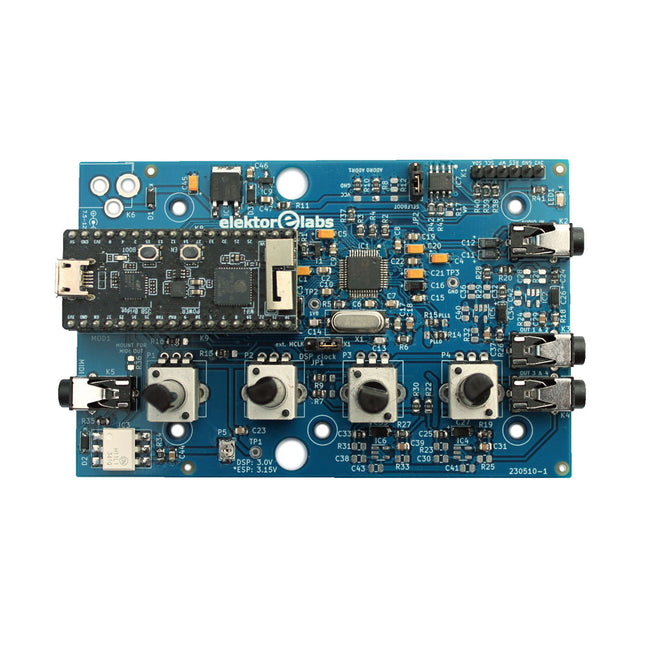
    The Elektor Audio DSP FX Processor combines an ESP32 microcontroller and an ADAU1701 Audio DSP from Analog Devices. Besides a user-programmable DSP core, the ADAU1701 has high-quality analog-to-digital and digital-to-analog converters built-in and features an I²S port. This makes it suitable as a high-quality audio interface for the ESP32. Programs for the ESP32 can be created with Arduino, Platform IO, CMake or by using the Espressif IDF in another way. Programs for the ADAU7101 audio DSPs are created with the free visual programming tool SigmaStudio by dragging and dropping pre-defined algorithm blocks on a canvas. Applications Bluetooth/Wi-Fi audio sink (e.g. loudspeaker) & source Guitar effect pedal (stomp box) Music synthesizer Sound/function generator Programmable cross-over filter for loudspeakers Advanced audio effects processor (reverb, chorus, pitch shifting, etc.) Internet-connected audio device DSP experimentation platform Wireless MIDI MIDI to CV converter and many more... Specifications ADAU1701 28-/56-bit, 50-MIPS digital audio processor supporting sampling rates of up to 192 kHz ESP32 32-bit dual-core microcontroller with Wi-Fi 802.11b/g/n and Bluetooth 4.2 BR/EDR and BLE 2x 24-bit audio inputs (2 V RMS, 20 kΩ) 4x 24-bit audio outputs (0.9 V RMS, 600 Ω) 4x Control potentiometer MIDI in- and output I²C expansion port Multi-mode operation Power supply: 5 V DC USB or 7.5-12 V DC (barrel jack, center pin is GND) Current consumption (average): 200 mA Included 1x ESP32 Audio DSP FX Processor board (assembled) 1x ESP32-PICO-KIT 2x Jumpers 2x 18-pin headers (female) 4x 10 KB potentiometers Downloads Documentation GitHub

    € 99,95€ 84,95

    Members identical

  •  -19% Elektor ESP32 Energy Meter

    Elektor Labs Elektor ESP32 Energy Meter

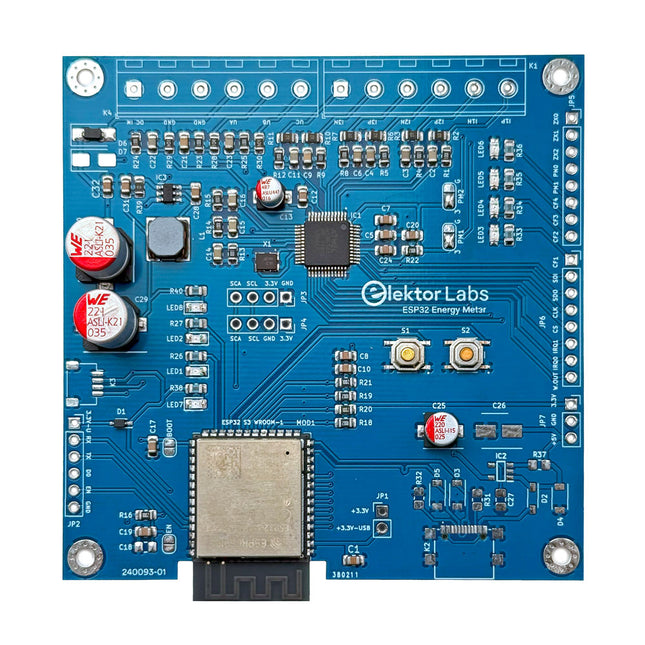
    The Elektor ESP32 Energy Meter is a device designed for real-time energy monitoring and smart home integration. Powered by the ESP32-S3 microcontroller, it offers robust performance with modular and scalable features. The device uses a 220 V-to-12 V step-down transformer for voltage sampling, ensuring galvanic isolation and safety. Its compact PCB layout includes screw-type terminal blocks for secure connections, a Qwiic connector for additional sensors, and a programming header for direct ESP32-S3 configuration. The energy meter is compatible with single-phase and three-phase systems, making it adaptable for various applications. The energy meter is simple to set up and integrates with Home Assistant, offering real-time monitoring, historical analytics, and automation capabilities. It provides accurate measurements of voltage, current, and power, making it a valuable tool for energy management in homes and businesses. Features Comprehensive Energy Monitoring: Get detailed insights into your energy usage for smarter management and cost savings. Customizable Software: Tailor functionality to your needs by programming and integrating custom sensors. Smart Home Ready: Compatible with ESPHome, Home Assistant, and MQTT for full Smart Home integration. Safe & Flexible Design: Operates with a 220 V-to-12 V step-down transformer and features a pre-assembled SMD board. Quick Start: Includes one Current Transformer (CT) sensor and access to free setup resources. Specifications Microcontroller ESP32-S3-WROOM-1-N8R2 Energy Metering IC ATM90E32AS Status Indicators 4x LEDs for power consumption indication2x Programmable LEDs for custom status notifications User Input 2x Push buttons for user control Display Output I²C OLED display for real-time power consumption visualization Input Voltage 110/220 V AC (via step-down transformer) Input Power 12 V (via step-down transformer or DC input) Clamp Current Sensor YHDC SCT013-000 (100 A/50 mA) included Smart Home Integration ESPHome, Home Assistant, and MQTT for seamless connectivity Connectivity Header for programming, Qwiic for sensor expansion Applications Supports single-phase and three-phase energy monitoring systems Dimensions 79.5 x 79.5 mm Included 1x Partly assembled board (SMDs are pre-mounted) 2x Screw terminal block connerctors (not mounted) 1x YHDC SCT013-000 current transformer Required Power transformer not included Downloads Datasheet (ESP32-S3-WROOM-1) Datasheet (ATM90E32AS) Datasheet (SCT013-000) Frequently Asked Questions (FAQ) From Prototype to Finished Product What started as an innovative project to create a reliable and user-friendly energy meter using the ESP32-S3 microcontroller has evolved into a robust product. Initially developed as an open-source project, the ESP32 Energy Meter aimed to provide precise energy monitoring, smart home integration and more. Through meticulous hardware and firmware development, the energy meter now stands as a compact, versatile solution for energy management.

    € 79,95€ 64,95

    Members identical

  •  -50% ESP - C3 - 12F - Kit Development Board with built - in 4 MB Flash - Elektor

    Espressif ESP-C3-12F-Kit Development Board with built-in 4 MB Flash

    The ESP32-C3 chip has industry-leading low-power performance and radio frequency performance, and supports Wi-Fi IEEE802.11b/g/n protocol and BLE 5.0. The chip is equipped with a RISC-V 32-bit single-core processor with an operating frequency of up to 160 MHz. Support secondary development without using other microcontrollers or processors. The chip has built-in 400 KB SRAM, 384 KB ROM, 8 KB RTC SRAM, built-in 4 MB Flash also supports external Flash. The chip supports a variety of low power consumption working states, which can meet the power consumption requirements of various application scenarios. The chip's unique features such as fine clock gating function, dynamic voltage clock frequency adjustment function, and RF output power adjustable function can achieve the best balance between communication distance, communication rate and power consumption. The ESP-C3-12F module provides a wealth of peripheral interfaces, including UART, PWM, SPI, I²S, I²C, ADC, temperature sensor and up to 15 GPIOs. Features Support Wi-Fi 802.11b/g/n, 1T1R mode data rate up to 150 Mbps Support BLE5.0, does not support classic Bluetooth, rate support: 125 Kbps, 500 Kbps, 1 Mbps, 2 Mbps RISC-V 32-bit single-core processor, supports a clock frequency of up to 160 MHz, has 400 KB SRAM, 384 KB ROM, 8 KB RTC SRAM Support UART/PWM/GPIO/ADC/I²C/I²S interface, support temperature sensor, pulse counter The development board has RGB three-in-one lamp beads, which is convenient for the second development of customers. Support multiple sleep modes, deep sleep current is less than 5 uA Serial port rate up to 5 Mbps Support STA/AP/STA+AP mode and promiscuous mode Support Smart Config (APP)/AirKiss (WeChat) of Android and iOS, one-click network configuration Support serial port local upgrade and remote firmware upgrade (FOTA) General AT commands can be used quickly Support secondary development, integrated Windows and Linux development environment About Flash configuration ESP-C3-12F uses the built-in 4 MB Flash of the chip by default, and supports the external Flash version of the chip.

    € 14,95€ 7,50

    Members identical

  •  -50% ESP32 - S3 - DevKitC - 1U - N8R8 - Elektor

    Espressif ESP32-S3-DevKitC-1U-N8R8

    Out of stock

    The ESP32-S3-DevKitC-1 is an entry-level development board equipped with ESP32-S3-WROOM-1U, a general-purpose Wi-Fi + Bluetooth Low Energy MCU module that integrates complete Wi-Fi and Bluetooth Low Energy functions. Most of the I/O pins on the module are broken out to the pin headers on both sides of this board for easy interfacing. Developers can either connect peripherals with jumper wires or mount ESP32-S3-DevKitC-1 on a breadboard. Features Module integrated: ESP32-S3-WROOM-1U-N8R8 Flash: 8 MB QD PSRAM: 8 MB OT SPI voltage: 3.3 V Specifications ESP32-S3-WROOM-1U ESP32-S3-WROOM-1U is a powerful, generic Wi-Fi + Bluetooth Low Energy MCU module that has a rich set of peripherals. It provides acceleration for neural network computing and signal processing workloads. ESP32-S3-WROOM-1U comes with an external antenna connector. 5 V to 3.3 V LDO Power regulator that converts a 5 V supply into a 3.3 V output. Pin Headers All available GPIO pins (except for the SPI bus for flash) are broken out to the pin headers on the board for easy interfacing and programming. USB-to-UART Port A Micro-USB port used for power supply to the board, for flashing applications to the chip, as well as for communication with the chip via the on-board USB-to-UART bridge. Boot Button Download button. Holding down Boot and then pressing Reset initiates Firmware Download mode for downloading firmware through the serial port. Reset Button Press this button to restart the system. USB Port ESP32-S3 full-speed USB OTG interface, compliant with the USB 1.1 specification. The interface is used for power supply to the board, for flashing applications to the chip, for communication with the chip using USB 1.1 protocols, as well as for JTAG debugging. USB-to-UART Bridge Single USB-to-UART bridge chip provides transfer rates up to 3 Mbps. RGB LED Addressable RGB LED, driven by GPIO38. 3.3 V Power On LED Turns on when the USB power is connected to the board. Downloads Pinout

    Out of stock

    € 29,95€ 14,95

    Members identical

  • ESP32 Development Board (Cheap Yellow Display) - Elektor

    Generic ESP32 Cheap Yellow Display Board

    This development board (also known as "Cheap Yellow Display") is powered by the ESP-WROOM-32, a dual-core MCU with integrated Wi-Fi and Bluetooth capabilities. It operates at a main frequency of up to 240 MHz, with 520 KB SRAM, 448 KBROM, and a 4 MB Flash memory. The board features a 2.8-inch display with a resolution of 240x320 and resistive touch. Furthermore, the board includes a backlight control circuit, touch control circuit, speaker drive circuit, photosensitive circuit, and RGB-LED control circuit. It also provides a TF card slot, serial interface, DHT11 temperature and humidity sensor interface, and additional IO ports. The module supports development in Arduino IDE, ESP-IDE, MicroPython, and Mixly. Applications Image transmission for Smart Home device Wireless monitoring Smart agriculture QR wireless recognition Wireless positioning system signal And other IoT applications Specifications Microcontroller ESP-WROOM-32 (Dual-core MCU with integrated Wi-Fi and Bluetooth) Frequency Up to 240 MHz (computing power is up to 600 DMIPS) SRAM 520 KB ROM 448 KB Flash 4 MB Operating voltage 5 V Power consumption approx. 115 mA Display 2.8-inch color TFT screen (240x320) Touch Resistive Touch Driver chip ILI9341 Dimensions 50 x 86 mm Weight 50 g Included 1x ESP32 Dev Board with 2.8" Display and acrylic Shell 1x Touch pen 1x Connector cable 1x USB cable Downloads GitHub

    € 24,95

    Members € 22,46

  •  -50% ESP32 - WROOM - 32D - Elektor

    Espressif ESP32-WROOM-32D

    The ESP32-WROOM-32, measuring 25.2 x 18 mm only, contains the ESP32 SoC, flash memory, precision discrete components, and PCB antenna to provide outstanding RF performance in space-constrained applications. ESP32-WROOM-32 is a powerful, generic Wi-Fi + BT + BLE MCU module that targets a wide variety of applications, ranging from low-power sensor networks to the most demanding tasks, such as voice encoding, music streaming and MP3 decoding. At the core of this module is the ESP32-D0WDQ6 chip. The chip embedded is designed to be scalable and adaptive. There are two CPU cores that can be individually controlled, and the clock frequency is adjustable from 80 MHz to 240 MHz. The user may also power off the CPU and make use of the low-power co-processor to monitor the peripherals for changes or crossing of thresholds constantly. ESP32 integrates a rich set of peripherals, ranging from capacitive touch sensors, Hall sensors, SD card interface, Ethernet, high-speed SPI, UART, I²S and I²C. The integration of Bluetooth, Bluetooth LE and Wi-Fi ensures that a wide range of applications can be targeted and that the module is future proof. Using Wi-Fi allows a vast physical range and direct connection to the internet through a Wi-Fi router while using Bluetooth allows the user to conveniently connect to the phone or broadcast low energy beacons for its detection. The sleep current of the ESP32 chip is less than 5 µA, making it suitable for battery powered and wearable electronics applications. ESP32 supports a data rate of up to 150 Mbps, and 20.5 dBm output power at the antenna to ensure the broadest physical range. As such the chip does offer industry-leading specifications and the best performance for electronic integration, range, power consumption, and connectivity. Downloads Datasheet

    € 9,95€ 4,95

    Members identical

  •  -50% ESP32 - S2 - Saola - 1R Development Board - Elektor

    Espressif ESP32-S2-Saola-1R Development Board

    ESP32-S2-Saola-1R is a small-sized ESP32-S2 based development board. Most of the I/O pins are broken out to the pin headers on both sides for easy interfacing. Developers can either connect peripherals with jumper wires or mount ESP32-S2-Saola-1R on a breadboard.ESP32-S2-Saola-1R is equipped with the ESP32-S2-WROVER module, a powerful, generic Wi-Fi MCU module that has a rich set of peripherals. It is an ideal choice for a wide variety of application scenarios relating to Internet of Things (IoT), wearable electronics and smart home. The board a PCB antenna and features a 4 MB external SPI flash and an additional 2 MB SPI Pseudo static RAM (PSRAM).FeaturesMCU ESP32-S2 embedded, Xtensa® single-core 32-bit LX7 microprocessor, up to 240 MHz 128 KB ROM 320 KB SRAM 16 KB SRAM in RTC Wi­Fi 802.11 b/g/n Bit rate: 802.11n up to 150 Mbps A-MPDU and A-MSDU aggregation 0.4 µs guard interval support Center frequency range of operating channel: 2412 ~ 2484 MHz Hardware Interfaces: GPIO, SPI, LCD, UART, I²C, I²S, Camera interface, IR, pulse counter, LED PWM, TWAI (compatible with ISO 11898-1), USB OTG 1.1, ADC, DAC, touch sensor, temperature sensor 40 MHz crystal oscillator 4 MB SPI flash Operating voltage/Power supply: 3.0 ~ 3.6 V Operating temperature range: –40 ~ 85 °C Dimensions: 18 × 31 × 3.3 mm Applications Generic Low-power IoT Sensor Hub Generic Low-power IoT Data Loggers Cameras for Video Streaming Over-the-top (OTT) Devices USB Devices Speech Recognition Image Recognition Mesh Network Home Automation Smart Home Control Panel Smart Building Industrial Automation Smart Agriculture Audio Applications Health Care Applications Wi-Fi-enabled Toys Wearable Electronics Retail & Catering Applications Smart POS Machines

    € 22,95€ 11,50

    Members identical

  •  -50% PÚCA DSP ESP32 Development Board - Elektor

    Ohmic PÚCA DSP ESP32 Development Board

    PÚCA DSP is an open-source, Arduino-compatible ESP32 development board for audio and digital signal processing (DSP) applications with expansive audio-processing features. It provides audio inputs, audio outputs, a low-noise microphone array, an integrated test-speaker option, additional memory, battery-charge management, and ESD protection all on a small, breadboard-friendly PCB. Synthesizers, Installations, Voice UI, and More PÚCA DSP can be used for a wide range of DSP applications, including but not limited to those in the fields of music, art, creative technology, and adaptive technology. Music-related examples include digital-music synthesis, mobile recording, Bluetooth speakers, wireless line-level directional microphones, and the design of smart musical instruments. Art-related examples include acoustic sensor networks, sound-art installations, and Internet-radio applications. Examples related to creative and adaptive technology include voice user interface (VUI) design and Web audio for the Internet of Sounds. Compact, Integrated Design PÚCA DSP was designed for portability. When used with an external 3.7 V rechargeable battery, it can be deployed almost anywhere or integrated into just about any device, instrument, or installation. Its design emerged from months of experimentation with various ESP32 development boards, DAC breakout boards, ADC breakout boards, Microphone breakout boards, and audio-connector breakout boards, and – despite its diminutive size – it manages to provide all of that functionality in a single board. And it dos so without compromising signal quality. Specifications Processor & Memory Espressif ESP32 Pico D4 Processor 32-bit dual core 80 MHz / 160 MHz / 240 MHz 4 MB SPI Flash with 8 MB additional PSRAM (Original Edition) Wireless 2.4 GHz Wi-Fi 802.11b/g/n Bluetooth BLE 4.2 3D Antenna Audio Wolfson WM8978 Stereo Audio Codec Audio Line In on 3.5 mm stereo onnector Audio Headphone / Line Out on 3.5 mm stereo connector Stereo Aux Line In, Audio Mono Out routed to GPIO Header 2x Knowles SPM0687LR5H-1 MEMS Microphones ESD protection on all audio inputs and outputs Support for 8, 11.025, 12, 16, 22.05, 24, 32, 44.1 and 48 kHz sample rates 1 W Speaker Driver, routed to GPIO Header DAC SNR 98 dB, THD -84 dB (‘A’ weighted @ 48 kHz) ADC SNR 95 dB, THD -84 dB (‘A’ weighted @ 48 kHz) Line input impedance: 1 MOhm Line output impedance: 33 Ohm Form Factor and Connectivity Breadboard friendly 70 x 24 mm 11x GPIO pins broken out to 2.54 mm pitch header, with access to both ESP32 ADC channels, JTAG and capacitive touch pins USB 2.0 over USB Type C connector Power 3.7/4.2 V Lithium Polymer Rechargeable Battery, USB or external 5 V DC power source ESP32 and Audio Codec can be placed into low power modes under software control Battery voltage level detection ESD protection on USB data bus Downloads GitHub Datasheet Links Crowd Supply Campaign (includes FAQs) Hardware Overview Programming the Board The Audio Codec

    € 69,95€ 34,95

    Members identical

  • Universal Maker Sensor Bundle - Elektor

    SunFounder Universal Maker Sensor Kit (for Raspberry Pi, Pico W, Arduino, ESP32)

    Out of stock

    Discover endless creativity with the Universal Maker Sensor Kit, designed for use with Raspberry Pi, Pico W, Arduino, and ESP32. This versatile kit offers compatibility across popular development platforms, including Arduino Uno R4 Minima/WiFi, Uno R3, Mega 2560, Raspberry Pi 5, 4, 3B+, 3B, Zero, Pico W, and ESP32. Featuring over 35 sensors, actuators, and displays, it's perfect for projects ranging from environmental monitoring and smart home automation to robotics and interactive gaming. Step-by-step tutorials in C/C++, Python, and MicroPython guide beginners and experienced makers alike through 169 exciting projects. Features Wide Compatibility: Fully supports Arduino (Uno R3, Uno R4 Minima/WiFi, Mega 2560), Raspberry Pi (5, 4, 3B+, 3B, Zero, Pico W), and ESP32, enabling extensive flexibility across numerous development platforms. Includes instructions for building 169 projects. Comprehensive Components: Features more than 35 sensors, actuators, and display modules suitable for diverse projects such as environmental monitoring, smart home automation, robotics, and interactive game controllers. Detailed Tutorials: Provides clear, step-by-step tutorials covering Arduino, Raspberry Pi, Pico W, ESP32, and each included component. Tutorials are available in C/C++, Python, and MicroPython, catering effectively to both beginners and experienced makers. Suitable for All Skill Levels: Offers structured projects designed to guide users seamlessly from beginner to advanced proficiency in electronics and programming, enhancing creativity and technical expertise. Included Breadboard Button Module Capacitive Soil Moisture Module Flame Sensor Module Gas/Smoke Sensor Module (MQ2) Gyroscope & Accelerometer Module (MPU6050) Hall Sensor Module Infrared Speed Sensor Module IR Obstacle Avoidance Sensor Module Joystick Module PCF8591 ADC DAC Converter Module Photoresistor Module PIR Motion Module (HC-SR501) Potentiometer Module Pulse Oximeter and Heart Rate Sensor Module (MAX30102) Raindrop Detection Module Real Time Clock Module (DS1302) Rotary Encoder Module Temperature Sensor Module (DS18B20) Temperature and Humidity Sensor Module (DHT11) Temperature, Humidity & Pressure Sensor (BMP280) Time of Flight Micro-LIDAR Distance Sensor (VL53L0X) Touch Sensor Module Ultrasonic Sensor Module (HC-SR04) Vibration Sensor Module (SW-420) Water Level Sensor Module I²C LCD 1602 OLED Display Module (SSD1306) RGB LED Module Traffic Light Module 5 V Relay Module Centrifugal Pump L9110 Motor Driver Module Passive Buzzer Module Servo Motor (SG90) TT Motor ESP8266 Module JDY-31 Bluetooth Module Power Supply Module Documentation Online Tutorial

    Out of stock

    € 69,95

    Members € 62,96

  •  -50% ESP32 - S2 - WROVER - Elektor

    Espressif ESP32-S2-WROVER

    At the core of this module is ESP32-S2, an Xtensa® 32-bit LX7 CPU that operates at up to 240 MHz. The chip has a low-power co-processor that can be used instead of the CPU to save power while performing tasks that do not require much computing power, such as monitoring of peripherals. ESP32-S2 integrates a rich set of peripherals, ranging from SPI, I²S, UART, I²C, LED PWM, TWAITM, LCD, Camera interface, ADC, DAC, touch sensor, temperature sensor, as well as up to 43 GPIOs. It also includes a full-speed USB On-The-Go (OTG) interface to enable USB communication.FeaturesMCU ESP32-S2 embedded, Xtensa® single-core 32-bit LX7 microprocessor, up to 240 MHz 128 KB ROM 320 KB SRAM 16 KB SRAM in RTC Wi­Fi 802.11 b/g/n Bit rate: 802.11n up to 150 Mbps A-MPDU and A-MSDU aggregation 0.4 µs guard interval support Center frequency range of operating channel: 2412 ~ 2484 MHz Hardware Interfaces: GPIO, SPI, LCD, UART, I²C, I²S, Camera interface, IR, pulse counter, LED PWM, TWAI (compatible with ISO 11898-1), USB OTG 1.1, ADC, DAC, touch sensor, temperature sensor 40 MHz crystal oscillator 4 MB SPI flash Operating voltage/Power supply: 3.0 ~ 3.6 V Operating temperature range: –40 ~ 85 °C Dimensions: 18 × 31 × 3.3 mm Applications Generic Low-power IoT Sensor Hub Generic Low-power IoT Data Loggers Cameras for Video Streaming Over-the-top (OTT) Devices USB Devices Speech Recognition Image Recognition Mesh Network Home Automation Smart Home Control Panel Smart Building Industrial Automation Smart Agriculture Audio Applications Health Care Applications Wi-Fi-enabled Toys Wearable Electronics Retail & Catering Applications Smart POS Machines

    € 7,95€ 3,95

    Members identical

  •  -50% Phambili Newt 2.7" IoT Display (powered by ESP32 - S2) - Elektor

    Phambili Phambili Newt 2.7" IoT Display (powered by ESP32-S2)

    A low-power, open source, 2.7-inch IoT display powered by an ESP32-S2 module and featuring SHARP's Memory-in-Pixel (MiP) screen technology The Newt is a battery-powered, always-on, wall-mountable display that can go online to retrieve weather, calendars, sports scores, to-do lists, quotes…really anything on the Internet! It is powered by an ESP32-S2 microcontroller that you can program with Arduino, CircuitPython, MicroPython, or ESP-IDF. It's perfect for makers: Sharp’s Memory-in-Pixel (MiP) technology avoids the slow refresh times associated with E-Ink displays A real-time clock (RTC) was added to support timers and alarms The Newt was designed with battery operation in mind; every component on the board was chosen for its ability to operate at low power. Newt was designed to operate 'untethered,' which means it can be mounted in places where a power cord would be inconvenient, for example a wall, refrigerator, mirror, or dry-erase board. With the optional stand, desks, shelves, and nightstands are also good options. Newt is open source, and all design files and libraries are available for review, use, and modification. However, doing that is not required. Each Newt is delivered with working code with the following features: Current weather details Hourly and daily weather forecast Alarm Timer Inspirational quotes Air-quality forecast Habit calendar Pomodoro timer Oblique Strategy cards Only following the Wi-Fi provisioning instructions is needed to get started. No app downloads are required. Specifications Display Sharp Memory LCD Screen Size 2.7 inch Resolution 240 x 400 Deep Sleep Current 30 uA Refresh Rate < 0.001 s Periodic Screen Refresh Required No Input Buttons 10 capacitive pads, 1 push button RTC included Yes Speaker included Yes Power Input USB Type-C Battery included No Programming Languages Arduino, CircuitPython, ESP IDF, MicroPython Dimensions 91 x 61 x 9 mm Microcontroller Espressif ESP32-S2-WROVER Module with 4 MB flash and 2 MB PSRAM Wi-Fi capable Supports Arduino, MicroPython, CircuitPython, and ESP-IDF Deep sleep current as low as 25 μA Display 2.7-inch, 240 x 400 pixel MiP LCD Capable of delivering high-contrast, high-resolution, low-latency content with ultra-low power consumption Reflective mode leverages ambient light to eliminate the need for a backlight Time Keeping, Timers, and Alarms Micro Crystal RV-3028-C7 RTC Optimized for extreme low-power consumption (45 μA) Able to simultaneously manage a periodic timer, a countdown timer, and an alarm Hardware interrupt for timers and alarms 43 bytes of non-volatile user memory, 2 bytes of user RAM Separate UNIX time counter Buzzer Speaker/buzzer with mini class-D amplifier on DAC output A0 can play tones or lo-fi audio clips User Input Power switch Two programmable tactile buttons for Reset and Boot 10 capacitive touchpads Power Newt is designed to operate for one to two months between charges using a 500 mAH LiPo battery. The exact run time varies. (Heavy Wi-Fi use, in particular, will reduce battery charge more quickly.) USB Type-C connector for programming, power, and charging Low-quiescence voltage regulator (TOREX XC6220) that can output 1 A of current and operate as low as 8 μA. JST connector for a Lithium-Ion battery Battery-charging circuity (MCP73831) Low-battery indicator (1 μA quiescence current) Software Newt hardware is compatible with open-source Arduino libraries for ESP32-S2, Adafruit GFX (fonts), Adafruit Sharp Memory Display (display writing), and RTC RV-3028-C7 (RTC) Arduino libraries and sample programs are under development and will be available in our GitHub repository before launch CircuitPython libraries and registration are on the roadmap, with the development of a CircuitPython library for the RV-3028 real-time clock as a key dependency Included Phambili Newt – Fully assembled with pre-loaded firmware Laser-cut desktop stand Mini-magnet feet Required screws Support & Documentation Full instructions for use GitHub: Arduino Library and Codebase GitHub: Board schematics Videos of prototypes or demos (build tracked on Hackaday)

    € 144,95€ 72,50

    Members identical

  •  -50% ESP32 - S2 - WROOM - Elektor

    Espressif ESP32-S2-WROOM

    At the core of this module is ESP32-S2, an Xtensa® 32-bit LX7 CPU that operates at up to 240 MHz. The chip has a low-power co-processor that can be used instead of the CPU to save power while performing tasks that do not require much computing power, such as monitoring of peripherals. ESP32-S2 integrates a rich set of peripherals, ranging from SPI, I²S, UART, I²C, LED PWM, TWAITM, LCD, Camera interface, ADC, DAC, touch sensor, temperature sensor, as well as up to 43 GPIOs. It also includes a full-speed USB On-The-Go (OTG) interface to enable USB communication.FeaturesMCU ESP32-S2 embedded, Xtensa® single-core 32-bit LX7 microprocessor, up to 240 MHz 128 KB ROM 320 KB SRAM 16 KB SRAM in RTC Wi­Fi 802.11 b/g/n Bit rate: 802.11n up to 150 Mbps A-MPDU and A-MSDU aggregation 0.4 µs guard interval support Center frequency range of operating channel: 2412 ~ 2484 MHz Hardware Interfaces: GPIO, SPI, LCD, UART, I²C, I²S, Camera interface, IR, pulse counter, LED PWM, TWAI (compatible with ISO 11898-1), USB OTG 1.1, ADC, DAC, touch sensor, temperature sensor 40 MHz crystal oscillator 4 MB SPI flash Operating voltage/Power supply: 3.0 ~ 3.6 V Operating temperature range: –40 ~ 85 °C Dimensions: 18 × 31 × 3.3 mm Applications Generic Low-power IoT Sensor Hub Generic Low-power IoT Data Loggers Cameras for Video Streaming Over-the-top (OTT) Devices USB Devices Speech Recognition Image Recognition Mesh Network Home Automation Smart Home Control Panel Smart Building Industrial Automation Smart Agriculture Audio Applications Health Care Applications Wi-Fi-enabled Toys Wearable Electronics Retail & Catering Applications Smart POS Machines

    € 6,95€ 3,50

    Members identical

  •  -50% ESP32 - C3 - WROOM - 02U - N4 - Elektor

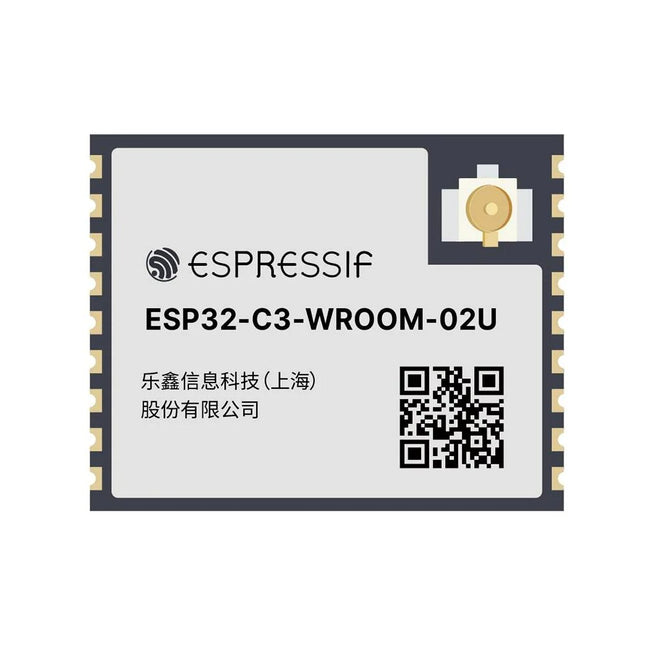
    Espressif ESP32-C3-WROOM-02U-N4

    ESP32-C3-WROOM-02U is a general-purpose Wi-Fi and Bluetooth LE module. The rich set of peripherals and high performance make the module an ideal choice for smart homes, industrial automation, health care, consumer electronics, etc. ESP32-C3-WROOM-02U features an external SPI flash and comes with a connector for an external antenna. ESP32-C3-WROOM-02U has an operating ambient temperature option of –40∼85°C, embedded with the ESP32-C3 chip. ESP32-C3 has a 32-bit RISC-V single-core processor. It integrates a rich set of peripherals, ranging from UART, I²C, I²S, remote control peripheral, LED PWM controller, general DMA controller, TWAI controller, USB Serial/JTAG controller, temperature sensor, ADC, etc. It also includes SPI, Dual SPI and Quad SPI interfaces. Features Flash: 4 MB (Quad SPI) Dimensions: 18.0 x 20.0 x 3.2 mm Downloads Datasheet

    € 7,95€ 3,95

    Members identical

The ESP32 is a chip designed for mobile, wearable electronics and Internet-of-Things (IoT) applications. It's packed with all the state-of-the-art low-power features you need, including clock gating, multiple power modes and dynamic power scaling.

Microcontroller with Wi-Fi and Bluetooth

The ESP32 is a highly integrated chip that combines Wi-Fi and Bluetooth capabilities with a powerful CPU and memory. It is ideal for applications that require low power consumption, such as sensors and wearable devices.

ESP32 offers two CPU cores that can be controlled separately, clocked up to 240 MHz, and each equipped with its own set of peripherals. In addition to the CPU cores, the ESP32 has a special Tensilica LX6 microprocessor for ultra-low power co-processing.

ESP32 module and applications

The ESP32 module can be used in different ways. The most popular ways to use the ESP32 in a project is:

ESP32 as Arduino compatible board

The ESP32 can be used as an Arduino compatible board. This means you can use the Arduino IDE to develop applications for the ESP32. The ESP offers users the ability to make WiFi and Bluetooth connections.

ESP32 as a standalone microcontroller

The ESP32 can also be used as a standalone microcontroller. This means you can develop applications for the ESP32 without using the Arduino IDE. The ESP32 is a good choice for many Internet of Things applications. The built-in WiFi and Bluetooth make it perfect for wireless applications.

Internet of Things projects with ESP32

The ESP32 is a great choice for many Internet of Things applications. The built-in WiFi and Bluetooth make it perfect for wireless applications. The ESP32 is also a very popular microcontroller for hobbyists. Some popular applications for the ESP32 are:

  • Home automation
  • IoT devices
  • Wearable electronics

Manual and books about ESP32

When you work with ESP modules for the first time, it is nice to receive an explanation so that you become familiar with the possibilities and projects with ESP32 technology. The Official ESP32 Book is a book that takes you step by step as a beginner. The Elektor ESP32 Smart Kit offers beginners everything they need to follow the projects in the book.

Login

Forgot password?

Don't have an account yet?
Create account