3D Printers

1 product

  •  -10% Voltera V - One Desktop PCB Printer - Elektor

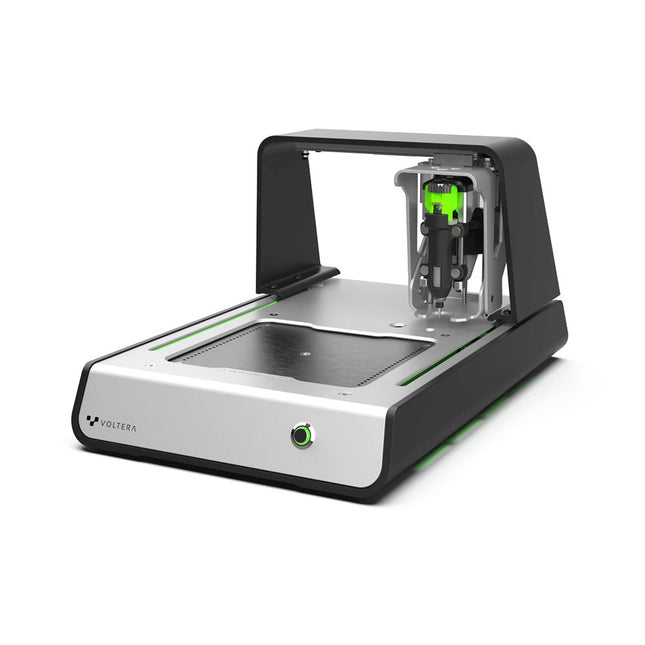
    Voltera Voltera V-One Desktop PCB Printer

    Out of stock

    Solder Paste Dispensing and Reflow All-in-One The Voltera V-One creates two-layer prototype circuit boards on your desk. Gerber files go in, printed circuit boards come out. The dispenser lays down a silver-based conductive ink to print your circuit right before your eyes. Assembling traditional and additive boards is easy with the V-One’s solder paste dispensing and reflow features. Simply mount your board on the print bed and import your Gerber file into Voltera’s software. No more stencils required Voltera’s software is designed to be understood easily. From importing your Gerber files to the moment you press print, the software safely walks you through each step. Compatible with EAGLE, Altium, KiCad, Mentor Graphics, Cadence, DipTrace, Upverter. Included V-One PCB printer V-One dispenser V-One probe Nozzle pack Tip caps 3 x 4" FR1 substrate pack 2 x 3" FR1 substrate pack Substrate clamps Thumbscrew pack Hello World kit Solder wire Tweezers Power supply Power adapter Cables User guides Downloads Specifications V-One Software Manuals Safety Datasheets Technical Datasheets Voltera CAM file for EAGLE Substrates and Templates More Info Frequently Asked Questions More from the Voltera community Technical Specifications Printing Specifications Minimum trace width 0.2 mm Minimum passive size 1005 Minimum pin-to-pin pitch (conductive ink) 0.8 mml Minimum pin-to-pin pitch (solder paste) 0.5 mml Resistivity 12 mΩ/sq @ 70 um height Substrate material FR4 Maximum board thickness 3 mm Soldering Specifications Solder paste alloy Sn42/Bi57.6/Ag0.4 Solder wire alloy SnBiAg1 Soldering iron temperature 180-210°C Print Bed Print area 135 x 113.5 mm Max. heated bed temperature 240°C Heated bed ramp rate ~2°C/s Footprint Dimensions 390 x 257 x 207 mm (L x W x H) Weight 7 kg Computing Requirements Compatible operating systems Windows 7 or higher, MacOS 10.11 or higher Compatible file format Gerber Connection type Wired USB Certification EN 61326-1:2013 EMC requirements IEC 61010-1 Safety requirements CE Marking Affixed to the Voltera V-One printers delivered to European customers Designed and assembled in Canada. More technical information Quickstart Explore Flexible Printed Electronics on the V-One Voltera V-One Capabilities Reel Voltera V-One PCB Printer Walkthrough Unpacking the V-One V-One: Solder Paste Dispensing and Reflow All-in-One Voltera @ Stanford University's Bao Research Group: Robotic Skin and Stretchable Sensors Voltera @ Princeton: The Future of Aerospace Innovation

    Out of stock

    € 5.499,00€ 4.949,00

    Members identical

What is 3D Printing? What are the advantages of a 3D Printer?

3D printing or additive manufacturing is the process of creating three-dimensional solid objects from a digital 3D printable model. In additive manufacturing, an object is made by laying down successive layers of material until an object is created. Each of these layers can be thought of as a thinly sliced cross-section of the object. This is the opposite of subtractive manufacturing, where a piece of metal or plastic is cut (e.g. with a milling machine).

The 3D printable model can be created with computer-aided design (CAD) software, via a 3D scanner, or with a digital camera used with photogrammetry software. 3D printed models made with CAD tend to have fewer errors than other methods, but there are many different software programs available, from industrial-grade to open-source.

With a 3D printer you can create complex shapes using less material than traditional manufacturing methods. In the past, the material used for this technology was polymer, but nowadays printing has also become possible for other materials, such as metals and ceramics. Furthermore, 3D printers have reached the level of quality and price that allows most people to enter the world of 3D printing.

What can you do with a 3D printer?

In this DIY era, more and more people are using 3D printers to make their own objects. The most common 3D printing materials are plastic and raw materials such as metal, graphite, and carbon fiber. That's why you can use a 3D printer to print items to order, including phone cases, miniatures, photo frames, and many other personalized items.

Which 3D printing applications does Elektor offer?

Elektor offers products from the well-known company Creality, such as the popular Ender-3 V2 3D Printer or the HALOT-ONE CL-60 Resin 3D Printer. The resin 3D printer is the ideal 3D printer for making small models with high detail and excellent quality. The level of resolution that a resin printer can bring is on another level. In addition to 3D printers, Elektor also sells a variety of filaments, such as the high-quality Creality CR-PLA filaments .

Why should you buy 3D printers and accessories from Elektor?

Elektor customers include electrical engineers, maker professionals, and electronics enthusiasts interested in 3D printing, electronics design, and general engineering. We stock a range of 3D printing products to meet the different needs of our customers.

Login

Forgot password?

Don't have an account yet?
Create account