Development Boards
-
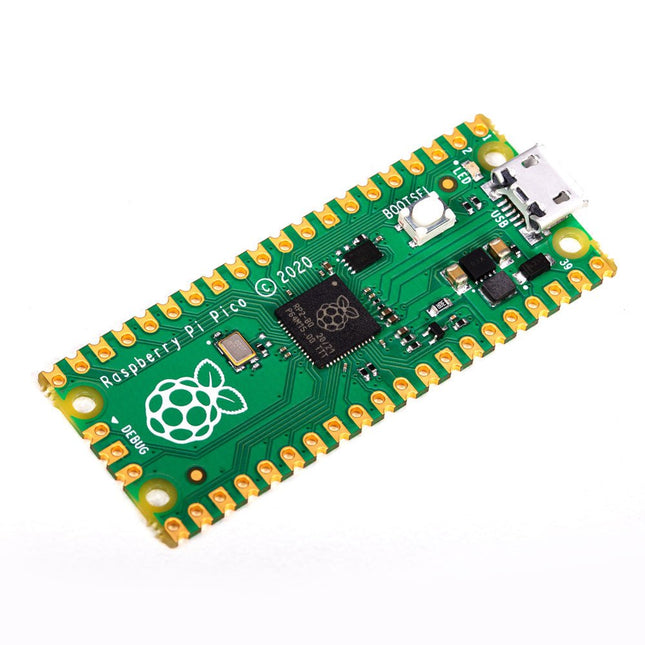
Raspberry Pi Foundation Raspberry Pi Pico
Specifications RP2040 microcontroller chip designed by Raspberry Pi in the UK Dual-core ARM Cortex M0+ processor, with a flexible clock running up to 133 MHz 264 kB SRAM, and 2 MB on-board Flash memory Castellated module allows soldering directly to carrier boards USB 1.1 host and device support Energy-efficient sleep and dormant modes Drag and drop programming using mass storage via USB 26x multifunction GPIO pins 2x SPI, 2x I²C, 2x UART, 3x 12-bit ADC, 16x controllable PWM channels On-chip accurate clock and timer Temperature sensor On-chip accelerated floating point libraries 8x programmable IO (PIO) state machines for custom peripherals Why a Raspberry Pi Pico? Designing your own microcontroller instead of buying an existing one brings a number of advantages. According to Raspberry Pi itself, not one of the existing products available for this comes close to their price/performance ratio. This Raspberry Pi Pico has also given Raspberry Pi the ability to add some innovative and powerful features of their own. These features are not available anywhere else. A third reason is that the Raspberry Pi Pico has given Raspberry Pi the ability to create powerful software around the product. Surrounding this software stack is an extensive documentation set. The software and documentation meet the high standard of Raspberry Pi's core products (such as the Raspberry Pi 400, Pi 4 Model B and Pi 3 Model A+). Who is this microcontroller for? The Raspberry Pi Pico is suitable for both advanced and novice users. From controlling a display to controlling many different devices that you use every day. Automating everyday operations is made possible by this technology. Beginner users The Raspberry Pi Pico is programmable in the C and MicroPython languages and is customizable for a wide range of devices. In addition, the Pico is as easy to use as dragging and dropping files. This makes this microcontroller ideally suited for the novice user. Advanced users For advanced users, it is possible to take advantage of the Pico's extensive peripherals. The peripherals include the SPI, I²C, and eight programmable I/O (PIO)-state machines. What makes the Raspberry Pi Pico unique? What's unique about the Pico is that it was developed by Raspberry Pi itself. The RP2040 features a dual-core Arm Cortex-M0+ processor with 264 KB of internal RAM and support for up to 16 MB of off-chip Flash. The Raspberry Pi Pico is unique for several reasons: The product has the highest price/quality ratio in the microcontroller board market. The Raspberry Pi Pico has been developed by Raspberry Pi itself. The software stack surrounding this product is of high quality and comes paired with a comprehensive documentation set.
-
Espressif ESP32-C3-DevKitM-1
ESP32-C3-DevKitM-1 is an entry-level development board based on ESP32-C3-MINI-1, a module named for its small size. This board integrates complete Wi-Fi and Bluetooth LE functions. Most of the I/O pins on the ESP32-C3-MINI-1 module are broken out to the pin headers on both sides of this board for easy interfacing. Developers can either connect peripherals with jumper wires or mount ESP32-C3-DevKitM-1 on a breadboard. Specifications ESP32-C3-MINI-1 ESP32-C3-MINI-1 is a general-purpose Wi-Fi and Bluetooth LE combo module that comes with a PCB antenna. At the core of this module is ESP32-C3FN4, a chip that has an embedded flash of 4 MB. Since flash is packaged in the ESP32-C3FN4 chip, rather than integrated into the module, ESP32-C3-MINI-1 has a smaller package size. 5 V to 3.3 V LDO Power regulator that converts a 5 V supply into a 3.3 V output. 5 V Power On LED Turns on when the USB power is connected to the board. Pin Headers All available GPIO pins (except for the SPI bus for flash) are broken out to the pin headers on the board. For details, please see Header Block. Boot Button Download button. Holding down Boot and then pressing Reset initiates Firmware Download mode for downloading firmware through the serial port. Micro-USB Port USB interface. Power supply for the board as well as the communication interface between a computer and the ESP32-C3FN4 chip. Reset Button Press this button to restart the system. USB-to-UART Bridge Single USB-UART bridge chip provides transfer rates up to 3 Mbps. RGB LED Addressable RGB LED, driven by GPIO 8. Downloads ESP32-C3 Datasheet ESP32-C3-MINI-1 Datasheet ESP32-C3-DevKitM-1 Schematic ESP32-C3-DevKitM-1 PCB Layout ESP32-C3-DevKitM-1 Dimensions
€ 19,95€ 9,95
Members identical
-
Nordic Semiconductor Nordic Semiconductor nRF52840 USB Dongle
The nRF52840 dongle is a small, low-cost USB dongle that supports Bluetooth 5.3, Bluetooth mesh, Thread, ZigBee, 802.15.4, ANT and 2.4 GHz proprietary protocols. The dongle is the perfect target hardware for use with nRF Connect for Desktop as it is low-cost but still support all the short range wireless standards used with Nordic devices. The dongle has been designed to be used as a wireless HW device together with nRF Connect for Desktop. For other use cases please do note that there is no debug support on the dongle, only support for programming the device and communicating through USB. It is supported by most of the nRF Connect for Desktop apps and will automatically be programmed if needed. In addition custom applications can be compiled and downloaded to the dongle. It has a user programmable RGB LED, a green LED, a user programmable button as well as 15 GPIO accessible from castellated solder points along the edge. Example applications are available in the nRF5 SDK under the board name PCA10059. The nRF52840 dongle is supported by nRF Connect for Desktop as well as programming through nRFUtil. Features Bluetooth 5.2 ready multiprotocol radio 2 Mbps Long Range Advertising Extensions Channel Selection Algorithm #2 (CSA #2) IEEE 802.15.4 radio support Thread ZigBee Arm Cortex-M4 with floating point support DSP instruction set ARM CryptoCell CC310 cryptographic accelerator 15 GPIO available via edge castellation USB interface direct to nRF52840 SoC Integrated 2.4 GHz PCB antenna 1 user-programmable button 1 user-programmable RGB LED 1 user-programmable LED 1.7-5.5 V operation from USB or external Downloads Datasheet Hardware Files
€ 19,95€ 9,95
Members identical
-
Arduino Arduino Uno Rev3
Arduino Uno is an open-source microcontroller board based on the ATmega328P. It has 14 digital input/output pins (of which 6 can be used as PWM outputs), 6 analog inputs, a 16 MHz ceramic resonator (CSTCE16M0V53-R0), a USB connection, a power jack, an ICSP header and a reset button. It contains everything needed to support the microcontroller; simply connect it to a computer with a USB cable or power it with a AC-to-DC adapter or battery to get started. You can tinker with your Uno without worring too much about doing something wrong, worst case scenario you can replace the chip for a few dollars and start over again. 'Uno' means one in Italian and was chosen to mark the release of Arduino Software (IDE) 1.0. The Uno board and version 1.0 of Arduino Software (IDE) were the reference versions of Arduino, now evolved to newer releases. The Uno board is the first in a series of USB Arduino boards, and the reference model for the Arduino platform; for an extensive list of current, past or outdated boards see the Arduino index of boards. Specifications Microcontroller ATmega328P Operating Voltage 5 V Input Voltage (recommended) 7-12 V Input Voltage (limit) 6-20 V Digital I/O Pins 14 (of which 6 provide PWM output) PWM Digital I/O Pins 6 Analog Input Pins 6 DC Current per I/O Pin 20 mA DC Current for 3.3 V Pin 50 mA Flash Memory 32 KB (ATmega328P) of which 0.5 KB used by bootloader SRAM 2 KB (ATmega328P) EEPROM 1 KB (ATmega328P) Clock Speed 16 MHz LED_BUILTIN 13 Dimensions 68.6 x 53.4 mm Weight 25 g
-
WIZnet WIZnet W5100S-EVB-Pico
Features RP2040 microcontroller with 2 MB Flash Dual-core cortex M0+ at up to 133 MHz 264 KB multi-bank high performance SRAM External Quad-SPI Flash with eXecute In Place (XIP) High performance full-crossbar bus fabric 30 multi-function General Purpose IO (4 can be used for ADC) 1.8-3.3 V IO Voltage (NOTE. Pico IO voltage is fixed at 3.3 V) 12-bit 500 ksps Analogue to Digital Converter (ADC) Various digital peripherals 2× UART, 2× I²C, 2× SPI, 16× PWM channels 1× Timer with 4 alarms, 1× Real Time Counter 2× Programmable IO (PIO) blocks, 8 state machines total Flexible, user-programmable high-speed IO Can emulate interfaces such as SD Card and VGA Includes W5100S Supports Hardwired Internet Protocols: TCP, UDP, WOL over UDP, ICMP, IGMPv1/v2, IPv4, ARP, PPPoE Supports 4 Independent Hardware SOCKETs simultaneously Internal 16 KB Memory for TX/ RX Buffers SPI Interface Micro-USB B port for power and data (and for reprogramming the Flash) 40 pin 21x51 'DIP' style 1mm thick PCB with 0.1' through-hole pins also with edge castellations 3-pin ARM Serial Wire Debug (SWD) port 10 / 100 Ethernet PHY embedded Supports Auto Negotiation Full / Half Duplex 10 / 100 Based Built-in RJ45 (RB1-125BAG1A) Built-in LDO (LM8805SF5-33V) Downloads RP2040 Datasheet W5100S Datasheet Schematic & Part list & Gerber File C/C++ Examples CircuitPython Examples
-
Espressif ESP32-S3-DevKitC-1U-N8R8
The ESP32-S3-DevKitC-1 is an entry-level development board equipped with ESP32-S3-WROOM-1U, a general-purpose Wi-Fi + Bluetooth Low Energy MCU module that integrates complete Wi-Fi and Bluetooth Low Energy functions. Most of the I/O pins on the module are broken out to the pin headers on both sides of this board for easy interfacing. Developers can either connect peripherals with jumper wires or mount ESP32-S3-DevKitC-1 on a breadboard. Features Module integrated: ESP32-S3-WROOM-1U-N8R8 Flash: 8 MB QD PSRAM: 8 MB OT SPI voltage: 3.3 V Specifications ESP32-S3-WROOM-1U ESP32-S3-WROOM-1U is a powerful, generic Wi-Fi + Bluetooth Low Energy MCU module that has a rich set of peripherals. It provides acceleration for neural network computing and signal processing workloads. ESP32-S3-WROOM-1U comes with an external antenna connector. 5 V to 3.3 V LDO Power regulator that converts a 5 V supply into a 3.3 V output. Pin Headers All available GPIO pins (except for the SPI bus for flash) are broken out to the pin headers on the board for easy interfacing and programming. USB-to-UART Port A Micro-USB port used for power supply to the board, for flashing applications to the chip, as well as for communication with the chip via the on-board USB-to-UART bridge. Boot Button Download button. Holding down Boot and then pressing Reset initiates Firmware Download mode for downloading firmware through the serial port. Reset Button Press this button to restart the system. USB Port ESP32-S3 full-speed USB OTG interface, compliant with the USB 1.1 specification. The interface is used for power supply to the board, for flashing applications to the chip, for communication with the chip using USB 1.1 protocols, as well as for JTAG debugging. USB-to-UART Bridge Single USB-to-UART bridge chip provides transfer rates up to 3 Mbps. RGB LED Addressable RGB LED, driven by GPIO38. 3.3 V Power On LED Turns on when the USB power is connected to the board. Downloads Pinout
-
Generic ESP32 Cheap Yellow Display Board
This development board (also known as "Cheap Yellow Display") is powered by the ESP-WROOM-32, a dual-core MCU with integrated Wi-Fi and Bluetooth capabilities. It operates at a main frequency of up to 240 MHz, with 520 KB SRAM, 448 KBROM, and a 4 MB Flash memory. The board features a 2.8-inch display with a resolution of 240x320 and resistive touch. Furthermore, the board includes a backlight control circuit, touch control circuit, speaker drive circuit, photosensitive circuit, and RGB-LED control circuit. It also provides a TF card slot, serial interface, DHT11 temperature and humidity sensor interface, and additional IO ports. The module supports development in Arduino IDE, ESP-IDE, MicroPython, and Mixly. Applications Image transmission for Smart Home device Wireless monitoring Smart agriculture QR wireless recognition Wireless positioning system signal And other IoT applications Specifications Microcontroller ESP-WROOM-32 (Dual-core MCU with integrated Wi-Fi and Bluetooth) Frequency Up to 240 MHz (computing power is up to 600 DMIPS) SRAM 520 KB ROM 448 KB Flash 4 MB Operating voltage 5 V Power consumption approx. 115 mA Display 2.8-inch color TFT screen (240x320) Touch Resistive Touch Driver chip ILI9341 Dimensions 50 x 86 mm Weight 50 g Included 1x ESP32 Dev Board with 2.8" Display and acrylic Shell 1x Touch pen 1x Connector cable 1x USB cable Downloads GitHub
€ 24,95
Members € 22,46
-
Pinecone Pinecone BL602 Evaluation Board
Features Build in USB to Serial interface Build-in PCB antenna Powered by Pineseed BL602 SoC using Pinenut model: 12S stamp 2 MB Flash USB-C connection Suitable to breadboard BIY project On board three color LEDs output Dimensions: 25.4 x 44.0 mm Note: USB cable is not included.
€ 8,95€ 4,50
Members identical
-
Ohmic PÚCA DSP ESP32 Development Board
PÚCA DSP is an open-source, Arduino-compatible ESP32 development board for audio and digital signal processing (DSP) applications with expansive audio-processing features. It provides audio inputs, audio outputs, a low-noise microphone array, an integrated test-speaker option, additional memory, battery-charge management, and ESD protection all on a small, breadboard-friendly PCB. Synthesizers, Installations, Voice UI, and More PÚCA DSP can be used for a wide range of DSP applications, including but not limited to those in the fields of music, art, creative technology, and adaptive technology. Music-related examples include digital-music synthesis, mobile recording, Bluetooth speakers, wireless line-level directional microphones, and the design of smart musical instruments. Art-related examples include acoustic sensor networks, sound-art installations, and Internet-radio applications. Examples related to creative and adaptive technology include voice user interface (VUI) design and Web audio for the Internet of Sounds. Compact, Integrated Design PÚCA DSP was designed for portability. When used with an external 3.7 V rechargeable battery, it can be deployed almost anywhere or integrated into just about any device, instrument, or installation. Its design emerged from months of experimentation with various ESP32 development boards, DAC breakout boards, ADC breakout boards, Microphone breakout boards, and audio-connector breakout boards, and – despite its diminutive size – it manages to provide all of that functionality in a single board. And it dos so without compromising signal quality. Specifications Processor & Memory Espressif ESP32 Pico D4 Processor 32-bit dual core 80 MHz / 160 MHz / 240 MHz 4 MB SPI Flash with 8 MB additional PSRAM (Original Edition) Wireless 2.4 GHz Wi-Fi 802.11b/g/n Bluetooth BLE 4.2 3D Antenna Audio Wolfson WM8978 Stereo Audio Codec Audio Line In on 3.5 mm stereo onnector Audio Headphone / Line Out on 3.5 mm stereo connector Stereo Aux Line In, Audio Mono Out routed to GPIO Header 2x Knowles SPM0687LR5H-1 MEMS Microphones ESD protection on all audio inputs and outputs Support for 8, 11.025, 12, 16, 22.05, 24, 32, 44.1 and 48 kHz sample rates 1 W Speaker Driver, routed to GPIO Header DAC SNR 98 dB, THD -84 dB (‘A’ weighted @ 48 kHz) ADC SNR 95 dB, THD -84 dB (‘A’ weighted @ 48 kHz) Line input impedance: 1 MOhm Line output impedance: 33 Ohm Form Factor and Connectivity Breadboard friendly 70 x 24 mm 11x GPIO pins broken out to 2.54 mm pitch header, with access to both ESP32 ADC channels, JTAG and capacitive touch pins USB 2.0 over USB Type C connector Power 3.7/4.2 V Lithium Polymer Rechargeable Battery, USB or external 5 V DC power source ESP32 and Audio Codec can be placed into low power modes under software control Battery voltage level detection ESD protection on USB data bus Downloads GitHub Datasheet Links Crowd Supply Campaign (includes FAQs) Hardware Overview Programming the Board The Audio Codec
€ 69,95€ 34,95
Members identical
-
Espressif ESP32-S2-Saola-1R Development Board
ESP32-S2-Saola-1R is a small-sized ESP32-S2 based development board. Most of the I/O pins are broken out to the pin headers on both sides for easy interfacing. Developers can either connect peripherals with jumper wires or mount ESP32-S2-Saola-1R on a breadboard.ESP32-S2-Saola-1R is equipped with the ESP32-S2-WROVER module, a powerful, generic Wi-Fi MCU module that has a rich set of peripherals. It is an ideal choice for a wide variety of application scenarios relating to Internet of Things (IoT), wearable electronics and smart home. The board a PCB antenna and features a 4 MB external SPI flash and an additional 2 MB SPI Pseudo static RAM (PSRAM).FeaturesMCU ESP32-S2 embedded, Xtensa® single-core 32-bit LX7 microprocessor, up to 240 MHz 128 KB ROM 320 KB SRAM 16 KB SRAM in RTC WiFi 802.11 b/g/n Bit rate: 802.11n up to 150 Mbps A-MPDU and A-MSDU aggregation 0.4 µs guard interval support Center frequency range of operating channel: 2412 ~ 2484 MHz Hardware Interfaces: GPIO, SPI, LCD, UART, I²C, I²S, Camera interface, IR, pulse counter, LED PWM, TWAI (compatible with ISO 11898-1), USB OTG 1.1, ADC, DAC, touch sensor, temperature sensor 40 MHz crystal oscillator 4 MB SPI flash Operating voltage/Power supply: 3.0 ~ 3.6 V Operating temperature range: –40 ~ 85 °C Dimensions: 18 × 31 × 3.3 mm Applications Generic Low-power IoT Sensor Hub Generic Low-power IoT Data Loggers Cameras for Video Streaming Over-the-top (OTT) Devices USB Devices Speech Recognition Image Recognition Mesh Network Home Automation Smart Home Control Panel Smart Building Industrial Automation Smart Agriculture Audio Applications Health Care Applications Wi-Fi-enabled Toys Wearable Electronics Retail & Catering Applications Smart POS Machines
€ 22,95€ 11,50
Members identical
-
Microchip Microchip AVR-IoT WA Development Board
The AVR-IoT WA development board combines a powerful ATmega4808 AVR MCU, an ATECC608A CryptoAuthentication secure element IC and the fully certified ATWINC1510 Wi-Fi network controller – which provides the most simple and effective way to connect your embedded application to Amazon Web Services (AWS). The board also includes an on-board debugger, and requires no external hardware to program and debug the MCU. Out of the box, the MCU comes preloaded with a firmware image that enables you to quickly connect and send data to the AWS platform using the on-board temperature and light sensors. Once you are ready to build your own custom design, you can easily generate code using the free software libraries in Atmel START or MPLAB Code Configurator (MCC). The AVR-IoT WA board is supported by two award-winning Integrated Development Environments (IDEs) – Atmel Studio and Microchip MPLAB X IDE – giving you the freedom to innovate with your environment of choice. Features ATmega4808 microcontroller Four user LED’s Two mechanical buttons mikroBUS header footprint TEMT6000 Light sensor MCP9808 Temperature sensor ATECC608A CryptoAuthentication™ device WINC1510 WiFi Module On-board Debugger Auto-ID for board identification in Atmel Studio and Microchip MPLAB X One green board power and status LED Programming and debugging Virtual COM port (CDC) Two DGI GPIO lines USB and battery powered Integrated Li-Ion/LiPo battery charger
€ 39,95€ 19,95
Members identical
-
SparkFun SparkFun RedBoard Qwiic
The SparkFun RedBoard Qwiic is an Arduino-compatible board that combines features of different Arduinos with the Qwiic Connect System. Features ATmega328 microcontroller with Optiboot Bootloader R3 Shield Compatible CH340C Serial-USB Converter 3.3 V to 5 V Voltage Level Jumper A4 / A5 Jumpers AP2112 Voltage Regulator ISP Header Input voltage: 7 V - 15 V 1 Qwiic Connector 16 MHz Clock Speed 32 k Flash Memory All SMD Construction Improved Reset Button
€ 27,95€ 13,95
Members identical
-
Farnell element14 OKdo E1 Development Board
The OKdo E1 is an ultra-low-cost Development Board based on the NXP LPC55S69JBD100 dual-core Arm Cortex-M33 microcontroller. The E1 board is perfect for Industrial IoT, building control and automation, consumer electronics, general embedded and secure applications. Features Processor with Arm TrustZone, Floating Point Unit (FPU) and Memory Protection Unit (MPU) CASPER Crypto co-processor to enable hardware acceleration for certain asymmetric cryptographic algorithms PowerQuad Hardware Accelerator for fixed and floating point DSP functions SRAM Physical Unclonable Function (PUF) for key generation, storage and reconstruction PRINCE module for real-time encryption and decryption of flash data AES-256 and SHA2 engines Up to Nine Flexcomm interfaces. Each Flexcomm interface can be selected by software to be a USART, SPI, I²C, and I²S interface USB 2.0 High-Speed Host/Device controller with on-chip PHY USB 2.0 Full-Speed Host/Device controller with on-chip PHY Up to 64 GPIOs Secure digital input/output (SD/MMC and SDIO) card interface Specifications LPC55S69JBD100 640kbyte flash microcontroller In-built CMSIS-DAP v1.0.7 debugger based on LPC11U35 Internal PLL support up to 100MHz operation, 16MHz can be mounted for full 150MHz operation. SRAM 320kB 32kHz crystal for real-time clock 4 user switches 3-colour LED User USB connector 2-off 16-way expansion connectors UART over USB virtual COM port
€ 24,95€ 12,50
Members identical
-
Luckfox LuckFox Pico Mini B Linux Micro Development Board (with Headers)
LuckFox Pico Mini is a compact Linux micro development board based on the Rockchip RV1103 chip, providing a simple and efficient development platform for developers. It supports a variety of interfaces, including MIPI CSI, GPIO, UART, SPI, I²C, USB, etc., which is convenient for quick development and debugging. Features Single-core ARM Cortex-A7 32-bit core with integrated NEON and FPU Built-in Rockchip self-developed 4th generation NPU, features high computing precision and supports int, int8, and int16 hybrid quantization. The computing power of int8 is 0.5 TOPS, and up to 1.0 TOPS with int4 Built-in self-developed third-generation ISP3.2, supports 4-Megapixel, with multiple image enhancement and correction algorithms such as HDR, WDR, multi-level noise reduction, etc. Features powerful encoding performance, supports intelligent encoding mode and adaptive stream saving according to the scene, saves more than 50% bit rate of the conventional CBR mode so that the images from camera are high-definition with smaller size, double the storage space Built-in RISC-V MCU supports low power consumption and fast start-up, supports 250 ms fast picture capture and loading Al model library at the same time to realize face recognition "in one second" Built-in 16-bit DRAM DDR2, which is capable of sustaining demanding memory bandwidths Integrated with built-in POR, audio codec and MAC PHY Specifications Processor ARM Cortex-A7, single-core 32-bit CPU, 1.2 GHz, with NEON and FPU NPU Rockchip 4th-gen NPU, supports int4, int8, int16; up to 1.0 TOPS (int4) ISP Third-gen ISP3.2, up to 4 MP input at 30fps, HDR, WDR, noise reduction RAM 64 MB DDR2 Storage 128 MB SPI NAND Flash USB USB 2.0 Host/Device via Type-C Camera Interface MIPI CSI 2-lane GPIO Pins 17 GPIO pins Power Consumption Low power, RISC-V MCU for fast startup Dimensions 28 x 21 mm Downloads Wiki
€ 19,95€ 9,95
Members identical
-
Waveshare QuecPython EC200U-EU C4-P01 Development Board
The EC200U-EU C4-P01 development board features the EC200U-EU LTE Cat 1 wireless communication module, offering a maximum data rate of up to 10 Mbps for downlink and 5 Mbps for uplink. It supports multi-mode and multi-band communication, making it a cost-effective solution. The board is designed in a compact and unified form factor, compatible with the Quectel multi-mode LTE Standard EC20-CE. It includes an onboard USB-C port, allowing for easy development with just a USB-C cable. Additionally, the board is equipped with a 40-pin GPIO header that is compatible with most Raspberry Pi HATs. Features Equipped with EC200U-EU LTE Cat 1 wireless communication module, multi-mode & multi-band support Onboard 40-Pin GPIO header, compatible with most Raspberry Pi HATs 5 LEDs for indicating module operating status Supports TCP, UDP, PPP, NITZ, PING, FILE, MQTT, NTP, HTTP, HTTPS, SSL, FTP, FTPS, CMUX, MMS protocols, etc. Supports GNSS positioning (GPS, GLONASS, BDS, Galileo, QZSS) Onboard Nano SIM card slot and eSIM card slot, dual card single standby Onboard MIPI connector for connecting MIPI screen and is fully compatible with Raspberry Pi peripherals Onboard camera connector, supports customized SPI cameras with a maximum of 300,000 pixels Provides tools such as QPYcom, Thonny IDE plugin, and VSCode plugin, etc. for easy learning and development Comes with online development resources and manual (example in QuecPython) Specifications Applicable Regions Europe, Middle East, Africa, Australia, New Zealand, Brazil LTE-FDD B1, B3, B5, B7, B8, B20, B28 LTE-TDD B38, B40, B41 GSM / GPRS / EDGE GSM: B2, B3, B5, B8 GNSS GPS, GLONASS, BDS, Galileo, QZSS Bluetooth Bluetooth 4.2 (BR/EDR) Wi-Fi Scan 2.4 GHz 11b (Rx) CAT 1 LTE-FDD: DL 10 Mbps; UL 5 Mbps LTE-TDD: DL 8.96 Mbps; UL 3.1 Mbps GSM / GPRS / EDGE GSM: DL 85.6 Kbps; UL 85.6 Kbps USB-C Port Supports AT commands testing, GNSS positioning, firmware upgrading, etc. Communication Protocol TCP, UDP, PPP, NITZ, PING, FILE, MQTT, NTP, HTTP, HTTPS, SSL, FTP, FTPS, CMUX, MMS SIM Card Nano SIM and eSIM, dual card single standby Indicator P01: Module Pin 1, default as EC200A-XX PWM0 P05: Module Pin 5, NET_MODE indicator SCK1: SIM1 detection indicator, lights up when SIM1 card is inserted SCK2: SIM2 detection indicator, lights up when SIM2 card is inserted PWR: Power indicator Buttons PWK: Power ON/OFF RST: Reset BOOT: Forcing into firmware burning mode USB ON/OFF: USB power consumption detection switch Antenna Connectors LTE main antenna + DIV / WiFi (scanning only) / Bluetooth antenna + GNSS antenna Operating Temperature −30~+75°C Storage Temperature −45~+90°C Downloads Wiki Quectel Resources
€ 69,95€ 34,95
Members identical
-
milkV Milk-V Duo 256M RISC-V Singe-board Computer
The Milk-V Duo 256M is an ultra-compact embedded development platform based on the SG2002 chip. It can run Linux and RTOS, providing a reliable, low-cost, and high-performance platform for professionals, industrial ODMs, AIoT enthusiasts, DIY hobbyists, and creators. This board is an upgraded version of Duo with a memory boost to 256M, catering to applications demanding larger memory capacities. The SG2002 elevates computational power to 1.0 TOPS @ INT8. It enables seamless switching between RISC-V/ARM architectures and supports simultaneous operation of dual systems. Additionally, it includes an array of rich GPIO interfaces such as SPI, UART, suitable for a wide range of hardware development in edge intelligent monitoring, including IP cameras, smart peephole locks, visual doorbells, and more. SG2002 is a high-performance, low-power chip designed for various product fields such as edge intelligent surveillance IP cameras, smart door locks, visual doorbells, and home intelligence. It integrates H.264 video compression and decoding, H.265 video compression encoding, and ISP capabilities. It supports multiple image enhancement and correction algorithms such as HDR wide dynamic range, 3D noise reduction, defogging, and lens distortion correction, providing customers with professional-grade video image quality. The chip also incorporates a self-developed TPU, delivering 1.0 TOPS of computing power under 8-bit integer operations. The specially designed TPU scheduling engine efficiently provides high-bandwidth data flow for all tensor processing unit cores. Additionally, it offers users a powerful deep learning model compiler and software SDK development kit. Leading deep learning frameworks like Caffe and Tensorflow can be easily ported to its platform. Furthermore, it includes security boot, secure updates, and encryption, providing a series of security solutions from development, mass production, to product applications. The chip integrates an 8-bit MCU subsystem, replacing the typical external MCU to achieve cost-saving and power efficiency goals. Specifications SoC SG2002 RISC-V CPU C906 @ 1 Ghz + C906 @ 700 MHz Arm CPU 1x Cortex-A53 @ 1 GHz MCU 8051 @ 6 KB SRAM Memory 256 MB SIP DRAM TPU 1.0 TOPS @ INT8 Storage 1x microSD connector or 1x SD NAND on board USB 1x USB-C for power and data, USB Pads available CSI 1x 16P FPC connector (MIPI CSI 2-lane) Sensor Support 5 M @ 30 fps Ethernet 100 Mbps Ethernet with PHY Audio Via GPIO Pads GPIO Up to 26x GPIO Pads Power 5 V/1 A OS Support Linux, RTOS Dimensions 21 x 51 mm Downloads Documentation GitHub
€ 32,95€ 16,50
Members identical
-
Luckfox LuckFox Pico Ultra Linux Micro Development Board
The LuckFox Pico Ultra is a compact single-board computer (SBC) powered by the Rockchip RV1106G3 chipset, designed for AI processing, multimedia, and low-power embedded applications. It comes equipped with a built-in 1 TOPS NPU, making it ideal for edge AI workloads. With 256 MB RAM, 8 GB onboard eMMC storage, integrated WiFi, and support for the LuckFox PoE module, the board delivers both performance and versatility across a wide range of use cases. Running Linux, the LuckFox Pico Ultra supports a variety of interfaces – including MIPI CSI, RGB LCD, GPIO, UART, SPI, I²C, and USB – providing a simple and efficient development platform for applications in smart home, industrial control, and IoT. Specifications Chip Rockchip RV1106G3 Processor Cortex-A7 1.2 GHz Neural Network Processor (NPU) 1 TOPS, supports int4, int8, int16 Image Processor (ISP) Max input 5M @30fps Memory 256 MB DDR3L WiFi + Bluetooth 2.4GHz WiFi-6 Bluetooth 5.2/BLE Camera Interface MIPI CSI 2-lane DPI Interface RGB666 PoE Interface IEEE 802.3af PoE Speaker interface MX1.25 mm USB USB 2.0 Host/Device GPIO 30 GPIO pins Ethernet 10/100M Ethernet controller and embedded PHY Default Storage Medium eMMC (8 GB) Included 1x LuckFox Pico Ultra W 1x LuckFox PoE module 1x IPX 2.4G 2 db antenna 1x USB-A to USB-C cable 1x Screws pack Downloads Wiki
€ 39,95€ 19,95
Members identical
-
NXP Semiconductors NXP FRDM-MCXN947 Development Board
The FRDM-MCXN947 is a compact and versatile development board designed for rapid prototyping with MCX N94 and N54 microcontrollers. It features industry-standard headers for easy access to the MCU's I/Os, integrated open-standard serial interfaces, external flash memory, and an onboard MCU-Link debugger. Specifications Microcontroller MCX-N947 Dual Arm Cortex-M33 cores @ 150 MHz each with optimized performance efficiency, up to 2 MB dual-bank flash with optional full ECC RAM, External flash Accelerators: Neural Processing Unit, PowerQuad, Smart DMA, etc. Memory Expansion *DNP Micro SD card socket Connectivity Ethernet Phy and connector HS USB-C connectors SPI/I²C/UART connector (PMOD/mikroBUS, DNP) WiFi connector (PMOD/mikroBUS, DNP) CAN-FD transceiver Debug On-board MCU-Link debugger with CMSIS-DAP JTAG/SWD connector Sensor P3T1755 I³C/I²C Temp Sensor, Touch Pad Expansion Options Arduino Header (with FRDM expansion rows) FRDM Header FlexIO/LCD Header SmartDMA/Camera Header Pmod *DNP mikroBUS User Interface RGB user LED, plus Reset, ISP, Wakeup buttons Included 1x FRDM-MCXN947 Development Board 1x USB-C Cable 1x Quick Start Guide Downloads Datasheet Block diagram
€ 29,95€ 14,95
Members identical
-
SparkFun SparkFun RP2040 mikroBUS Development Board
The SparkFun RP2040 mikroBUS Development Board is a low-cost, high performance platform with flexible digital interfaces featuring the Raspberry Pi Foundation's RP2040 microcontroller. Besides the Thing Plus or Feather PTH pin layout, the board also includes a microSD card slot, 16 MB (128 Mbit) flash memory, a JST single cell battery connector (with a charging circuit and fuel gauge sensor), an addressable WS2812 RGB LED, JTAG PTH pins, four (4-40 screw) mounting holes, our signature Qwiic connectors, and a mikroBUS socket. The mikroBUS standard was developed by MikroElektronika. Similar to Qwiic and MicroMod interfaces, the mikroBUS socket provides a standardized connection for add-on Click boards to be attached to a development board and is comprised of a pair of 8-pin female headers with a standardized pin configuration. The pins consist of three groups of communications pins (SPI, UART and I²C), six additional pins (PWM, Interrupt, Analog input, Reset and Chip select), and two power groups (3.3 V and 5 V). The RP2040 is supported with both C/C++ and MicroPython cross-platform development environments, including easy access to runtime debugging. It has UF2 boot and floating-point routines baked into the chip. While the chip has a large amount of internal RAM, the board includes an additional 16 MB of external QSPI flash memory to store program code. The RP2040 contains two ARM Cortex-M0+ processors (up to 133 MHz) and features: 264 kB of embedded SRAM in six banks 6 dedicated IO for SPI Flash (supporting XIP) 30 multifunction GPIO: Dedicated hardware for commonly used peripherals Programmable IO for extended peripheral support Four 12-bit ADC channels with internal temperature sensor (up to 0.5 MSa/s) USB 1.1 Host/Device functionality Features (SparkFun RP2040 mikroBUS Dev. Board) Raspberry Pi Foundation's RP2040 microcontroller 18 Multifunctional GPIO Pins Four available 12-bit ADC channels with internal temperature sensor (500kSa/s) Up to eight 2-channel PWM Up to two UARTs Up to two I²C buses Up to two SPI buses Thing Plus (or Feather) Pin Layout: 28 PTH Pins USB-C Connector: USB 1.1 Host/Device functionality 2-pin JST Connector for a LiPo Battery (not included): 500mA charging circuit 4-pin JST Qwiic Connector LEDs: PWR - Red 3.3V power indicator CHG - Yellow battery charging indicator 25 - Blue status/test LED (GPIO 25) WS2812 - Addressable RGB LED (GPIO 08) Buttons: Boot Reset JTAG PTH Pins 16MB QSPI Flash Memory µSD Card Slot mikroBUS Socket Dimensions: 3.7' x 1.2' Four Mounting Holes: 4-40 screw compatible Downloads Schematic Eagle Files Board Dimensions Hookup Guide Qwiic Info Page GitHub Hardware Repository
€ 19,95€ 9,95
Members identical
-
Heltec Automation CubeCell HTCC-AB02S LoRa Development Board with GPS (EU868)
The CubeCell series is designed primarily for LoRa/LoRaWAN node applications. Built on the ASR605x platform (ASR6501, ASR6502), these chips integrate the PSoC 4000 series MCU (ARM Cortex-M0+ Core) with the SX1262 module. The CubeCell series offers seamless Arduino compatibility, stable LoRaWAN protocol operation, and straightforward connectivity with lithium batteries and solar panels. The HTCC-AB02S is a developer-friendly board with an integrated AIR530Z GPS module, ideal for quickly testing and validating communication solutions. Features Arduino compatible Based on ASR605x (ASR6501, ASR6502), those chips are already integrated the PSoC 4000 series MCU (ARM Cortex M0+ Core) and SX1262 LoRaWAN 1.0.2 support Ultra low power design, 21 uA in deep sleep Onboard SH1.25-2 battery interface, integrated lithium battery management system (charge and discharge management, overcharge protection, battery power detection, USB/battery power automatic switching) Good impendence matching and long communication distance Onboard solar energy management system, can directly connect with a 5.5~7 V solar panel Micro USB interface with complete ESD protection, short circuit protection, RF shielding, and other protection measures Integrated CP2102 USB to serial port chip, convenient for program downloading, debugging information printing Onboard 0.96-inch 128x64 dot matrix OLED display, which can be used to display debugging information, battery power, and other information Using Air530 GPS module with GPS/Beidou Dual-mode position system support Specifications Main Chip ASR6502 (48 MHz ARM Cortex-M0+ MCU) LoRa Chipset SX1262 Frequency 863~870 MHz Max. TX Power 22 ±1 dBm Max. Receiving Sensitivity −135 dBm Hardware Resource 2x UART1x SPI2x I²C1x SWD3x 12-bit ADC input8-channel DMA engine16x GPIO Memory 128 Kb FLASH16 Kb SRAM Power consumption Deep sleep 21 uA Interfaces 1x Micro USB1x LoRa Antenna (IPEX)2x (15x 2.54 Pin header) + 3x (2x 2.54 Pin header) Battery 3.7 V lithium battery (power supply and charging) Solar Energy VS pin can be connected to 5.5~7 V solar panel USB to Serial Chip CP2102 Display 0.96" OLED (128 x 64) Operating temperature −20~70°C Dimensions 55.9 x 27.9 x 9.5 mm Included 1x CubeCell HTCC-AB02S Development Board 1x Antenna 1x 2x SH1.25 battery connector Downloads Datasheet Schematic GPS module (Manual) Quick start GitHub
€ 49,95€ 24,95
Members identical
-
Velleman Velleman ATmega328 Uno Development Board
The ATmega328 Uno Development Board (Arduino Uno compatible) is a microcontroller board based on the ATmega328. It has 14 digital input/output pins (of which 6 can be used as PWM outputs), 6 analogue inputs, a 16 MHz ceramic resonator, a USB connection, a power jack, an ICSP header and a reset button. It contains everything needed to support the microcontroller; connect it to a computer with a USB cable or power it with a AC-to-DC adapter or battery to get started. Specifications Microcontroller ATmega328 Operating voltage 5 V DC Input voltage (recommended) 7-12 V DC Input voltage (limits) 6-20 V DC Digital I/O pins 14 (of which 6 provide PWM output) Analogue input pins 6 SRAM 2 kB (ATmega328) EEPROM 1 kB (ATmega328) Flash memory 32 kB (ATmega328) of which 0.5 kB used by bootloader Clock speed 16 MHz Downloads Manual
€ 22,95€ 11,50
Members identical
-
Arduino Arduino MKR NB 1500
Arduino MKR NB 1500 allows you to build your next smart project. Ever wanted an automated house? Or a smart garden? Well, now it’s easy with the Arduino IoT Cloud compatible boards. It means: you can connect devices, visualize data, control and share your projects from anywhere in the world. Whether you’re a beginner or a pro, we have a wide range of plans to make sure you get the features you need. Add Narrowband communication to your project with the MKR NB 1500. It's the perfect choice for devices in remote locations without an Internet connection, or in situations in which power isn't available like on-field deployments, remote metering systems, solar-powered devices, or other extreme scenarios. The board's main processor is a low power ARM Cortex-M0 32-bit SAMD21, like in the other boards within the Arduino MKR family. The Narrowband connectivity is performed with a module from u-blox, the SARA-R410M-02B, a low power chipset operating in the de different bands of the IoT LTE cellular range. On top of those, secure communication is ensured through the Microchip ECC508 crypto chip. Besides that, the pcb includes a battery charger, and a connector for an external antenna. This board is designed for global use, providing connectivity on LTE's Cat M1/NB1 bands 1, 2, 3, 4, 5, 8, 12, 13, 18, 19, 20, 25, 26, 28. Operators offering service in that part of the spectrum include: Vodafone, AT&T, T-Mobile USA, Telstra, and Verizon, among others. Specifications The Arduino MKR NB 1500 is based on the SAMD21 microcontroller. Microcontroller SAMD21 Cortex-M0+ 32-bit low power ARM MCU (datasheet) Radio module u-blox SARA-R410M-02B (datasheet summary) Secure element ATECC508 (datasheet) Board power supply (USB/VIN) 5 V Supported battery Li-Po Single Cell, 3.7 V, 1500 mAh Minimum Circuit operating voltage 3.3 V Digital I/O pins 8 PWM pins 13 (0 .. 8, 10, 12, 18 / A3, 19 / A4) UART 1 SPI 1 I²C 1 Analog input pins 7 (ADC 8/10/12 bit) Analog output pins 1 (DAC 10 bit) External interrupts 8 (0, 1, 4, 5, 6, 7, 8, 16 / A1, 17 / A2) DC current per I/O pin 7 mA Flash memory 256 KB (internal) SRAM 32 KB EEPROM No Clock speed 32.768 kHz (RTC), 48 MHz LED_BUILTIN 6 USB Full-speed USB device and embedded host Antenna gain 2 dB Carrier frequency LTE bands 1, 2, 3, 4, 5, 8, 12, 13, 18, 19, 20, 25, 26, 28 Power class (radio) LTE Cat M1 / NB1: Class 3 (23 dBm) Data rate (LTE M1 halp-duplex) UL 375 kbps / DL 300 kbps Data rate (LTE NB1 full-duplex) UL 62.5 kbps / DL 27.2 kbps Working region Multiregion Device location GNSS via modem Power consumption (LTE M1) min 100 mA / max 190 mA Power consumption (LTE NB1) min 60 mA / max 140 mA SIM card MicroSIM (not included with the board) Dimensions 67.6 x 25 mm Weight 32 g Downloads Eagle Files Schematics Pinout
€ 94,95€ 47,50
Members identical
-
Arduino Arduino MKR Zero
The Arduino MKR Zero is a development board for music makers! With an SD card holder and dedicated SPI interfaces (SPI1), you are able to play music files without extra hardware. The MKR Zero brings you the power of a Zero in the smaller format established by the MKR form factor. The MKR Zero board acts as a great educational tool for learning about 32-bit application development. It has an on-board SD connector with dedicated SPI interfaces (SPI1) that allows you to play with MUSIC files with no extra hardware! The board is powered by Atmel’s SAMD21 MCU, which features a 32-bit ARM Cortex M0+ core. The board contains everything needed to support the microcontroller; simply connect it to a computer with a micro-USB cable or power it by a LiPo battery. The battery voltage can also be monitored since a connection between the battery and the analog converter of the board exists. Specifications Microcontroller SAMD21 ARM Cortex-M0+ 32-bit low power Board power supply (USB/VIN) 5 V Supported battery Li-Po single cell, 3.7 V, 700 mAh minimum DC current for 3.3 V pin 600 mA DC current for 5 V pin 600 mA Circuit operating voltage 3.3 V Digital I/O pins 22 PWM pins 12 (0, 1, 2, 3, 4, 5, 6, 7, 8, 10, A3 - or 18 -, A4 -or 19) UART 1 SPI 1 I²C 1 Analog input pins 7 (ADC 8/10/12 bit) Analog output pins 1 (DAC 10 bit) External interrupts 10 (0, 1, 4, 5, 6, 7, 8, A1 -or 16-, A2 - or 17) DC current per I/O pin 7 mA Flash memory 256 KB Flash memory for bootloader 8 KB SRAM 32 KB EEPROM No Clock speed 32.768 kHz (RTC), 48 MHz LED_BUILTIN 32 Downloads Datasheet Eagle Files Schematics Fritzing Pinout
€ 36,95€ 18,50
Members identical
-
Arduino Arduino Pro Portenta Cat-M1 NB-IoT GNSS Shield
The Arduino Pro Portenta Cat. M1/NB IoT GNSS Shield allows you to enhance the connectivity features of your Portenta H7 applications. The shield leverages a Cinterion TX62 wireless module by Thales, designed for highly efficient, low-power IoT applications to deliver optimized bandwidth and performance. The Portenta Cat. M1/NB IoT GNSS Shield combines with the strong edge computing power of the Portenta H7 to enable the development of asset tracking and remote monitoring applications in industrial settings, as well as in agriculture, public utilities and smart cities. The shield offers cellular connectivity to both Cat. M1 and NB-IoT networks with the option to use eSIM technology. Easily track your valuables – across the city or worldwide – with your choice of GPS, GLONASS, Galileo or BeiDou. Features Change connectivity capabilities without changing the board Add NB-IoT, CAT. M1 and positioning to any Portenta product Possibility to create a small multiprotocol router (WiFi - BT + NB-IoT/CAT. M1) Greatly reduce communication bandwidth requirements in IoT applications Low-power module Compatible also with MKR boards Remote Monitoring Industrial and agricultural companies can leverage the Portenta Cat. M1/NB IoT GNSS Shield to remotely monitor gas detectors, optical sensors, machinery alarm systems, biological bug traps and more. Technology providers providing smart city solutions can compound the power and reliability of the Portenta H7 with the Portenta Cat. M1/NB IoT GNSS Shield, to connect data and automate actions for a truly optimized use of resources and enhanced user experience. Asset Monitoring Add monitoring capabilities to any asset by combining the performance and edge computing features of the Portenta family boards. The Portenta Cat. M1/NB IoT GNSS Shield is ideal to monitor valuable goods and also for monitoring industrial machinery and equipment. Specifications Connectivity Cinterion TX62 wireless module; NB-IoT - LTE CAT.M1; 3GPP Rel.14 Compliant Protocol LTE Cat. M1/NB1/NB2; UMTS BANDS: 1 / 2 / 3 / 4 / 5 / 8 / 12(17) / 13 / 18 / 19 / 20 / 25 / 26 / 27 / 28 / 66 / 71 / 85; LTE Cat.M1 DL: max. 300 kbps, UL: max. 1.1 Mbps; LTE Cat.NB1 DL: max. 27 kbps, UL: max. 63 kbps; LTE Cat.NB2 DL: max. 124 kbps, UL: max. 158 kbps Short messaging service (SMS) Point-to-point mobile terminated (MT) and mobile originated (MO) Text Mode; Protocol Data Unit (PDU) Mode Localization support GNSS capability (GPS/BeiDou/Galileo/GLONASS) Other Embedded IPv4 and IPv6 TCP/IP stack access; Internet Services: TCP server/client, UDP client, DNS, Ping, HTTP client, FTP client, MQTT client Secure Connection with TLS/DTLS Secure boot Dimensions 66 x 25.4 mm Operating temperature -40° C to +85° C (-104° F to 185°F) Downloads Datasheet Schematics
€ 99,95€ 49,95
Members identical