
Search results for "the OR three OR fives OR 555 OR discrete OR timer OR kit"
-
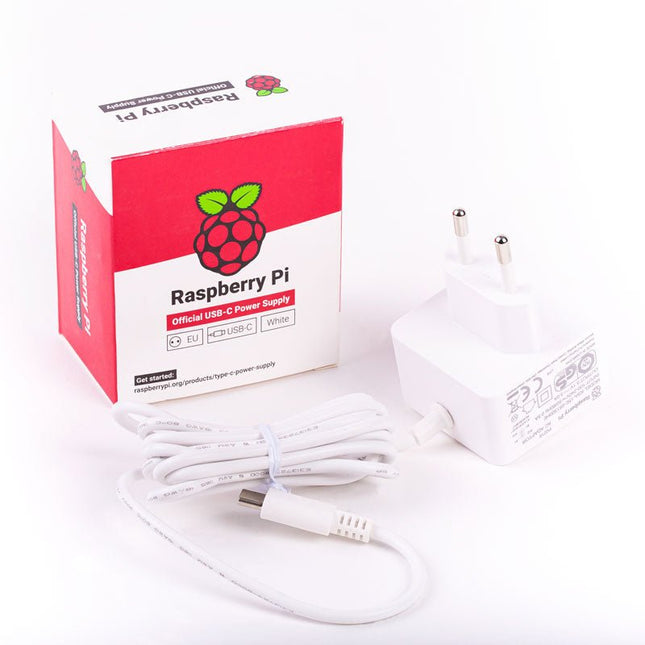
Raspberry Pi Foundation Official EU Power Supply for Raspberry Pi 4 (white)
The Raspberry Pi USB-C power supply is designed specifically to power the Raspberry Pi 4. The power supply features a USB-C cable and is available in four different models to suit different international power sockets, and in two colors. Specifications Output Output voltage +5.1 V DC Minimum load current 0 A Nominal load current 3.0 A Maximum power 15.3 W Load regulation ±5% Line regulation ±2% Ripple & noise 120 mVp-p Rise time 100 ms maximum to regulation limits for DC outputs Turn-on delay 3000 ms maximum at nominal input AC voltage and full load Protection Short circuit protectionOvercurrent protectionOver temperature protection Efficiency 81% minimum (output current from 100%, 75%, 50%, 25%)72% minimum at 10% load Output cable 1.5 m 18AWG Output connector USB-C Input Voltage range 100-240 V AC (rated)96-264 V AC (operating) Frequency 50/60 Hz ±3 Hz Current 0.5 A maximum Power consumption (no load) 0.075 W maximum Inrush current No damage shall occur, and the input fuse shall not blow Operating ambient temperature 0-40°C
-
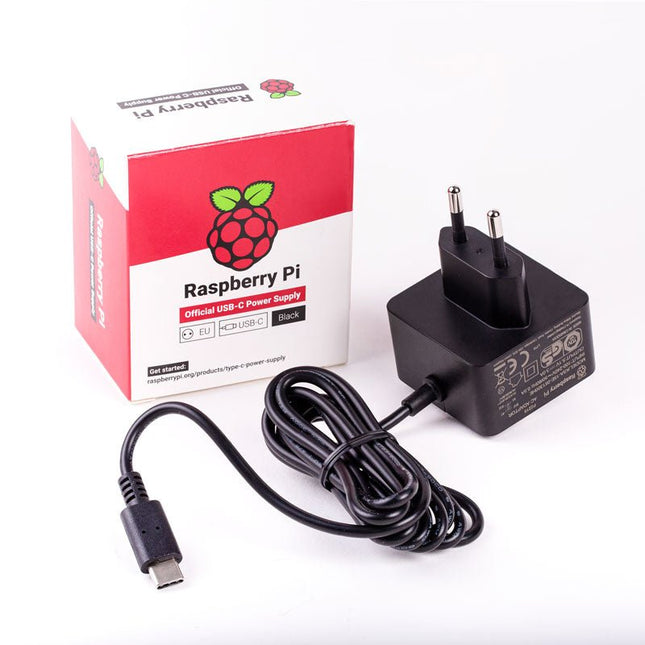
Raspberry Pi Foundation Official EU Power Supply for Raspberry Pi 4 (black)
The Raspberry Pi USB-C power supply is designed specifically to power the Raspberry Pi 4. The power supply features a USB-C cable and is available in four different models to suit different international power sockets, and in two colors. Specifications Output Output voltage +5.1 V DC Minimum load current 0 A Nominal load current 3.0 A Maximum power 15.3 W Load regulation ±5% Line regulation ±2% Ripple & noise 120 mVp-p Rise time 100 ms maximum to regulation limits for DC outputs Turn-on delay 3000 ms maximum at nominal input AC voltage and full load Protection Short circuit protectionOvercurrent protectionOver temperature protection Efficiency 81% minimum (output current from 100%, 75%, 50%, 25%)72% minimum at 10% load Output cable 1.5 m 18AWG Output connector USB-C Input Voltage range 100-240 V AC (rated)96-264 V AC (operating) Frequency 50/60 Hz ±3 Hz Current 0.5 A maximum Power consumption (no load) 0.075 W maximum Inrush current No damage shall occur, and the input fuse shall not blow Operating ambient temperature 0-40°C
-
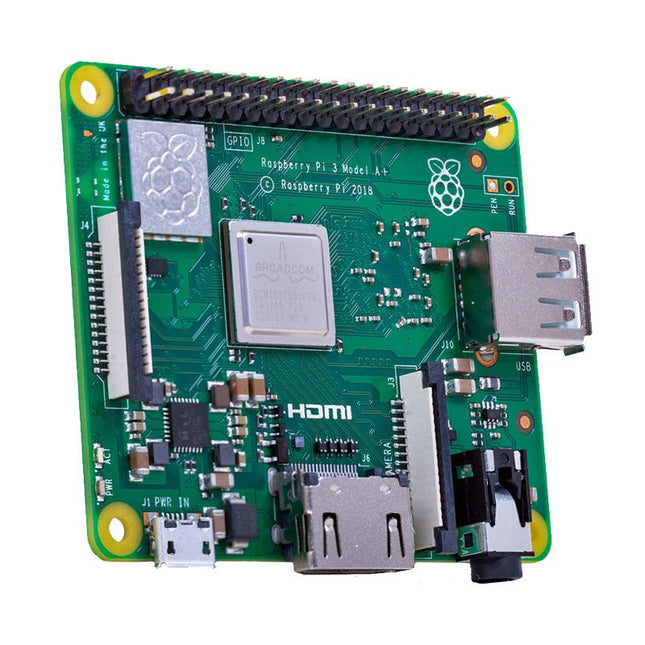
Raspberry Pi Foundation Raspberry Pi 3 A+
Like the Raspberry Pi 3 B+, the Raspberry Pi 3 A+ boasts a 64-bit quad-core processor running at 1.4 GHz, dual-band 2.4 GHz and 5 GHz wireless LAN, and Bluetooth 4.2/BLE. The dual-band wireless LAN comes with modular compliance certification, allowing the board to be designed into end products with significantly reduced wireless LAN compliance testing, improving both cost and time to market. The Raspberry Pi 3 A+ has the same mechanical footprint as the Raspberry Pi 1 A+. Specifications Processor Broadcom BCM2837B0, Cortex-A5364-bit SoC @ 1.4 GHz Memory 512 MB LPDDR2 SDRAM Connectivity 2.4 GHz and 5 GHz IEE 802.11.b/g/n/ac wireless LANBluetooth 4.2/BLE Video & Sound 1x full size HDMIMIPI DSI display portMIPI CSI camera port4 pole stereo output and composite video port Multimedia H.264, MPEG-4 decode (1080p30)H.264 encode (1080p30)OpenGL ES 1.1, 2.0 graphics SD Card support Micro SD format for loading operating system and data storage Input Power 5 V/2.5 A DC via micro-USB connector5 V DC via GPIO header Environment Operating temperature, 0-50°C Dimensions 65 x 56.5 mm
-
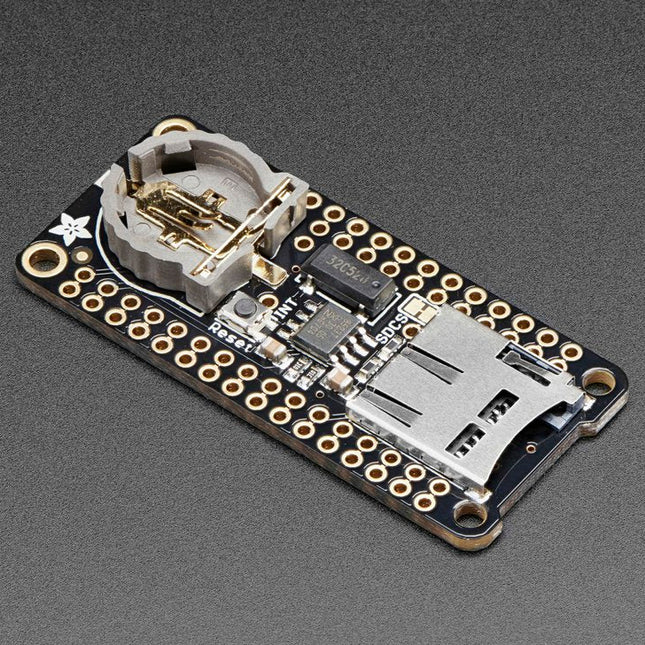
Adafruit Adafruit Adalogger FeatherWing (RTC + SD Add-on)
This FeatherWing will make it easy to add data logging to any Feather Board you might have. You get both an I²C real-time clock (PCF8523) with 32 KHz crystal and battery backup, and a microSD socket that connects to the SPI port pins (+ extra pin for CS). Note: FeatherWing doesn't come with a microSD card. A CR1220 coin cell is required to use the RTC battery-backup capabilities. If you're not using the RTC part of the FeatherWing, a battery is not required. To talk to the microSD card socket Arduino's default SD library is recommended. Some light soldering is required to attach the headers onto the Wing. Pinouts Power pins On the bottom row, the 3.3 V (second from left) and GND (fourth from left) pin are used to power the SD card and RTC (to take a load off the coin cell battery when main power is available) RTC & I²C Pins In the top right SDA (rightmost) and SCL (to the left of SDA) are used to talk to the RTC chip. SCL - I²C clock pin to connect to your microcontroller's I2C clock line. This pin has a 10 kΩ pull-up resistor to 3.3 V SDA - I²C data pin to connect to your microcontroller's I2C data line. This pin has a 10 kΩ pull-up resistor to 3.3 V There's also a breakout for INT which is the output pin from the RTC. It can be used as an interrupt output or it could also be used to generate a square wave. Note that this pin is an open drain - you must enable the internal pull-up on whatever digital pin it is connected to. SD & SPI Pins Starting from the left you've got SPI Clock (SCK) - output from feather to wing SPI Master Out Slave In (MOSI) - output from feather to wing SPI Master In Slave Out (MISO) - input from wing to feather These pins are in the same location on every Feather. They are used for communicating with the SD card. When the SD card is not inserted, these pins are completely free.
-
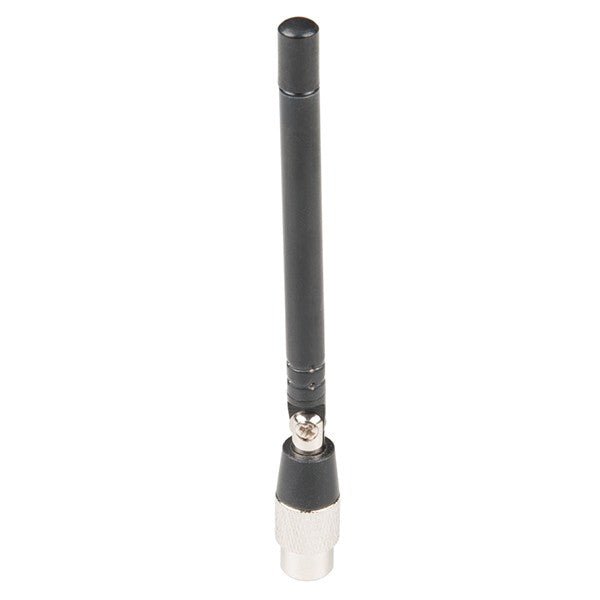
Great Scott Gadgets Great Scott Gadgets ANT700 Telescopic Antenna (300 MHz – 1100 MHz)
ANT700 from Great Scott Gadgets is a lightweight telescopic antenna designed for operation from 300 MHz to 1100 Hz. Its total length is configurable from 9.5 cm to 24.5 cm. ANT700 is constructed of stainless steel and features an SMA male connector, rotating shaft, and adjustable elbow. ANT700 is a 50 ohm general purpose antenna. It is a perfect first antenna for use with HackRF One/Pro.
-
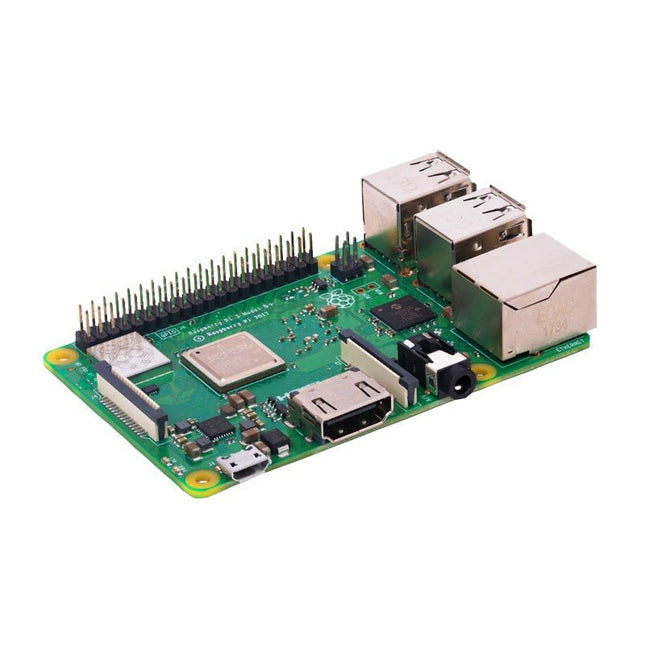
Raspberry Pi Foundation Raspberry Pi 3 B+
This Raspberry Pi 3 B+ has 15% better performance than its predecessor, the Raspberry Pi 3 B. Despite the upgrade, the Raspberry Pi 3 B+ is still compatible with the Raspberry Pi 3 B, 2 and B+. Improvements over Raspberry Pi 3 Model B: Dual band Wireless connectivity 802.11ac (2.4 GHz/5 GHz) Improved power performance Power over Ethernet (PoE) enabled New Ethernet controller Dual band Wireless connectivity 802.11ac (2.4 GHz/5 GHz) Increased connection speed and bandwidth Greater range when connected to the 5 GHz channel Backward compatibility within applications Improved streaming HD video over WiFi Increased effectiveness as a wireless access point Improved power performance Enabling the core processor to operate faster (4x 1.4 GHz) Power over Ethernet (PoE) enabled PoE operation requires the purchase of the new PoE HAT which will be available at launch. Without being tethered to an electrical outlet, the Raspberry Pi 3 B+ can be located wherever it is needed most, and repositioned easily if required up to a range of 100 m. Having power available over a network means that installation and distribution of network of Raspberry Pi’s becomes simpler and more effective. New Ethernet controller 3x Ethernet speed of the current Raspberry Pi 3 B (~300 Mbps) Faster network data transfer Specifications SoC Broadcom BCM2837B0 CPU 64-bit ARM Cortex-A53 (4x 1.4 GHz) GPU Dual-Core VideoCore IV Multimedia Co-Processor RAM 1024 MB USB 4x USB-A 2.0 GPIO 40 Pins Ethernet Gigabit Ethernet over USB 2.0 Wireless LAN 802.11b/g/n/ac (2.4 GHz/5 GHz) Bluetooth 4.2 + LE Power Micro-USB (5 V/2.5 A) Dimensions 85 x 56 x 17 mm
-

LabNation LabNation SmartScope USB Oscilloscope
SmartScope is a compact 2-channel USB oscilloscope with a bandwidth of 30 MHz and a sampling rate of 2x 100 MSa/s. It is compatible with all major platforms, including Windows, macOS, Linux, and Android. The operation and display of measurement signals are done via smartphone, tablet, or PC. Additionally, a logic analyzer and a signal generator are integrated. Even more, you can get mobile with it: take the SmartScope on the road, thanks to the single-cable connectivity. Everything is going to be intuitive: pointing, pinching and swiping finally replaces the clunky interfaces of old scopes. With the SmartScope you develop your digital interfaces using the 100 MS/s logic analyzer. With this tool you can design any signal you want using Excel, then upload it to the built-in Arbitrary Waveform Generator (AWG). At the end capture the voltage at any point of your design at 100 million times each second. The Software for the support of Windows / macOS / Linux / Android and Export formats (Excel .csv / Matlab .mat) are given. Features Channel sampled at 100 MHz/s each AC/DC coupling on analog inputs 100% silent 64 Mbit RAM: x10000 zoom Arbitrary Waveform Generator 8 digital inputs at 100 MS/s each 4 digital outputs at 100 MS/s each Externally power your scope in case your mobile can't supply the juice. Specifications Oscilloscope Bandwidth 30 MHz (-3 dB point) Sample rate 2x 100 MS/s Channels 2 Max pre-trigger position 16x full scale Max post-trigger position Full scale Max full voltage scale 10 V/div (±35 V input range) Min full voltage scale 20 mV/div Analog input range -35 V, +35 V Max input peak-to-peak 40 V Signal coupling AC / DC Precision 8 bit Input impedance 1 MΩ // 10 pF Waverforms 200 waveforms/s Data delay to host < 10 ms Sample depth Up to 4 million samples per channel External trigger Yes Logic Analyzer Input channels 8 Input impedance 100 kOhm // 2 pF to GND Sample rate 100 MS/s Logic level 1.8 V to 5.0 V Diode protection Bidirectional Input data buffer 4 million samples Waverforms 200 waveforms/s Data delay to host < 10 ms Protocol decoders I²C, SPI, UART, I²S integrated User extensible Wave Generator (Analog Output) Output channels 1 Data rate Up to 50 MS/s Output level 0-3.3 V (Opamp driven) Output buffer Up to 2048 samples Max slew rate 30 ns/V Step 13 mV Wave Generator (Digital Output) Channels 4 Data rate Up to 100 MS/s Output level 3.3 V or 5 V (selectable) Output buffer Up to 2048 samples Diode protected Yes Programmable Logic USB controller MicroChip PIC18F14K50 USB interface PicKit3 or USB flashable FPGA Xilinx Spartan 6 FPGA interface JTAG and USB flashable Size & Weight Dimensions (L x W x D) 110 x 64 x 24.2 mm (4.33 x 2.52 x 0.95") Weight 158 g Case Aluminium Connectivity Device/Host mini USB included Record waveforms Store Matlab (.mat) or Excel (.csv) files through Dropbox Analog BNC 2 probes included Digital 8x 0.1" pitch, probes (included) Sync USB micro B-B Power USB micro B (optional) Included 1x SmartScope USB Oscilloscope 2x Analog probes 1x Digital probe cable 1x USB cable Downloads Software GitHub Wiki
