The 2-channel OWON XDG2035 is a function/waveform generator that can generate signals with a maximum frequency of 35 Hz. The generator has a resolution of 1 µHz and a sample rate of 500 MSa/s.
The OWON XDG2035 is capable of generating 6 standard waveforms and 150 arbitrary waveforms. With the included software you can write advanced functions up to 10 million points. Waveforms can be saved to the function generator's internal memory using a PC via USB or LAN.
The OWON XDG2035 also supports SCPI commands and LabView. The function generator has an integrated high-quality frequency counter, which can operate from 100 to 200 MHz.
Features
Max. 35 MHz frequency output
500 MSa/s Sample rate, Vertical resolution 1μHz
14 bits Vertical Resolution, 10 Marb waveform length
Comprehensive waveform output: 6 basic waveforms,and 150 built-in arbitrary waveforms
Comprehensive modulation functions: AM, FM, PM, FSK, 3FSK, 4FSK, PSK, OSK, ASK, BPSK, PWM, Sweep, and Burst
High-accuracy frequency counter integrated, supported range 100-200 MHz
SCPI and LabVIEW supported
7 inch multi-touch screen (800 x 480 pixels)
Specifications
Channel
2
Frequency Output
35 MHz
Sample Rate
500 MSa/s
Vertical Resolution
14 bits
Waveform
Standard Waveform
sine, square, pulse, ramp, noise, and harmonic
Arbitrary Waveform
exponential rise, exponential fall, sin(x)/x, step wave, and others, total 150 built-in waveforms, and user-defined arbitrary waveform
Frequency (resolution 1 μHz)
Sine
1 μHz-100 MHz
Square
1 μHz ~ 30 MHz
Pulse
1 μHz ~ 25 MHz
Ramp
1 μHz ~ 3 MHz
Noise (-3 dB, typical)
100 MHz
Arbitrary Waveform
1 μHz ~ 15 MHz
Harmonic
1 μHz ~ 50 MHz
Accuracy
±2ppm, 25°C ±5°C
Waveform Length
2 points - 10M points
Amplitude
Into 50Ω load
1mVpp ~ 10Vpp (≤25 MHz); 1mVpp ~ 5Vpp (≤60 MHz); 1mVpp ~ 2.5Vpp (≤100 MHz)
Modulation
Type
AM, DSB-AM, FM, PM, ASK, FSK, PSK, BPSK, QPSK, 3FSK, 4FSK, OSK, PWM, SUM
Frequency Counter
Function
Frequency, period, +width, -width, +duty, and -duty
Frequency Range
100 ~ 200 MHz
Frequency Resolution
7 digits
Input/Output
Input mode
frequency counter, external modulation input, external trigger input, internal clock output, external reference clock input/output
Communication Interface
USB Host, USB Device, LAN, RS232 (optional)
Mechanical specifications
Dimensions
340 x 177 x 90 mm
Weight
2.3 kg
Included
1x OWON XDG2035
1x Power Cord
1x CD-ROM
1x Quick start guide
1x USB Cable
1x BNC-BNC Cable
Downloads
Quick Guide
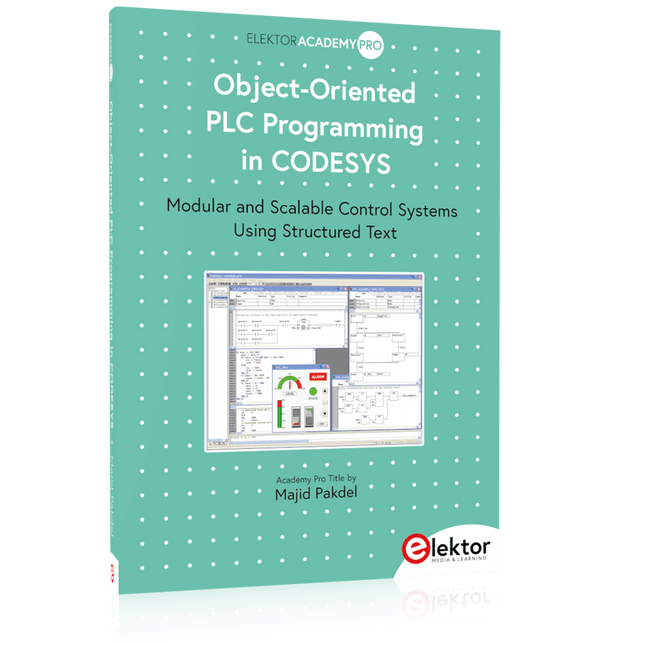
Modular and Scalable Control Systems Using Structured Text
This book offers a structured and practical approach to modern PLC development using object-oriented principles. It is a guide for engineers, programmers, and students seeking to harness the power of object-oriented programming (OOP) in the context of industrial automation with PLCs.
The content focuses on the CODESYS development environment and Structured Text (ST), both of which support modern programming techniques while maintaining compatibility with real-time automation requirements. Through step-by-step demos and instructional examples, it demonstrates how modular, reusable code can enhance development efficiency, simplify ongoing maintenance, and enable scalable and flexible control system architectures.
Key topics include:
Structured Text fundamentals: conditions, loops, arrays, and functions
Object-oriented concepts: classes, methods, and inheritance
Advanced techniques: polymorphism, interfaces, and access control
Modular design with reusable components and structured program flow
Implementation of finite state machines and scalable application design
Built around instructional demos and clear explanations, this book helps readers develop maintainable and modern control software in the CODESYS environment using proven programming techniques.
Le téléchargement intégral de ce numéro est disponible pour nos membres GOLD et GREEN sur le site Elektor Magazine !
Pas encore membre ? Cliquez ici.
mise à jour du projet : compteur d'énergie basé sur l'ESP32Prochaines étapes du prototypage
optimisation des centrales solaires sur balconConsidérations, faits intéressants et calculs
ESP32 avec OpenDTU pour les centrales sur balconRelever les données des petits onduleurs avec des microcontrôleurs
alimentation linéaire variable EnsembleAlimentation 0-50 V / 0-2 A + alim symétrique double
le stockage d?énergie aujourd?hui et dans le futurinterview de Simon Engelke
2024 : l'Odyssée de l'IAsans répit
Bluetooth LE sur le STM32Un moyen de lire les mesures à distance
boîte de conservation intelligente centrée sur l'être humain
MAUI : programmation pour PC, tablettes et smartphonesle nouveau framework en théorie et en pratique
ChatMagLevlévitation magnétique ? version IA
régulateur de puissance PV simpleRéalisez votre premier système de gestion de l'énergie photovoltaïque entièrement fonctionnel
les composants à cathode froide
sur le vifnostalgie
démarrer en électronique?Les FET
tutoriel bus CAN pour l'Arduino UNO R4deux UNO R4 connectés au bus
infographie
assistance complète à la conception et au développementles services d?ingénierie d?Arrow
comparatif entre densité de puissance et rendement énergétique
condensateurs électrolytiques en aluminiumsources potentielles de distorsions en technologie audio
test et mesure USBle Fnirsi FNB58
l'outil Pick-and-Place manuel Pixel Pumpsimplifier l'assemblage manuel des cartes CMS
visite à domicilenaguère, dans un pays lointain?
« Dans le monde de l'éthique en électronique, même les petits pas peuvent avoir un impact significatif. »
éthique en électroniqueles lignes directrices de l'OCDE et la loi allemande sur le devoir de diligence dans la chaîne d'approvisionnement
Chadèche : chargeur/déchargeur intelligent pour accus NiMhrésumé d?un projet de lecteur
projet 2.0Corrections, mises à jour et courriers des lecteurs
Elektor GREEN en GOLD leden kunnen deze uitgave hier downloaden.
Nog geen lid? Klik hier om een lidmaatschap af te sluiten.
ESP32 Audio Transceiver Board (Deel 2)Draadloze audio-overdracht
Inductieve AM-zenderGebruikt Pico's PIO in een Arduino-sketch
Navigeren door draadloze protocollen navigerenEen technische gids
Satelliettracking met behulp van LoRaHet TinyGS-netwerk brengt gegevens uit de ruimte naar de aarde.
4G-Compatibele SMS afstandsbedieningBedien je apparatuur op afstand
Hogesnelheids-probeIngangen met hoge impedantie voor signalen tot 200 MHz
Uit het leven gegrepenKafka
KrakenSDR
Prestatietests met de RP2350Is een upgrade van Raspberry Pi Pico 1 naar versie 2 de moeite waard?
Contactloze E-veldmetingen (2)Een laservibrometer voor het beoordelen van de trillingen van het membraan
Kristallen en oscillatorenVerbetering van de kristalnauwkeurigheid door gerichte keuze van condensatoren
Alle begin......gaat audio!
Zelf firmware coderen voor embedded projecten
SPECTRAN® V6 MobileModulaire, configureerbare realtime-spectrumanalyzer voor betrouwbare metingen over alle frequentiebereiken
De toekomst van AI wordt gesmeed in siliciumEen interview met Anastasiia Nosova
Autonome Sensor-Node v2.0 (Systeemarchitectuur)Zonne-energieplatform met geïntegreerde GPS, LoRaWAN en meer
Precieze positioneringBluetooth channel sounding getest
Testgestuurd ontwikkelen bij het schrijven van firmware
Telefoon gestuurde modelautoWi-Fi + ESP32 + Smartphone = Afstandsbediening
2025: Een AI-odysseeAI-redeneermodellen: De gedachtegang-revolutie
Zonne-laadregelaar met MPP-tracking (3)Software en Inbedrijfstelling
Raspberry Pi Zero Web Streaming CameraDe ZeroTier VPN gebruiken
Beste soldeerder van de Beneluxvakmanschap in de schijnwerpers
Seminaroverzicht Electronics & ApplicationsLeer, ontdek en netwerk op E&A 2025
Eurocircuits at E&A 2025
E&A gadget 2025: racen over de beursvloer met slimme printplaat op wielenVijf vragen aan Casper van Doorne, ontwerper van de beursgadget
Beursgadget E&A bekendontwerp en bestuur je eigen raceauto
Vakbeurs E&A is het elektronicaparadijs van de Benelux“Techneuten blijven kinderen”
Rohde & SchwarzPioneering Innovation in Test & Measurement
Diederik Jekel opent Electronics & Applications
Program, build, and master over 50 projects with MicroPython and the RP2040 microprocessor The Raspberry Pi Pico is a high-performance microcontroller module designed especially for physical computing. Microcontrollers differ from single-board computers, like the Raspberry Pi 4, in not having an operating system. The Raspberry Pi Pico can be programmed to run a single task very efficiently within real-time control and monitoring applications requiring speed. The ‘Pico’ as we call it, is based on the fast, efficient, and low-cost dual-core ARM Cortex-M0+ RP2040 microcontroller chip running at up to 133 MHz and sporting 264 KB of SRAM, and 2 MB of Flash memory. Besides its large memory, the Pico has even more attractive features including a vast number of GPIO pins, and popular interface modules like ADC, SPI, I²C, UART, and PWM. To cap it all, the chip offers fast and accurate timing modules, a hardware debug interface, and an internal temperature sensor. The Raspberry Pi Pico is easily programmed using popular high-level languages such as MicroPython and or C/C++. This book is an introduction to using the Raspberry Pi Pico microcontroller in conjunction with the MicroPython programming language. The Thonny development environment (IDE) is used in all the projects described. There are over 50 working and tested projects in the book, covering the following topics: Installing the MicroPython on Raspberry Pi Pico using a Raspberry Pi or a PC Timer interrupts and external interrupts Analogue-to-digital converter (ADC) projects Using the internal temperature sensor and external temperature sensor chips Datalogging projects PWM, UART, I²C, and SPI projects Using Wi-Fi and apps to communicate with smartphones Using Bluetooth and apps to communicate with smartphones Digital-to-analogue converter (DAC) projects All projects given in the book have been fully tested and are working. Only basic programming and electronics experience is required to follow the projects. Brief descriptions, block diagrams, detailed circuit diagrams, and full MicroPython program listings are given for all projects described. Readers can find the program listings on the Elektor web page created to support the book.
Diese Ausgabe steht allen GOLD- und GREEN-Mitgliedern auf der ElektorMagazine-Website zum Download bereit!
Sie sind noch kein Mitglied? Hier klicken!
Projekt-Update: Energiemessgerät mit ESP32Nächste Schritte beim Prototyping
Balkonkraftwerke optimierenÜberlegungen, Wissenswertes und Kalkulationen
Für Balkonkraftwerke: ESP32 mit OpenDTUDaten kleiner Wechselrichter per µC auslesen
Variables lineares Stromversorgungs-Ensemble0...50 V / 0...2 A + Doppelsymmetrische Versorgung
Energiespeicherung heute und morgenEin Interview mit Simon Engelke
2024: Eine Odyssee in die KIWeiter, immer weiter...
Bluetooth LE auf dem STM32Auf dem Weg zum fernabgelesenen Messgerät
Intelligentes KücheninventarsystemMehr als eine Küchenwaage
MAUI: Programmieren für PC, Tablet und SmartphoneDas neue Framework in Theorie und Praxis
ChatMagLevDer KI-Weg der Levitation
Einfacher PV-Energieregler für InselanlagenBauen Sie ein voll funktionsfähiges PV-Energiemanagement-System
KaltkathodenröhrenBemerkenswerte Bauteile
Aus dem Leben gegriffenNostalgie
Aller Anfang ...... muss nicht schwer sein: Vom FET zum Opamp
CAN-Bus-Tutorial für den Arduino UNO R4Zwei UNO R4 nehmen den Bus!
Infografik: Strom und Energie
Umfangreiche Unterstützung bei Design und EntwicklungArrow Engineering Services
Leistungsdichte vs. Wirkungsgrad
Aluminium-ElektrolytkondensatorenStörpotential in der Audiotechnik?
USB-Tester FNB58 von Fnirsi
Pixel Pump Das Pick-and-Place ToolVereinfachung der manuellen SMD-Bestückung
HomeLab-ToursVor nicht allzu langer Zeit in einem weit entfernten Land...
„In der Welt der Ethik in der Elektronik können auch kleine Schritte eine große Wirkung haben.“
Ethik in der ElektronikDie OECD-Leitsätze und das deutsche Lieferkettengesetz
Intelligentes Ni-MH-Ladegerät/EntladegerätDas Leserprojekt „Chadèche“ in Kürze
Projekt 2.0Korrekturen, Updates und Leserbriefe
Elektor GREEN en GOLD leden kunnen deze uitgave hier downloaden.
Nog geen lid? Klik hier om een lidmaatschap af te sluiten.
OBD2-sensordashboardOude meters vormden het startpunt van een zoektocht naar echte gegevens
OBD2: voeg een toerenteller en schakelindicator toe aan je autoRetro, maar uiterst nuttig
LiDAR- en Visiesensoren voor Robotica
Sensor+Test 2025 en PCIM 2025
Contactloze E-Veldmetingen (1)Een Trillende Membraan voor het Detecteren van Gelijkspanningen of Statische Elektrische Velden
Draadloze brievenbusmeldervan optische sensoren tot radar: enkele mogelijkheden
Elektor Mini-Wheelieeen zelfbalancerende robot
ZonnecellenVreemde onderdelen, de serie
Aan de slag met een moderne radarsensorStaat een nauwkeurige meting op uw radar?
Uit het leven gegrepenpapierfabriek
CybersecurityZware tijden voor hackers
Infographics: IoT en sensoren 2025
Bluetooth 6.0 brengt verbeterde toepassingen voor afstandsbepalingNieuwe versie biedt betere apparaatpositionerings- en -locatieservices
Draadloze communicatie verkennen met BeagleY-AI
Err-lectronicsCorrecties, updates en lezerspost
Alle begin......sluit het thema opamps af
Een krachtige AI-codeerassistentsneller ontwikkelen met Continue en Visual Studio Code
Zonne-laadregelaar met MPPT (2)Het schema
Ultrasone obstakeldetectoreen eenvoudig project om slechtzienden te helpen
2025: Een AI-odysseeHalfjaaroverzicht
Raspberry Pi Standalone MIDI-synthesizer (3)Het slimmer maken en een gebruikersinterface toevoegen
Meshtastic: een demonstratieprojectEen slim netwerk van LoRa-radio's
Analoge audio-frequentiegeneratorHoogwaardige sinusgenerator met instelbare frequentie
Diese Ausgabe steht allen GOLD- und GREEN-Mitgliedern auf der ElektorMagazine-Website zum Download bereit!
Sie sind noch kein Mitglied? Hier klicken!
electronica Fast Forward Start- & Scale-Up AwardsDie Vorbereitungen laufen auf Hochtouren!
Bluetooth Low Energy mit dem ESP32-C3 und ESP32Es muss nicht immer WLAN sein!
Bluetooth-LE-SnifferMit dem makerdiary nRF52840 MDK USB-Dongle
Magischer RGB-LED-WürfelHardware-Design rund um einen RP2040
Automatischer Ein/Ausschalter für Lötpastenkompressor
Elektor - live und in FarbeLivestreams, Webinare und Kurse für Ingenieure und Maker
Fahrrad elektrifizierenE-Bike-Nachrüstkit in der Praxis
Aller Anfang ...Muss nicht schwer sein: Multiplikation von Spannungen
Aus dem Leben gegriffenNebenbeschäftigungen
Teensy 4.0 - warum ist das Board so schnell?Oder: Geschwindigkeit ist keine Hexerei!
Simulation von Audio-Leistungsverstärkern mit TINADer „Try-Before-You-Build“-Ansatz
LoRaWAN-Knoten im IoTEin Beispiel-Kapitel: Die LoRaWAN-Module Dragino LHT65, LDS01 und LDS02
Projekt 2.0Korrekturen, Updates und Leserbriefe
5G für mich alleinVollständige Kontrolle über 5G-Implementierungen in privaten Mobilfunknetzen
Infographics 7-8/2022
Wie lernt mein Gerät funken?Applikationen mit WiFi-Schnittstellen ausrüsten
Rheinturmuhr – Wecker de luxe
Audio-Spektrum-Analysator mit DekatronsEine neue Art, alte Röhren zu verwenden
Senden von Daten an TelegramEin ESP32 und ein paar Bauteile erledigen den Job32 and a Few Parts
Fliege-Bandsperre für Audio-MessungenBesseres Messen durch Notch-Filterung
CO2-Messgerät auseinandergenommenIst das Gerät hackbar für Ihre Projekte?
Spielereien mit PUTsAnaloge Entwürfe mit dem Programmierbaren Unijunction-Transistor
Ein runder Touchscreen für den Raspberry PiHyperPixel 2.1 Round von Pimoroni
Fernwirken und die Erkennung von Verbindungsverlustenmit Hilfe von nRF24L01+ Modulen
Digitaler UKW-EmpfängerMit Arduino Nano und TEA5767
OLED-Display - aus SPI mach I²C
Zutritt für Unbefugte verboten!Ein Hobby geht nicht in Rente!
Ein Jahrzehnt der Ethik in der ElektronikTessel Renzenbrink sinniert über die digitale Gesellschaft
HexadokuSudoku für Elektroniker
Elektor GREEN and GOLD members can download their digital edition here.
Not a member yet? Click here.
PIO Programming on the Raspberry Pi PicoNine Instructions, Many Possibilities
Breaking AI Out of the BrowserUsing AI CLIs to Code, Compile, and Validate Embedded Projects
The Scrutiny DebuggerDebug, Visualize, and Test Embedded C/C++ Code
Sigfox Breakout Board (1)A Self-Built Radio BoB
Low-Noise Power Supply (2)Construction, Assembly, and Practical Implementation
Simple Signal Generator Using the RP2040Analog and Digital Signals for Around €10
Navigating the Future of Smart Homes with Matter and Edge AIAre Matter’s Latest Updates and the Rise of Edge AI Finally Giving Engineers the Tools to Build the Intelligent, Seamless Smart Homes Users Have Been Promised?
Differential Pressure SensorsPredictive Maintenance in HVAC-Systems
Security by DesignEngineering Fundamentals Limit Failure
Embedded Security Is No Longer Optional
CRA and PQC Are Rewriting Embedded Security PrioritiesWhy Even Small IoT and Industrial Firms Need an Upgrade Plan
embedded world 2026An Interview With Benedikt Weyerer, Executive Director of embedded world
Hands on with I3CUsing Hardware from ST and Microchip
The BLEnky ProjectRapid Prototyping of Bluetooth Low Energy Applications
Pulse Width ModulationFrom a Simple On/Off Thermostat to a Smoothed DC Analog Signal
AudiotronicsEar-Pleasing Electronics for DIY Construction
From Life’s ExperienceRead The F...ing Manual!
ESP32 Audio Transceiver Board (Part 4)Tuning the Clocks - And a Wired Option
2026: An AI OdysseyThe 2025 Vibe-Coding Hangover
Symmetrical DC LoadDC Load, Static or Dynamic, and Symmetrical
Counting Faces with MaixCAMAn Easy Way to Capture Audience Sizes
Elektor GREEN and GOLD members can download their digital edition here.
Not a member yet? Click here.
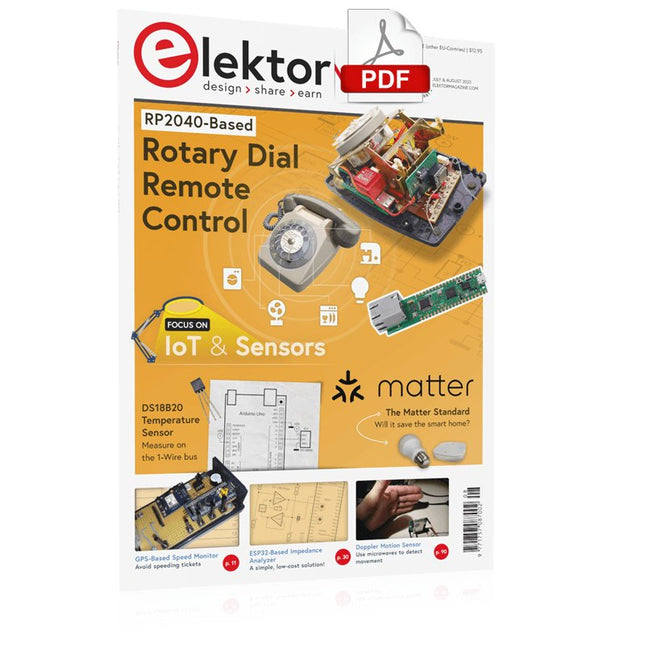
Rotary Dial Phone as Remote ControlTo Switch On the Lights, Dial 1; For the Coffee Maker, Dial 2
GPS-Based Speed MonitorNo More Speeding Tickets
RGB Stroboscope with ArduinoA Colorful Adaptation of a Useful Instrument
Wireless Emergency Push ButtonEnhanced Safety with LoRa
Starting Out in ElectronicsFollow the Emitter
Arbitrary, Independent Hysteresis Levels for Comparatorswith Simulations, Spreadsheets and Algebra
ESP32-Based Impedance AnalyzerSimple, Low-Part-Count, and Inexpensive!
HomeLab ToursEncouraging DIY
The MCCAB Arduino Nano Training BoardAll-in-One Hardware for the “Microcontrollers Hands-On Course”
From Life’s ExperienceModern Luddism
Sensor 101: The DS18B20 Temperature SensorConnection to the 1-Wire Bus
Is Matter the Thread to Save the Smart Home?New Standards to Simplify the Smart Home
A Matter of CollaborationDeveloping with the Thing Plus Matter Board and Simplicity Studio
Infographics: IoT and Sensors
Matter, ExpressLink, Rainmaker — What Is This All About?Q&A with Amey Inamdar, Technical Marketing Director at Espressif
Selecting Microcontroller Dev Kits for IoT and IIoT ApplicationsAn Introductory Guide
Capacitors Do Not Always Behave Capacitively!
An NTP Clock with CircuitPythonWhy Should You Use This Programming Language?
Build a Cool IoT DisplayWith the Phambili Newt
The HB100 Doppler Motion SensorTheory and Practice
A Bare-Metal Programming Guide (Part 1)For STM32 and Other Controllers
Siglent SDM3045X Multimeter
Microprocessors for Embedded SystemsPeculiar Parts, the Series
Microcontroller Documentation Explained (Part 3)Block Diagrams and More
Low-Power LoRa Weather StationBuild a long-range weather station by yourself
Transverter for the 70 cm Band
Climate Calling EngineersMove Fast and Fix Things
Hexadoku
Elektor GREEN en GOLD leden kunnen deze uitgave hier downloaden.Nog geen lid? Klik hier om een lidmaatschap af te sluiten.
Raspberry Pi Pico als spectrumanalyzerFFT’s met goedkope hardware
±40 V lineaire spanningsregelaaralternatieve voeding voor de Fortissimo-100 eindversterker... en andere!
Flexibele draadloze communicatie met een MCUEEPROM opent netwerkmogelijkheden voor draadloze MCU’s
€ 5000 voor het oprapen!doe mee aan de STM32 Wireless Innovation Design Contest
2023: een AI-odysseeaan de slag met Code Interpreter van ChatGPT
LoRa – een Zwitsers zakmesdeel 1: het LoRa-protocol en zijn voordelen
Instelbare current sink met geïntegreerde klokgeneratortest voedingen, spanningsconverters en accu’s
Twee nieuwe Arduino UNO R4-boards: Minima en WiFi
Logaritmische potentiometersze zijn exponentieel!
Motordriver breakout-boardeen BoB voor een 5 A DC-motordriver van 3×3 mm
Uit het leven gegrepenelektronica periculosa
Biedt cellulair het laagste stroomverbruik voor IoT?energie-eisen van LTE-M en NB-IoT in LPWAN-implementaties
Draadloze communicatie in IoT-systemen met Arduino MKR-moduleshet juiste board voor WiFi, LoRa en andere standaarden
AC-verliezen in magnetische componentenvoorkom hete spoelen!
Meten voor optimale cloud-connectiviteit
Matter implementatie: Wat is er nodig om Matter-devices in te zetten?
YARD Stick Onesub-1 GHz draadloos testtool
Houdrelaisvreemde onderdelen
PIC voor tien – precies op tijdontwerp van een SDR-tijdseinontvanger
Due Diligence DirectiveBusiness as Usual Will Not Do
Alle begin......versterkt spanningen
Infrageluid-recorder met de Arduino Pro Minieen voorbeeldproject uit de Elektor-uitgave “Arduino & Co”
Cloud-gebaseerde energiemetermet een ESP32-module en een PZEM-004T spanning/stroom-sensor
Een gids voor puristisch programmeren (deel 2)nauwkeurige timing, de UART en debugging
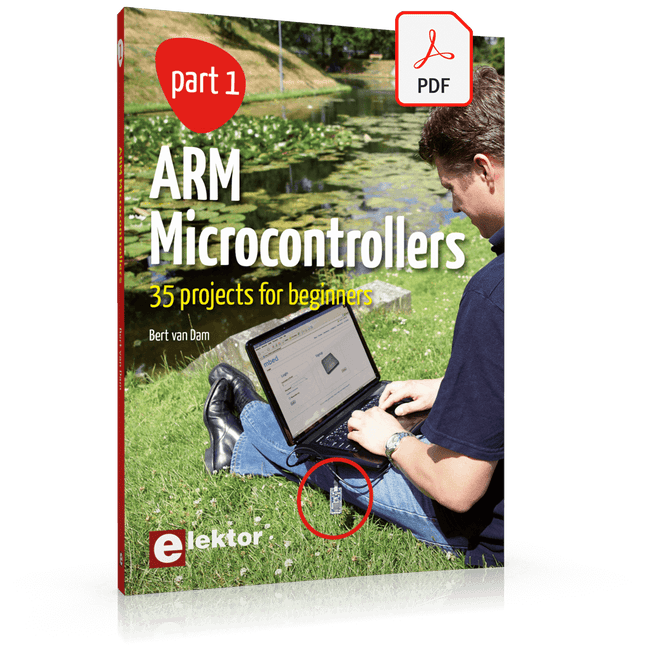
35 Projects for Beginners
This book is for hobbyists, students and engineers who want to learn C and how to use an mbed ARM microcontroller in an easy and fun way, without the need for cumbersome software installations.
ARM mbed microcontroller NXP LPC1768
The projects in this book are meant for beginners in C and ARM microcontrollers. That doesn't mean the projects are simple, but it does mean that they are easy to understand. We use for example USB communications, a subject that is made so easy by the mbed that it is suitable for a beginners book.
Cloud technology
The mbed NXP LPC1768 uses cloud technology, a revolutionary concept in software development. This means you do not need to install software on your PC in order to program the mbed!
The only thing you need is a browser such as Microsoft Internet Explorer, and a USB port on your PC. You can get access to your project from any PC anywhere in the world and continue working on it. When you are done a few simple mouse clicks transfer the program to your mbed hardware. Of course you can optionally download the projects and store them on your own PC.
Features of this Book
Learn how to program an mbed ARM microcontroller using cloud technology. No complicated software installation on your PC needed.
Learn programming in C by doing fun and interesting projects. No previous experience or knowledge required.
Examples of projects in this book: flashing light, timer, light activated switch, digital thermometer, people detector, USB communication, talking microcontroller, debugging, sound switch, and much more - 35 projects in total.
Examples of C subjects in this book: variables, commands, functions, program execution, pointers (introduction).