Construisez votre contrôleur RISC-VDébuter sur le noyau logiciel RISC-V NEORV32 pour FPGA à faible coût
Tracer des graphiques avec ArduinoC?est facile avec le traceur sériel d'Arduino
Carte CLUE d'AdafruitUne solution intelligente pour les projets IoT
Carte tampon pour le Raspberry Pi 400Protection des entrées/sorties
Cartes Raspberry Pi RP2040 à gogo
Approche DIY de la sécurité et de l'espionnage électroniqueChauffez ou refroidissez la SRAM
Identification des composantsTrucs et astuces, bonnes pratiques et autres informations utiles
Interrupteur sans contact DIY
Démarrer en électronique? (12)Adaptation d?impédance et transformateurs
Quoi de neuf dans le développement de l'embarqué ?Rust et mises à jour des déploiements IoT
Infographie
Les bénéfices de la 5G pour l?industrie et l?automobile
Relais à bobine mobile
Visite à domicileChacun son tour
Voyage dans les réseaux neuronaux (4e partie)Les neurones embarqués
Lévitation magnétique : encore plus simpleTroisième version : la plus compacte
Programmation d'automates avec le Raspberry Pi et le projet OpenPLCVisualisation des programmes PLC avec AdvancedHMI
Sur le vifEmballé, c?est pesé
Sous votre radarDes microcontrôleurs que vous devriez connaître
Surveillance et débogage sans filUne solution pour Arduino, ESP32 et Cie
Station de mesure de température et d'humidité, au format de pocheUtilisation de modules prêts à l'emploi
Réparation des batteries au lithiumÉconomisez de l'argent et augmentez la puissance !
Création d?interfaces graphiques en PythonGénérateur de mèmes
Trois questions fondamentalesPourquoi, avec quoi, avec qui ?
Hexadoku
ZELFBOUW LIPO-SUPERCHARGER KITvan prototype tot productie
ELEKTOR @ 60gedachten bij zestig jaar elektronica
SIGLENT SDM3045X TAFELMULTIMETER
DC-STROOMKLEMHall-sensor + ferrietkern + Arduino
SOLDEERSTATION 2021makkelijk om te bouwen!
KENNISMAKING MET DE PARALLAX PROPELLER 2 (DEEL 2)de ontwikkelomgeving en de code
WIFI VOOR DE LORA SWITCHgeïntegreerd in Home Assistant met ESPHome
GEEN ANGST VOOR DE CELLULAIRE MODULE!
HOUD DE TIJD BIJ MET ESP32 EN TOGGLwerken met de M5Stack
KENNISMAKING MET HET RASPBERRY PI PICO-BOARD EN DE RP2040
MICROPYTHON VOOR MICROCONTROLLERStechnieken voor kleine displays
12–200 V DC/DC-CONVERTERvoor buizenversterkers
WARMTEZOEKERde Seek Shot Pro warmtebeeldcamera
OBJECTGEORIËNTEERD PROGRAMMERENeen korte inleiding met C++
OOST WEST LAB BEST...waar Kurt Diedrich synthesizers bouwt
JAVA OP DE RASPBERRY PIdeel 1: GPIO’s
DIP-SCHAKELAARSvreemde onderdelen
INTERACTIEFcorrecties & updates || brieven van lezers
WIENS PRODUCT IS HET EIGENLIJK?recht-op-reparatie beweging laat van zich horen
UIT HET LEVEN GEGREPENhet grote blunderboek
MICRO-PROFESSORassembleertaal leren op een Z80
ALLE BEGIN......hoeft niet zo moeilijk te zijn – zelfs als het om condensatoren gaat
HEXADOKUThe Original Elektorized Sudoku
This complete Arduino Uno-based microcontroller programming course features a textbook, a component kit, hands-on projects, and a comprehensive online course with simulations. It is ideal for step-by-step learning of embedded systems programming with Arduino using a practical, hands-on approach.
A Practical Introduction to Embedded Systems with the Arduino Uno
This course is designed for people who are new to embedded systems and looking for a structured, example-driven way to get started.
A kit of parts comprising LEDs and resistors, switches, sensors and actuators, displays, a breadboard and wires, and more is included. These are used in the course to illustrate example applications.
No prior experience with Arduino or embedded development is required. Each section features hands-on examples and mini projects designed to reinforce key concepts and inspire deeper exploration. By the end of the course, you’ll be able not only to reproduce the examples but also to build on them with your own ideas and applications.
What Will You Learn?
Microcontroller programming with Arduino using the Uno R3 board
Working with Digital I/O, read buttons and encoders, control LEDs and relays
Read analog inputs, voltages, and analog sensors
Generating analog output signals and PWM
Use serial communication like UART, I²C and SPI to control displays and read digital sensors and SD cards
Managing time
Working with interrupts
Real-time sensor input and control via buttons, LEDs, and displays
Control actuators like relays and servo motors
Who Is It For?
Students and self-learners exploring embedded systems
Makers and IoT enthusiasts looking to improve their hardware skills
Educators and trainers seeking ready-to-teach material
What's Inside the Box?
Access to the full course on the Elektor Academy Pro Learning Platform
Uno R3 microcontroller board + USB cable
Book: Programming Microcontrollers in C/C++ Using Arduino
Downloadable project files for every module
Component Box:
2× LED, red, 5 mm
LED, green, 5 mm
3× Resistor, 470 Ω, 0.25 W
LDR
Potentiometer, 10 kΩ, linear
Pushbutton
Rotary encoder module
Relay module
DHT22 Humidity & Temperature Sensor
TM1637-compatible 4-digit 7-segment display
MPU-6050 IMU with headers
SSD1306-compatible I²C OLED display
Micro SD card adapter with header
Buzzer
SG90 Micro Servo
ILI9341-compatible SPI 240×320 TFT display
20× Jumper wires
Breadboard
All Programming Courses (and differences in content)
Course
Arduino
Raspberry Pi Pico with Arduino C/C++
ESP32 with Arduino C/C++
Raspberry Pi Pico with MicroPython
ESP32 with MicroPython
Online Course
Access to Arduino Course
Access to Pico with Arduino C/C++ Course
Access to ESP32 with Arduino C/C++ Course
Access to Pico with MicroPython Course
Access to ESP32 with MicroPython Course
Board
Uno R3
Raspberry Pi Pico
ESP32
Raspberry Pi Pico
ESP32
Book
Programming Microcontrollers in C/C++ Using Arduino
Programming Microcontrollers in C/C++ Using Arduino
Programming Microcontrollers in C/C++ Using Arduino
Programming Microcontrollers in MicroPython
Programming Microcontrollers in MicroPython
Kit
40-piece Component Box
40-piece Component Box
40-piece Component Box
40-piece Component Box
40-piece Component Box
Le téléchargement intégral de ce numéro est disponible pour nos membres GOLD et GREEN sur le site Elektor Magazine !
Pas encore membre ? Cliquez ici.
un nœud de capteurs autonometransmission de données basée sur LoRa et alimentation en énergie par cellules solaires
la carte eXpansion V1.0 d'Elektorpour ESP32S3 et autres cartes XIAO
une caméra dans un train miniatureinstallation d’un module ESP32 CAM
antenne magnétique à large bande pour les grandes ondestous les émetteurs sans aucun accord
TensorFlow Lite pour microcontrôleurspar un débutant, pour les débutants
un concentrateur pour les appareils RS-422 et RS-485câbler votre bus comme une star
sonde RFWith LED Bar Graph
démarrer en électronique...…plus de montages à ampli-op
Open Variovariomètre multifonction open source pour vol en parapente
sur le vifÀ propos de prendre les choses pour acquises
relevé des compteurs d'eau basé sur l'IA (Partie 2)intégrez votre ancien compteur dans l'IdO !
agriculture intelligentedétection des nuisibles basée sur l’apprentissage machine avec connectivité IdO
Anybus CompactCom est le choix idéal pour la communication industrielle embarquée – voici pourquoi
norme de communication IQRFfiabilité des réseaux maillés sans fil à faible débit avec perte
comment construire un robot agricole intelligentquelles sont les considérations essentielles que les concepteurs de robots agricoles doivent prendre en compte et à quels défis techniques sont-ils confrontés ?
filtre coupe-bande audio à fréquence réglablesolution universelle de suppression de fréquences dans le domaine audio
le système LeoINAGPSsurveillez votre véhicule électrique
nœud LoRa alimenté par énergie solaireune solution IdO modulaire, compacte et polyvalente
AWS pour Arduino et cie. (2)transmission de données avec AWS IoT ExpressLink
projet 2.0corrections, mises à jour et courrier des lecteurs
2024 : l'odyssée de l'IAexamen des Accélérateurs IA : comparaison
extension de couverture Wi-Fi sur ESP32comment modifier simplement une antenne
The Joy-Pi Note 2 is a portable, all-in-one electronics experimentation and learning platform, fully compatible with the Raspberry Pi 4 and 5. Combining an 11.6-inch IPS display, a detachable wireless keyboard, and a compact, robust housing, it provides a flexible environment for electronics development, programming, and education.
With more than 45 hands-on courses and projects, the Joy-Pi Note 2 supports learning and experimentation with Python, Scratch, robotics, and IoT applications. Its integrated learning platform provides step-by-step instructions, making it suitable for beginners, students, educators, and experienced makers.
The system features over 22 integrated sensors and modules, including temperature, light, motion, and distance sensors, as well as LED displays and motor interfaces. Additional connectivity options, including USB-C and GPIO expansion interfaces, allow users to develop and test their own projects.
With support for the Raspberry Pi 5, the Joy-Pi Note 2 also benefits from improved processing power and graphics performance, making it a versatile platform for electronics education, prototyping, and advanced experimentation.
Features
Complete Electronics Experimentation Kit
All-in-One Learning and Experimentation Platform
Compatible with Raspberry Pi 4 & 5
Pre-installed Interactive Learning Platform
Detachable Wireless Keyboard
Integrated Storage Compartment for Power Bank and Accessories
Specifications
Display
11.6" LCD Display
Camera
2 MP
Learning platform
45+ courses & projects
Displays
7-segment display, 16x2 display, 1.8" TFT display, 0.96" OLED display, 8x8 RGB matrix
Power supply
5 V/5 A, USB-C
Displays
7-segment display, 16x2 LCD module, 8x8 RGB matrix
Sensors
DHT temperature & humidity sensor, tilt sensor, motion sensor, sound sensor, touch sensor, RFID module, light sensor, ultrasonic sensor
Motors
Servo interface, stepper motor interface, vibration motor
Control system
Joystick, 4x4 button matrix, Raspberry Pi & PCV connection switch, motion sensor sensitivity controller, sound sensor sensitivity controller, 16x2 LCD module brightness controller
Miscellaneous
Relay, fan, GPIO extension, GPIO LED indicator, breadboard, IO/ ADC/I²C/UART extension interface, infrared sensor interface, buzzer, display driver
Accessories
RFID chip, RFID card, power supply unit, servo motor, stepper motor, infrared receiver, infrared remote control, DC motor with fan attachment, screwdriver, microSD card (32 GB), SD card reader, electronic accessories, wireless mouse, wireless keyboard
Dimensions
291 x 190 x 46 mm
Weight
1.3 kg
Included
Joy-Pi Note 2 Notebook
Raspberry Pi 5 (8 GB RAM)
Accessories
USB-C power supply unit
Quick start guide
Downloads
Joy-Pi website
Datasheet
Elektor GREEN en GOLD leden kunnen deze uitgave hier downloaden.
Nog geen lid? Klik hier om een lidmaatschap af te sluiten.
Autonome sensor-nodeLoRa-gebaseerde datatransmissie, voeding met zonnecellen
Elektor eXpansion Board v1.0voor ESP32S3 en andere XIAO-controllerboards
Modeltrein met camerainbouw van een ESP32 CAM-module
Breedbandige magnetische lange golf-antenneontvang meerdere kanalen zonder afstemmen
TensorFlow Lite op kleine microcontrollersvanuit het standpunt van een (absolute) beginner
Een hub voor RS-422- en RS-485-apparatende bus is de ster!
RF-sondemet LED-staafdiagram
Alle begin......bekijkt meer opampschakelingen
Open VarioEen Open-Source Multifunctie Variometer voor Paragliden
Uit het leven gegrepenover de vanzelfsprekendheid der dingen
AI-gebaseerde watermeter-uitlezing (2)koppel uw oude watermeter met het IoT!
Slimme landbouwdetectie van ongedierte op basis van machine learning met IoT-connectiviteit
Waarom Anybus CompactCom de ideale keuze is voor embedded industriële communicatie
Communicatie standaard IQRFBetrouwbaarheid voor draadloze, low-rate Mesh-netwerken met verlies
Constructie van een slimme landbouwrobotbelangrijkste technische overwegingen en uitdagingen
Audio-notchfilter met instelbare frequentieuniversele oplossing voor het onderdrukken van frequenties in audiotoepassingen
Het LeoINAGPS-systeemnuttige informatie over uw elektrische voertuig
LoRa-node op zonne-energieeenmodulaire, compacte en veelzijdige IoT-oplossing
AWS voor Arduino en co. (2)data versturen met AWS IoT ExpressLink
Project 2.0correcties, updates en brieven van lezers
2024: een AI-odysseedesktop- versus embedded accelerators: enkele opties
ESP32-bereiksuitbreidingeen eenvoudige antenne-modificatie
WoTS 2024World of Industry, Technology & Science biedt oplossingen
Metafas @ WoTS 2024Smart thinking in printed electronics
Hansamatrix @ WoTS 2024
Value Procurement Centre @ WoTS 2024Omdat niet alles in Nederland kan!
PCBWay @ WoTS 2024
GW Instek @ WoTS 2024
Rohde & Schwarz @ WoTS 2024
Unis Group @ WoTS 2024
Eurocircuits @ WoTS 2024Jouw Pad naar Uitmuntendheid in Elektronica Productie
Open-Source-Code mit Arduino IDE und PlatformIO
Autonomes Fahren: GPS, Accelerometer, Gyroskop
PS3-Controller
Mikrocontroller wie der Arduino und Einplatinenrechner wie der Raspberry Pi haben sich zu beliebten Komponenten entwickelt. Dritter im Bunde ist der ESP32 der Firma Espressif. Mikrocontroller dieser Baureihe zeichnen sich durch eine Vielzahl implementierter Funktionen aus, die bei einem Arduino konventioneller Prägung mit einem Atmel-AVR-Mikrocontroller erst mit weiterer Hardware möglich sind. Prominentes Beispiel sind hier die WiFi- und Bluetooth-Funktionalitäten. Gegenüber einem Raspberry Pi zeichnen sie sich durch einen deutlich geringeren Preis aus.
Allgemeine Informationen für die Realisierung eines Roboterauto-Projekts mit dem ESP32 sind leicht zu finden. Dabei handelt es sich aber oft nur um Ausführungen zu einem Teilaspekt, ohne inhaltliche oder funktionale Abstimmung. So ist nicht nur die Beschaffung der benötigten Informationen mühselig und zeitaufwändig, sie kann auch außerordentlich fehlerträchtig sein.
Ansatzpunkt dieses Buches ist, diese Lücke zu schließen. Es geht auf verschiedene Möglichkeiten eines Chassis ein, vermittelt nötige Kenntnisse und führt schrittweise von einer einfachen Motorsteuerung zu einem komplexen sensor- und sprachgesteuerten Roboterauto. Hacks rund um GPS und eine PlayStation 3 runden die Sache ab.
Inhalt
Bei der Reihenfolge der Kapitel wurde versucht – beginnend bei der Darstellung von grundlegenden Informationen – über die Lösung einfacher Aufgaben zu etwas anspruchsvolleren Techniken zu führen.
Der Mikrocontroller ESP32
Die Software erstellen
Die Stromversorgung
Rund um die Hardware
Das Chassis
Der Gleichstrommotor
Kabellose Steuerung über WiFi
Mit Sensoren Hindernisse erkennen
Eine eigene Roboterauto-App
Servo und Lichtsensor
GPS
Accelerometer / Gyroskop
PS3-Controller
Roboterauto-App
Hinweis zur Software
Die Dateien haben das Suffix (.cpp). Grund ist die Entwicklung mit PlatformIO. Mit Copy & Paste sollten sie auch in der Arduino-IDE verwendet werden können.
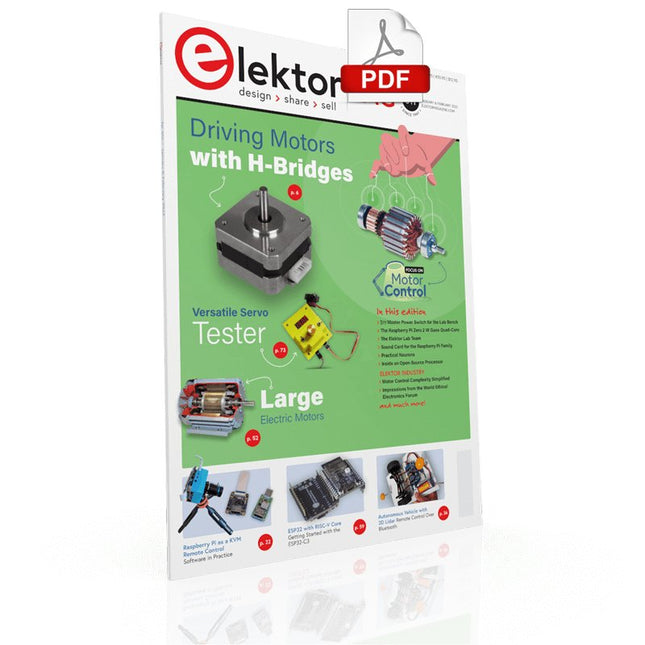
DRIVING MOTORS WITH H-BRIDGESAn Introduction to DC, Stepper, and Brushless Motors
THE ELEKTOR LAB TEAMOur Approach, Preferred Tools, and More
RASPBERRY PI AS A KVM REMOTE CONTROLPi-KVM Software Test
IQAUDIO CODEC ZEROA Sound Card for the Raspberry Pi Family
THE PIKVM PROJECT AND LESSONS LEARNEDInterview with Maxim Devaev (Developer, PiKVM)
AUTONOMOUS VEHICLE WITH 2D LIDARESP32 Pico Interprets Data from the Lidar Module THE RASPBERRY PI ZERO 2 W GOES QUAD-CORE NOTES FROM THE 2021 WORLD ETHICAL ELECTRONICS FORUM
MOTOR CONTROLHow the Complexity of Motor Control Is Simplified
LARGE ELECTRIC MOTORSBasic Principles and Useful Information GETTING STARTED WITH THE ESP32-C3 RISC-V MCU
PROTECT YOURSELF AND OTHERS!DIY Master Power Switch for the Lab Bench
CREATE GUIS WITH PYTHON (PART 2)Spy name chooser
PRODUCTRONICA FAST FORWARD 2021 WINNERSExciting Technologies and Creative Engineering Solutions
VERSATILE SERVO TESTERCheck Behavior When There’s No Datasheet
MODBUS OVER WLAN (PART 2)Software for the Modbus TCP WLAN Module
UNDERSTANDING THE NEURONS IN NEURAL NETWORKS (PART 3)Practical Neurons
INSIDE AN OPEN-SOURCE PROCESSORSample Chapter: Lattice and Xilinx FPGA Results
STARTING OUT IN ELECTRONICSWe Are Not Yet Done with the Coil
ERR-LECTRONICSCorrections, Updates and Readers’ Letters
COLOR TO SOUNDHow to Read Out a Color Sensor via I2C
BATTLAB-ONEMeasure and Optimize the Battery Life of IoT Devices
SIMPLE EARTH-LEAKAGE TRACERTesting Isolation of Mains Supply
POVERTY AND ELECTRONICSSustainable Development Goal 1
HEXADOKUThe Original Elektorized Sudoku
Elektor GREEN and GOLD members can download their digital edition here.
Not a member yet? Click here.
The ESP-BLASTA Mini ESP32 Rocket Drone That Flies 100 km/h+
Wireless Workshop (1)Radio Modules Unlocked: 433 MHz CC1101 Sub-GHz Transceiver
AM TransmitterWith Square/Sine Wave Generator on Raspberry Pi Pico
STM32Cube Innovation ChallengeCompete with Your Best STM32C5 Design
CoffeeCallerHow a Long Hallway Led to a Custom Mesh-Networked PCB
AudiotronicsTotal Harmonic Distortion
Elektor at 65Projects from Septembers and Octobers Past
Bluetooth Channel Sounding for Asset TrackingCentimeter-Level Precision Ranging for Next-Generation IoT
2026: An AI OdysseyQuantum Computing Is Not the Next GPU
Protecting the Cloud Demands Security at the Edge
First Experiences with the HackRF ProPractical Tests with the New SDR Hardware
Modem Upgrade from GPRS/2G to LTE/4GUsing a Wireless Alarm Control Panel as an Example
Loop Antenna with RF BricksPart 1: A DIY Shortwave Antenna with Adjustable Directivity
Internet Radio to AM ConverterUsing an ESP32-S3 as Transmitter
Err-lectronics
mioty — An OverviewFraunhofer’s Approach to LPWAN
Workbench WisdomPractical Tips from Experts
Walter, the Compact IoT ModulePart 2: Accessing Weather and Data Services
Diese Ausgabe steht allen GOLD- und GREEN-Mitgliedern auf der ElektorMagazine-Website zum Download bereit!
Sie sind noch kein Mitglied? Hier klicken!
High-End aus dem Elektor-Labor
High-End-Verstärker Fortissimo-100Vollsymmetrische Audio-Endstufe mit 100/190 W
Frequenzbestimmung unbekannter Schwingkreise und QuarzeTips & Tricks, Best Practices and Other Useful Information
Platinen entwerfenTipps aus der Praxis
Löten ….na und?Ein etwas genauerer Blick auf die heutige Löttechnik
Bluetooth-Garagentorsteuerung mit niedriger LatenzSteuerung mit kurzen BLE-Nachrichten über ein Smartphone
Ideal Diode Controller„Dioden“ mit geringer Verlustleistung
LED-Girlanden mit ESP32 und FreeRTOSBlinken und variable Helligkeit
Aller Anfang ...... muss nicht schwer sein: Es geht weiter mit den Z-Dioden
UKW/DAB+-EmpfängerDas Beste aus beiden Welten
Aus dem Leben gegriffenElectronica Obscura
Software-Fehlern drahtlos auf der SpurZirkularer Puffer und Webserver auf dem ESP32
Hat Covid einen Innovationsschub im Ingenieurwesen ausgelöst?Innovative Bauteile, Komponenten und Lösungen 2022
Ersa i-CON TRACE – die IoT-Lötstation für Praktiker
Infographics
Was wollen wir mit all diesen Daten machen?
Ansteuerung des E-Paper-Displays von Ynvisible
Immer innovativ mit InnoFaithF&A mit Walter Arkesteijn
Industrielle AutomatisierungEinfache und skalierbare IoT-Nachrüstungen
Das Oszilloskop der nächsten Generation für schnellere EinblickeRohde & Schwarz präsentiert die R&S MXO 4 Serie
Linear-Steckverbinder mit niedrigem Profil lösen Aufgaben im Multi-Signal-Datenmanagement
Smart – Innovativ – KosteneffizientGateMate-FPGAs entwickelt und hergestellt in Deutschland
Vom Layout zum Prototypen an einem Tag4-Lagen-PCBs im Elektronik-Labor
Tools für die kostengünstige Sensorentwicklung
Isolierter Analogausgang für Arduino Uno
Betreten für Unbefugte verboten!Herr Karenovics entdeckt das Theremin
electronica fast forward 2022 - powered by ElektorLine-up und Zeitplan
SenderpeilungVerlorene Funk-Wettersensoren wiederfinden
Das interne Rauschen eines ICs abschätzenMit einer einfachen Methode
Ethik in AktionUnterstützt vom WEEF
Ohne Ethik kein nachhaltiges GeschäftEin Interview mit Professor Stefan Heinemann
Der WEEF-Index 2023
Filter-SoftwareDesign-Tools für analoge Filter
TV-B-Gone!... oder zumindest: B-OFF
RP2040-basierte Luftgütemessung
Kickstart zu Python 3Ein Beispiel-Kapitel: Digitale Bildverarbeitung und Wand-Bibliothek
PolyfusesBemerkenswerte Bauteile
Hexadoku
Le téléchargement intégral de ce numéro est disponible pour nos membres GOLD et GREEN sur le site Elektor Magazine !
Pas encore membre ? Cliquez ici.
carte de développement MultiRFUne plateforme pour évaluer les protocoles sans fil à courte et longue portée
Elektor fête ses 65 ansAu cœur de l'électronique depuis 1961
détection de personnes par Wifi sur un ESP32Quand votre routeur devient un capteur de mouvement
balances sans filQuatre petites balances = une grande balance
Walter, le module IoT compactSoC ESP32-S3, modem 5G LTE-M/NB-IoT et récepteur GNSS
conditionnement des capteurs RTD à 3 et 4 filsAvec ajustement d’échelle et compensation des câbles
oscilloscope/générateur/multimètre à 2 voies 3-en-1Revue du Fnirsi 2D15P
electronica Fast Forward 2026 ouvre ses candidatures aux startups et partenaires industriels
EcologgingUne station IoT environnementale modulaire pour la recherche de terrain
la connectivité sans fil dans les applications médicalesAu rythme du pouls avec le Bluetooth LE
audiotroniqueRéduction du ronflement
optimiser les rendements agricoles grâce à la modélisation par IA et aux capteursAméliorer la productivité agricole
OPC UA : un aperçuÉchange de données indépendant des plateformes
redox-mètre
amplificateur d’instrumentation pour expériences de physique et d’ingénierie
filtres audio actifs différentielsPour les crossovers et plus encore
perspectives de la communauté Elektor sur l’IdO et les capteurs
module d’interface pour chauffe-eau piloté via TelegramUne solution basée sur un ESP32 et Arduino
2026 : une odyssée de l'IALa logique floue a-t-elle disparu ?
projet 2.0
injecteur de signal d’alarme plus secteuroutils pour localiser les coupures de fil
Elektor GREEN en GOLD leden kunnen deze uitgave hier downloaden.Nog geen lid? Klik hier om een lidmaatschap af te sluiten.
Kiesschijftelefoon als afstandsbedieningvoor licht kies 1; voor koffie kies 2
GPS-gebaseerde snelheidsmeternooit meer bekeuringen
RGB-stroboscoop met Arduinokleurige toepassing van een nuttig instrument
Draadloze nooddrukknopmeer veiligheid met LoRa
Alle begin......volgt de emitter
Vrij te kiezen onafhankelijke hystereseniveaus voor comparatorenmet simulaties, spreadsheets en algebra
Impedantie-analyzer op basis van een ESP32simpel, weinig onderdelen en goedkoop!
Oost West Lab Bestzelfbouw moet gestimuleerd!
Het MCCAB Arduino Nano Training Boardalle hardware voor de “Microcontrollers Hands-On Course”
Uit het leven gegrepenmodern luddisme
Sensor-ABC: de DS18B20 temperatuursensoraansluiting op de 1-Wire bus
Gaan Matter en Thread het Smart Home redden?nieuwe standaarden om het slimme huis te vereenvoudigen
Een kwestie van samenwerkingontwikkelen met het Thing Plus Matter Board en Simplicity Studio
Elektor IIIIinfographicIoT en sensoren
Matter, ExpressLink, Rainmaker – waar hebben we het over?vraaggesprek met Amey Inamdar van Espressif
De juiste keuze van microcontroller-ontwikkelkitsvoor IoT- en IIoT-toepassingen
Condensatoren gedragen zich niet altijd capacitief!
Een NTP-klok met CircuitPythonwaarom zou je deze programmeertaal gebruiken?
Bouw een cool IoT-display'met de Phambili Newt
De doppler-bewegingssensor HB100theorie en praktijk
Een gids voor puristisch programmeren (deel 1)voor STM32 en andere controllers
Siglent SDM3045X-multimeter
Microprocessoren voor embedded systemenvreemde onderdelen
Microcontroller-documentatie verklaarddeel 3: blokschema’s en meer
Low-power LoRa-weerstationbouw zelf een weerstation met een groot bereik
Transverter voor de 70cm-band
Klimaat aan ingenieurssnelheid is geboden!
Hexadoku