
Search results for "sdr"
-
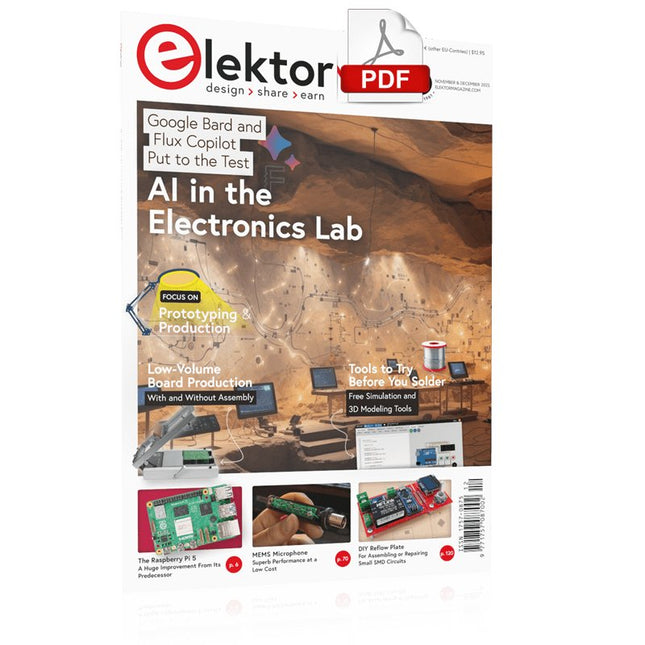
Elektor Digital Elektor November/December 2023 (PDF)
Elektor GREEN and GOLD members can download their digital edition here. Not a member yet? Click here. The Raspberry Pi 5A Huge Improvement From Its Predecessor AI in the Electronics LabGoogle Bard and Flux Copilot Put to the Test Arduino Nano Waveform GeneratorNano + Code = Function Generator Solar-Powered Christmas GarlandAn Eco-Friendly Solution for Garnishing Your Balcony USB Killer DetectorBetter Safe Than Sorry A Simple CNCed EnclosureWith Autodesk Fusion 360 for Personal Use Low-Volume Board ProductionWith and without Assembly IoT Simulation Simplified with WokwiDeveloper Uri Shaked on Design, Software, and More A Bare-Metal Programming Guide (Part 3)CMSIS Headers, Automatic Testing, and a Web Server LoRa, a Swiss Army Knife (2)The Hardware and Software MEMS Microphone Design and Construction Tools to Try Before You SolderSimulation and 3D Modeling Tools That Can Be Used for Free New Tools From Microchip!PICkit 5 and MPLAB ICD 5 Available Now! Rapid Prototyping of Flexible, Stretchable ElectronicsHow the Voltera NOVA Speeds Up Innovation in Wearable Electronic Systems Galvanic IsolationUsing Phototransistor Optocouplers Successfully The Complex Solution or the Anybus Solution?Embedded Industrial Ethernet in 2 Days Rather Than Many Months Your Essential DFM ChecklistHow to Start Designing for Manufacture 3D Printing FilamentsTypes, Features and Use in Prototyping Specialists for Effective Signal Analysis from ELF to EHF BandAaronia’s latest real-time SPECTRAN® V6 series spectrum analyzers Challenges of DFM Analysis for Flex and Rigid-Flex Design Setting Up an SMT Line The Right Combination for a Reliable Assembly Revolutionizing IndustriesThe Rise of Autonomous Mobile Robots (AMRs) Evolved for More ChallengesRohde & Schwarz Adds Eight-Channel R&S MXO 5 to Next-Generation Oscilloscopes Starting Out in Electronics……Amplifying Differences Mini Reflow PlateFor Assembling or Repairing Small SMD Circuits Don’t Start with a Prototype – Start with a Pretotype!Check That a Market Exists for Your Product Before Warming Your Soldering Iron 2023: An AI OdysseyGetting Help Designing a Physical Project Brussels Is InnovatingSupport for Deep Tech
€ 7,50
-

Elektor Digital LoRaWAN-Knoten im IoT (PDF)
Fertige und selbst aufgebaute Arduino-Knoten im TTN LoRaWAN hat sich als Kommunikationslösung im IoT hervorragend entwickelt. The Things Network (TTN) hat hierzu seinen Beitrag geleistet. Aktuell wird The Things Network auf The Things Stack Community Edition (TTS (CE)) aktualisiert. Die Cluster von TTN V2 werden gegen Ende 2021 geschlossen. Der Autor zeigt Ihnen die notwendigen Schritte, damit Sie in gewohnter Weise LoRaWAN-Knoten mit Hilfe von TTS (CE) betreiben und vielleicht auch das Netz der Gateways durch ein eigenes Gateway erweitern. Mittlerweile gibt es sogar für den mobilen Einsatz geeignete LoRaWAN-Gateways mit denen Sie über Ihr Mobiltelefon Verbindung zum TTN-Server aufbauen können. In diesem Buch werden eine Reihe kommerzieller und Arduino-basierter LoRaWAN-Knoten als auch neue, kostengünstige und für den Batteriebetrieb geeignete Hardware zum Aufbau autonomer LoRaWAN-Knoten vorgestellt. Die Registrierung von LoRaWAN-Knoten und Gateways im TTS (CE) sowie die Bereitstellung der erhobenen Daten über MQTT und die Visualisierung über Node-RED, Cayenne, Thingspeak und Datacake ermöglichen komplexe IoT-Projekte und völlig neue Anwendungen zu sehr geringen Kosten. Das vorliegende Buch versetzt Sie in die Lage, mit batteriebetriebenen Sensoren (LoRaWAN-Knoten) erfasste Daten drahtlos im Internet bereitzustellen und zu visualisieren. Sie lernen die Grundlagen für Smart-City- und IoT-Anwendungen, die beispielsweise die Messung von Luftqualität, Wasserständen, Schneehöhen, das Ermitteln von freien Parkfeldern (Smart Parking) und die intelligente Steuerung der Straßenbeleuchtung (Smart Lighting) u.a.m. ermöglichen.
€ 32,80
Members: € 29,52
-

Elektor Digital Arduino entdecken (PDF)
Arduino entdecken (E-book)
€ 32,80
Members: € 29,52
-

Elektor Digital Röhren 5 (PDF)
Aus dem Inhalt Lohnt sich der Selbstbau von Verstärkern noch? Warum HiFi-Geräte unterschiedlich klingen Elkos, Gleichrichter und ihr korrekter Einsatz PPP-Endstufe mit der Röhre EL 84 T Mittelwellen-Zweikreisempfänger 0-V-2-Kurzwellenaudion mit ECC 88 Kaffeewärmer mit Röhrenantrieb Vielseitige Experimentierplatinen Röhrensound-Konverter Mikrofonverstärker mit Röhren EL34, 6L6GC oder KT88 Magische Augen, Fächer und Bänder Kampf den Exemplarstreuungen Einfache Röhrenprüfung Kummer mit minderwertigen Röhren Das SRPP-Prinzip
€ 16,90
Members: € 15,21
-

Elektor Digital Introductie tot de Elektro-akoestiek (E-book)
Dit boek is bedoeld voor diegenen die zich bezig houden met geluidsversterking en geluidsdistributie. Het gaat in op de akoestische eigenschappen van open, halfopen en omsloten ruimten. Belangrijk is hoe luidsprekers aangepast kunnen worden op allerlei omgevingen. Meestal moet men een keuze maken uit het aanbod van luidsprekers en microfoons. De vraag is dan welke luidspreker en microfoon de juiste keuze zijn. En hoe deze moeten worden opgesteld waarbij spraak- en muziekverstaanbaarheid en de maximaal haalbare versterking in de live-situatie de belangrijkste criteria zijn. Dit boek geeft antwoord op die vragen. Verder wordt de lezer meegenomen naar het ontwerpen van luidsprekers op basis van de T/S parameters. Met eenvoudige software is het mogelijk akoestische en mechanische elementen van een luidspreker met de eventuele behuizing te vertalen naar de elektrische analogieën, zodat de luidspreker op de PC gesimuleerd kan worden. Aan de hand van rekenvoorbeelden worden bovenstaande simulaties ondersteund. Tot slot zijn in de referentielijst een aantal internetlinks opgenomen waaruit zeer waardevolle gegevens gehaald kunnen worden. De auteur, Peter Swarte, is natuurkundig ingenieur en was werkzaam bij Philips. Momenteel is hij_eigenaar van consultancy bureau P.A.S. Electro Acoustics en is hij actief lid van zowel het NAG (Nederlands Akoestisch Genootschap) als de AES (Audio Engineering Society).
€ 29,95
Members: € 26,96
-
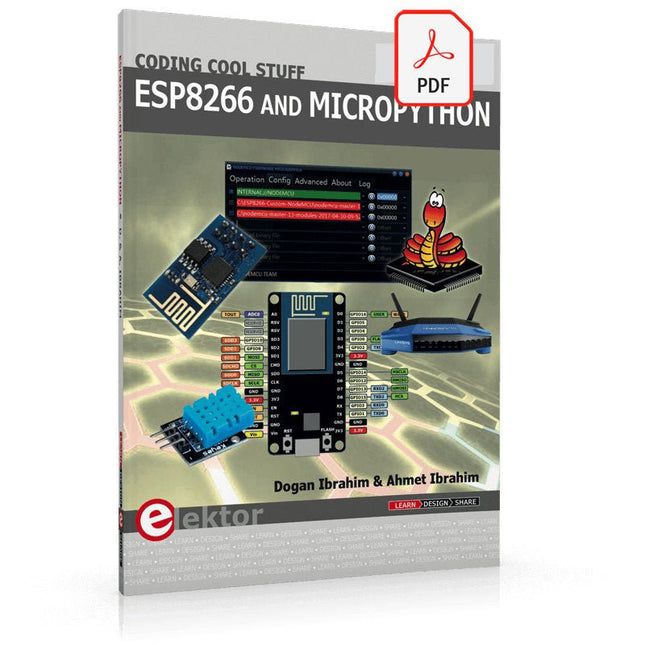
Elektor Digital ESP8266 and MicroPython (E-book)
Recently, the development of a tiny chip called the ESP8266 has made it possible to interface any type of microcontroller to a Wi-Fi AP. The ESP8266 is a low-cost tiny Wi-Fi chip having fully built-in TCP/IP stack and a 32-bit microcontroller unit. This chip, produced by Shanghai based Chinese manufacturer Espressif System, is IEEE 802.11 b/g/n Wi-Fi compatible with on-chip program and data memory, and general purpose input-output ports. Several manufacturers have incorporated the ESP8266 chip in their hardware products (e.g. ESP-xx, NodeMCU etc) and offer these products as a means of connecting a microcontroller system such as the Android, PIC microcontroller or others to a Wi-Fi. The ESP8266 is a low-power chip and costs only a few Dollars. ESP8266 and MicroPython – Coding Cool Stuff is an introduction to the ESP8266 chip and describes the features of this chip and shows how various firmware and programming languages such as the MicroPython can be uploaded to the chip. The main aim of the book is to teach the readers how to use the MicroPython programming language on ESP8266 based hardware, especially on the NodeMCU. Several interesting and useful projects are given in the e-book (pdf) to show how to use the MicroPython in NodeMCU type ESP8266 hardware: Project “What shall I wear today?”: You will be developing a weather information system using a NodeMCU development board together with a Text-to-Speech processor module. Project “The Temperature and Humidity on the Cloud”: You will be developing a system that will get the ambient temperature and humidity using a sensor and then store this data on the cloud so that it can be accessed from anywhere. Project “Remote Web Based Control”: You will be developing a system that will remotely control two LEDs connected to a NodeMCU development board using an HTTP Web Server application.
€ 29,95
Members: € 26,96
-

Elektor Digital Control Engineering with Fuzzy Logic (E-book)
Practical Applications and Project with Arduino, ESP32, and RP2040 Immerse yourself in the fascinating world of control engineering with Arduino and ESP32! This book offers you a practical introduction to classic and modern control methods, including PID controllers, fuzzy logic, and sliding-mode controllers. In the first part, you will learn the basics of the popular Arduino controllers, such as the Arduino Uno and the ESP32, as well as the integration of sensors for temperature and pH measurement (NTC, PT100, PT1000, and pH sensor). You will learn how to use these sensors in various projects and how to visualize data on a Nextion TFT display. The course continues with an introduction to actuators such as MOSFET switches, H-bridges, and solid-state relays, which are used to control motors and actuators. You will learn to analyze and model controlled systems, including PT1 and PT2 control. The book focuses on the implementation of fuzzy and PID controllers for controlling temperature and DC motors. Both the Arduino Uno and the ESP32 are used. The sliding-mode controller is also introduced. In the second-to-last chapter, you will explore the basics of neural networks and learn how machine learning can be used on an Arduino. In the last chapter, there is a practical example of a fuzzy controller for feeding electricity into the household grid. This book is the perfect choice for engineers, students, and electronics engineers who want to expand their projects with innovative control techniques.
€ 34,95
Members: € 31,46
-

Elektor Digital Oszilloskope und Analysatoren (E-book)
Oszilloskope und Analysatoren (E-book)
€ 39,80
Members: € 35,82
-

Elektor Digital Elektor November/December 2023 PDF (NL)
Elektor GREEN en GOLD leden kunnen deze uitgave hier downloaden.Nog geen lid? Klik hier om een lidmaatschap af te sluiten. De Raspberry Pi 5veel beter dan zijn voorganger AI in het elektronicalabontwerpen, componenten zoeken en programmeren Arduino Nano-golfvormgeneratorNano + code = functiegenerator Kerstslinger op zonne-energiemilieuvriendelijke oplossing voor op het balkon USB-killer-detectorvoorkomen is beter Een eenvoudige behuizing CNC’enmet Autodesk Fusion 360 voor persoonlijk gebruik Printen in geringe aantallen producerenmet en zonder assemblage IoT-simulatie vereenvoudigd met Wokwiontwikkelaar Uri Shaked over ontwerp, software en meer Een gids voor puristisch programmeren (deel 3)CMSIS-headers, automatisch testen en een webserver LoRa, een Zwitsers zakmesdeel 2: de hard- en software MEMS-microfoonontwerp en constructie Eerst proberen, dan solderengratis simulatie- en 3D-ontwerptools Nieuwe tools van Microchip!PICkit 5 en MPLAB ICD 5 nu verkrijgbaar! Snelle prototypen van flexibele, rekbare elektronicahoe de Voltera NOVA innovatie bij wearables versnelt Galvanische isolatiefototransistor-optocouplers succesvol gebruiken De complexe of de Anybus-oplossing?embedded industrieel ethernet in twee dagen in plaats van maanden De essentiële DFM-checklistontwerpen voor productie – hoe doe je dat? Filamenten voor 3D-printensoorten, kenmerken en gebruik bij prototyping Specialisten voor effectieve signaalanalyse van de ELF- tot de EHF-bandde nieuwste real-time SPECTRAN® V6 serie spectrumanalyzers van Aaronia Uitdagingen van DFM-analyse voor flex- en rigid-flex-ontwerpen Een SMT-productielijn installeren Elektor infographicsprototyping en productie Een revolutie voor de industriede opkomst van autonome mobiele robots Gemaakt voor groteuitdagingenRohde & Schwarz voegt achtkanaals R&S MXO 5 toe aan volgende generatie oscilloscopen Alle begin......versterkt verschillen Mini-reflowplaatvoor assemblage of reparatie van kleine SMD-schakelingen Begin niet met een prototype – begin met een pretotype!kijk of er wel een markt is voor je product voordat je de soldeerbout warmstookt 2023: een AI-odysseehulp bij het ontwerp van een tastbaar project Brussel innoveertsteun voor deep tech
€ 9,95
-

Elektor Digital C# 2010 Programmierung und PC-Anbindung (PDF)
Ziel dieses Buches ist, auf einfache Weise zu zeigen, wie mit der populären Hochsprache C# ein PC programmiert werden kann. Am Anfang beschreibt das Buch Datentypen und Programmsteuerungen, die dann um fortschrittliche Konzepte wie die objektorientierte Programmierung, Threads, die Internetkommunikation und Datenbanken erweitert werden. Alle verwendeten Code-Beispiele stehen unter "Downloads" zum Herunterladen bereit. Mit den vorgestellten Konzepten können auf einfache Weise eigene Ergebnisse erzielt und somit der Lernprozess unterstützt werden. Auch professionelle Software-Tools von Microsoft stehen zum kostenlosen Download zur Verfügung. Die Anwender stellen für Microsoft's Visual Studio 2010 eine Vielzahl von Steuerungen, Eigenschaften, Methoden und Ereignissen bereit. Leser, die die Hardware eines PCs steuern wollen, erhalten genaue Anleitungen. In den Kapiteln über PC-Schnittstellen wird das Erbe der seriellen und parallelen Ports besprochen, analoge Zugänge steuern die Soundkarte und verwenden DirectX-Treiber von Microsoft. Die Anbindung des allgegenwärtigen USB-Ports wird genau erklärt, einschließlich des Entwurfs von Hard- und Software zur Steuerung eines PIC-Boards via USB. Viele Programmbeispiele, praktische Übungen und Links auf Support-Videos vervollständigen dieses Buch – das teilweise in englischer Originalsprache. Universitätsdozenten bieten für die meisten Kapitel Hilfen in Form von herunterladbaren PowerPoint-Präsentationen an. Das vorliegende Buch von Dr. John Allwork berücksichtigt bei der C#-Entwicklung auch die neue Version Visual Studio 2010 und das Microsoft-Betriebssystem Windows 7.
€ 39,80
Members: € 35,82
-

Elektor Digital High-End-Röhrenverstärker (PDF)
High-End-Röhrenverstärker (PDF)
€ 44,80
Members: € 40,32
-

Elektor Digital Elektronik-Praxis für Einsteiger (E-book)
Elektronik-Praxis für Einsteiger (E-book)
€ 32,80
Members: € 29,52


