This book is all about building your own DIY home control system. It presents two innovative ways to assemble such a system: By recycling old PC hardware – possibly extending the life of an old PC, or by using Raspberry Pi. In both cases, the main system outlined in this book will consist of a computer platform, a wireless mains outlet, a controller and a USB webcam – All linked together by Linux.
By using the Raspberry Pi in conjunction with Arduino (used as an advanced I/O system board), it is possible to construct a small, compact, embedded control system offering enhanced capacity for USB integration, webcams, thermal monitoring and communication with the outside world.
The experience required to undertake the projects within this book are minimal exposure to PC hardware and software, the ability to surf the internet, burn a CD-ROM and assemble a small PCB.
Elektor GREEN en GOLD leden kunnen deze uitgave hier downloaden.
Nog geen lid? Klik hier om een lidmaatschap af te sluiten.
IoT-innovatie in galop
Een E-Ink WiFi kleuren-fotolijst
ESP-Launchpad tutorialvan nul tot flashen in een paar minuten
ESP32 en ChatGPTop weg naar een zelf-programmerend systeem…
Walkie-talkie met ESP-NOWniet echt WiFi, niet echt Bluetooth, maar...
Van idee tot schakeling met de ESP32-S3zo bouw je een prototype met Espressif-chips
AIoT chip-innovatieeen vraaggesprek met Teo Swee-Ann, CEO van Espressif
Simuleer ESP32 met Wokwide digitale tweeling van je project
Test van de ESP32-S3-BOX-3een uitgebreid AIoT-ontwikkelplatform
voor je elektronica-werkplekoverwegingen en tips van Espressif-technici
Het ESP RainMaker-verhaalhoe we “jouw” IoT-cloud bouwden
Bouw van de Elektor Cloc 2.0een Elektor-product uitgepakt door Espressif
De ESP32-P4 ontketendde volgende microcontroller-era
Rust + embeddedeen krachtig ontwikkelduo
Wie zijn de onvervaarde embedded Rust-ontwikkelaars?zo cultiveert Espressif embedded Rust voor de ESP32
de SoC-serie van Espressif
Een PLC met oplossingen van Espressifmet de mogelijkheden en functionaliteit van het ISOBUS-protocol
Het ESP32-S3 VGA-boardvolg Bitluni tijdens het ontwerpproces
Acoustic fingerprinting met de ESP32songherkenning met het open-source project Olaf
Ronde kerstboom 2023een high-tech manier om de feestdagen te vieren
Een eenvoudiger en handiger leveneen amateurproject op basis van de ESP8266-module van Espressif
IoT-apps bouwen zonder software-expertisemet het Blynk IoT-platform en Espressif-hardware
Bouw een slimme gebruikersinterface op ESP32
Snelle en gemakkelijke IoT-ontwikkeling met M5Stack
Prototype van een ESP32-gebaseerde energiemeter
Een distributeur met meerwaarde voor IoT en meer
Achter de schermen: vraaggesprek met Arduino over de Nano ESP32Alessandro Ranellucci en Martino Facchin over de samenwerking met Espressif
achter de schermen van Espressif
Stroomlijnen van MCU-ontwikkeling met ESP-IDF Privilege Separation
Een open-source spraakherkenningsserver......en de ESP BOX
Het denkende ooggezichtsherkenning en meer met de ESP32-S3-EYE
Knoopcel-schakelaar met ESP32-C2prestatiegericht ontwerpen
Matter stuwt het slimme huis voorwaartsontsluit het potentieel van Smart Home IoT
Tech the Future: Waarheen met Smarthome IoT?
Elektor GREEN and GOLD members can download their digital edition here.
Not a member yet? Click here.
Small Thermal Imaging CameraAn Arduino UNO-Based DIY Solution
Project Update #3: ESP32-Based Energy MeterIntegration and Testing with Home Assistant
2024: An AI OdysseyEnhancing Object Detection: Integrating Refined Techniques
Raspberry Pi Goes AINew Kit Incorporates M.2 HAT+ With AI Accelerator
Weather Station SensorsWhich One Should You Choose?
AI-Based Water Meter Reading (1)Get Your Old Meter Onto the IoT!
A GSM AlarmHarnessing GSM Technology for Remote Garage Safety
Low-Power Thread Devices Optimized and ScrutinizedLow Power … Low Effort?
From Life’s ExperienceThe Gender Gap
DIY Cloud ChamberMaking Invisible Radiation Visible
SparkFun Thing Plus MatterA Versatile Matter-Based IoT Development Board
IoT RetrofittingMaking RS-232 Devices Fit for Industry 4.0
Enabling IoT with 8-Bit MCUs
Technology Drives SustainabilityAdvances Lead to More Efficient Use of Energy in Many Applications
AWS for Arduino and Co. (1)Using AWS IoT ExpressLink in Real Life
Airflow Detector Using Arduino OnlyNo External Sensors Needed!
Water Leak DetectorConnected to Arduino Cloud
CrystalsPeculiar Parts, the Series
Universal Garden LoggerA Step Towards AI Gardening
Analog 1 kHz GeneratorSine Waves with Low Distortion
Miletus: Using Web Apps OfflineSystem and Device Access Included!
From 4G to 5GIs It Such an Easy Step?
Starting Out in Electronics……Balances Out
Le téléchargement intégral de ce numéro est disponible pour nos membres GOLD et GREEN sur le site Elektor Magazine !
Pas encore membre ? Cliquez ici.
petite alimentation solairelumière du soleil en entrée, 3,3 V en sortie
commutateur audio stéréo statiquesans clics ni pièces mobiles
grand chiffre RGBavec LED traversants de type WS2812
préamplificateur de microphone avec alimentation fantôme 48 Vidéal pour le podcasting et la sonorisation pro
générateurs d'ondes carrées avec commande de rapport cyclique et de fréquencemontages simples avec des CI CMOS et TTL
compresseur Dynamique Simpleavec contrôle doux et un son chaleureux
serrure électronique simple
redresseur actifde 2 à 40 V jusqu'à 3 A avec suppression du courant inverse
commutation marche/arrêt pour enceintes actives
convertisseur symétrique/asymétriqueavec filtre RFI et protection CC
2023 : l'odyssée de l'IAorigine et évolution
régulateur de vitesse pour ventilateur ou aérateuravec modes manuel et thermostat
Plateforme Projets Arduino?: dernières nouvellesnouveaux projets de la communauté
moniteur de surchargesurveillez les lignes électriques pour détecter les courants excessifs
clignotement nocturne sans transistorsun oscillateur ne comportant que des composants à deux fils
générateur de code morseutilisez-le comme balise ou dispositif d'apprentissage !
CNA vidéo programmabletraite tous les formats jusqu'à RGB888
un tout petit pianosans pièces mobiles
double-dé électronique sans microcontrôleurdeux dés sur un seul circuit imprimé ? plus quelques astuces de conception
effaroucheur électronique
circuits qui amusent, inspirent et étonnent
thermomètre LC-LP-HAmesures précises et affichage binaire
générateur de distorsion harmoniquegénérer volontairement de la distorsion
indicateur de surchauffe à thyristorutilisation non conventionnelle des composants électroniques
une bascule CTP
un drôle d'oiseauun classique d'Elektor qui émet des gazouillis
lampe au néon avec microcontrôleur
source de courant stable en températureéliminer la dérive de température des CI sources de courant
correcteur d'aigus d'ordre 2 réglablecorrection auditive pour personnes âgées
Edwin revientaprès 53 ans d?absence
machine à sous à levierun classique d'Elektor simple, amusant, nostalgique et éducatif
résistance variable simple à contrôle numérique
protection contre les fuites d'eauprotection et alarme contre les fuites d'eau
minuterie économique avec arrêt automatiquenécessite 0,0 mW en mode éteint !
ChatGPT fait de l'Arduino
ZD-mètremesure de la tension de coude des diodes Z ? 100 V
testeur de servos
Contrôleur Windows ESP32 avec logiciel gratuit
circuits analogiques et mixtes de Microchipgestion de l'alimentation économe en énergie et traitement de signal
standards d?interfacesfiltrage et protection contre leurtensions pour le bus I²C
moniteur de batterie Li-Ionl'indicateur de charge résiduelle fournit un retour d'information visuel
souris PS/2 comme codeur rotatif (et plus?)
interrupteur crépusculaire simplepour moderniser vos luminaires ou vos installations
commande de pompe à eauprotégez-vous contre la montée des eaux
boule de Noël solaire avec radio FMtout ce que vous voulez pour Noël, c'est cela
capteur de vibrations avec relaistapotez ou secouez pour allumer
testeur de continuitésensible et discret
bouton-poussoir marche/arrêt
Contrôleur pour mini-perceuse 2023révision d'un projet de 1980
détecteur de vibration numériquetransformez les vibrations en impulsions précises
protection contre l'inversion de polarité avec faible chute de tension
étalon de fréquence peu coûteux
petit simulateur DCF77une référence précise pour le Fake-Time
le Lilygo T-PicoC3combine un RP2040 et un ESP32-C3 avec un écran TFT couleur
Hexadoku
Aus dem Inhalt
Lohnt sich der Selbstbau von Verstärkern noch?
Warum HiFi-Geräte unterschiedlich klingen
Elkos, Gleichrichter und ihr korrekter Einsatz
PPP-Endstufe mit der Röhre EL 84 T
Mittelwellen-Zweikreisempfänger
0-V-2-Kurzwellenaudion mit ECC 88
Kaffeewärmer mit Röhrenantrieb
Vielseitige Experimentierplatinen
Röhrensound-Konverter
Mikrofonverstärker mit Röhren
EL34, 6L6GC oder KT88
Magische Augen, Fächer und Bänder
Kampf den Exemplarstreuungen
Einfache Röhrenprüfung
Kummer mit minderwertigen Röhren
Das SRPP-Prinzip
Diese Ausgabe steht allen GOLD- und GREEN-Mitgliedern auf der ElektorMagazine-Website zum Download bereit!
Sie sind noch kein Mitglied? Hier klicken!
ESP32-Audio-Transceiver-Board (Teil 2)Drahtlose Audioübertragung
Induktiver AM-SenderPIO des Pico in einem Arduino-Sketch
Navigieren durch drahtlose ProtokolleEin technischer Leitfaden
Satellitenverfolgung mit LoRaDas TinyGS-Netzwerk: Raumfahrtdaten gelangen zur Erde
4G-kompatible SMS-FernbedienungSteuern Sie Ihr Zuhause per Telefon aus der Ferne
Hochgeschwindigkeits-TastkopfHochohmige Eingänge für Signale bis 200 MHz
Aus dem Leben gegriffenKafka
KrakenSDREin phasenkohärenter SDR-Empfänger
Geschwindigkeitstests mit dem RP2350Lohnt sich der Umstieg von Raspberry Pi Pico 1 auf Version 2?
Kontaktlose E-Feld-Messungen (2)Ein Laser-Vibrometer zur Erfassung der Membranschwingungen
Quarze und OszillatorenQuarzgenauigkeit durch die Kondensatorwahl verbessern
Aller Anfang ...... ist gar nicht schwer: Spezielle Audio-ICs
Einstieg ins Programmieren von Selbstbauprojekten
SPECTRAN® V6 MobileModular konfigurierbarer Echtzeit-Spektrum-Analyzer für zuverlässige Messungen in allen Frequenzbereichen
Die Zukunft der KI wird in Silizium geschmiedetEin Interview mit Anastasiia Nosova
Autonomer Sensorknoten v2.0 (Systemarchitektur)Solarbetriebene Sensorplattform mit integriertem GPS, LoRaWAN und weiteren Funktionen
Präzise PositionsbestimmungBluetooth Channel Sounding ausprobiert
Die Zukunft der Wireless-KommunikationDie ultradünnen Festkörperbatterien von BTRY
Testgetriebene Programmierung in der Firmware-Entwicklung
Handy-gesteuertes ModellautoWLAN + ESP32 + Smartphone = Fernsteuerung
2025: Eine KI-OdysseeKI-Denkmodelle: die Gedankenketten-Revolution
Solarladeregler mit MPP-TrackingTeil 3: Software und Inbetriebnahme
Web-Streaming-Kamera mit Raspberry Pi ZeroVerwendung des ZeroTier-VPN
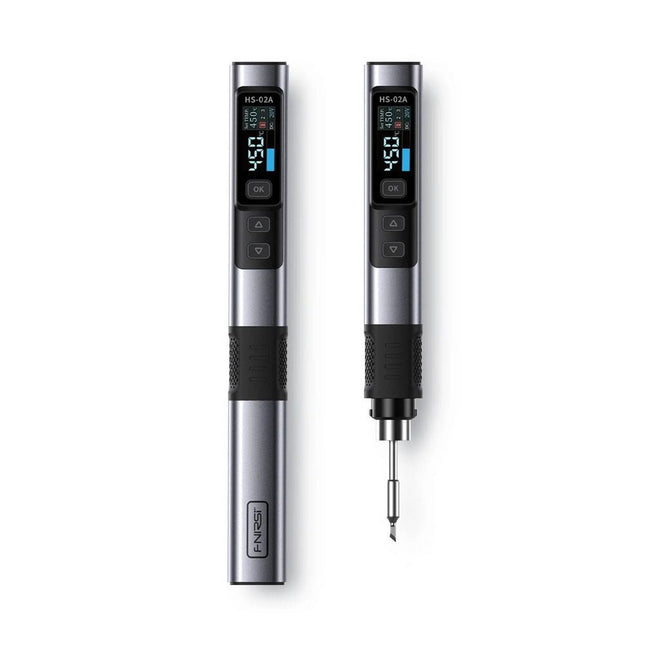
The FNIRSI HS-02A is an improved version of the HS-01 soldering iron with a better grip and a shorter tip for more comfort and precision during use. It features a larger 0.96-inch IPS HD color display that allows for better visibility of settings and status. With an output power of 100 W, the HS-02A heats up quickly and reaches operating temperature in about 2 seconds. The temperature is adjustable in a range of 100-450°C (212-842°F) to meet different soldering requirements.
Features
Temperature: 100-450°C (212-842°F)
Accurate temperature adjusting and control
Fast heating
CNC Metal Shell
Adaptive Power
100 W High Power
Protocols: PD, QC
Specifications
Temperature Range
100-450°C (212-842°F)
Working Voltage
9-20 V
Display
0.96" IPS HD Color Screen
Power Supply
USB-C
Fast Charging Protocols
PD / QC
Power
100 W (max)
Dimensions
180 x 20 mm
Weight
61 g
Included
1x FNRISI HS-02A Smart soldering iron
6x Soldering iron tips (HS02A-KU, HS02A-K, HS02A-JS, HS02A-I, HS02A-C2, HS02A-B)
1x Mini soldering iron stand
1x Manual
Downloads
Manual
Firmware V1.7
The Internet of Things is rapidly gaining interest, and that has fueled the development of the Edison. A tiny computer, the size of a postage stamp, with a lot of power and built-in wireless communication capabilities.
In this eBook we will help you get up-to-speed with the Edison, by installing the software both on the Edison as well as on your Windows PC. We will use the Edison Arduino break-out board because it is easy to work with. We will discuss Linux, Arduino C++ and Python, and show examples of how the Edison can interface with other hardware. We will use Wi-Fi and Bluetooth to set up wireless connections, and show you a trick to program sketches over Wi-Fi.
Once you have completed this book your Edison will be up and running with the latest software version, and you will have sufficient knowledge of both hardware and software to start making your own applications. You will even be able to program the Edison over USB and wireless both in Arduino C++ and Python.
This is not a projects eBook, but a toolbox that will allow you to explore the wonderful world of the Intel Edison!
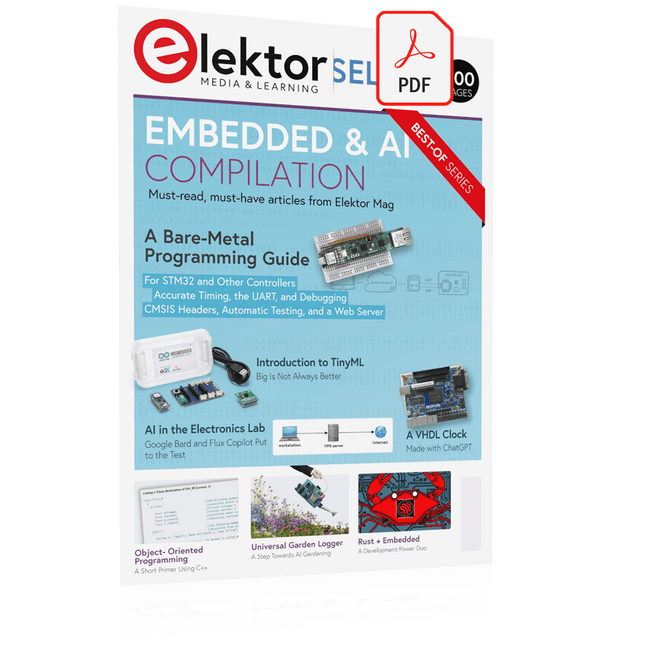
This collection features the best of Elektor Magazine's articles on embedded systems and artificial intelligence. From hands-on programming guides to innovative AI experiments, these pieces offer valuable insights and practical knowledge for engineers, developers, and enthusiasts exploring the evolving intersection of hardware design, software innovation, and intelligent technology.
Contents
Programming PICs from the Ground UpAssembler routine to output a sine wave
Object-Oriented ProgrammingA Short Primer Using C++
Programming an FPGA
Tracking Down Microcontroller Buffer Overflows with 0xDEADBEEF
Too Quick to Code and Too Slow to Test?
Understanding the Neurons in Neural NetworksEmbedded Neurons
MAUI Programming for PC, Tablet, and SmartphoneThe New Framework in Theory and Practice
USB Killer DetectorBetter Safe Than Sorry
Understanding the Neurons in Neural NetworksArtificial Neurons
A Bare-Metal Programming Guide
Part 1: For STM32 and Other Controllers
Part 2: Accurate Timing, the UART, and Debugging
Part 3: CMSIS Headers, Automatic Testing, and a Web Server
Introduction to TinyMLBig Is Not Always Better
Microprocessors for Embedded SystemsPeculiar Parts, the Series
FPGAs for BeginnersThe Path From MCU to FPGA Programming
AI in Electronics DevelopmentAn Update After Only One Year
AI in the Electronics LabGoogle Bard and Flux Copilot Put to the Test
ESP32 and ChatGPTOn the Way to a Self-Programming System…
Audio DSP FX Processor Board
Part 1: Features and Design
Part 2: Creating Applications
Rust + EmbeddedA Development Power Duo
A Smart Object CounterImage Recognition Made Easy with Edge Impulse
Universal Garden LoggerA Step Towards AI Gardening
A VHDL ClockMade with ChatGPT
TensorFlow Lite on Small MicrocontrollersA (Very) Beginner’s Point of View
Mosquito DetectionUsing Open Datasets and Arduino Nicla Vision
Artificial Intelligence Timeline
Intro to AI AlgorithmsPrompt: Which Algorithms Implement Each AI Tool?
Bringing AI to the Edgewith ESP32-P4
The Growing Role of Edge AIA Trend Shaping the Future
Elektor GREEN en GOLD leden kunnen deze uitgave hier downloaden.
Nog geen lid? Klik hier om een lidmaatschap af te sluiten.
OBD2-sensordashboardOude meters vormden het startpunt van een zoektocht naar echte gegevens
OBD2: voeg een toerenteller en schakelindicator toe aan je autoRetro, maar uiterst nuttig
LiDAR- en Visiesensoren voor Robotica
Sensor+Test 2025 en PCIM 2025
Contactloze E-Veldmetingen (1)Een Trillende Membraan voor het Detecteren van Gelijkspanningen of Statische Elektrische Velden
Draadloze brievenbusmeldervan optische sensoren tot radar: enkele mogelijkheden
Elektor Mini-Wheelieeen zelfbalancerende robot
ZonnecellenVreemde onderdelen, de serie
Aan de slag met een moderne radarsensorStaat een nauwkeurige meting op uw radar?
Uit het leven gegrepenpapierfabriek
CybersecurityZware tijden voor hackers
Infographics: IoT en sensoren 2025
Bluetooth 6.0 brengt verbeterde toepassingen voor afstandsbepalingNieuwe versie biedt betere apparaatpositionerings- en -locatieservices
Draadloze communicatie verkennen met BeagleY-AI
Err-lectronicsCorrecties, updates en lezerspost
Alle begin......sluit het thema opamps af
Een krachtige AI-codeerassistentsneller ontwikkelen met Continue en Visual Studio Code
Zonne-laadregelaar met MPPT (2)Het schema
Ultrasone obstakeldetectoreen eenvoudig project om slechtzienden te helpen
2025: Een AI-odysseeHalfjaaroverzicht
Raspberry Pi Standalone MIDI-synthesizer (3)Het slimmer maken en een gebruikersinterface toevoegen
Meshtastic: een demonstratieprojectEen slim netwerk van LoRa-radio's
Analoge audio-frequentiegeneratorHoogwaardige sinusgenerator met instelbare frequentie
Arduinonext is an initiative powered by an electronics and microcontrollers specialist team aiming to help all those who are entering in the technology world, using the well-known Arduino platform to take the next step in electronics.
We strive to bring you the necessary knowledge and experience for developing your own electronics applications; interacting with environment; measuring physical parameters; processing them and performing the necessary control actions.
This is the first title in the 'Hands-On' series in which Arduino platform co-founder, David Cuartielles, introduces board programming, and demonstrates the making of an 8-bit Sound Generator.
Lancé en mars 2012, plus les 30 millions d'exemples nanométriques du Raspberry Pi exposés. Il s’agit d’une contribution à la révolution des technologies de l’information et d’un grand stimulant pour le développement du monde de l’électronique. Le succès de la « tarte à la framboise » (traduction littérale de Raspberry Pie) est le résultat de l'industrie micro-électronique de transformation des produits.
Eben Upton, son créateur, âme à l'origine, les acheteurs étaient presque tous des makers , adultes en général. Cependant la plupart d'entre eux étaient également des ingénieurs professionnels. Rapidité, les gens sont responsables de leurs activités personnelles lors de l'utilisation du Raspberry Pi avec une plateforme informatique stable, et ils sont également adoptés pour leur métier.
La Fondation Raspberry Pi édite un magazine édité par la communauté Raspberry Pi : le MagPi (en anglais). Le magazine aborde les passions selon la nature du numérique nano-ordonné et global. Il contient des bancs d'essai de nouveaux produits, de nombreux tutoriels et un grand nombre de projets. Les membres de la communauté Raspberry Pi participent à leur expérience.
La maison d'édition Elektor s'associe à la Fondation Raspberry Pi pour la publication dans le magazine français MagPi. Il est conçu pour assembler 84 projets publics du MagPi en développant l'utilisation du Raspberry Pi et son inspiration.
Grâce à la taille fine et aux possibilités du Raspberry Pi, les créateurs du monde sont fiers des idées des plus folles.
Partez en voyage dans un monde où est faisable !
Le Raspberry Pi à toutes les sauces pour ?
s'inspirateur des projets réalisés par les membres de la communauté
dénicher des utilisations inouïes
découvrir des accessoires et technologies diverses
entrer dans une communauté intégrée et active de Raspberry Pi