Elektor GREEN en GOLD leden kunnen deze uitgave hier downloaden.
Nog geen lid? Klik hier om een lidmaatschap af te sluiten.
OBD2-sensordashboardOude meters vormden het startpunt van een zoektocht naar echte gegevens
OBD2: voeg een toerenteller en schakelindicator toe aan je autoRetro, maar uiterst nuttig
LiDAR- en Visiesensoren voor Robotica
Sensor+Test 2025 en PCIM 2025
Contactloze E-Veldmetingen (1)Een Trillende Membraan voor het Detecteren van Gelijkspanningen of Statische Elektrische Velden
Draadloze brievenbusmeldervan optische sensoren tot radar: enkele mogelijkheden
Elektor Mini-Wheelieeen zelfbalancerende robot
ZonnecellenVreemde onderdelen, de serie
Aan de slag met een moderne radarsensorStaat een nauwkeurige meting op uw radar?
Uit het leven gegrepenpapierfabriek
CybersecurityZware tijden voor hackers
Infographics: IoT en sensoren 2025
Bluetooth 6.0 brengt verbeterde toepassingen voor afstandsbepalingNieuwe versie biedt betere apparaatpositionerings- en -locatieservices
Draadloze communicatie verkennen met BeagleY-AI
Err-lectronicsCorrecties, updates en lezerspost
Alle begin......sluit het thema opamps af
Een krachtige AI-codeerassistentsneller ontwikkelen met Continue en Visual Studio Code
Zonne-laadregelaar met MPPT (2)Het schema
Ultrasone obstakeldetectoreen eenvoudig project om slechtzienden te helpen
2025: Een AI-odysseeHalfjaaroverzicht
Raspberry Pi Standalone MIDI-synthesizer (3)Het slimmer maken en een gebruikersinterface toevoegen
Meshtastic: een demonstratieprojectEen slim netwerk van LoRa-radio's
Analoge audio-frequentiegeneratorHoogwaardige sinusgenerator met instelbare frequentie
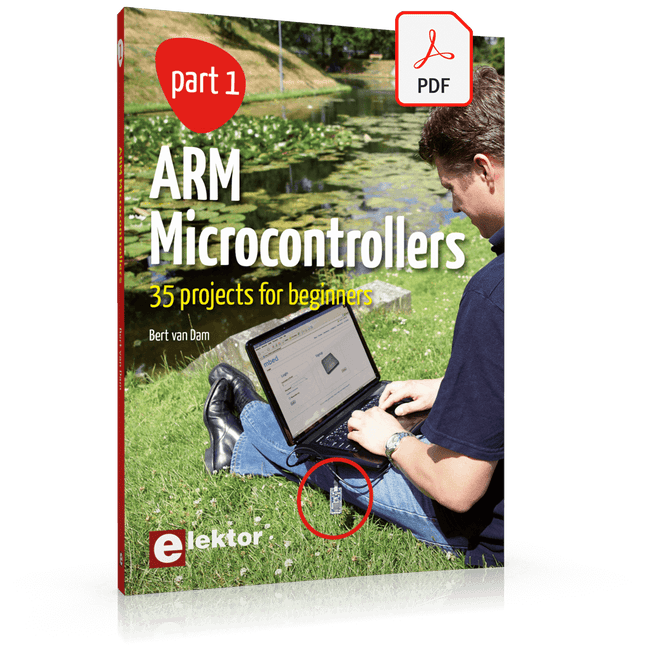
35 Projects for Beginners
This book is for hobbyists, students and engineers who want to learn C and how to use an mbed ARM microcontroller in an easy and fun way, without the need for cumbersome software installations.
ARM mbed microcontroller NXP LPC1768
The projects in this book are meant for beginners in C and ARM microcontrollers. That doesn't mean the projects are simple, but it does mean that they are easy to understand. We use for example USB communications, a subject that is made so easy by the mbed that it is suitable for a beginners book.
Cloud technology
The mbed NXP LPC1768 uses cloud technology, a revolutionary concept in software development. This means you do not need to install software on your PC in order to program the mbed!
The only thing you need is a browser such as Microsoft Internet Explorer, and a USB port on your PC. You can get access to your project from any PC anywhere in the world and continue working on it. When you are done a few simple mouse clicks transfer the program to your mbed hardware. Of course you can optionally download the projects and store them on your own PC.
Features of this Book
Learn how to program an mbed ARM microcontroller using cloud technology. No complicated software installation on your PC needed.
Learn programming in C by doing fun and interesting projects. No previous experience or knowledge required.
Examples of projects in this book: flashing light, timer, light activated switch, digital thermometer, people detector, USB communication, talking microcontroller, debugging, sound switch, and much more - 35 projects in total.
Examples of C subjects in this book: variables, commands, functions, program execution, pointers (introduction).
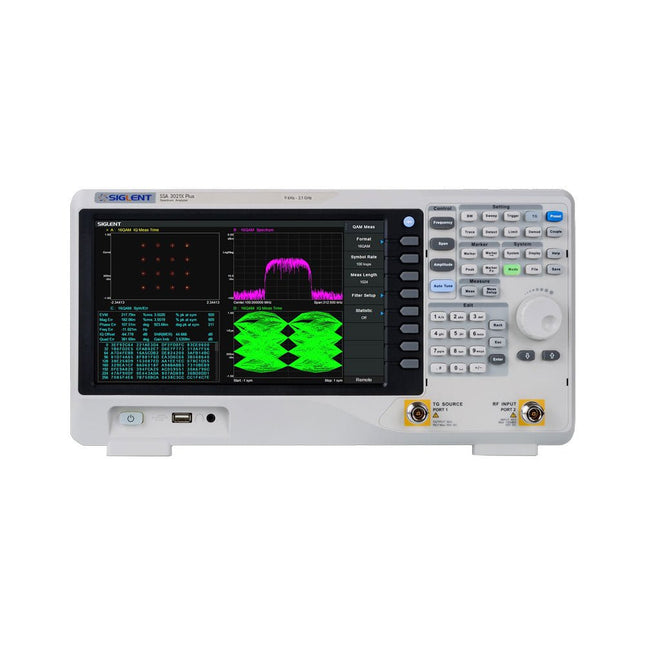
The Siglent SSA3021X Plus spectrum analyzer is a powerful and flexible tool for RF signal and network analysis. With a frequency range of 2.1 GHz, the analyzer delivers reliable automatic measurements and multiple modes of operation: spectrum analyzer the base, optional functions include RF power measurement, vector signal modulation analysis, reflection measurement, and EMI test.
Applications include broadcast monitoring/evaluation, site surveying, S-parameter measurement, analog/digital modulation analysis, EMI pre-compliance test, research and development, education, production, and maintenance.
Features
Spectrum Analyzer Frequency Range from 9 kHz to 2.1 GHz
–161 dBm/Hz Displayed Average Noise Level (Typ.)
–98 dBc/Hz. @ 10 kHz Offset Phase Noise (1 GHz, Typ.)
Level Measurement Uncertainty <0.7 dB (Typ.)
1 Hz Minimum Resolution Bandwidth (RBW)
Preamplifier (Std.)
Tracking Generator (incl. free of charge)
Analog and Digital Signal Modulation Analysis Mode (opt.)
Reflection Measurement Kit (opt.)
EMI Filter and Quasi-Peak Detector Kit (opt.)
Advanced Measurement Kit (opt.)
10.1-inch Multi-Touch Screen , Mouse and Keyboard supported
Web Browser Remote Control on PC and Mobile Terminals and File Operation
Specifications
SSA3015X Plus
SSA3021X Plus
SSA3032X Plus
SSA3075X Plus
Frequency Range
9 kHz ~ 1.5 GHz
9 kHz ~ 2.1 GHz
9 kHz ~ 3.2 GHz
9 kHz ~ 7.5 GHz
Resolution Bandwidth
1 Hz ~ 1 MHz
1 Hz ~ 1 MHz
1 Hz ~ 1 MHz
1 Hz ~ 3 MHz
Phase Noise
<–99 dBc/Hz
<–98 dBc/Hz
<–98 dBc/Hz
<–98 dBc/Hz
Total Amplitude Accuracy
<1.2 dB
<0.7 dB
<0.7 dB
<0.7 dB
Display Average Noise Level
–156 dBm/Hz
–161 dBm/Hz
–161 dBm/Hz
–165 dBm/Hz
Included
Siglent SSA3021X Plus spectrum analyzer
USB cable
Power cord
Quick start guide
Downloads
Datasheet
Manual
Documentation
Firmware
Elektor GREEN en GOLD leden kunnen deze uitgave hier downloaden.
Nog geen lid? Klik hier om een lidmaatschap af te sluiten.
DHZ-accusysteem voor zonne-energiebouw uw eigen energieopslag voor zonnepanelen
Simulator voor zonnepanelentest en optimaliseer MPP-trackers en omvormers
De STM32 Edge-AI-ContestOntdek de nieuwe STM32N6 en ding mee naar € 5000!
Vergroten van de bandgapdaarom is er zoveel interesse in SiC en GaN
Powerbank voor noteboekgeef uw oude laptop een tweede leven
Medische robotshet overwinnen van technische en regelgevende barrières
Vorstbescherming voor fruitbomenmet temperatuurlogger
Het analoge dingde Arduino onder de analoge computers?
Zuinige relaisdriverspaart 90% spoelstroom
Verbetering van de ET5410A+ DC-belastingblijf koel en stil
electronica 2024een terugblik
Elektromagnetische compatibiliteitEMC in een notendop!
Alle begin......filtert actief
Reduceer vermogensverlies met seriecondensatorenslim gebruik van capacitieve reactantie
De betaalbare MCP4725 12-bit digitaal/analoog-omzetterEEPROM-functie zorgt voor veilig inschakelgedrag
FNIRSI LCR-ST1 smart LCR-meetpincet
Raspberry Pi-gebaseerd test- en meetlabals eerste: de ADC
Elektronische belastingweerstandmet onderdelen die u waarschijnlijk hebt liggen
2025: een AI-odysseeenkele projecten voor het nieuwe jaar
Project-update: AmpVolt v2.0100 ampère en meer!
Project 2.0correcties, updates en brieven van lezers
Ethische transparantie ontsluierdinzichten uit het Ethics in Electronics 2024 onderzoek
Audio DSP FX Processor Boarddeel 2: toepassingen maken
The QAV250 Kit is the perfect way to get started developing on either PX4 or Ardupilot. It pairs a carbon fiber 250 racing frame and essential electronics with Pixhawk 6C mini autopilot. The kit is easy to assemble. No soldering needed. Specifications Micro Power Module (PM06 v2) Motors: 2207 KV1950 Wheelbase: 250 mm Dimensions: 198 x 235 x 70 mm Weight: 347 g Included Carbon fiber 250 airframe with hardware Micro Power Module (PM06 v2) Motors: 2207 KV1950 5' Plastic Props Fully assembled Power Management Board with ESCs (BLHeli S ESC 20A) Battery Straps Note: LiPo battery is not included.
Features
Data-logger & Multimeter & Thermometer
3 (5/6) digits
True RMS test supported
BLE 4.0 wireless transmission, more stable, less power consumption
Chart and Diagram mode, to analyze your data
Supports NCV
Voice Broadcast simplifies testing
Flashlight function
Built-in offline recording function
Supports Android, iOS
Included
Test leads
K-type thermocouple
9 V Battery
Bolt driver
Crocodile clip
Quick guide
Elektor GREEN en GOLD leden kunnen deze uitgave hier downloaden.
Nog geen lid? Klik hier om een lidmaatschap af te sluiten.
OBD2-sensordashboardOude meters vormden het startpunt van een zoektocht naar echte gegevens
OBD2: voeg een toerenteller en schakelindicator toe aan je autoRetro, maar uiterst nuttig
LiDAR- en Visiesensoren voor Robotica
Sensor+Test 2025 en PCIM 2025
Contactloze E-Veldmetingen (1)Een Trillende Membraan voor het Detecteren van Gelijkspanningen of Statische Elektrische Velden
Draadloze brievenbusmeldervan optische sensoren tot radar: enkele mogelijkheden
Elektor Mini-Wheelieeen zelfbalancerende robot
ZonnecellenVreemde onderdelen, de serie
Aan de slag met een moderne radarsensorStaat een nauwkeurige meting op uw radar?
Uit het leven gegrepenpapierfabriek
CybersecurityZware tijden voor hackers
Infographics: IoT en sensoren 2025
Bluetooth 6.0 brengt verbeterde toepassingen voor afstandsbepalingNieuwe versie biedt betere apparaatpositionerings- en -locatieservices
Draadloze communicatie verkennen met BeagleY-AI
Err-lectronicsCorrecties, updates en lezerspost
Alle begin......sluit het thema opamps af
Een krachtige AI-codeerassistentsneller ontwikkelen met Continue en Visual Studio Code
Zonne-laadregelaar met MPPT (2)Het schema
Ultrasone obstakeldetectoreen eenvoudig project om slechtzienden te helpen
2025: Een AI-odysseeHalfjaaroverzicht
Raspberry Pi Standalone MIDI-synthesizer (3)Het slimmer maken en een gebruikersinterface toevoegen
Meshtastic: een demonstratieprojectEen slim netwerk van LoRa-radio's
Analoge audio-frequentiegeneratorHoogwaardige sinusgenerator met instelbare frequentie
Elektor GREEN en GOLD leden kunnen deze uitgave hier downloaden.
Nog geen lid? Klik hier om een lidmaatschap af te sluiten.
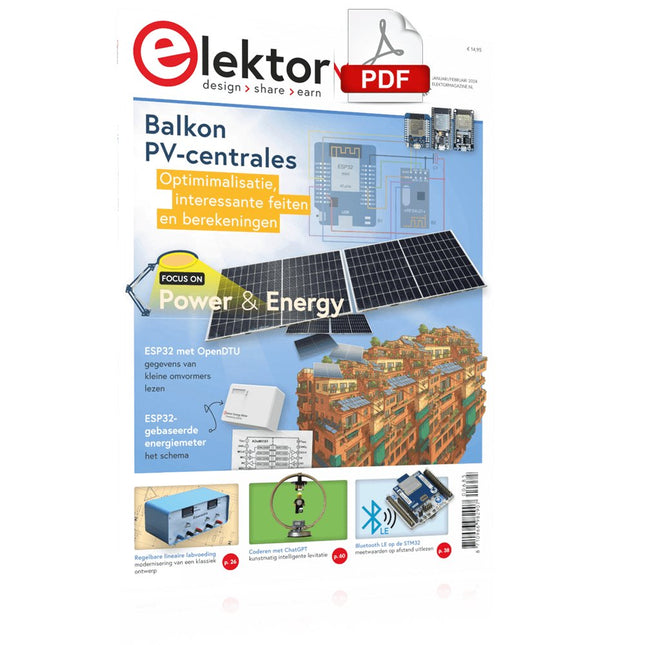
Project-update: ESP32-gebaseerde energiemeterwe gaan verder met het prototype
Optimalisatie van balkon PV-centralesoverwegingen, interessante feiten en berekeningen
ESP32 met OpenDTU voor balkoncentralesgegevens van kleine omvormers via MCU’s uitlezen
Regelbare lineaire labvoeding0...50 V / 0...2 A + dubbele symmetrische voeding
Energieopslag – vandaag en morgeneen vraaggesprek met Simon Engelke
2024: een AI-odysseehet houdt nog lang niet op
Bluetooth LE op de STM32meetwaarden op afstand uitlezen
Mensvriendelijk slim keuken-voorraadsysteem
MAUI: programmeren voor PC, tablet en smartphonehet nieuwe framework in theorie en praktijk
ChatMagLevkunstmatig intelligente levitatie
Eenvoudige PV-regelaarbouw je eerste, volledig functionele PV-energiebeheersysteem
Koude-kathode-buizenvreemde onderdelen
Uit het leven gegrepennostalgie
Alle begin......bekijkt de FET
CAN-bus voor de Arduino UNO R4: een tutorialtwee UNO R4’s nemen de bus!
Elektor infographicvoeding en energie
Vergelijking van vermogensdichtheid en vermogensefficiëntie
Aluminium elektrolytische condensatorenstoringspotentieel in audiotechnologie
USB testen en metenmet de Fnirsi FNB58
De Pixel Pump pick&place-tooleenvoudiger handmatige assemblage van SMT-printen
Oost West Lab Bestnog niet zo lang geleden, in een land heel ver van hier...
“In de wereld van ethiek in elektronica kunnen zelfs kleine stappen een aanzienlijke invloed hebben.”
Ethiek in elektronicade OECD Guidelines en het Lieferkettensorgfaltspflichtengesetz
Chadèche: slimme NiMH-(ont)laderlezersproject in het kort
Project 2.0correcties, updates en brieven van lezers
The software simulation of gauges, control-knobs, meters and indicators which behave just like real hardware components on a PC’s screen is known as virtual instrumentation.
In this book, the Delphi program is used to create these mimics and PIC based external sensors are connected via a USB/RS232 converter communication link to a PC.
Detailed case studies in this Book include a virtual compass displayed on the PC’s screen, a virtual digital storage oscilloscope, virtual -50 to +125 degree C thermometer, and FFT sound analyser, a joystick mouse and many examples detailing virtual instrumentation Delphi components. Arizona’s embedded microcontrollers – the PIC's are used in the projects and include PIC16F84A, PIC16C71, DSPIC30F6012A, PIC16F877, PIC12F629 and the PIC16F887. Much use is made of Microchip’s 44 pin development board (a virtual instrument ‘engine)’, equipped with a PIC16F887 with an onboard potentiometer in conjunction with the PIC’s ADC to simulate the generation of a variable voltage from a sensor/transducer, a UART to enable PC RS232 communications and a bank of 8 LED's to monitor received data is also equipped with an ISP connector to which the ‘PICKIT 2’ programmer may easily be connected.
Full source code examples are provided both for several different PIC’s, both in assembler and C, together with the Pascal code for the Delphi programs which use different 3rd party Delphi virtual components.
High-quality soldering with the most important tools and consumables, ideal for universal soldering applications.
Features
Power unit, 1 channel
1-channel Soldering Station digital 90 W (95 W)
WTP 90: The soldering iron for universal use with power response tips. Tip family XNT & THM (high mass tips)
Lock function
Specifications
Dimensions W x D x H (mm): 149 x 138 x 101
Dimensions W x D x H (inch): 5.87 x 5.43 x 3.98
Weight (ca) in kg: 1.9
Channels: 1
Voltage: 230 V, 50/60 Hz
Heating output: 90 W (95 W)
Temperature accuracy °C: ±9
Display: Backlit LCD
Temperature range: Adjustable from 50°C - 450°C (150°F - 850°C)Adjustable temperature range varies among tools
Temperature stability °C: ±2
Temperature accuracy °F: ±17
Temperature stability °F: ±4
Temperature range (depends on tool) °C: 100-450
Temperature range (depends on tool) °F: 150-850
Equipotential balance: yes
Fuse: 0,5 A
WT compatible: yes
ESD-safe: yes
Power cord: EMEA
Inhalt
Praxis
Flash Box – Projekt: RGB-Controller für LED-Stripes
LED-Module für Spot-Leuchten à la Zhaga – Referenzdesign: Zhaga-kompatibles LED-Modul auf Basis der Cree XLamp XB-D
LUVLED II – Optimierung eines Kühlkonzeptes zur Aktivluftkühlung eines Hochleistungs-UV-LED-Moduls
Lumen-Pumpe – HB-LEDs für Niedervolt-Systeme mit Li-Ion-Batterien
Bei Licht besehen – Licht-Design mit LEDs
Qualitätssicherung – Optische Charakterisierung von Leuchtdioden
LED-Treiber für Scheinwerfer – Synchroner Buck-Boost-Schaltregler für LED-Frontscheinwerfer
Theorie & Anwendung
LEDs am TRIAC-Dimmer – LED-Treiber für isolierte Offline-LED-Beleuchtungen ohne Optokoppler
Kalte Platte – Platinentechnik ermöglicht effizientes Wärmemanagement und mehrdimensionale LED-Lichtgestaltung
Abweichler – Kolorimetrie und Binning-Grundlagen
Info
Marktübersicht – LED-Hersteller, LED-Treiber-Hersteller
Licht mit LEDs: kreatives Leuchten-Design
Plädoyer für LED-Arrays – Multichip-LED-Module für ein flexibleres Leuchtendesign
Zugeschnittene Lichtleistung – Optogan X10 Chip-on-Board-System
Mid-Power LEDs im Aufwind – Trends bei Seoul Semiconductor für LEDs der Allgemeinbeleuchtung
Aktuell – Treiber, LEDs, Entwicklungs-Boards
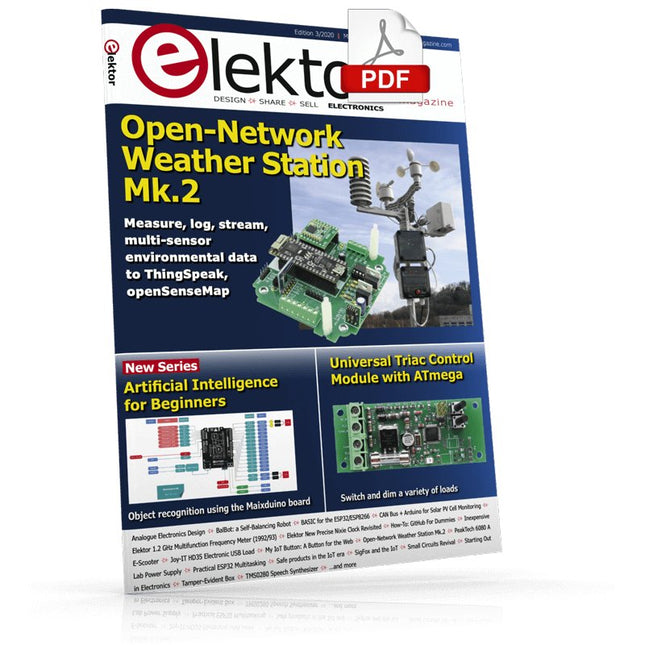
Open-Network Weather Station Mk.2Part 1: Introduction and hardware elements
Artificial Intelligence for Beginners (1)Object recognition using the Maixduino board
Universal Triac Control Module with ATmegaSwitch and dim a variety of loads
GitHub For DummiesHow to download something from GitHub
My IoT Button: A Button for the WebPart 2: Prototyping with board and cloud
TMS0280 Speech SynthesizerPeculiar Parts, the series
InteractiveCorrections & Updates || Questions & Answers
BASIC for the ESP32/ESP8266 (2)An hourglass with the ESP8266 and Annex WiFi RDS
Developer's ZoneTips & Tricks, Best Practices and Other Useful Information
BalBot: a Self-Balancing RobotModern acceleration sensors ease the construction process
Starting Out in Electronics (3)Easier than imagined!
Small Circuits RevivalCapita Selecta from the Elektor Project Suggestions Box
Tamper-Evident BoxSend data securely through postal services
Elektor New Precise Nixie Clock RevisitedAn engineering bulletin for enthusiastic users new and old
Practical ESP32 Multitasking (3)Software timers
SigFox and the IoT (4)Setting up a dashboard
Start-Up Update: The Elektor Investment Program
Review: Joy-IT HD35 Electronic USB LoadTest & verify USB power performance
CAN Bus + Arduino for Solar PV Cell MonitoringDetect and locate serviceable panels in large arrays
Analogue Electronics Design (3)Case Study #1 — Section 3: Preamplifier response optimization and trade-offs
Inexpensive E-ScooterHow does Lidl's "road approved" 300 euro E-scooter perform?
Steeped in ElectronicsLead-free soldering and EU regulatory zeal
Lab, Sweet LabA glimpse of The Holy Place — no unauthorized entry.
Review: The PeakTech 6080 A Lab Power SupplyA neat lab PSU for not much money
A Big ChallengeSafe products in the IoT era
Elektor 1.2 GHz Multifunction Frequency Meter (1992/93)Crossing the magic 1 GHz border
Hexadoku