
Search results for "elektor or septembre or octobre or 2023 or fr"
-

Elektor Digital Formelsammlung (E-book)
Formelsammlung (E-book)
€ 29,80
Members: € 26,82
-

Elektor Digital Grundlagen und Schaltungen der Stromversorgungstechnik (PDF)
Aus der Reihe "Stromversorgung ohne Stress" (Band 1) 2., überarbeitete und erweiterte Auflage Eines haben alle elektronischen Schaltungen und Geräte gemeinsam: Ihre Funktion hängt von der Stromversorgung ab. Deshalb muss dieser Baugruppe besondere Aufmerksamkeit gewidmet werden. Dieses Buch beinhaltet Grundlagen und Schaltungen der Stromversorgungstechnik für elektronische Geräte aus der Praxis. Dem aktuellen Trend folgend behandelt der Autor insbesondere die mobile Stromversorgungstechnik sowie die Schaltnetzteiltechnik. Dabei wird berücksichtigt, dass Stromkonstanter gegenüber Spannungskonstantern zunehmend an Bedeutung gewinnen. Im Buch finden sich die notwendigen Grundlagen zum Bau eigener Stromversorgungsgeräte und -baugruppen. Außerdem enthält es ganz praktische Anwendungsbeispiele, z. B. für den Ersatz defekter Netztransformatoren, für die mobile Stromversorgung auf Fahrradtouren oder für den Betrieb von LEDs. Diese zweite Auflage wurde gründlich überarbeitet, Fehler wurden behoben und einige Ergänzungen vorgenommen. Der Autor Franz Peter Zantis ist Energieanlagenelektroniker und Ingenieur der Nachrichtentechnik. In einem Forschungsprojekt hat er sich ausführlich mit der Stromversorgung eigensicherer Geräte auseinandergesetzt und zahlreiche Beiträge zum Thema Schaltnetzteile veröffentlicht.
€ 32,80
Members: € 29,52
-

Elektor Digital Node-RED and Raspberry Pi Pico W (E-book)
From basics to flows for sensors, automation, motors, MQTT, and cloud services This book is a learning guide and a reference. Use it to learn Node-RED, Raspberry Pi Pico W, and MicroPython, and add these state-of-the-art tools to your technology toolkit. It will introduce you to virtual machines, Docker, and MySQL in support of IoT projects based on Node-RED and the Raspberry Pi Pico W. This book combines several elements into a platform that powers the development of modern Internet of Things applications. These elements are a flow-based server, a WiFi-enabled microcontroller, a high-level programming language, and a deployment technology. Combining these elements gives you the tools you need to create automation systems at any scale. From home automation to industrial automation, this book will help you get started. Node-RED is an open-source flow-based development tool that makes it easy to wire together devices, APIs, and online services. Drag and drop nodes to create a flowchart that turns on your lights at sunset or sends you an email when a sensor detects movement. Raspberry Pi Pico W is a version of the Raspberry Pi Pico with added 802.11n Wi-Fi capability. It is an ideal device for physical computing tasks and an excellent match to the Node-RED. Quick book facts Project-based learning approach. Assumes no prior knowledge of flow-based programming tools. Learn to use essential infrastructure tools in your projects, such as virtual machines, Docker, MySQL and useful web APIs such as Google Sheets and OpenWeatherMap. Dozens of mini-projects supported by photographs, wiring schematics, and source code. Get these from the book GitHub repository. Step-by-step instructions on everything. All experiments are based on the Raspberry Pi Pico W. A Wi-Fi network is required for all projects. Hardware (including the Raspberry Pi Pico W) is available as a kit. Downloads GitHub
€ 39,95
Members: € 35,96
-

Elektor Digital Geheimnisse der Elektronik erklärt (E-book)
Geheimnisse der Elektronik erklärt (E-book)
€ 32,80
Members: € 29,52
-
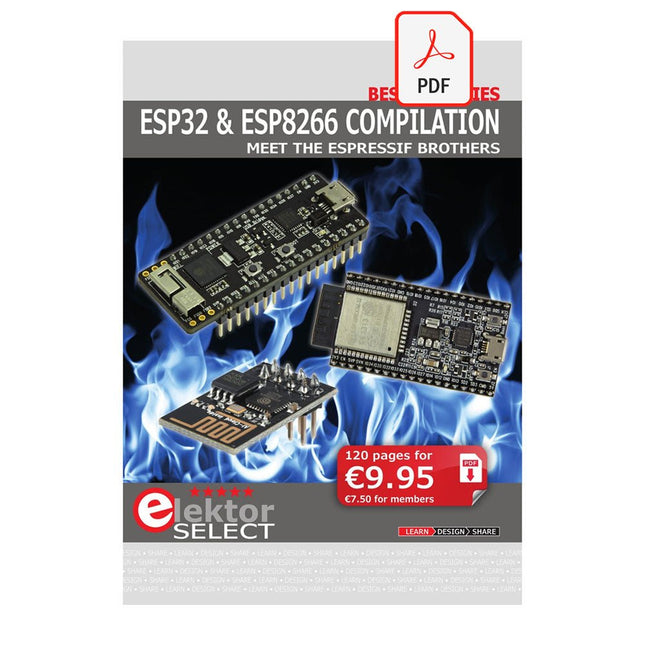
Elektor Digital ESP32 & ESP8266 Compilation (EN) | E-book
The ESP8266 from Espressif is a Wi-Fi microchip with full TCP/IP stack and microcontroller capability. It has made waves in the maker community with its low price. But many developers were unhappy with ESP8266's high power consumption. The ESP32, equipped with a ULP (Ultra Low Power) coprocessor, offers a remedy for this. This e-book features a number of projects featuring ESP32 & ESP8266 as well as an interview with the CEO of Espressif Teo Swee Ann. Articles ESP32 for Use in Industry 4.0 Equipment Scrolling Message Display, 512 LEDs controlled over Wi-Fi via an ESP-12F The Connected Greenhouse IoT demonstration project using MQTT and Node-RED VFD-tube Clock with ESP32 with an accurate Internet-derived time ESP32 Low Power DCF77 Emulator with ESP8266 ESP8266 on the Elektor Android I/O Board The Reason Behind the Hugely Popular ESP8266? Wi-Fi Desktop Thermostat Timers for the Wi-Fi Desktop Thermostat PlatformIO, the Universal Programming Tool Weather Display, Visualize current weather data on an LC display GoNotify, a Flexible IoT Sensor Interface ESP32 for Power Users USB Programming Adaptor for ESP8266 Getting started with ESP32 and the Arduino IDE MicroPython, Python for small systems RGBDigit Clock WLAN for Microcontrollers Return of the Wi-Fi Controller Board Compact and Self-contained WLAN
€ 9,95
Members: € 8,96
-

Elektor Digital Photovoltaik für Quereinsteiger (PDF)
In seinem leidenschaftlichen Plädoyer für die Nutzung von Sonnenenergie wendet sich der Autor an technisch nicht versierte Leser. Der Autor von Photovoltaik für Quereinsteiger hat drei klare Botschaften: Es ist ziemlich einfach, eine Photovoltaikanlage erfolgreich in Betrieb zu nehmen. Die notwendigen Kalkulationen dazu, ob sich eine Solaranlage lohnt, passen auf einen Bierdeckel. Elektrischer Strom kann mit Photovoltaik schon heute für 3,5 Eurocent pro Kilowattstunde erzeugt werden. Allerdings nur tagsüber und auch nicht überall auf der Welt (aber an sehr vielen Orten). Das Buch erklärt, wie man zu marktüblichen Preisen Anlagen bauen kann, die zu unschlagbaren Niedrigstpreisen Strom liefern können. Es wird erläutert, wie man Anlagen abhängig vom Standort kalkulieren muss. Dabei beleuchtet der Autor in leicht verständlichen Worten die physikalischen Grundlagen der Gewinnung von Energie durch Photovoltaik und erklärt, wie eine Solarzelle prinzipiell arbeitet. Die grundsätzlichen Bestandteile einer Photovoltaikanlage werden so erklärt, dass sie auch von Laien verstanden werden. Ausführlich geht der Autor auf die richtige Wahl von Batterien zur Speicherung des gewonnenen Stromes ein. Potentielle Fehler- und Gefahrenquellen beim Auf- und Ausbau finden ebenso Berücksichtigung. Das Buch richtet sich dabei an Privatpersonen und an Projektbetreiber, die Strom für den Eigenverbrauch erzeugen möchten.
€ 29,80
Members: € 26,82
-

Elektor Digital Embedded Electronics 1 (NL) | E-book
De werking van veruit de meeste moderne elektronische apparaten is niet slechts op één enkel principe gebaseerd. Vaak staat een of andere computer (doorgaans een microcontroller) centraal. Uit deze fundamentele opzet – een computer die is ingebed in een bepaalde toepassingsschakeling – is de algemene benaming Embedded Systems voortgekomen. De meeste van deze systemen moeten vanuit het niets worden ontwikkeld, en daarbij komt het op elk detail aan. Vindingrijkheid en veelzijdigheid zijn dan een vereiste. De problemen die opgelost moeten worden, vormen niet zelden een ware uitdaging en betreffen niet alleen de analoge en digitale elektronica maar ook de systeemarchitectuur, programmering en programma-organisatie. De delen van deze reeks zijn geschreven voor iedereen – leerling, student of beginnend elektronicus – die zich terdege wil bekwamen in de professionele hardware- en systeemontwikkeling. En ze richten zich tot de allround-elektronicus die geen tijd heeft om specialist op een van de vele deelgebieden te worden maar die weet dat hij met standaard huis-, tuin- en keukenoplossingen niet ver komt. Ze bieden wat studenten en professionele elektronici nodig hebben: een opfrissing en verdieping van de basiskennis, een bron van inspiratie en een schat aan details en spitsvondigheden. Dit deel behandelt de passieve componenten: vaste weerstanden instelbare weerstanden NTC- en PTC-weerstanden spanningsafhankelijke weerstanden condensatoren spoelen transformatoren contactelementen
€ 39,95
Members: € 35,96
-

Elektor Publishing PLC Programming with the Raspberry Pi and the OpenPLC Project
ModbusRTU and ModbusTCP examples with the Arduino Uno and ESP8266 Introduction to PLC programming with OpenPLC, the first fully open source Programmable Logic Controller on the Raspberry Pi, and Modbus examples with Arduino Uno and ESP8266 PLC programming is very common in industry and home automation. This book describes how the Raspberry Pi 4 can be used as a Programmable Logic Controller. Before taking you into the programming, the author starts with the software installation on the Raspberry Pi and the PLC editor on the PC, followed by a description of the hardware. You'll then find interesting examples in the different programming languages complying with the IEC 61131-3 standard. This manual also explains in detail how to use the PLC editor and how to load and execute the programs on the Raspberry Pi. All IEC languages are explained with examples, starting with LD (Ladder Diagram) over ST (Structured Control Language) to SFC (Special Function Chart). All examples can be downloaded from the author's website. Networking gets thorough attention too. The Arduino Uno and the ESP8266 are programmed as ModbusRTU or ModbusTCP modules to get access to external peripherals, reading sensors and switching electrical loads. I/O circuits complying with the 24 V industry standard may also be of interest for the reader. The book ends with an overview of commands for ST and LD. After reading the book, the reader will be able to create his own controllers with the Raspberry Pi.
€ 39,95
Members: € 35,96
-

Elektor Digital Funkempfänger-Kompendium (PDF)
Wollten Sie schon immer wissen, wie sich die klassische Funkempfängertechnik fortentwickelt hat? Wie funktionieren professionelle Funkempfänger heute und was können sie leisten? Wie ist es der modernen Funküberwachung und den Nachrichtendiensten möglich, gleich ganze Frequenzbänder in kürzester Zeit auszuforschen? Welche Empfangssysteme und Techniken stehen heute zur Verfügung? Möchten Sie auch ausgefallene Anwendungen von Empfängern kennenlernen und wissen, wie ein Software Defined Radio (Digitalempfänger) nun wirklich funktioniert und was der letzte Stand der entsprechenden Technik kann? Wodurch unterscheiden sich Kreuzmodulation und Intermodulation und worauf ist bei der messtechnischen Bestimmung und Datenblattvergleichen unbedingt zu achten? Warum folgen Intermodulationsprodukte nicht immer den Darstellungen von Lehrbüchern? Welche Artefakte zeigen digital nachgebildete Signalverarbeitungsketten abweichend von analogen Schaltungsstufen? Welche Auswirkungen haben derartige Kenngrößen tatsächlich auf die Empfangspraxis und warum kommt es nicht nur auf den IP3 an? Wie hängt beispielsweise die Grenzempfindlichkeit mit der Empfangsbandbreite zusammen? Was unterscheidet einen Signal/Rauschabstand nach der Beurteilung durch SINAD und (S+N)/N? Wie ist ein Empfangssystem zur Aufnahme kleinster Signalpegel zu optimieren? Fragen über Fragen – im vorliegenden Buch findet man die Antworten! Ausführlich und mit Details. Mit vielen speziell dafür erdachten Zeichnungen zur visuellen Erläuterung der Zusammenhänge. Mit durchgerechneten Fallbeispielen und dem stetigen Bezug zur Empfangspraxis. Großer Wert wurde den Darstellungen auf einheitliche Betrachtungsweise und durchgehende Systematik gelegt. Das erhöht die Übersichtlichkeit und erleichtert den Vergleich einzelner Vorgänge, Konzepte und Anlagen. Um den tatsächlichen Stand der Technik gut zu erfassen, wurden dutzende Patentschriften recherchiert und die Industrie mit eingebunden. Durch das sorgfältig aufbereitete Stichwortverzeichnis mit über 1200 Einträgen lassen sich die entsprechenden Stellen mit den Erklärungen rasch und punktgenau auffinden. Auch über die Thematik von Funkempfängern hinaus wird beim Studium der Lektüre vieles klar! Denn auch Messgeräte der Hochfrequenztechnik funktionieren vielmals nach ähnlichen Prinzipien. Wer den Inhalt durcharbeitet, kann wichtige Eigenschaften verstehen, beispielsweise von Spektrumanalysatoren und bei der Arbeit damit professionell vorgehen. Diese überarbeitete und erweiterte Neuauflage bringt erstmals sämtliche Bilder durchgehend in Vollfarbdruck, vertieft spezielle Themenschwerpunkte und bietet zusätzliche Fach- und Detailinformationen hinsichtlich den Realisierungsbeispielen gegenwärtiger Funkempfänger wie ferner durch das ergänzende Erörtern von jüngst verwendeten Messverfahren. Mit dem Erarbeiten und der Einbindung eines besonders umfangreichen, auf die Belange der heutigen Empfängertechnik zugeschnittenen Fach- und Übersetzungsglossars liegt zur Deutung entsprechender Fachbegriffe nunmehr eine Referenz vor.
€ 44,80
Members: € 40,32
-

FNIRSI FNIRSI SWM-20 Dual-Pulse Spot Welder
The FNIRSI SWM-20 handheld spot welder is a high-efficiency, user-friendly, and easy-to-carry welding tool. It features dual-pulse spot welding technology, ensuring more stable and reliable welds, and also includes a convenient power bank function. Equipped with a 2.4-inch HD display, the SWM-20 offers clear and intuitive operation. Its rotary encoder knob allows users to adjust parameters quickly and precisely, making it easy to set the required welding settings and improving the overall user experience. Features 2-in-1: Spot Welder & 5000 mAh Power Bank 1200 A High-Power Output for Strong, Reliable Welds Dual-Pulse Technology for Cleaner & More Stable Welding Dual A-Grade Batteries with 8 Safety Protections 0.1–0.5 mm Multi-Material Welding Capability 10,000+ Precision Adjustment Levels for Professional Control 2.4-inch TFT Display with Real-Time Data Monitoring Specifications Max Welding Current 1200 A Battery Capacity 5000 mAh Charging 5 V/2.1 A Discharging 5 V/2.1 A Welding Materials Nickel, Iron, Stainless Steel Welding Thickness 0.1‒0.5 mm Level 4 Preset Combination Levels Dimensions 13.3 x 8.8 x 3.2 cm Weight 850 g Included 1x FNIRSI SWM-20 Spot Welder 2x Welding Pens 2x Replacement Tips 1x Nickel Strip 1x USB-C Cable 1x Manual Downloads Manual
€ 79,95€ 67,95Best Price
-

Elektor Publishing MIT App Inventor for AI and IoT
Build Smart Applications with Raspberry Pi, Arduino, and ESP32 Discover how easy and exciting mobile app development can be with MIT App Inventor. This hands-on guide takes you from basic concepts to building real-world mobile applications using a simple visual programming approach—no prior coding experience required. You will create IoT and AI-powered apps for Android devices and explore how App Inventor can also be used with iPhones and iPads. Connect your applications to platforms such as Arduino UNO R4 WiFi, ESP32, Raspberry Pi Pico (2)W and Raspberry Pi 5, enabling you to build smart, connected systems. Inside the book, you will learn how to: Build interactive apps using buttons, images, sound, and multimedia Create text-to-speech and speech-recognition applications Develop camera-based and location-aware (GPS) apps Design useful tools such as calculators and educational apps Work with smartphone sensors like accelerometers and light sensors Build AI-powered applications, including voice assistants and image-generation features Send and receive messages, and create communication-based apps Connect mobile apps to hardware using Wi-Fi and Bluetooth Control real devices such as LEDs, motors, and sensors Designed for beginners, students, and hobbyists, this book focuses on learning by doing. By the end, you will have the skills and confidence to create your own innovative applications that interact with both the digital and physical worlds. Start building and turning your ideas into reality.
€ 44,95
Members: € 40,46
-

Elektor Publishing Mastering the Arduino Uno R4
Programming and Projects for the Minima and WiFi Based on the low-cost 8-bit ATmega328P processor, the Arduino Uno R3 board is likely to score as the most popular Arduino family member, and this workhorse has been with us for many years. Eleven years later, the long-overdue successor, the Arduino Uno R4, was released. It is built around a 48 MHz, 32-bit Arm Cortex-M4 microcontroller and provides significantly expanded SRAM and Flash memory. Additionally, a higher-precision ADC and a new DAC are added to the design. The Uno R4 board also supports the CAN Bus with an interface. Two versions of the board are available: Uno R4 Minima, and Uno R4 WiFi. This book is about using these new boards to develop many different and interesting projects with just a handful of parts and external modules. All projects described in the book have been fully tested on the Uno R4 Minima or the Uno R4 WiFi board, as appropriate. The project topics include the reading, control, and driving of many components and modules in the kit as well as on the relevant Uno R4 board, including LEDs 7-segment displays (using timer interrupts) LCDs Sensors RFID Reader 4x4 Keypad Real-time clock (RTC) Joystick 8×8 LED matrix Motors DAC (Digital-to-analog converter) LED matrix WiFi connectivity Serial UART CAN bus Infrared controller and receiver Simulators … all in creative and educational ways with the project operation and associated software explained in great detail.
€ 44,95
Members: € 40,46


