Elektor GREEN en GOLD leden kunnen deze uitgave hier downloaden.
Nog geen lid? Klik hier om een lidmaatschap af te sluiten.
OBD2-sensordashboardOude meters vormden het startpunt van een zoektocht naar echte gegevens
OBD2: voeg een toerenteller en schakelindicator toe aan je autoRetro, maar uiterst nuttig
LiDAR- en Visiesensoren voor Robotica
Sensor+Test 2025 en PCIM 2025
Contactloze E-Veldmetingen (1)Een Trillende Membraan voor het Detecteren van Gelijkspanningen of Statische Elektrische Velden
Draadloze brievenbusmeldervan optische sensoren tot radar: enkele mogelijkheden
Elektor Mini-Wheelieeen zelfbalancerende robot
ZonnecellenVreemde onderdelen, de serie
Aan de slag met een moderne radarsensorStaat een nauwkeurige meting op uw radar?
Uit het leven gegrepenpapierfabriek
CybersecurityZware tijden voor hackers
Infographics: IoT en sensoren 2025
Bluetooth 6.0 brengt verbeterde toepassingen voor afstandsbepalingNieuwe versie biedt betere apparaatpositionerings- en -locatieservices
Draadloze communicatie verkennen met BeagleY-AI
Err-lectronicsCorrecties, updates en lezerspost
Alle begin......sluit het thema opamps af
Een krachtige AI-codeerassistentsneller ontwikkelen met Continue en Visual Studio Code
Zonne-laadregelaar met MPPT (2)Het schema
Ultrasone obstakeldetectoreen eenvoudig project om slechtzienden te helpen
2025: Een AI-odysseeHalfjaaroverzicht
Raspberry Pi Standalone MIDI-synthesizer (3)Het slimmer maken en een gebruikersinterface toevoegen
Meshtastic: een demonstratieprojectEen slim netwerk van LoRa-radio's
Analoge audio-frequentiegeneratorHoogwaardige sinusgenerator met instelbare frequentie
Le téléchargement intégral de ce numéro est disponible pour nos membres GOLD et GREEN sur le site Elektor Magazine !
Pas encore membre ? Cliquez ici.
Prototypage, production et composants !
carte processeur Audio DSP FXpartie 1 : caractéristiques et conception
50 ans d'Elektor en anglais
KiCad 8nouvelles et dernières caractéristiques
Elektor @ electronica 2024electronica Fast Forward 2024, des experts sur scène, des forums d'influenceurs, des talk-shows Elektor Lab en direct, et plus encore
kit MultiCalculator d'ElektorUn kit de calculatrice basé sur Arduino pour l'électronique
systèmes GNSS RTK à faible coûtavec un degré de précision de l'ordre du centimètre
routage des Circuits Imprimés et sécuritéConseils pour une conception sure et fiable de vos cartes électroniques
testeur d'ampli-oppour les applications audio et autres
mise à jour du projet #4 : compteur d'énergie ESP32surveiller l'énergie avec MQTT
analyseur de spectre temps-réel à technologie guide d’onde et PC à interfaces multiplesAaronia introduit une nouvelle ligne de produit et présente ses premiers prototypes au salon Electronica de Munich
inductances SMTbobines et ferrites – un choix simplifié
utilisation d’un blindage EMI pour assurer la conformité à la compatibilité électromagnétique
l'outil ultime pour tous les passionnés d’électroniqueDébloquez des possibilités infinies avec Red Pitaya et plus de 1000 Click Boards™
HDI au milieuUn nouveau service PCB-pooling rentable pour des petits BGA
défis de l'analyse DFM pour les circuits flexibles et flexibles-rigides
outils open-sourcesimulateur d'antennes, gestion des composants, calculatrice, et bien plus
Infographie : prototypage et production
sur le vifmicrotechnophobie : c’est grave, docteur ?
arbre de Noël 3Dcircuit imprimé 3D avec un microcontrôleur 32 bits peu coûteux
démarrer en électronique......on continue avec l'ampli-op !
nœud de capteurs autonome (mise à jour du projet #1)Reducing Idle Power Consumption with External RTC and Power Switch
2024 : l'odyssée de l'IAUn regard sur l'avenir
afficheurs LED avec le MAX7219Une méthode pratique pour une excellente puce
projet 2.0Corrections, mises à jour et courrier des lecteurs
gants vibro-tactilesune avancée pour les patients de Parkinson
Diese Ausgabe steht allen GOLD- und GREEN-Mitgliedern auf der ElektorMagazine-Website zum Download bereit!
Sie sind noch kein Mitglied? Hier klicken!
Drehscheibentelefon als FernbedienungLicht einschalten, wählen Sie die 1, Kaffeemaschine einschalten, wähle Sie die 2
GPS-gestützte GeschwindigkeitsüberwachungNie mehr rasen, nie mehr Knöllchen!
RGB-Stroboskop mit ArduinoFarbenfrohe Anwendung eines nützlichen Werkzeugs
Drahtloser Notruf-TasterErhöhte Sicherheit mit LoRa
Aller Anfang......muss nicht schwer sein: Folgen Sie dem Emitter!
Beliebige und unabhängige Hysteresestufen für Komparatorenmit Simulationen, Tabellenkalkulationen und etwas Algebra
ESP32-basierter Impedanz-AnalysatorEinfach, wenige Bauteile und preiswert!
Das besondere ProjektErmutigung zum Heimwerken
Mikrocontroller-Praxiskurs für Arduino-Einsteiger mit TrainingsboardAll-in-One-Trainingshardware für den Mikrocontroller-Kurs
Aus dem Leben gegriffenModerner Luddismus
Sensor 1x1: Temperatur-Sensor DS18B20Anschluss am 1-Draht-Bus
Rettet Matter das Smart Home?Neue Standards zur Vereinfachung der Hausautomatisierung
Eine Frage der ZusammenarbeitEntwickeln mit dem Board Thing Plus Matter und dem Simplicity Studio
Infografik: IoT und Sensoren
Matter, ExpressLink, Rainmaker - Worum geht es eigentlich?Interview mit Amey Inamdar von Espressif
Development-Kits für IoT- und IIoT-ApplikationenÜber die Auswahl von Mikrocontroller-Entwicklungsboards
Kondensatoren verhalten sich nicht immer kapazitiv
Eine NTP-Uhr mit CircuitPythonWarum Sie diese Programmiersprache verwenden sollten
Bauen Sie ein cooles IoT-DisplayMit dem Phambili Newt
Der Doppler-Bewegungssensor HB100Theorie und Praxis eines ungewöhnlichen Sensors
Eine Anleitung zur Bare-Metal-ProgrammierungTeil 1: STM32 und andere Controller
Siglent-Multimeter SDM3045X
Mikroprozessoren für eingebettete SystemeBemerkenswerte Bauteile
Mikrocontroller-Dokumentation verstehenTeil 3: Blockdiagramme und mehr
LoRa-Wetterstation mit niedriger StromaufnahmeBauen Sie Ihre entfernte Wetterstation selbst!
Transverter für das 70-cm-Band
Climate Calling EngineersMove Fast and Fix Things
Hexadoku
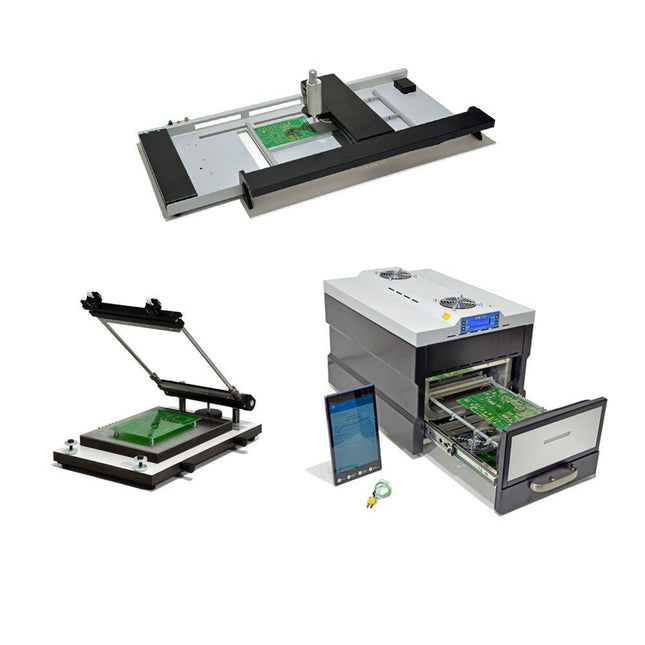
The SMD Starter I prototype production line consists of the stencil printer TSD240, the SMD placement device PlaceMAN and the reflow oven 3LHR10. Stencil printer SD240 (+ Metal Squeegee 155 mm) Stencil size: max. 175 x 255 mm PCB size: max. 180 x 240 mm Size: 410 x 270 x 110 mm Weight: 6.7 kg incl. metal squeegee 155 mm incl. 8 magnets to hold the PCB, 6 of them with M3 grub screw Manual SMD pick-and-place device PlaceMAN for standard components incl. vacuum pump (without feeders, camera, monitor and dispenser) Equipped with smooth-running placement arm, placement head with one-hand operation, rotation of the Z-axis and automatic vacuum switch-off, incl. PCB holder, vacuum unit and 2 placement needles with rubber suction cups. Capacity of feeder (not included) 2x feeder cassette for 10 x 8 mm wheels left 4x feeder cassette for rod feeders for 5 rods each Further feeding systems are possible within the assembly area, e.g. strip-feeder plug-in system Dimensions Base unit (LxWxH): 765 x 390 x 210 mm With feeder cassette for 10 x 8 mm rolls (LxWxH): 765 x 390 x 210 mm With feeder cassette for 10 x 8 mm rolls and feeder cassette for rod feeder (LxWxH): 765 x 430 x 210 mm (height may vary due to rod length) With feeder cassette for 10 x 8 mm rolls incl. holder for 10 rolls and feeder cassette for rod feeder (LxWxH): 765 x 430 x 210 mm (height may vary due to rod length) Specifications Weight of basic unit: approx. 6 kg Axis travel (x,y,z): 470 x 230 x 15 mm Max. working area: 380 x 240 mm Max. PCB size: 230 x 360 mm Power supply: 230/12 V, 800 mA Power supply vacuum pump: 230 V, 6 W 3LHR10 Reflow Oven (programmable for lead-free soldering with manual drawer and tablet control) Reflow oven with IR and convection heating. Forced hot air convection ensures a uniform temperature profile throughout the chamber. After manually opening the door, the fans are turned on and the soldered PCB is quickly cooled. Small reflow oven with manual door Industry 4.0 ready, Bluetooth communication + tablet IR + convection heating Android application to connect to tablet or smartphone 100 different user programs Delivery content: 3LHR10, tablet with app, protective cover for tablet, 4 PCB holders, external thermocouple, manual at tablet Application Connect the oven to the power supply and connect the optionally available extraction system (3LFE10S) to the exhaust air nozzle. After the first turn on, the oven will search for a tablet or smartphone. When both are connected to the Android app, choose the programming of the oven. Here, programmable temperature and preheating time as well as temperature and other data are to be set. Register with the tablet to use the full scope of the software. If the oven is already programmed, the user can control the operation with buttons and display at the front panel. When the reflow process is complete, an audible signal sounds. A signal is also displayed on the tablet/smartphone. The drawer must now be opened manually. The Android application displays process status, time and temperature or other information. Specifications Power supply: 230 V, 50 Hz Maximum power: 3100 W Temperatures: 50-260°C Dimensions: 510 x 370 x 340 mm Maximum weight: 16 kg Grid dimensions: 350 x 220 mm Maximum dimensions of the printed circuit board: 300 x 200 mm Maximum component height on the PCB: 50 mm at the top, 30 mm at the bottom Scope of delivery Stencil printer TSD240 SMD placement device PlaceMAN Reflow oven 3LHR10
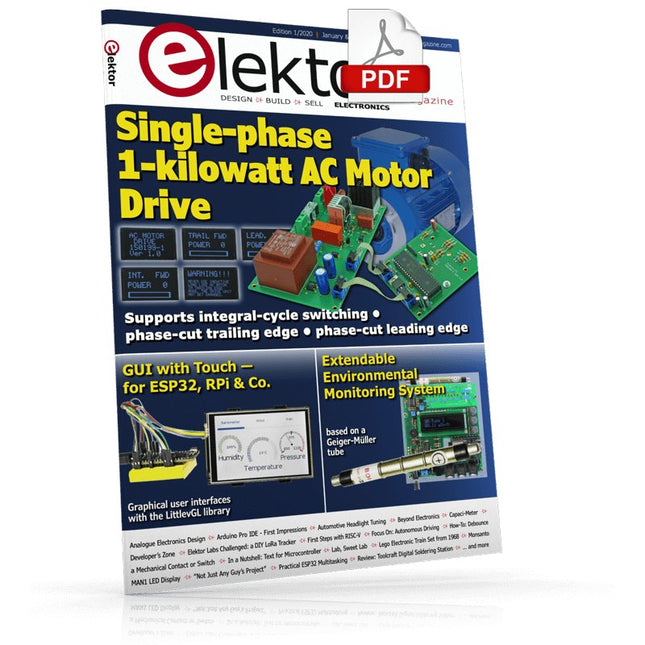
GUI with Touch — for ESP32, RPi & Co.Graphical user interfaces with the LittlevGL library
"Not Just Any Guy's Project”Interview with Gábor Kiss-Vámosi, the developer of LittlevGL
Capaci-Meterwith two-digit Dekatron-style LED display
How To: Debounce a Mechanical Contact or SwitchA switch is either open or closed, isn't It?
Developer's ZoneTips & Tricks, Best Practices and Other Useful Information
Extendable Environmental Monitoring Systempublishes data on IoT platforms
Practical ESP32 MultitaskingTask programming with FreeRTOS and the Arduino IDE
InteractiveCorrections & Updates || Questions & Answers
Automotive Headlight TuningLegal, illegal — it matters!
Review: Toolcraft Digital Soldering Station
Arduino Pro IDE - First Impressions
Two Thermal Imaging Cameras ComparedSeek ShotPro and Seek Compact
Steeped in ElectronicsOutfitting the e-lab and e-workshop
Monsanto MAN1 LED DisplayPeculiar Parts, the series
Thermoelectric Tea TimerFirst dealings with energy harvesting
Single-Phase 1-Kilowatt AC Motor DriveThree-mode design: integral-cycle switching, phase-cut trailing, or phase-cut leading edge.
RPi Gets a Fast 3.5" Touch DisplayMore power at no extra charge
Lab, Sweet LabA glimpse of The Holy Place — no unauthorized entry.
First Steps with RISC-VTrying out the LoFive Board
Elektor Labs Challenged: a DIY LoRa Tracker
Glitches and results in electronics development
Sigfox and the IoT (2)Registration in the Sigfox network
Starting Out in ElectronicsEasier than imagined!
Analogue Electronics Design
Case Study #1 — Section 1: MEMS Microphone… Testing 1-2-3
Small Circuits RevivalCapita Selecta from the Elektor Project Suggestions Box
In a Nutshell: Text for MicrocontrollersUsing compression to save memory
Focus On: Autonomous DrivingState of the art at a glance
Start-Up Leaders and Innovators Talk “Innovation 4.0” in Munich
Lego Electronic Train Set from 196850 years on, electronic toys still fascinate
Beyond ElectronicsThe MX3D Bridge Senses the City
The tinySA Ultra+ ZS-407 is a compact, handheld spectrum analyzer and signal generator. Covering 100 kHz to 7.3 GHz in Ultra mode, it lets you visualize and analyze RF signals from HF right through many modern wireless bands – and can even spot signals up to ~12 GHz thanks to harmonic tracking.
The intuitive 4-inch resistive touchscreen and rechargeable battery make it great for fieldwork, while features like a built-in signal generator, switchable bandpass filters, step attenuator, USB-PC control and auto-calibration add serious versatility.
Features
Screen size: 4 inch (480 x 320)
Spectrum Analyzer for 0.1-900 MHz or, with Ultra mode enabled up to 7.3 GHz, level calibrated up to 7.3 GHz. Can observe signals up to 12 GHz
Signal Generator with sine wave output between 0.1-900 MHz or square wave up to 6.3 GHz or RF test signal output up to 7.3 GHz when not used as Spectrum Analyzer.
Switchable resolution bandpass filters from 200 Hz to 850 kHz
Built-in 20 dB optional LNA
Color display showing max 450 points providing gapless covering up to the full frequency range.
MicroSD card slot for storing measurements, settings and screen captures.
Specifications (Spectrum Analyzer)
Input frequency range from 100 kHz to 900 MHz in normal mode and up to 7.3 GHz with ULTRA mode enabled
Input impedance 50 ohm when input attenuation set to 10 dB or more.
Selectable manual and automatic input attenuation between 0 dB and 31 dB in 1 dB steps when LNA not active
Maximum +/-5V DC input
Absolute maximum input level of +6 dBm with 0 dB internal attenuation
Absolute maximum short term peak input power of +20 dBm with 30 dB internal attenuation
Suggested maximum input power of +0 dBm with internal attenuation in automatic mode
For best measurements keep input power below -25 dBm
Input Intercept Point of third order modulation products (IIP3) of +15 dBm with 0 dB internal attenuation
1 dB compression point at -1 dBm with 0 dB internal attenuation
Power detector resolution of 0.5 dB and linearity versus frequency of ±2 dB below 5.3 GHz, ±5dB between 5.3 GHz and 6 GHz
Minimum burst length for correct level measurement at 850 kHz RBW in zero span mode of 50 microseconds
Absolute power level accuracy after power level calibration of ±2 dB
Built-in optional 20 dB LNA with Noise Figure of 5 dB up to 6 GHz
Lowest discernible signal without LNA at 30 MHz using a resolution bandwidth of 30 kHz of -102 dBm
Lowest discernible signal with LNA at 30 MHz using a resolution bandwidth of 200 Hz of -145 dBm
Frequency accuracy equal to the selected resolution bandwidth
Phase noise at 30 MHz of -108 dB/Hz at 100 kHz offset and -115 dB/Hz at 1MHz offset
Spur free dynamic range when using a 30 kHz resolution bandwidth of 70 dB
Resolution filters with a width of 0.2, 1, 3, 10, 30, 100, 300, 600 and 850 kHz
On screen resolution of 51, 101, 145, 290 or 450 measurement points.
Scanning speed of over 1000 points/second using largest resolution filters.
Automatic optimization of actual scanning points to ensure coverage of the whole scan range regardless of the chosen resolution bandwidth
Spur suppression option for assessing if certain signals are internally generated or actually present in the input signal
Headphone output for listening to the demodulated audio (AM only). Stereo connector with or without microphone, high impedance is louder, short protected
Specifications (Signal Generator)
Sine wave output with harmonics below -40 dB of fundamental from 100 kHz to 900 MHz
Output level selectable in 1 dB steps between -115 dBm and -19 dBm
Above 800 MHz choice of two output modes:
Cleanest signal mode: square wave, up to 6 GHz with coarse frequency steps and less accurate output level
Highest accuracy mode: reduced harmonics with possibly strong spurs up to 7.3 GHz with frequency resolution equal to below 800 MHz and fine output level steps
Level accuracy ±2 dB up to 800 MHz between -72 dBm and -19 dBm, less accuracy below -72 dBm, even less accuracy below -110 dBm
Output frequency resolution 57.2 Hz
Optional AM or FM modulation frequencies between 50 Hz and 5 kHz (AM) or 1 kHz (FM) or sweep over selectable frequency span
AM modulation depth between 10% and 100%
FM deviation between 1 kHz and 300 kHz
Optional output level sweep over maximum the entire output level range
Included
1x tinySA Ultra+ ZS407 Spectrum Analyzer
2x SMA connection cables
1x Barrel connector
1x Antenna with SMA connector
1x USB-C cable
1x microSD card (32 GB)
Downloads
Wiki
De Elektor LoRa Nodeveelzijdige 868MHz-afstandsbediening met status-feedback, een groot bereik en een STM32
Interactiefcorrecties & updates || vragen & antwoorden
Analoge elektronica ontwerpencase-study #1 – deel 2: de voorversterker voor de MEMS-microfoon
My IoT-button: de knop voor het netdeel 1: IoT-architectuur
BASIC voor ESP32/ESP8266programmeren met Annex WiFi RDS
ESP32-deurbel via Telegram“de postbode belt maar één keer”
Wie het kleine niet eert
Beginnen met LoRaWANmet Blue Pill, LoRa-breakout-board en The Things Network
“Een voorvechter van Open Internet”vraaggesprek met Wienke Giezeman, initiatiefnemer van The Things Network
Meadow F7een board voor .NET-ontwikkelaars
Multitasking met de ESP32 (2)taakprioriteiten
Met de vos in het IoT (3)eerste stappen op het net
Raspberry Pi Bash-commando cheat sheet
De meest succesvolle start-up aanjager?HighTechXL, Eindhoven, Nederland
Review: RPi-HAT Enviro+meet milieudata met Raspberry Pi en de Enviro+ HAT
Uit het leven gegrepenonderdelen bestellen in Oekraïne en Rusland
Review: Andonstar AD407beter dan zijn voorganger?
Oost West Lab Besteen blik in het allerheiligste, waar onbevoegden geen toegang hebben...
Optische probe voor de oscilloscoopmeet helderheidsvariaties van verlichtingssystemen
Het TABULA-project: een updatetangibles met gebruikersfeedback
Hoe... de maximale kortsluitstroom berekenenen de juiste zekeringautomaat te kiezen
TMS1000-serie microcontrollersvreemde onderdelen
Alle begin......hoeft niet zo moeilijk te zijn
Developer’s Zonetips & trucs, vakkunstigheden en andere nuttige informatie
Leidingen opsporenover het zoeken en vinden van onzichtbare en onderbroken leidingen
Review: Joy-IT DMSO2D72 portable 3-in-1 oscilloscoop
Doe-het-zelf PC voor het elektronicalabtips voor componentenkeuze en bouw
De Elektuur 'Intelekt' schaakcomputer (1981)Tiny Chess-86 geport naar de Intel 8088
PCB-kunstverlegt de grenzen van industriële productie
Hexadoku
Elektor GREEN and GOLD members can download their digital edition here.
Not a member yet? Click here.
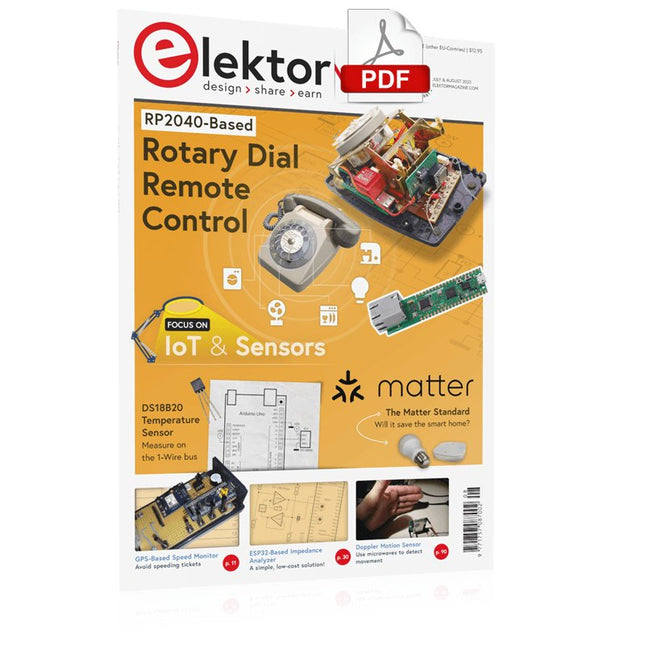
Rotary Dial Phone as Remote ControlTo Switch On the Lights, Dial 1; For the Coffee Maker, Dial 2
GPS-Based Speed MonitorNo More Speeding Tickets
RGB Stroboscope with ArduinoA Colorful Adaptation of a Useful Instrument
Wireless Emergency Push ButtonEnhanced Safety with LoRa
Starting Out in ElectronicsFollow the Emitter
Arbitrary, Independent Hysteresis Levels for Comparatorswith Simulations, Spreadsheets and Algebra
ESP32-Based Impedance AnalyzerSimple, Low-Part-Count, and Inexpensive!
HomeLab ToursEncouraging DIY
The MCCAB Arduino Nano Training BoardAll-in-One Hardware for the “Microcontrollers Hands-On Course”
From Life’s ExperienceModern Luddism
Sensor 101: The DS18B20 Temperature SensorConnection to the 1-Wire Bus
Is Matter the Thread to Save the Smart Home?New Standards to Simplify the Smart Home
A Matter of CollaborationDeveloping with the Thing Plus Matter Board and Simplicity Studio
Infographics: IoT and Sensors
Matter, ExpressLink, Rainmaker — What Is This All About?Q&A with Amey Inamdar, Technical Marketing Director at Espressif
Selecting Microcontroller Dev Kits for IoT and IIoT ApplicationsAn Introductory Guide
Capacitors Do Not Always Behave Capacitively!
An NTP Clock with CircuitPythonWhy Should You Use This Programming Language?
Build a Cool IoT DisplayWith the Phambili Newt
The HB100 Doppler Motion SensorTheory and Practice
A Bare-Metal Programming Guide (Part 1)For STM32 and Other Controllers
Siglent SDM3045X Multimeter
Microprocessors for Embedded SystemsPeculiar Parts, the Series
Microcontroller Documentation Explained (Part 3)Block Diagrams and More
Low-Power LoRa Weather StationBuild a long-range weather station by yourself
Transverter for the 70 cm Band
Climate Calling EngineersMove Fast and Fix Things
Hexadoku
Elektor GREEN en GOLD leden kunnen deze uitgave hier downloaden.
Nog geen lid? Klik hier om een lidmaatschap af te sluiten.
Relio v1.0 – Aanwezigheidsdetectie en afstandsbedieningEen smart controller met Matter-functionaliteit voor AC-apparaten
Betere printplaten ontwerpenEen praktische gids voor professionals en makers
KiCad 9De belangrijkste nieuwe en verbeterde functies
Precisie pico-ampèremeter (1)Met curvetracer-functionaliteit tot in het pA-bereik!
Kerstster 2025soldeer de sterren van de hemel!
100mV-doorgangstester
Wie verlegt de grenzen van de Europese elektronica?Bedrijven om in het oog te houden
Productronica 2025: Wat is er nieuw in de ontwikkeling en productie van elektronica
Automatisering om reshoring van productie, invoerheffingen en tekorten aan arbeidskrachten aan te pakken
Meer dan toekomstbestendigCirculariteit in elektronica
Passieve componentenVerliesarme inductoren voor hoogrendements DC/DC-converters
Hoe desktopmachines de printplaatproductie toegankelijker maken
Alle begin......heeft voeding nodig
Uit het leven gegrepenKnopjeskoorts
Soldeertechniek in 2025Praktische soldeertips rechtstreeks van de werkbank
SimulIDEEen alles-in-één tool voor circuit-prototyping
2025: Een AI OdysseyVan autocomplete tot collega
Wordy Christmas TreeEen feestelijk elektronica-project met een taalkundig tintje
Err-lectronicsCorrecties, updates en lezersbrieven
Analoge pipeline-vervormingEen fraai audio-effect voor gitaren en andere instrumenten
ESP32 audiotransceiver-board (deel 3)Stereotransmissie en dual-radio
Mit einem Arduino-Board ohne zusätzliche Sensoren kann man nicht viel anfangen. Dieses Buch richtet sich an jeden, der seinem Arduino-Uno-Board mit Hilfe von zahlreichen Sensoren Leben einhauchen möchte. Wie das geht, zeigt der Autor Schritt für Schritt mit zahlreichen Abbildungen, und das in einer leicht verständlichen Sprache.
Damit ein Mikrocontroller wie der Arduino Uno Einfluss auf seine Umwelt nehmen kann, sind Sensoren und Aktoren erforderlich, die von einer Software gesteuert werden. Inzwischen gibt es eine große Auswahl an Sensor-Modulen, die an das Arduino-Board angeschlossen werden können.
Als Einstieg in die faszinierende Welt der Sensorik wird in diesem Buch auf das auch bei Elektor erhältliche 37 Module umfassende Sensor-Kit zurückgegriffen. In diesem populären Set sind die Sensoren auf einer kleinen Platine montiert und mit Steckverbindern ausgestattet, was den Anschluss via Breadboard oder Drahtbrücken vereinfacht. Mit den auch für Einsteiger einfach anzuwendenden Sensor-Modulen lassen sich schnell beeindruckende Erfolge erzielen, ohne dass man tief in die Materie der Elektronik eintauchen muss.
Die Funktionsweise und Beschaltung der einzelnen Sensoren wird ausführlich erklärt und ihre Verwendung durch die gut dokumentierten Beispielprogramme leicht nachvollziehbar gemacht.
Elektor GREEN and GOLD members can download their digital edition here.
Not a member yet? Click here.
MultiRF Dev BoardA Platform for Evaluating Short- and Long-Range Wireless Protocols
Elektor at 65Disrupting Electronics Since 1961
Wi-Fi-Based Person Detection on an ESP32When Your Router Becomes a Motion Sensor
Wireless ScalesFour Small Scales = One Big Scale
Walter, the Compact IoT ModuleESP32-S3 SoC, LTE-M/NB-IoT 5G Modem, and GNSS Receiver
3- and 4-Wire RTD Sensors ConditioningWith Full-Scale Adjustment and Cable Compensation
3-in-1 2-Channel Oscilloscope/Generator/MultimeterA Review of The Fnirsi 2D15P
electronica Fast Forward 2026 Invites Startups and Industry Partners
EcologgingA Modular Environmental IoT Station for Field Research
Wireless Connectivity in Medical ApplicationsAlways on the Pulse with Bluetooth LE
AudiotronicsHum Reduction
Increasing Agricultural Efficiency with AI Modeling and SensorsBoosting Agricultural Productivity
OPC UA — An OverviewPlatform-Independent Data Exchange
Redox Meter
Instrumentation Amplifier for Physics and Engineering Experiments
Active Differential Audio FiltersFor Professional Crossovers and More
Elektor Community Perspectives on IoT & Sensors
Telegram-Controlled Water Heater Interface ModuleA Solution Based on an ESP32 and Arduino Software
2026: An AI OdysseyWhatever Happened to Fuzzy Logic?
Err-lectronics
Alarm Signal Injector Plus PowerTools for Finding Broken Wires
High-quality soldering station with the most important tools and consumables, ideal for universal soldering applications.
Features
1-Channel Power Unit, digital, 70 W
Power unit, 1 channel with soldering iron WEP 70 and safety rest PH 70
70W solder iron with ergonomic handle and providing toolless tip change
ESD safe station, iron and heat-resistant silicon cable for safe handling
Using ET soldering tips
Standby mode and auto setback conserves energy, protects equipment
Password-protected to preserve settings
Specifications
Dimensions: 150 x 120 x 98 mm
Weight: 1.4 kg
Display: Digital LC Display
Temperature range: Adjustable from 100°C - 450°C (200°F - 850°F)
Voltage: 230 V
Channels: 1
Temperature range (depends on tool) °C: 100-450
Temperature range (depends on tool) °F: 200-850
Temperature accuracy °C: Average tip temperature can be „offset“ to +/- 5°C at idle with no load
Temperature accuracy °F: Average tip temperature can be „offset“ to +/- 9°F at idle with no load
Temperature stability °C: ±6
Temperature stability °F: ±10
Heat-up time (ca) in seconds (50-350°C / 120-660°F): 28 sec.
Heating output: 85 W