
Search results for "elektor OR magazine OR nl OR november OR december OR 2018"
-

Elektor Digital Das offizielle ESP32-Handbuch (PDF)
Die chinesische Firma Espressif Systems hat den neuen Mikrocontroller ESP32 entwickelt, das Nachfolgemodell des ESP8266-WiFi-Chips. Zusätzlich zu allen ESP8266-Funktionen stellt der ESP32 nun Bluetooth-Funk, einen größeren SRAM-Datenspeicher, mehr GPIOs, mehr Schnittstellen, einen Touch-Sensor, einen Temperatursensor, höhere CPU-Geschwindigkeit, einen CAN-Bus, ADCs mit höherer Auflösung, DACs und Sicherheitsfunktionen bereit. Der ESP32 ist Arduino-kompatibel. Dieses Buch ist eine Einführung in den ESP32-Prozessor und beschreibt die wichtigsten Hardware- und Software-Features dieses Chips. Das Hauptziel des Buches ist es, dem Leser zu vermitteln, wie man ESP32-Hard- und Software in praktischen Projekten einsetzt, vor allem durch Verwendung des hochmodernen ESP32-Entwicklungsboards. Im Buch sind viele einfache, grundlegende und weitere Projekte mittlerer Schwierigkeit auf Basis des Entwicklungsboards ESP32 DevKitC samt der beliebten Arduino-IDE und der Programmiersprache MicroPython enthalten. Die Projekte sind nach aufsteigender Komplexität organisiert.
€ 32,80
Members: € 29,52
-

Elektor Publishing Vacuum Tubes
A Practical Guide to Tube Electronics Vacuum tubes continue to exert a special fascination. Their long-lasting operation, robustness, and characteristic behavior fundamentally distinguish them from modern semiconductor technology. Despite their age, tubes are by no means merely historical components; they are still used today in audio technology, measurement technology, and especially in hobbyist applications. This book is aimed at electronics enthusiasts and hobbyists who want to not only learn about and understand vacuum tubes in theory, but also use them in practice. It conveys the fundamentals of tube technology, explains the different designs and designations, shows typical circuits, and addresses power supplies, measurements, and safety-related aspects. The focus is on practical explanations and realistic examples from the workshop. Numerous tips help you avoid typical mistakes, build circuits, and understand tube devices and their construction. Basic knowledge of electronics is assumed. Vacuum Tubes: A Practical Guide to Tube Electronics offers an accessible and thorough introduction to tube technology – factual, comprehensible, and with a clear focus on practical applications.
€ 39,95
Members: € 35,96
-

Elektor Digital Mastering the Arduino Uno R4 (E-book)
Programming and Projects for the Minima and WiFi Based on the low-cost 8-bit ATmega328P processor, the Arduino Uno R3 board is likely to score as the most popular Arduino family member, and this workhorse has been with us for many years. Eleven years later, the long-overdue successor, the Arduino Uno R4, was released. It is built around a 48 MHz, 32-bit Arm Cortex-M4 microcontroller and provides significantly expanded SRAM and Flash memory. Additionally, a higher-precision ADC and a new DAC are added to the design. The Uno R4 board also supports the CAN Bus with an interface. Two versions of the board are available: Uno R4 Minima, and Uno R4 WiFi. This book is about using these new boards to develop many different and interesting projects with just a handful of parts and external modules. All projects described in the book have been fully tested on the Uno R4 Minima or the Uno R4 WiFi board, as appropriate. The project topics include the reading, control, and driving of many components and modules in the kit as well as on the relevant Uno R4 board, including LEDs 7-segment displays (using timer interrupts) LCDs Sensors RFID Reader 4x4 Keypad Real-time clock (RTC) Joystick 8×8 LED matrix Motors DAC (Digital-to-analog converter) LED matrix WiFi connectivity Serial UART CAN bus Infrared controller and receiver Simulators … all in creative and educational ways with the project operation and associated software explained in great detail.
€ 34,95
Members: € 31,46
-

Elektor Digital Practical Microcontroller Cryptography (E-book)
From Simple Ciphers to Secure Systems Understanding how to apply cryptography on modern microcontrollers is essential for building secure, reliable, and trustworthy systems. This book explains cryptography in the context of embedded hardware, from classical ciphers that illustrate core principles to modern techniques such as AES for practical high-security applications. By combining mathematical theory with real-world microcontroller implementations, readers learn not only how cryptography works, but also how to implement it effectively on systems with limited processing power and memory. The book is intended for students starting out in cryptography, hobbyists securing personal projects, and engineers looking for a structured guide to embedded security. The book covers these key topics in applied cryptography: Classical ciphers on Arduino Uno and Raspberry Pi Pico, with full programs: Spartan Scytale, Hebrew Atbash, Caesar, ROT13, Alberti Disk, Vigenère, Affine, Polybius, Playfair, Beaufort, Ottoman Codebook, and One-Time Pad. Hacking classical ciphers using microcontrollers, with examples. Pseudo-random (PRNG) and true random number generation (TRNG) on microcontrollers. Symmetric-key cryptography with full programs: DES and AES-128/256. Memory and speed constraints of cryptography on microcontrollers. Asymmetric cryptography: public/private keys, digital signatures, key distribution and derivation (KDF), RSA, and SHA-256 implementations. A complete secure communication program using RSA and AES-256. A glossary of commonly used cryptography terms.
€ 29,95
Members: € 26,96
-

Elektor Digital Röhrenverstärker-Schaltungen (PDF)
Röhrenverstärker produzieren Verzerrungen. Aber abweichend von den üblichen Standardschaltungen existieren Schaltungsvarianten, die sich durch minimale Klirrfaktoren bei außerordentlich großen Ausgangsamplituden von 50 oder gar 100Vp auszeichnen. Solche Verstärkerstufen wurden unter den Bezeichnungen SRPP, µ-Follower und _-Follower bekannt. Eine große Zahl von Veröffentlichungen setzt sich mit diesen besonderen Schaltungen auseinander – leider aber auch häufig in fehlerhafter Form. Ganz offenbar steckt der Teufel im Detail. Ohne ausreichende Kenntnis der hinter diesen reizvollen Konzepten stehenden Theorie und den daraus abzuleitenden Dimensionierungsvorschriften besteht die Gefahr, die exzellenten Eigenschaften von SRPPs und deren Verwandten zunichte zu machen. Im ersten Teil des vorliegenden Buches werden die Ursachen von Verzerrungen untersucht; anschließend geht es um die praktische Umsetzung der theoretischen Hintergründe. Röhren-Interessierten wird nicht entgangen sein, dass das Internet eine Fülle von meist ausgesprochen aufwendig konzeptionierten Schaltungen bietet. Aufmerksames und kritisches Überprüfen solcher Entwürfe beweist aber in fast allen Fällen, dass solche „Exoten“ bei Weitem nicht die Übertragungsqualitäten erreichen, die sie zu versprechen vorgeben. In einem gesonderten Kapitel über fehlerhafte SRPPs und µ-Follower wird gezeigt, wie teilweise bizarr anmutende Fehler zu Schaltungen führen, die dann einfacher und zielführender durch gängige Standardschaltungen zu ersetzen wären. Des Weiteren werden Gegentakt-Endstufen und ihr Zusammenwirken mit SRPPs genauer besprochen. Ausgehend von der Urversion der gegen Ende der Röhrenära entwickelten eisenlosen Endstufe (OTL) – der HF 303 von Philips – wird vertieft auf diese äußerst bemerkenswerte Variante der Röhren-Leistungsverstärker eingegangen. Nicht zuletzt wird die Aufmerksamkeit auch auf den Frequenzgang und das Übertragungsverhalten, die Netzteile und die nicht ganz unkomplizierte Heizungsversorgung der Röhrenverstärker gerichtet. Auch die Praxis kommt nicht zu kurz: Für einige der besprochenen Schaltungsentwürfe wurden ausführliche konkrete Hinweise für deren praktische Realisierung in diesem Buch mit aufgenommen.
€ 44,80
Members: € 40,32
-
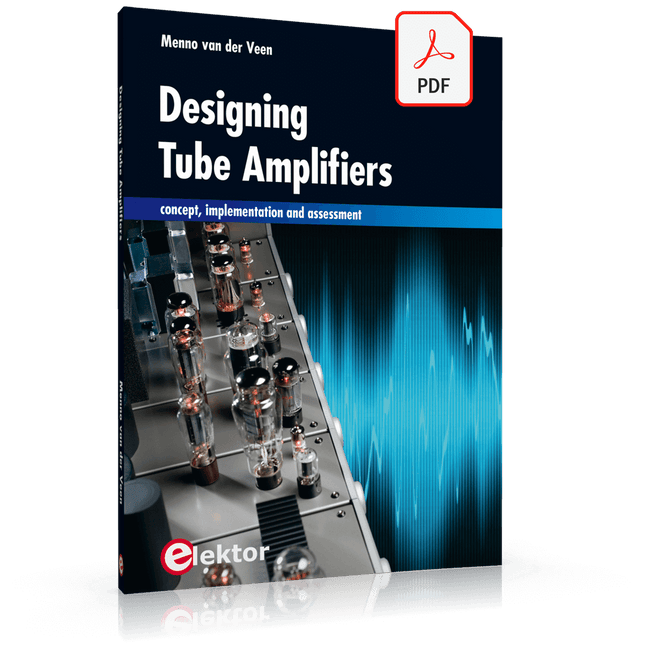
Elektor Digital Designing Tube Amplifiers (E-book)
This book focuses more on practical aspects than on theory, and it has an contemplative nature, as though the author were viewing amplifiers from above. Knowledge elements are integrated and placed in the context of a broad overview. Even now tube amplifiers still sound great perhaps better than ever before. In part that is because we now have access to modern components such as toroidal output transformers, extremely high-quality resistors and capacitors, and many sorts of wire with good acoustic properties. Modern audio sources, such as CD players, and the latest top-end loudspeakers also enable us to appreciate how well tube amplifiers reproduce music even better than before. This new book from Menno van der Veen looks at tube amplifiers from more than just a theoretical perspective. It focuses primarily on the design phase, where decisions must be taken with regard to the purpose and requirements of the amplifier, and it addresses the following questions: How do these aspects relate to subjective and objective criteria? Which circuits sound the best, and why? If you want to develop and market an amplifier, what problems should you expect? What are the significance and meaning of measurements? Are they still meaningful, or have they lost their relevance? Thanks to the enormous processing power of computers, we can now measure more details than ever before. How can these new methods be applied to tube amplifiers? Previously it was sufficient to measure the frequency range, power and distortion of an amplifier in order to characterize the amplifier. Are these measurements still sufficient, or should we start measuring according to how we hear, using real music signals instead of waveforms from signal generators? The author sketches a future where amplifier measurements that conform to our sense of hearing enable us to arrive at new insights. This book focuses more on practical aspects than on theory, and it has an contemplative nature, as though the author were viewing amplifiers from above. Knowledge elements are integrated and placed in the context of a broad overview.
€ 29,95
Members: € 26,96
-

Elektor Digital High-End mit Röhren (PDF)
High-End mit Röhren (PDF)
€ 44,80
Members: € 40,32
-
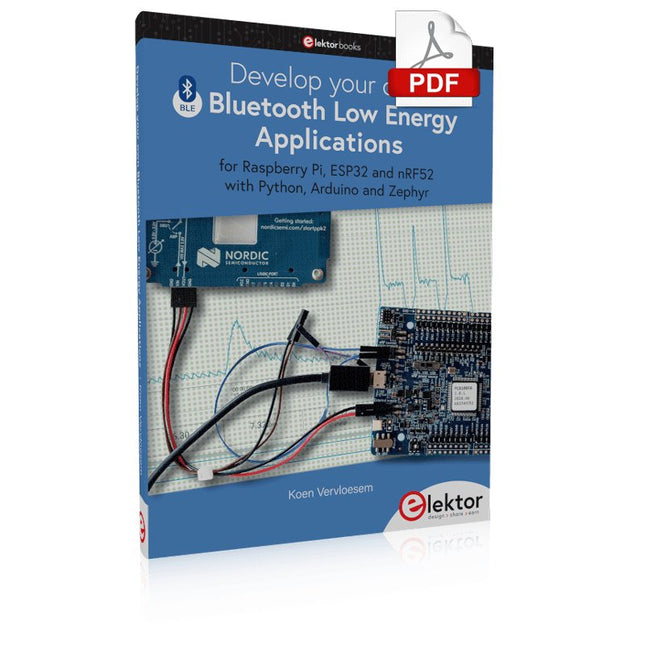
Elektor Digital Develop your own Bluetooth Low Energy Applications (E-book)
For Raspberry Pi, ESP32 and nRF52 with Python, Arduino and Zephyr Bluetooth Low Energy (BLE) radio chips are ubiquitous from Raspberry Pi to light bulbs. BLE is an elaborate technology with a comprehensive specification, but the basics are quite accessible. A progressive and systematic approach will lead you far in mastering this wireless communication technique, which is essential for working in low power scenarios. In this book, you’ll learn how to: Discover BLE devices in the neighborhood by listening to their advertisements. Create your own BLE devices advertising data. Connect to BLE devices such as heart rate monitors and proximity reporters. Create secure connections to BLE devices with encryption and authentication. Understand BLE service and profile specifications and implement them. Reverse engineer a BLE device with a proprietary implementation and control it with your own software. Make your BLE devices use as little power as possible. This book shows you the ropes of BLE programming with Python and the Bleak library on a Raspberry Pi or PC, with C++ and NimBLE-Arduino on Espressif’s ESP32 development boards, and with C on one of the development boards supported by the Zephyr real-time operating system, such as Nordic Semiconductor's nRF52 boards. Starting with a very little amount of theory, you’ll develop code right from the beginning. After you’ve completed this book, you’ll know enough to create your own BLE applications.
€ 32,95
Members: € 29,66
-
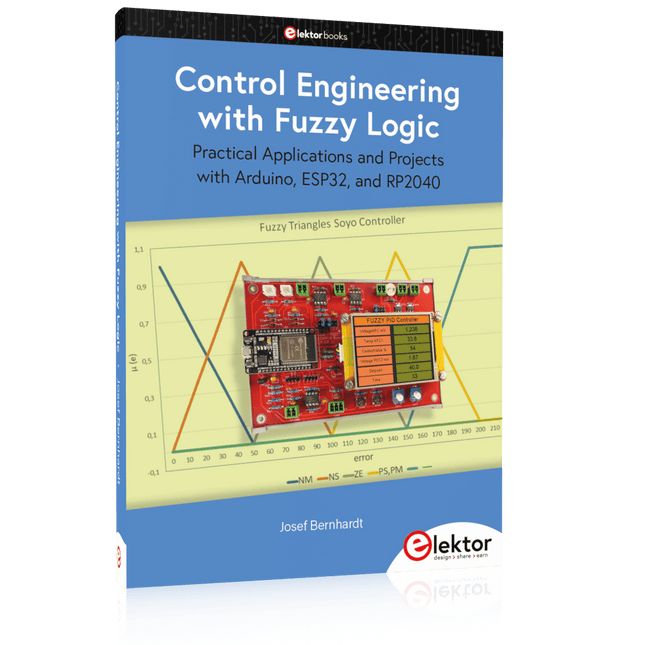
Elektor Publishing Control Engineering with Fuzzy Logic
Practical Applications and Project with Arduino, ESP32, and RP2040 Immerse yourself in the fascinating world of control engineering with Arduino and ESP32! This book offers you a practical introduction to classic and modern control methods, including PID controllers, fuzzy logic, and sliding-mode controllers. In the first part, you will learn the basics of the popular Arduino controllers, such as the Arduino Uno and the ESP32, as well as the integration of sensors for temperature and pH measurement (NTC, PT100, PT1000, and pH sensor). You will learn how to use these sensors in various projects and how to visualize data on a Nextion TFT display. The course continues with an introduction to actuators such as MOSFET switches, H-bridges, and solid-state relays, which are used to control motors and actuators. You will learn to analyze and model controlled systems, including PT1 and PT2 control. The book focuses on the implementation of fuzzy and PID controllers for controlling temperature and DC motors. Both the Arduino Uno and the ESP32 are used. The sliding-mode controller is also introduced. In the second-to-last chapter, you will explore the basics of neural networks and learn how machine learning can be used on an Arduino. In the last chapter, there is a practical example of a fuzzy controller for feeding electricity into the household grid. This book is the perfect choice for engineers, students, and electronics engineers who want to expand their projects with innovative control techniques.
€ 44,95
Members: € 40,46
-

Elektor Publishing Energy Harvesting
Aus der Reihe "Stromversorgung ohne Stress" (Band 3) Elektronik ohne Batterien oder Versorgungsnetz Für den Betrieb moderner elektronischer Bauteile ist vergleichsweise nur noch wenig Energie notwendig. Dies eröffnet neue Möglichkeiten, wie z. B. Schaltungen und Baugruppen, die ohne Batterien oder Akkumulatoren auskommen und auch keinen Anschluss an das Versorgungsnetz benötigen. Damit entfällt auch ein großer Teil des Wartungsaufwandes. Die Baugruppen arbeiten weitestgehend „für sich alleine“. Die Energie wird auf unterschiedlichste Weise aus der Umgebung gewonnen. Dazu sind allerdings spezielle Techniken erforderlich. Nicht nur zur Gewinnung der Energie – auch zur Umformung, so dass sie für elektronische Schaltungen nutzbar ist. In diesem Buch geht es um die Bereitstellung kleiner Energiemengen, mit denen kleine Geräte (Sensoren, Sender und Empfänger für QRP oder Datenübertragung, etc.) völlig autark betrieben werden können – wenn möglich, mit Bauteilen aus der Bastelkiste und ohne komplexe, spezialisierte Integrierte Schaltungen. Die am Thema interessierten Elektroniker und „Macher“ lernen hier, wie sie eigene reale Energy-Harvesting-Projekte mit Teilen aus der Bastelkiste umsetzen können, ohne vorher viel Zeit für lange theoretische Abhandlungen aufzubringen. Gerade beim Energy Harvesting ist es jedoch nicht immer möglich auf Spezial–ICs zu verzichten. Es geht eben um jedes µW und es ist leicht nachvollziehbar, dass es einfacher ist, auf einer kleinen Chipfläche mit wenig Energie zu arbeiten, als bei einer ausladenden Schaltung mit umfangreicher Verdrahtung. Die mehr „theoretischen“ oder grundsätzlichen Themen wurden in die einzelnen Kapitel und Projekte eingestreut. Den vollständigen Überblick erhält man deshalb erst, wenn man das Buch in Gänze gelesen hat. Dafür kann der Leser bereits im 2. Kapitel ein erstes Projekt umsetzen.
€ 39,80
Best Price
-

Elektor Publishing Les oscilloscopes anciens & modernes pour les débutants
Ce qui se passe en électronique est par définition invisible à l'oeil nu. L'instrument qui permet précisément de rendre visibles les signaux électriques, celui par le truchement duquel les effets de l'électronique se manifestent à nous, c'est l'oscilloscope. Hélas, quand on commence à faire de l'électronique, c'est souvent sans oscilloscope. Et l'on en est réduit à tâtonner, aussi bien physiquement que mentalement. Le jour où l'on goûte à la visualisation des signaux sur un écran, c'est une révélation. Plus personne ne souhaite se priver de cet enchantement. Pas de retour en arrière. En électronique, si l'on veut progresser dans le plaisir et dans la compréhension, il faut un oscillo. Commence alors une période d'interrogation : comment choisir ? Et à peine cette question-là aura-t-elle trouvé sa réponse, il en viendra une ribambelle d'autres que l'on peut résumer en une seule : comment se servir de l'oscilloscope de telle sorte que ce qu'il affiche corresponde bien à la réalité des signaux ? Dans ce livre, Rémy Mallard, répond clairement à ces questions. Il donne aussi de nombreuses informations pour aider son lecteur à élucider lui-même de nouveaux mystères qui ne manqueront pas de surgir. Ceux qui le connaissent déjà comme l'auteur d'un livre sur l'électronique dont le titre est un programme à lui tout seul : L'électronique pour les débutants qui sèchent les cours mais soudent sans se brûler les doigts, ainsi que d'un livre d'initiation à la programmation des microcontrôleurs PIC, savent qu'ils trouveront ici un ouvrage utile, qu'ils rouvriront souvent.
€ 44,95
Members: € 40,46
-

Elektor Digital De basis van elektronica (E-book)
Analoge schakelingen, sensors en microcontrollers Elektronica is spannend. Het is een hobby die zowel leuk als leerzaam is. Het stelt je in staat om thuis of op het werk nieuwe en nuttige vaardigheden te leren. Een ervaren elektronicus ontwerpt zijn eigen schakelingen, en brengt zijn projecten tot leven. Maar voordat je zover bent, moet je eerst de basis onder de knie krijgen. Daarom brengt dit boek een groot aantal inleidende artikelen samen die in het elektronicatijdschrift Elektor zijn gepubliceerd. Het is je metgezel bij het leerproces in de wereld van de elektronica. Het begint allemaal met analoge elektronica. Je zult de eenvoudigste componenten en circuits ontdekken om te begrijpen hoe ze werken, hoe ze op elkaar inwerken en de mogelijke problemen. De beste manier om vooruitgang te boeken is door echte experimenten uit te voeren, want theorie is niet genoeg. Dit boek begeleid je in een groot aantal praktische projecten voor beginners. Door ze te maken, doe je veel ervaring en kennis op. Het tweede deel van het boek neemt je mee in de wereld van de digitale elektronica. De auteur bespreekt het gebruik van microcontrollers. Taken die voorheen werden uitgevoerd door discrete componenten of conventionele geïntegreerde schakelingen worden nu uitgevoerd door microcontrollers. De programmeertaal BASCOM, maar ook platforms als Arduino, BBC micro:bit en andere, maken dit leerproces veel gemakkelijker. Dit boek beschrijft in detail vele toepassingen van microcontrollers, die betaalbaar zijn voor de beginner. Hier gaan programmeren en solderen hand in hand!
€ 32,95
Members: € 29,66


