Elektor GREEN en GOLD leden kunnen deze uitgave hier downloaden.Nog geen lid? Klik hier om een lidmaatschap af te sluiten.
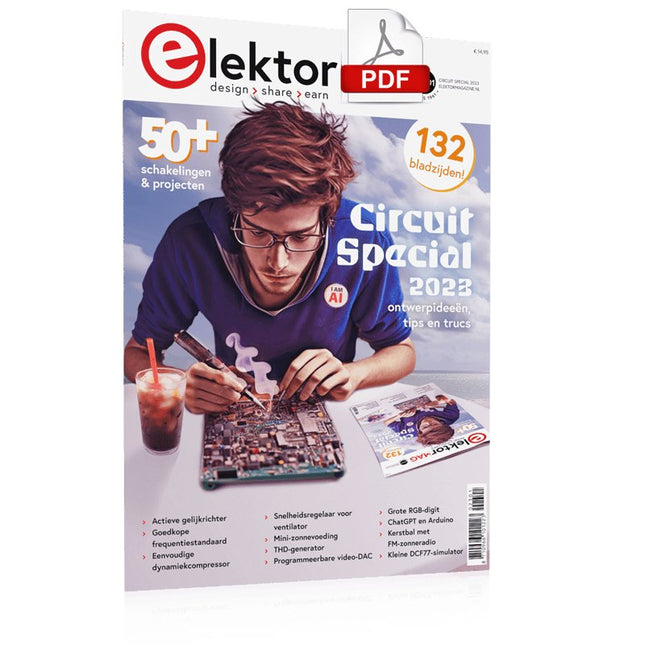
Mini-zonnevoedingzon in, 3,3 V uit
Solid-state stereo-audioschakelaarklikvrij en zonder bewegende onderdelen
Grote RGB-digitmet through-hole WS2812 LED’s
Microfoon-voorversterker met 48V-fantoomvoedingvoor podcasting en pro-audio
Blokgolfgeneratoren met regelbare duty cycle en frequentiesimpele schakelingen met CMOS- en TTL-IC’s
Eenvoudige dynamiekcompressorsofte aansturing, warm geluid
Simpel elektronisch slot
Actieve gelijkrichtervoor 2...40 V bij maximaal 3 A met tegenstroomonderdrukking
Actieve boxen in- en uitschakelen
Ongebalanceerd/gebalanceerd-convertermet RF-filter en DC-bescherming
2023: een AI-odysseewaar komt het vandaan en waar gaat het naar toe?
Snelheidsregelaar voor ventilatormet handmatige en thermostaatmodus
Laatste nieuwtjes van Arduino Project Hubnieuwe projecten uit de community
Overbelastingsmonitorbewaakt netsnoeren
Transistorloos knipperlicht in het donkeroscillator met alleen tweedraads onderdelen
Morsecode-generatorvoor gebruik als baken of leermiddel!
Programmeerbare video-DACvoor elk formaat tot RGB888
Kleintje klavierzonder bewegende onderdelen
Dubbel-dobbel zonder microprocessordubbele dobbelsteen op een enkele print – plus enkele ontwerptrucs
Elektronische vogelverschrikker
Amusante, inspirerende en verbazingwekkende schakelingen
LC/LP/HA-thermometernauwkeurige metingen en een binair display
THD-generatorvervorming, maar dan opzettelijk
Overtemperatuur-indicator met thyristorelektronische onderdelen ongebruikelijk gebruikt
Een PTC-flipflop
Sociale vogeleen tsjilpende Elektor Klassieker
Neonlamp plus microcontroller
Temperatuurgestabiliseerde IC-stroombronneutraliseer de temperatuurdrift van deze driebeners
Regelbare tweede-orde hogetonen-boostergehoorsteuntje voor ouderen
Edwin komt naar huisherinneringen na 53 jaar
Eénarmige bandieteen eenvoudige, leuke, nostalgische en leerzame Elektor-klassieker!
Eenvoudige digitaal gestuurde variabele weerstand
Lekdetectorbeveiligt en alarmeert bij lekkages
Eco-timer met automatische uitschakelingverbruikt niets in uitgeschakelde toestand!
ChatGPT en Arduino
Zenermetermeet de Z-spanning van Z-diodes ≤ 100 V
Servotester
ESP32 Windows-controller met gratis software
Analoge en mixed-signal IC’s van Microchipzuinige signaalverwerking
Interfacenormenfilter en overspanningsbeveiliging voor de I²C-bus
Li-Ion accumonitorrestlading-indicator geeft visuele feedback
PS/2-muis als draai-encoder (en meer...)
Simpele schemerschakelaarvoor bestaande lampen of installaties
Controller voor waterpompbereid je voor op hoogwater
Kerstbal met FM-zonneradiomeer heb je voor de kerst niet nodig
Trillingssensor met relaistik of schud om in te schakelen
Doorgangstestergevoelig en niet storend
In- en uitschakelen met een drukknop
Regeling voor mini-boor (2023)een ontwerp uit 1980 herzien
Digitale trillingssensorzet trillingen om in nauwkeurig getimede pulsen
Ompoolbeveiliging met kleine spanningsval
Goedkope frequentiestandaard
Kleine DCF77-simulatornauwkeurige fake-tijdstandaard
De Lilygo T-PicoC3combineert RP2040 en ESP32-C3 met een full-color TFT-display
Hexadoku
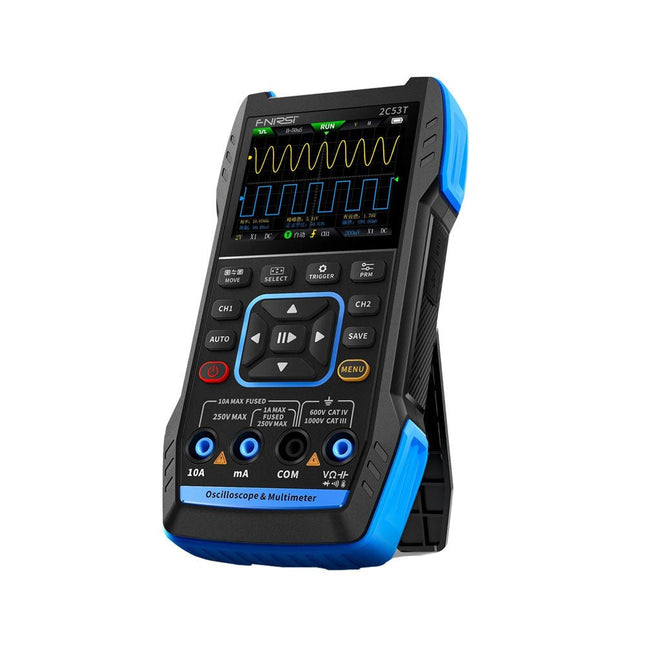
The FNIRSI 2C53T, an enhanced version of its 10 MHz predecessor, is a compact and versatile 3-in-1 device. It combines a dual-channel 50 MHz oscilloscope, a 4.5-digit True RMS multimeter, and a signal generator with 13 waveform types, making it an essential tool for maintenance and research professionals.
Oscilloscope: Features 50 MHz bandwidth, 250 MS/s sampling rate, ±400 V protection, FPGA + ARM + ADC architecture, and waveform saving for analysis.
Multimeter: 4.5-digit True RMS with 19999 counts, supports AC/DC voltage, current, capacitance, resistance, diode, and continuity measurements.
Signal Generator: Outputs 13 signal types up to 50 KHz, with adjustable frequency, amplitude, and duty cycle.
With a 2.8-inch LCD, 3000 mAh battery (6-hour runtime), and a portable design, it delivers powerful functionality in a user-friendly package.
Specifications
Oscilloscope
Channels
2
Analog Bandwidth
50 MHz
Real-time Sampling Rate
250 MS/s
Storage Depth
1 Kpts
Impedance
1 MΩ
Time Base Range
10ns-20s
Vertical Sensitivity
10 mV/div-10 V/div (x1)
Maximum Measured Voltage
±400 V
Trigger Mode
Auto/Normal/Single
Trigger Type
Rising edge, Falling edge
Display Mode
Y-T/Rolling/X-Y
Coupling Method
AC/DC
Persistence
OFF, 500ms, 1s, ∞
Math
8 Basic Operations + FFT
Supported
Waveform Screenshot Save, Export Waveform Image, Cursor Measurement, Infinite Afterglow
Multimeter
DC Voltage
1.9999V/19.999V/199.99V/1000V
±(0.5%+3)
AC Voltage
1.9999V/19.999V/199.99V/750.0V
±(1%+3)
DC Current
19.999mA/199.99mA/1.9999A/9.999A
±(1.2%+3)
AC Current
19.999mA/199.99mA/1.9999A/9.999A
±(1.5%+3)
Resistance
19.999MΩ/1.9999MΩ/199.99KΩ/19.999KΩ
±(0.5%+3)
1.9999KΩ/199.99Ω
±(2.0%+3)
Capacitance
999.9uF/99.99uF/9.999uF/999.9nF/99.99nF/9.999nF
±(2.0%+5)
9.999mF/99.99mF
±(5.0%+20)
Temperature
−55~1300°C (−67~2372°F)
±(2.5%+5)
Continuity Test
Yes
Diode
Yes
Signal Generator
13 Signal Waveforms
Sine wave, rectangular wave, sawtooth wave, half wave, full wave, positive step wave, reverse step wave, exponential rise, exponential fall, DC, multi-audio, Sinker pulse, Lorentz wave
Output Frequency
0-50 KHz
Output Amplitude
0-3 V
Output Duty Cycle
0-100%
General
Display
2.8" HD color screen
Resolution
320 x 240
Charging
USB-C (5 V/1 A)
Battery
3000 mAh Lithium battery
Standby Time
6 hours
Languages
English, Chinese
Dimensions
167 x 89 x 35 mm
Weight
300 g
Differences New vs Old Version
Model
2C53T Upgrade
2C53T Predecessor
Bandwidth
50 MHz
10 MHz
Display Mode
Y-T/Rolling/X-Y
Y-T/Rolling
Math
8 Basic Operations + FFT
N/A
Cursor Function
Yes
N/A
XY Lissau Graph
Yes
N/A
Afterglow Function
Yes
N/A
Multimeter Accuracy
19999 Counts
9999 Counts
Signal Generator
50 KHz
2 MHz
Included
1x FNIRSI 2C53T Oscilloscope (50 MHz)
2x P6100 Oscilloscope probes (10X)
1x Multimeter probe
1x Alligator clip probe
1x USB-C charging cable
1x Storage bag
1x Manual
Downloads
Manual
Firmware V1.2.0
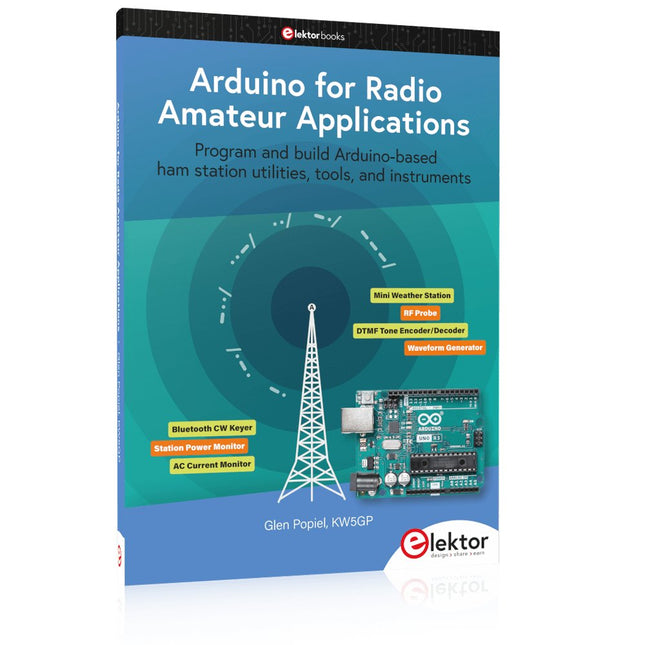
Program and build Arduino-based ham station utilities, tools, and instruments
In addition to a detailed introduction to the exciting world of the Arduino microcontroller and its many variants, this book introduces you to the shields, modules, and components you can connect to the Arduino. Many of these components are discussed in detail and used in the projects included in this book to help you understand how these components can be incorporated into your own Arduino projects. Emphasis has been placed on designing and creating a wide range of amateur radio-related projects that can easily be built in just a few days.
This book is written for ham radio operators and Arduino enthusiasts of all skill levels, and includes discussions about the tools, construction methods, and troubleshooting techniques used in creating amateur radio-related Arduino projects. The book teaches you how to create feature-rich Arduino-based projects, with the goal of helping you to advance beyond this book, and design and build your own ham radio Arduino projects.
In addition, this book describes in detail the design, construction, programming, and operation of the following projects:
CW Beacon and Foxhunt Keyer
Mini Weather Station
RF Probe with LED Bar Graph
DTMF Tone Encoder
DTMF Tone Decoder
Waveform Generator
Auto Power On/Off
Bluetooth CW Keyer
Station Power Monitor
AC Current Monitor
This book assumes a basic knowledge of electronics and circuit construction. Basic knowledge of how to program the Arduino using its IDE will also be beneficial.
Program and Build Raspberry Pi 5 Based Ham Station Utilities with the RTL-SDR
The RTL-SDR devices (V3 and V4) have gained popularity among radio amateurs because of their very low cost and rich features. A basic system may consist of a USB based RTL-SDR device (dongle) with a suitable antenna, a Raspberry Pi 5 computer, a USB based external audio input-output adapter, and software installed on the Raspberry Pi 5 computer. With such a modest setup, it is possible to receive signals from around 24 MHz to over 1.7 GHz.
This book is aimed at amateur radio enthusiasts and electronic engineering students, as well as at anyone interested in learning to use the Raspberry Pi 5 to build electronic projects. The book is suitable for both beginners through experienced readers. Some knowledge of the Python programming language is required to understand and eventually modify the projects given in the book. A block diagram, a circuit diagram, and a complete Python program listing is given for each project, alongside a comprehensive description.
The following popular RTL-SDR programs are discussed in detail, aided by step-by-step installation guides for practical use on a Raspberry Pi 5:
SimpleFM
GQRX
SDR++
CubicSDR
RTL-SDR Server
Dump1090
FLDIGI
Quick
RTL_433
aldo
xcwcp
GPredict
TWCLOCK
CQRLOG
klog
Morse2Ascii
PyQSO
Welle.io
Ham Clock
CHIRP
xastir
qsstv
flrig
XyGrib
FreeDV
Qtel (EchoLink)
XDX (DX-Cluster)
WSJT-X
The application of the Python programming language on the latest Raspberry Pi 5 platform precludes the use of the programs in the book from working on older versions of Raspberry Pi computers.
Diese Ausgabe steht allen GOLD- und GREEN-Mitgliedern auf der ElektorMagazine-Website zum Download bereit!
Sie sind noch kein Mitglied? Hier klicken!
Was genau ist eigentlich Edge-KI?Intelligenz direkt im Gerät
Wir stellen vor: Edge Impulse StudioKI-Modelle für Edge-Geräte einfach erstellen und bereitstellen
Keyword Spotting mit Edge ImpulseErfassen, Trainieren und Implementieren
Intelligente Gerätesteuerung per Sprachbefehl mit Nordic Thingy:53
Edge-KISchlüsselbegriffe zum Verständnis von Edge-KI und Machine Learning
Crashkurs: Einstieg in Edge ImpulseWie Sie mit dem Arduino Nano 33 BLE Sense ein ML-Modell erfassen, trainieren und bereitstellen
Ein neues Kapitel für ArduinoVom Hobby-Board zur Edge-Computing-Plattform
Erste Schritte mit Objekterkennung auf Edge-Geräten
Fehlererkennung auf LeiterplattenComputer Vision mit dem Raspberry Pi
KI-Skalierung für kleinste Geräte
Optimierung der Energieeffizienz bei batteriebetriebenen Edge-KI-Geräten
KI-ToasterWenn Edge-KI das Frühstück rettet
Thundercomm Rubik Pi 3Raspberry Pi trifft Edge-KI
Unternehmensführung, Embedded ML und die Edge-Revolution
Vision-Language-Modelle für Edge-GeräteKaskadierte Modelle für höhere Zuverlässigkeit
Lernen Sie Edge Impulse kennenFragen aus der Elektor-Community
Projekt-Update #5: Energiemessgerät mit ESP32Haushaltsgeräte mit Edge-KI erkennen
Bewegungserkennung mit Anomalie-ErkennungEin End-to-End-Tutorial
Intelligentes Belüftungssystem: Verbindung von Schall- und UmweltdatenEin Dual-MCU-Ansatz mit Machine Learning für die automatische Steuerung von Fenstern und Jalousien
Sprachsteuerung für Ohrhörer und Headsets
Edge-KI: Intelligente Geräte auf dem Vormarsch
Über 50 Schaltungen und Projekte
Sirene im US-Stil
Zwei Drehgeber an einem Analogeingang
Wie man mit dem Arduino einen 230-V-AC-Dimmer baut
Zehnfache LED-Stromquelle
Vier Schalter an einem Pin erkennen
Ein/Aus-Schalter mit Akku-Füllstandskontrolle
Handdesinfektionsmittel-Spender selbstgebaut
Eine einfache elektronische Orgel
Ultra-einfacher Stereo-Verstärker
Sound Activated Switch für Verstärker
Balanced/Unbalanced-Wandler
Externes Netzfilter
Tastenfreie Torsteuerung
DI-Box für ein Smartphone
Spaß mit Lauflichtern
Ein-Knopf-Thyristor-Steuerung
Quasi-analoger Belichtungstimer für die Dunkelkammer
Schaltungen von der Hackster.io-Community
Analoger Bräunungstimer
Noch eine Ein-Draht-LCD-Schnittstelle
Einfacher PWM-Generator mit ATtiny13
Zweites Leben für Batterien
Touch-Schalter für LED-Leuchten
Tester für LEDs und DIP-Schalter
Funktionstester für IR-Fernbedienungen
Leistungshalbleiter-Tester
SPI für WS2812(B)-LEDs
Messen von Leistungsinduktivitäten
Ein DIY-Doppelnetzteil
DIY-Testvorrichtung für das LCR-Meter
Arduino-Amperemeter
Zwei-Finger-Orgel
Rauscharmer ADC-Kalibrator
DC/DC-Aufwärtswandler
Zwei Potentiometer an einem digitalen Eingang
Akustischer Näherungssensor
Batterieloser Heizkörper-Sensor
Wanzen und drahtlose Kameras aufgespürt
Timer für die Innenbeleuchtung im Auto
Kerzensimulator
Digitaler Küchentimer
Milliohm-Meter
Verzögerungstimer für Heißwasserbereiter
Einfaches Ladegerät für zwei Zellen des Typs 18650
Winzige Frequenzreferenz
Sparsamer IR-Schalter
Recyceln Sie den Auto-Handylader!
Mikrofon-Vorverstärker für Arduino
EMI-Filter im Selbstbau
Elektronischer Würfel – ganz ohne MCU
Finger-Kondensator
Der selbstladende LED-Blitzer
Außerdem in dieser Ausgabe
KiCad 6 – Fünf interessante neue Funktionen
Flashback – Der Elektor-Computer SC/MP
Interview – Mit Elektrizität Kunst machen
Meine erste Platine – Crash-Einstieg in KiCad
Mit intelligenter Software Hardware minimieren
Infografik – Fakten und Zahlen
Neue ICs von Analog Devices
Flashback – DER Elektor-Metalldetektor
Hexadoku – Sudoku für Elektroniker
A Project-Based Introduction to Microcontrollers and Drone Control
A Practical Introduction to Embedded Systems with the ESP32
This book is intended for readers who are new to embedded systems and looking for a structured, example-driven way to begin. If you’ve explored general-purpose electronics or Arduino-based resources but found them too broad or lacking in practical application, this guide offers a more focused alternative.
With a small, affordable set of components – such as LEDs, sensors, an OLED screen and a motion sensor – you’ll build and work with the same hardware setup throughout the book. This allows you to focus on learning and experimenting without constant reconfiguration.
Topics include:
Understanding and programming the ESP32 microcontroller
Using the Arduino IDE to write and deploy code
Exploring cyber-physical systems, culminating in basic drone control
No prior experience with Arduino or embedded development is required. Each section includes hands-on examples and mini-projects designed to reinforce core concepts and encourage deeper exploration. By the end, you’ll be equipped not only to reproduce the book’s examples, but also to extend them toward your own ideas and applications.
Whether your interest is in learning embedded programming, building interactive systems, or exploring educational drone control, this book provides a clear and practical path to getting started.
From Simple Ciphers to Secure Systems
Understanding how to apply cryptography on modern microcontrollers is essential for building secure, reliable, and trustworthy systems. This book explains cryptography in the context of embedded hardware, from classical ciphers that illustrate core principles to modern techniques such as AES for practical high-security applications.
By combining mathematical theory with real-world microcontroller implementations, readers learn not only how cryptography works, but also how to implement it effectively on systems with limited processing power and memory. The book is intended for students starting out in cryptography, hobbyists securing personal projects, and engineers looking for a structured guide to embedded security.
The book covers these key topics in applied cryptography:
Classical ciphers on Arduino Uno and Raspberry Pi Pico, with full programs: Spartan Scytale, Hebrew Atbash, Caesar, ROT13, Alberti Disk, Vigenère, Affine, Polybius, Playfair, Beaufort, Ottoman Codebook, and One-Time Pad.
Hacking classical ciphers using microcontrollers, with examples.
Pseudo-random (PRNG) and true random number generation (TRNG) on microcontrollers.
Symmetric-key cryptography with full programs: DES and AES-128/256.
Memory and speed constraints of cryptography on microcontrollers.
Asymmetric cryptography: public/private keys, digital signatures, key distribution and derivation (KDF), RSA, and SHA-256 implementations.
A complete secure communication program using RSA and AES-256.
A glossary of commonly used cryptography terms.
KI in der Praxis
Tauchen Sie ein in die faszinierende Welt der Robotik und Automatisierung!
Dieses Elektor Special zeigt, wie Sie mit Kreativität, etwas Know-how und günstiger Technik eigene Roboter bauen können. Vom ersten DIY-Projekt mit Arduino oder Raspberry Pi bis hin zu intelligenten Systemen mit KI – dieses Heft macht moderne Robotik verständlich und greifbar.
Entdecken Sie praxisnahe Anleitungen, inspirierende Projekte und spannende Einblicke in die Maker-Szene. Lernen Sie, wie aus Experimentierfreude, Gemeinschaft und Offenheit echte Innovation entsteht – und warum Robotik weit mehr ist als nur ein technisches Hobby.
Inhalt
Phantasie wird Realität
Arduino-controlled Drawing Robot
GalaxyRVR Mars Rover Kit for Arduino
YDLIDAR X4Pro Lidar
xHuskyLens AI Camera
DOF Robot Arm mit Raspberry Pi Pico
Fertigungsroboter mit Fischertechnik
Pneumatischer Industrieroboter
Warum bauen wir immer wieder Roboterhunde?
Elektor Mini-Wheelie
Roboterfahrzeuge und autonomes Fahren
The Basics, New Ideas & Applications
Build digital electronics from the ground up—and take it all the way to practical circuits you can use.
This book guides you through the core principles of digital technology with a strongly hands-on approach. You’ll begin with the essentials: signals, devices for working with them, and what "logic 0" and "logic 1" mean in real hardware. Simple demonstration setups made from easy-to-find parts (LEDs, diodes, resistors, switches) help you see how logic behaves, making the theory click before you move on.
From there, you’ll explore a wide range of logic elements and how they’re implemented, including classic logic families such as TTL and CMOS. The fundamentals section covers the building blocks of digital systems: flip-flops, Schmitt triggers, registers, counters and dividers, encoders/ decoders, multiplexers/demultiplexers, plus A/D and D/A conversion and timing circuits.
Next, the book invites you into "new ideas" in digital electronics—universal logic elements, unconventional approaches (including thyristor-based and fractional logic), and creative logic functions that can inspire original designs.
Finally, a large, well-organized collection of application circuits turns knowledge into projects: electronic switches and selectors, pulse generators, PWM regulators, frequency multipliers/dividers, phase shifters, and digital filters.
Study it deeply, and you’ll gain not only understanding—but the ability to design and debug digital circuits independently.
Elektor GREEN and GOLD members can download their digital edition here.
Not a member yet? Click here.
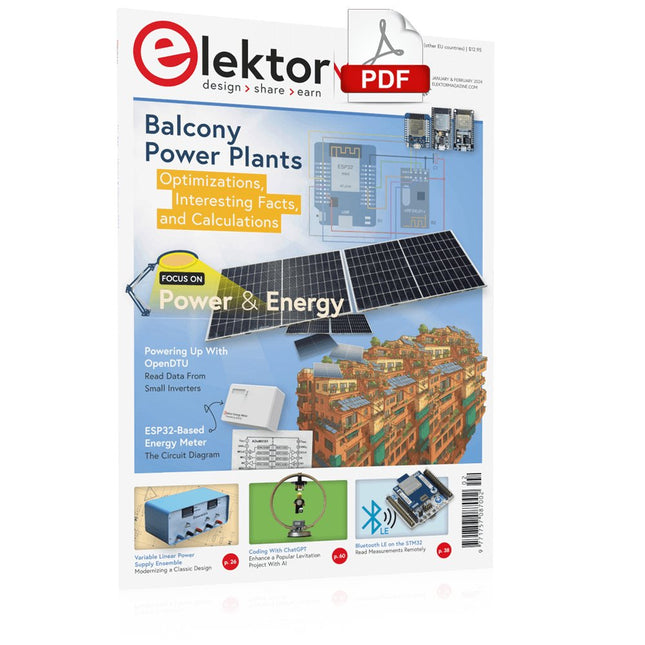
Project Update: ESP32-Based Energy MeterNext Steps in Prototyping
Optimizing Balcony Power PlantsConsiderations, Interesting Facts, and Calculations
ESP32 With OpenDTU for Balcony Power PlantsRead Data from Small Inverters Via MCUs
Variable Linear Power Supply Ensemble0…50 V / 0…2 A + Dual Symmetrical Supply
Energy Storage Today and TomorrowAn Interview With Simon Engelke
2024: An AI OdysseyIt’s Not Letting Up
Bluetooth LE on the STM32A Way to Read Measurements Remotely
Human-Centric Smart Kitchen Grocery Container
MAUI: Programming for PC, Tablet, and SmartphoneThe New Framework in Theory and Practice
ChatMagLevThe AI Way of Levitation
Simple PV Power RegulatorBuild Your First, Fully Functional PV Energy Management System
Cold-Cathode DevicesPeculiar Parts, the Series
From Life’s ExperienceNostalgia
Starting Out in Electronics……Looking at FETs
CAN Bus Tutorial for the Arduino UNO R4Two UNO R4s Hop on the Bus!
Infographics: Power & Energy
Comprehensive Design and Development SupportArrow Engineering Services
Comparing Power Density and Power Efficiency
Aluminium Electrolytic CapacitorsInterference Potential in Audio Technology
USB Test and MeasurementThe Fnirsi FNB58
The Pixel Pump Pick-and-Place ToolSimplifying Manual SMT Board Assembly
HomeLab ToursNot So Long Ago, in a Far-Away Country...
“In the world of ethics in electronics, even small steps can make a significant impact.”
Ethics in ElectronicsThe OECD Guidelines and Germany’s Supply Chain Due Diligence Act
Chadèche: Smart Ni-MH Charger/DischargerA Reader’s Project in Brief
Err-lectronicsCorrections, Updates and Readers’ Letters
Plus de 50 circuits et projets
Sirène de style américain
Deux codeurs rotatifs sur une seule entrée analogique
Construire un gradateur numérique 220-V CA avec Arduino
Source de courant pour LED
Détecter quatre contacts avec une seule broche
Petit interrupteur marche/arrêt avec protection de batterie
Distributeur de désinfectant DIY pour les mains
Un orgue électronique simple
Ampli stéréo ultrasimple
Interrupteur activé par le son pour amplificateurs
Balanced/Unbalanced Converter
Filtre externe pour réseau électrique
Télécommande comodo
Boîte de direct pour smartphone
Amusez-vous avec les feux de circulation
Commande de thyristor avec un seul bouton
Posemètre quasi analogique pour chambre noire
Circuits à volonté de la communauté Hackster.io
Minuteur analogique de bronzage
Encore une interface LCD à un seul fil
Générateur PWM simple avec AVR ATtiny13
Une seconde vie pour les piles
Interrupteur tactile pour les lampes à LED
Testeur de LED et d?interrupteurs DIP
Testeur de contrôle IR Go/No-Go
Testeur de semiconducteurs de puissance
SPI pour les LED WS2812(B)
Mesure des inductances de puissance
Une seule prise pour le RPi et le CN/A audio
Accessoire de test DIY pour le compteur LCR
Ampèremètre Arduino
Orgue à deux doigts
Calibrateur de CAN à faible bruit
Convertisseur élévateur DC/DC
Deux potentiomètres sur une entrée numérique
Capteur de proximité acoustique
Capteur de radiateur sans pile
Détecter les micros et les caméras sans fil
Minuteur pour éclairage intérieur de voiture
Simulateur de bougie
Minuteur numérique de cuisine
Milliohmmètre
Minuteur de production d?eau chaude
Chargeur simple pour les batteries 2S 18650
Référence de fréquence avec ATtiny
Commutateur IR à faible puissance
Recycler le chargeur de téléphone de votre voiture
Préamplificateur de microphone pour Arduino
Filtres IEM DIY
Dé électronique sans microcontrôleur
Condensateur digital
Clignotant à LED autochargeable
Aussi dans ce numéro
KiCad 6 ? Cinq fonctionnalités à prendre en compte
Flashback ? Ordinateur SC/MP d?Elektor
Interview ? Faire de l?art avec l?électricité
Mon premier circuit imprimé ? Se lancer avec KiCad
Minimiser le matériel avec un logiciel intelligent
Infographie ? Faits et chiffres
Nouveaux dispositifs d?Analog
Flashback ? Le détecteur de métaux d?Elektor
Hexadoku ? Casse-tête pour elektorniciens