
Search results for "wireless OR high OR power OR transmission"
-

Elektor Digital BBC micro:bit (E-book)
35 Touch Develop & MicroPython Projects The BBC micro:bit is a credit sized computer based on a highly popular and high performance ARM processor. The device is designed by a group of 29 partners for use in computer education in the UK and will be given free of charge to every secondary school student in the UK. The device is based on the Cortex-M0 processor and it measures 4 x 5 cm. It includes several important sensors and modules such as an accelerometer, magnetometer, 25 LEDs, 2 programmable push-button switches, Bluetooth connectivity, micro USB socket, 5 ring type connectors, and a 23-pin edge connector. The device can be powered from its micro USB port by connecting it to a PC, or two external AAA type batteries can be used. This book is about the use of the BBC micro:bit computer in practical projects. The BBC micro:bit computer can be programmed using several different programming languages, such as Microsoft Block Editor, Microsoft Touch Develop, MicroPython, and JavaScript. The book makes a brief introduction to the Touch Develop programming language and the MicroPython programming language. It then gives 35 example working and tested projects using these language. Readers who learn to program in Touch Develop and MicroPython should find it very easy to program using the Block Editor or any other languages. The following are given for each project: Title of the project Description of the project Aim of the project Touch Develop and MicroPython program listings Complete program listings are given for each project. In addition, working principles of the projects are described briefly in each section. Readers are encouraged to go through the projects in the order given in the book.
€ 24,95
Members: € 22,46
-
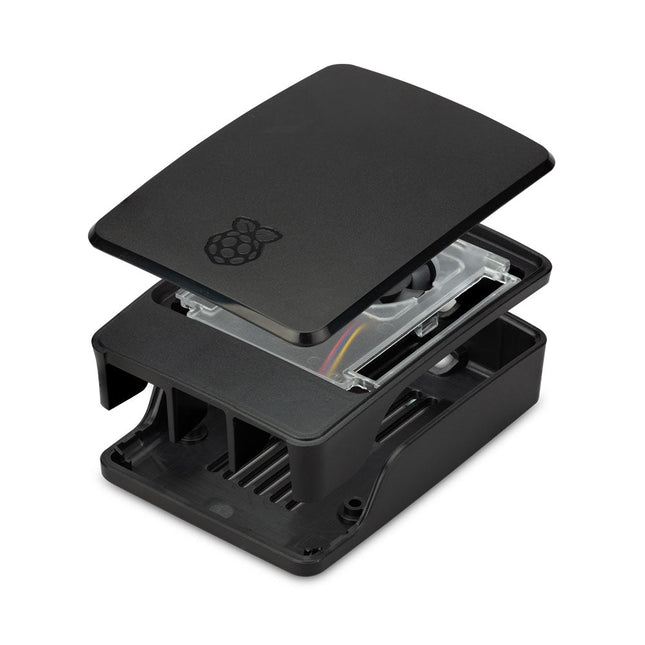
Raspberry Pi Foundation Official Case for Raspberry Pi 5 (black/gray)
The Raspberry Pi 5 case is a refinement of the Raspberry Pi 4 case with improved thermal features to support the higher peak power consumption of the Raspberry Pi 5. It integrates a variable speed fan that is powered and controlled via a dedicated connector on the Raspberry Pi 5.
€ 11,95€ 6,95Best Price
-

Zhongdi ZD-153A Solder Fume Extractor
Fumes released during the soldering process are potentially harmful to health. This solder fume extractor is securely fastened to the work table with a bracket. Thanks to the 3 axes, the solder fume extractor can be positioned perfectly, i.e. directly above the rising solder fumes. The harmful solder fumes are extracted by a powerful but quiet fan and filtered by an activated-carbon filter mat. Features Removes solder fumes Absorbs toxic gases and fumes from brazing operations Helps reduce the likelihood of headaches, eye irration and neusea Adjustable absorption angle for accurate placement Easy replaceable activated carbon filter High-performance fan Low noise and long life service Specifications Absorption capacity: 1 m³/min (max.) Power consumption: 23 W Power supply: 220-240 VAC Amount of activated carbon filter: 7 g Maximum absorption weight: 2 g Dimensions: 220 x 270 x 168 mm (W x H x D) Weight: 1.4 kg
€ 52,95
-
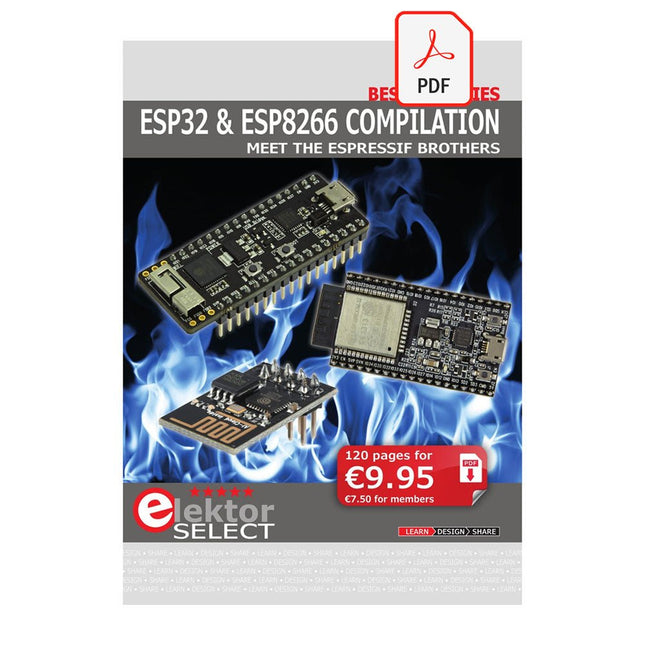
Elektor Digital ESP32 & ESP8266 Compilation (EN) | E-book
The ESP8266 from Espressif is a Wi-Fi microchip with full TCP/IP stack and microcontroller capability. It has made waves in the maker community with its low price. But many developers were unhappy with ESP8266's high power consumption. The ESP32, equipped with a ULP (Ultra Low Power) coprocessor, offers a remedy for this. This e-book features a number of projects featuring ESP32 & ESP8266 as well as an interview with the CEO of Espressif Teo Swee Ann. Articles ESP32 for Use in Industry 4.0 Equipment Scrolling Message Display, 512 LEDs controlled over Wi-Fi via an ESP-12F The Connected Greenhouse IoT demonstration project using MQTT and Node-RED VFD-tube Clock with ESP32 with an accurate Internet-derived time ESP32 Low Power DCF77 Emulator with ESP8266 ESP8266 on the Elektor Android I/O Board The Reason Behind the Hugely Popular ESP8266? Wi-Fi Desktop Thermostat Timers for the Wi-Fi Desktop Thermostat PlatformIO, the Universal Programming Tool Weather Display, Visualize current weather data on an LC display GoNotify, a Flexible IoT Sensor Interface ESP32 for Power Users USB Programming Adaptor for ESP8266 Getting started with ESP32 and the Arduino IDE MicroPython, Python for small systems RGBDigit Clock WLAN for Microcontrollers Return of the Wi-Fi Controller Board Compact and Self-contained WLAN
€ 9,95
Members: € 8,96
-

Techwatch Books ASML's Architects
The story of the engineers who shaped the world's most powerful chip machines How do you transform a hopeless research and business activity into a billion-dollar machine and a world-leading company? The Dutch enterprise ASML pulled it off, and the book ASML’s Architects by renowned technology writer René Raaijmakers reveals exactly how. ASML's Architects travels back to the origins, struggles, success factors and sheer luck of a company that was barely alive at the beginning of the 80s, yet managed to become the uncontested world leader in chip lithography. Today, ASML determines the pace at which all information technology advances. The book covers the technology and the business, but the real story is in the people behind them. Throughout its pages, the interviewed engineers, scientists and managers speak frankly about their struggles, their fights and the grueling teamwork behind the scenes. Downloads Preface and Introduction The Violin Maker (Chapter 5) The Reunion (Chapter 23) A Movie for IBM (Chapter 64)
€ 59,00
Members: € 53,10
-

Elektor Digital Elektor Mai/Juin 2026 (PDF) FR
Le téléchargement intégral de ce numéro est disponible pour nos membres GOLD et GREEN sur le site Elektor Magazine ! Pas encore membre ? Cliquez ici. mise à jour du PbMonitor v2.0Surveillance de batterie avec un circuit analogique améliorée mesure de la latence audioUn outil autonome pour évaluer les erreurs et la latence de la transmission audio onde carrée vs. diagramme de BodeVérification des performances d’un appareil audio embedded world 2026 coder intelligemment avec l’IAL’IA dans le développement logiciel pour les électroniciens analyseur audio QA403Une précision accessible pour les professionnels et les amateurs d’audio EasyGimbalAutonomous Camera Tracking with AI, Stepper and Servo Motors carte breakout Sigfox (2)Envoi de messages protection de circuitsContrôle des surtensions avec des diodes TVS tests de batteriesDes approches innovantes à l’aube d’une nouvelle ère diagnostique audiotroniqueUn premier préampli CANopenTermExplorer les réseaux CAN avec un outil open source stabilisation des amplificateurs opérationnelsstabilisation-des-amplificateurs-operationnels projet 2.0Corrections, mises à jour et courrier des lecteurs conditionnement du signalAstuces pour adapter des plages de tension adaptateur TDR pour oscilloscopeLongueur, court-circuit, désadaptation : tester les câbles par réflectométrie ! sur le vifLED It Be oscillateur de haut-parleur et testeur de résonanceUn projet expérimental dédié aux haut-parleurs perspectives de la communauté Elektor sur le test et la mesure carte émetteur-récepteur audio ESP32 (5)Traitement audio et contrôle à distance 2026 : une odyssée de l’IAL’IA a un problème de contexte solutions de stockage par batterie pour installation solaire sur balconPetites batteries, grand impact
€ 10,95
-
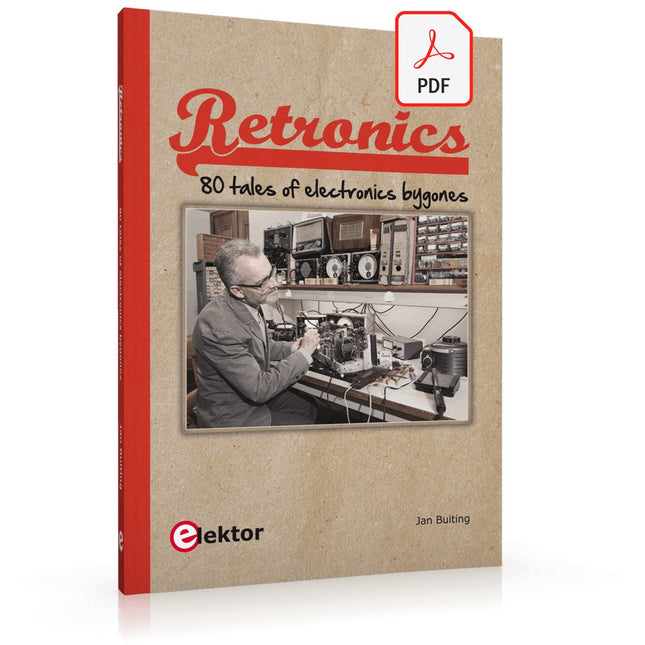
Elektor Digital Retronics (E-book)
Quite unintentionally a one-page story on an old Heathkit tube tester in the December 2004 edition of Elektor magazine spawned dozens of ‘Retronics’ tales appearing with a monthly cadence, and attracting a steady flow of reader feedback and contributions to the series. Since launching his Retronics columns, Elektor Editor Jan Buiting has never been short of copy to print, or vintage equipment to marvel at. This book is a compilation of about 80 Retronics installments published between 2004 and 2012. The stories cover vintage test equipment, prehistoric computers, long forgotten components, and Elektor blockbuster projects, all aiming to make engineers smile, sit up, object, drool, or experience a whiff of nostalgia. To reflect that our memories are constantly playing tricks on us, and honoring that “one man’s rubbish is another man’s gem”, the tales in the book purposely have no chronological order, and no bias in favor of transistor or tube, microprocessor or discrete part, audio or RF, DIY or professional, dry or narrative style. Although vastly diff erent in subject matter, all tales in the book are told with personal gusto because Retronics is about sentiment in electronics engineering, construction and repair, be it to reminisce about a 1960s Tektronix scope with a cleaning lady as a feature, or a 1928 PanSanitor box for dubious medical use. Owners of this book are advised to not exceed one Retronics tale per working day, preferably consumed in the evening hours under lamp light, in a comfortable chair, with a piece of vintage electronic equipment close and powered up.
€ 24,95
Members: € 22,46
-

Elektor Digital Raspberry Pi Pico W (E-book)
Program, build, and master 60+ projects with the Wireless RP2040 The Raspberry Pi Pico and Pico W are based on the fast, efficient, and low-cost dual-core ARM Cortex M0+ RP2040 microcontroller chip running at up to 133 MHz and sporting 264 KB of SRAM and 2 MB of Flash memory. Besides spacious memory, the Pico and Pico W offer many GPIO pins, and popular peripheral interface modules like ADC, SPI, I²C, UART, PWM, timing modules, a hardware debug interface, and an internal temperature sensor. The Raspberry Pi Pico W additionally includes an on-board Infineon CYW43439 Bluetooth and Wi-Fi chipset. At the time of writing this book, the Bluetooth firmware was not yet available. Wi-Fi is however fully supported at 2.4 GHz using the 802.11b/g/n protocols. This book is an introduction to using the Raspberry Pi Pico W in conjunction with the MicroPython programming language. The Thonny development environment (IDE) is used in all of the 60+ working and tested projects covering the following topics: Installing the MicroPython on Raspberry Pi Pico using a Raspberry Pi or a PC Timer interrupts and external interrupts Analogue-to-digital converter (ADC) projects Using the internal temperature sensor and external sensor chips Using the internal temperature sensor and external temperature sensor chips Datalogging projects PWM, UART, I²C, and SPI projects Using Bluetooth, WiFi, and apps to communicate with smartphones Digital-to-analogue converter (DAC) projects All projects are tried & tested. They can be implemented on both the Raspberry Pi Pico and Raspberry Pi Pico W, although the Wi-Fi-based subjects will run on the Pico W only. Basic programming and electronics experience are required to follow the projects. Brief descriptions, block diagrams, detailed circuit diagrams, and full MicroPython program listings are given for all projects.
€ 34,95
Members: € 31,46
-

Elektor Digital LEDs 2 (PDF)
Inhalt: Theorie & Anwendung UV-Leistungslichtquelle auf Leuchtdiodenbasis Wasserentkeimung mit UV-Leuchtdioden Cool down: LEDs richtig kühlen Umrüstung: Referenzdesign für eine LED-Leuchte Netzteil-Architekturen für Power- und RGB-LEDs Selbstbauprojekte Optische Messtechnik bei Leuchtdioden Sternschnuppe: ein Meteor aus LEDs LED-Interface mit 64 Ausgängen
€ 17,50
Members: € 15,75
-

Elektor Digital Elektor 03-04/2024 PDF (DE)
Diese Ausgabe steht allen GOLD- und GREEN-Mitgliedern auf der ElektorMagazine-Website zum Download bereit! Sie sind noch kein Mitglied? Hier klicken! CaptureCountEin Objektdetektor und -zähler auf dem Raspberry Pi 5 Spannungsreferenz mit Arduino Pro MiniLinearisieren und kalibrieren Sie analoge Eingänge FPGAs für EinsteigerDer Weg vom Mikrocontroller zur FPGA-Programmierung Update: STM32 Wireless Innovation Design Contest 2024 Bluetooth LE mit MAUISteuer-Apps für Android und Co. Breakout-Board für Port-ErweiterungMehr I/Os für Ihr Entwicklungssystem AI-SpezialistMachine Learning mit dem Jetson Nano 2024: Eine Odyssee in die KIErste Gehversuche mit TensorFlow 262.144 Wege, das Spiel des Lebens zu spielenEin Leserprojekt in Kürze Aus dem Leben gegriffenDer Chinesische Drache Bringen Sie Ihren DC-Bürstenmotor zum Laufen!Beispielprojekte aus dem Motor Control Development Bundle von Elektor ESP32-RS232-AdapterWireless-Anbindung klassischer Messgeräte Aller Anfang......muss nicht schwer sein: Mehr über Operationsverstärker Empfehlungen für ESP-Bibliotheken Piezoelektrische BauelementeBemerkenswerte Bauteile Ein intelligenter ObjektzählerBilderkennung leicht gemacht mit Edge Impulse Meistern Sie die kniffligsten Probleme Ihrer Embedded-Entwicklungen! ESP32-TerminalEin Handheld-Gerät mit Touch-Display Erste Schritte mit dem Zephyr RTOSSehr leistungsfähig, aber schwer zu beherrschen Preisgekrönte EthikEin Gespräch mit CTO Alexander Gerfer von Würth Elektronik eiSos über die Ermöglichung von Innovation und achtsames Verhalten Projekt 2.0Korrekturen, Updates und Leserbriefe
€ 11,90
-

Elektor Digital Design your own Embedded Linux Control Centre (E-book)
This book is all about building your own DIY home control system. It presents two innovative ways to assemble such a system: By recycling old PC hardware – possibly extending the life of an old PC, or by using Raspberry Pi. In both cases, the main system outlined in this book will consist of a computer platform, a wireless mains outlet, a controller and a USB webcam – All linked together by Linux. By using the Raspberry Pi in conjunction with Arduino (used as an advanced I/O system board), it is possible to construct a small, compact, embedded control system offering enhanced capacity for USB integration, webcams, thermal monitoring and communication with the outside world. The experience required to undertake the projects within this book are minimal exposure to PC hardware and software, the ability to surf the internet, burn a CD-ROM and assemble a small PCB.
€ 34,95
Members: € 31,46
-

Elektor Digital Linux PC-based Measurement Electronics (E-book)
This book is intended as a highly-practical guide for Hobbyists, Engineers and Scientists wishing to build measurement and control systems to be controlled by a local or remote Personal Computer running the Linux operating system. Both hardware and software aspects of designing typical embedded systems are covered in detail with schematics, code listings and full descriptions. Numerous examples have been designed to show clearly how straightforward it can be to create the interfaces between digital and analog electronics, with programming techniques for creating control software for both local and remote systems. Hardware developers will appreciate the variety of circuits, including a novel, low cost modulated wireless link and will discover how using Matlab® overcomes the need for specialist programming skills. Software developers will appreciate how a better understanding of circuits plus the freedom offered by Linux to directly control at the register level enables them to optimize related programs. There is no need to buy special equipment or expensive software tools in order to create embedded projects covered in this book. You can build such quality systems quickly using popular low-cost electronic components and free distributed or low-cost software tools. Some knowledge of basic electronics plus the very basics of C programming only is required. Many projects in this book are developed using Matlab® being a very popular worldwide computational tool for research in engineering and science. The book provides a detailed description of how to combine the power of Matlab® with practical electronics. With an emphasis on learning by doing, readers are encouraged by examples to program with ease; the book provides clear guidelines as to the appropriate programming techniques “on the fly”. Complete and well-documented source code is provided for all projects. If you want to learn how to quickly build Linux-based applications able to collect, process and display data on a PC from various analog and digital sensors, how to control circuitry attached to a computer, then even how to pass data via a network or control your embedded system wirelessly and more – then this is the book for you! Features of this Book Use the power, flexibility and control offered only by a Linux operating system on a PC. Use a free, distributed downloadable GNU C compiler Use (optional) a low-cost Student Version of Matlab®. Use low-cost electronic sub-assemblies for projects. Improve your skills in electronics, programming, networking and wireless design. A full chapter is dedicated to controlling your sound card for audio input and output purposes. Program sound using OSS and ALSA. Learn how to combine electronic circuits, software, networks and wireless technologies in the complete embedded system.
€ 29,95
Members: € 26,96


