Elektor GREEN and GOLD members can download their digital edition here.
Not a member yet? Click here.
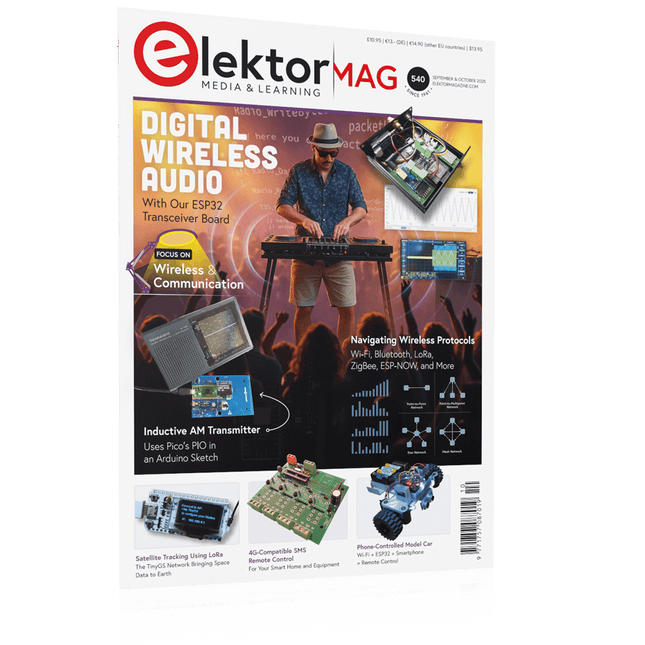
ESP32 Audio Transceiver Board (Part 2)Wireless Audio Transmission
Inductive AM TransmitterUses Pico’s PIO in an Arduino Sketch
Navigating Wireless ProtocolsA Technical Guide
Satellite Tracking Using LoRaThe TinyGS Network Bringing Space Data to Earth
4G-Compatible SMS Remote ControlRemotely Control Your Equipment
High-Speed ProbeHigh-Impedance Inputs for Signals up to 200 MHz
From Life’s ExperienceKafka
KrakenSDR
Performance Tests with the RP2350Is an Upgrade from Raspberry Pi Pico 1 to Pico 2 Worthwhile?
Contact-Free E-Field Measurements (2)A Laser Vibrometer for Assessing the Membrane's Vibrations
Crystals and OscillatorsImproving Crystal Accuracy Through Capacitor Selection
Starting Out in ElectronicsSpecial Audio ICs
Getting Started with Coding a DIY Project
SPECTRAN® V6 MobileModular, Configurable Real-Time Spectrum Analyzer for Reliable Measurements Across All Frequency Ranges
The Future of AI Is Forged in SiliconAn Interview with Anastasiia Nosova
Autonomous Sensor Node v2.0 (System Architecture)Solar-Powered Sensing Platform with Integrated GPS, LoRaWAN, and More
Precise PositioningBluetooth Channel Sounding Tested
Powering the Future of Wireless CommunicationBTRY’s Ultra-Thin Solid-State Batteries
Test-Driven Development in Firmware Writing
Phone-Controlled Model CarWi-Fi + ESP32 + Smartphone = Remote Control
2025: An AI OdysseyAI Reasoning Models: The Chain-of-Thought Revolution
Solar Charge Controller with MPP Tracking (3)Software and Commissioning
Raspberry Pi Zero Web Streaming CameraUsing the ZeroTier VPN
Elektor GREEN en GOLD leden kunnen deze uitgave hier downloaden.Nog geen lid? Klik hier om een lidmaatschap af te sluiten.
Super-servotestervoor vier servo’s – stand-alone of in-system
Analoge signalen en microcontrollersADC’s, DAC’s, stroommeting en meer
embedded world 2023
Sub-Nyquist-sampling in de praktijkhogere frequenties betrouwbaar bemonsteren met subsampling
Met Android-smartphone, spreek ik met ESP32?praktisch project met behulp van de Android WiFi-API
Actief 1kHz-filter voor vervormingsmetingmeet beter door het het meetsignaal te optimaliseren
Alle begin......multivibreert verder!
Project 2.0correcties, updates en brieven van lezers
Het nieuwe I3C-protocoleen waardig opvolger van I2C – of gebakken lucht?
BlueRC: IR-afstandsbediening met smartphone en ESP32universeel en aanpasbaar
Microcontroller-documentatie verklaarddeel 2: registers en blokschema’s
Automatisering van testen en metentestapparatuur programmeren om je te dienen
Elektor Infographicstesten en meten
Overspanningsbeveiliging voor veilige werkingtransiëntbescherming voor niet-geïsoleerde DC/DC-voedingsmodules
Meetapparatuur van het merk Wihatesters en meters voor installaties waar u op kunt bouwen
Automatisch testen en samenwerken aan testresultaten
Uit het leven gegrepenelektronica op hoog niveau
Energieloggermeet en registreert het stroomverbruik
Montage van de M.A.R.S. Rover Kit van 4tronix
Parkeerschijf met e-papier displayinnovatief digitaal alternatief
eCO2 Telegram-botmeet de luchtkwaliteit via Telegram
Achter de schermen van DHZ high-end audioTon Giesberts van Elektor over de fijne kneepjes van het analoog ontwerpen
Oost West Lab Bestwerk in uitvoering...
RFID-tag’s lezen, en een RFID-deurslotvoorbeeldprojecten uit de Elektor Arduino Experimenteerbundel
HF-stroomprobe voor oscilloscoopHF-stroommetingen gemakkelijk gemaakt
Niet voor watjes – Makerfabs Robot Arm Kitmet de Raspberry Pi Pico en MicroPython
Generatieve KIwie heeft dit eigenlijk gemaakt?
Hexadokupuzzelen voor elektronici
Diese Ausgabe steht allen GOLD- und GREEN-Mitgliedern auf der ElektorMagazine-Website zum Download bereit!
Sie sind noch kein Mitglied? Hier klicken!
Für Augen und Ohren
Videoausgabe mit MikrocontrollernTeil 1: Composite Video
electronica 2022Neues von der Weltleitmesse
ESP32-KameraSo einfach, dass sie nicht einmal WLAN braucht
ATX-Netzteil für Raspberry Pi
32-?-KopfhörerverstärkerEinfache, aber hochqualitative 3-Chip-Lösung
SDR-FunkuhrenFünf Zeitzeichen, sechs Anzeigen
Aller Anfang ...muss nicht schwer sein: Spezielle Dioden
Aus dem Leben gegriffenÜber die Qualität der Dinge
Reverse-Engineering eines LED-Displays mit Bluetooth Low EnergyWie man ein BLE-Gerät mit einem Python-Skript steuert
MakePython ESP32 Development KitAlles in einer Box
THD-Messung mit Oszilloskop und FFTDen Klirrfaktor einfach berechnen
Allsehende MaschinenDie Technologie hinter modernen industriellen Bildverarbeitungssystemen
Infografik
Die Entwicklung der Sprach- und Audiosteuerung für elektronische Geräte
WEEF 2022 im Rückblick
Im Rückblick: FFWD electronica 2022Innovatoren beeindrucken weiterhin!
The TubeEin Röhrenverstärker der anderen Art
Biomaterialien in der Elektronik: Bereit oder nicht?
Opera-Cake-Antennenumschalter für HackRF OneSchließen Sie bis zu acht Antennen an Ihr SDR an
Technik mit Arduino und mehrEin Interview mit Autor Ashwin Pajankar
LiDAR-PräzisionsmetermaßMisst bis zu zwölf Meter
Audio mit dem ESP32Das Framework ESP-ADF in der Praxis
Elektor-Leistungsverstärker-Bausatz Fortissimo-100
Licht für Klangeffekte nutzenLDR-basiertes spannungsgesteuertes 24 dB/Okt.-Synthesizer-Filter
Hochleistungsverstärker GigantDer Lauteste von allen!!
Betreten für Unbefugte verboten!Ein volumetrisches Display Made in Canada
Projekt 2.0Korrekturen, Updates und Leserbriefe
Hexadoku
Elektor GREEN en GOLD leden kunnen deze uitgave hier downloaden.
Nog geen lid? Klik hier om een lidmaatschap af te sluiten.
IoT-innovatie in galop
Een E-Ink WiFi kleuren-fotolijst
ESP-Launchpad tutorialvan nul tot flashen in een paar minuten
ESP32 en ChatGPTop weg naar een zelf-programmerend systeem…
Walkie-talkie met ESP-NOWniet echt WiFi, niet echt Bluetooth, maar...
Van idee tot schakeling met de ESP32-S3zo bouw je een prototype met Espressif-chips
AIoT chip-innovatieeen vraaggesprek met Teo Swee-Ann, CEO van Espressif
Simuleer ESP32 met Wokwide digitale tweeling van je project
Test van de ESP32-S3-BOX-3een uitgebreid AIoT-ontwikkelplatform
voor je elektronica-werkplekoverwegingen en tips van Espressif-technici
Het ESP RainMaker-verhaalhoe we “jouw” IoT-cloud bouwden
Bouw van de Elektor Cloc 2.0een Elektor-product uitgepakt door Espressif
De ESP32-P4 ontketendde volgende microcontroller-era
Rust + embeddedeen krachtig ontwikkelduo
Wie zijn de onvervaarde embedded Rust-ontwikkelaars?zo cultiveert Espressif embedded Rust voor de ESP32
de SoC-serie van Espressif
Een PLC met oplossingen van Espressifmet de mogelijkheden en functionaliteit van het ISOBUS-protocol
Het ESP32-S3 VGA-boardvolg Bitluni tijdens het ontwerpproces
Acoustic fingerprinting met de ESP32songherkenning met het open-source project Olaf
Ronde kerstboom 2023een high-tech manier om de feestdagen te vieren
Een eenvoudiger en handiger leveneen amateurproject op basis van de ESP8266-module van Espressif
IoT-apps bouwen zonder software-expertisemet het Blynk IoT-platform en Espressif-hardware
Bouw een slimme gebruikersinterface op ESP32
Snelle en gemakkelijke IoT-ontwikkeling met M5Stack
Prototype van een ESP32-gebaseerde energiemeter
Een distributeur met meerwaarde voor IoT en meer
Achter de schermen: vraaggesprek met Arduino over de Nano ESP32Alessandro Ranellucci en Martino Facchin over de samenwerking met Espressif
achter de schermen van Espressif
Stroomlijnen van MCU-ontwikkeling met ESP-IDF Privilege Separation
Een open-source spraakherkenningsserver......en de ESP BOX
Het denkende ooggezichtsherkenning en meer met de ESP32-S3-EYE
Knoopcel-schakelaar met ESP32-C2prestatiegericht ontwerpen
Matter stuwt het slimme huis voorwaartsontsluit het potentieel van Smart Home IoT
Tech the Future: Waarheen met Smarthome IoT?
Elektor GREEN and GOLD members can download their digital edition here.
Not a member yet? Click here.
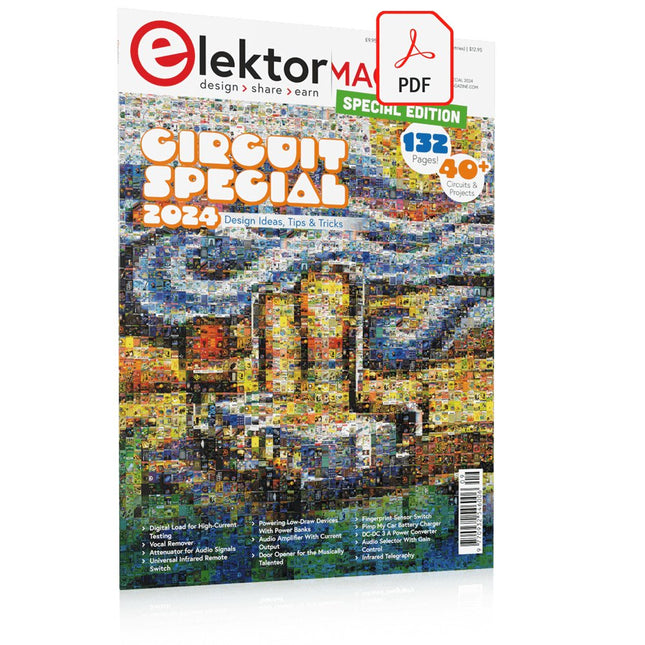
Digital Load for High-Current TestingFrom Necessity to Innovation
Vocal RemoverInstant Karaoke Circuit
Audio A/B Selector With Gain ControlSwitches from Microphone to Line Inputs
Better Charging for the LIR2032Be Kind to Your Coin Cells
Touch Sensing Made SimpleA DIY Guide for Any Microcontroller
Universal Infrared Remote SwitchA New Life for Old Remotes
Microcontroller-Powered Moo BoxMaking Playful Sounds With a Microcontroller
USB Battery Interface
Powering Low-Draw Devices With Power BanksA “Stay Alive” Solution
Small Class-A Audio Amplifier With Current OutputDrive Speakers with Current Instead of Voltage
Pseudo-Balanced ModuleHigh CMRR with Unbalanced Audio Links
Ni-MH Cells Automatic ChargerRefill All Your Battery Packs in One Go!
Thyristor-Based Power Supply Protection
Fingerprint Sensor SwitchA Useful Proof-of-Identity Device
DC-DC 3-A Power ConverterUpgrade Your Fixed-Voltage Sources
Remote Water Heater MonitorVoltage and Current Detection for AC Lines
Attenuators for Audio Signals (1)Adjustable Via Jumpers
Pimp My Car Battery Charger (Part 1)Don’t Throw It Away, Mod It!
A Board for the Blue OnePCB for Alps Motorized Potentiometer with Feedback
50-Hz Reference from 60-Hz Mains VoltageHow to Use 50-Hz Electronics in 60-Hz Environments
Digital IsolatorsRealizing Galvanic Isolation Easily
Compact 12-W Hi-Fi Mono AmplifierSmall But Powerful
LM386 Ramp Generator
Three-Phase GeneratorWith Raspberry Pi Pico
Door Opener for the Musically Talented
Elektor Classic: Surf SynthesizerOcean Watersports Background Sound Generator (OWBSG)
Pimp my Car Battery Charger (Part 2)Don’t Throw It Away, Mod It!
Lamp Current MonitorWith a Raspberry Pi Pico
Infrared Telegraphy
Fnirsi SWM-10Repair Battery Packs With This Portable Intelligent Spot Welding Machine
Stereo Audio Codec for the ESP32 and Co.No Need to Be Afraid of Audio Measurement Technology
Tin Soldering TechniquesMake Them Well Right Away!
Attenuators for Audio Signals (2)Switching Via Relays
USB-C PowerDrawing Power from USB-C Power Adapters
Three Circuits with Two and Three Counter ICs4017 ICs Working Together
Active Components – The Diode
A Timer For Ultra-Long DelaysSet It, and Forget It!
Jack In and Jack OutA Useful Insert Option for Audio Circuits
Power an ESP32 from a Single Li-ion Cell
Hexadoku
Projects with Thonny-IDE, uPyCraft-IDE, and ESP32
The 'Python' programming language has enjoyed an enormous upswing in recent years. Not least, various single-board systems such as the Raspberry Pi have contributed to its popularity. But Python has also found widespread use in other fields, such as artificial intelligence (AI) or machine learning (ML). It is obvious, therefore, to use Python or the 'MicroPython' variant for use in SoCs (Systems on Chip) as well.
Powerful controllers such as the ESP32 from Espressif Systems offer excellent performance as well as Wi-Fi and Bluetooth functionality at an affordable price. With these features, the Maker scene has been taken by storm. Compared to other controllers, the ESP32 has a significantly larger flash and SRAM memory, as well as a much higher CPU speed. Due to these characteristics, the chip is not only suitable for classic C applications, but also for programming with MicroPython.
This book introduces the application of modern one-chip systems. In addition to the technical background, the focus is on MicroPython itself. After the introduction to the language, the programming skills learned are immediately put into practice. The individual projects are suitable for use in the laboratory as well as for everyday applications. So, in addition to the actual learning effect, the focus is also on the joy of building complete and useful devices. By using laboratory breadboards, circuits of all kinds can be realized with little effort, turning the testing and debugging of the 100% homebrew projects into an instructive pleasure.
The various applications, such as weather stations, digital voltmeters, ultrasound range finders, RFID card readers or function generators, make the projects presented ideally suited for practical courses or subject and study work in the natural sciences, or in science and technology classes.
Le téléchargement intégral de ce numéro est disponible pour nos membres GOLD et GREEN sur le site Elektor Magazine !
Pas encore membre ? Cliquez ici.
tableau de bord OBD2Des cadrans anciens aux données en temps réel
OBD2 : ajoutez un compte-tours et un indicateur de changement de vitesse à votre voitureRétro, mais extrêmement utile
capteurs de vision et LiDAR pour la robotique
Sensor+Test 2025 et PCIM 2025
mesures sans contact du champ électrique (1)Membrane vibrante pour mesurer des tensions continues ou des champs électriques statiques
détecteur de courrier sans filCapteurs optiques, radars… quelques options à explorer
Elektor Mini-WheelieUn robot auto-équilibré
cellules solairesDrôles de composants, la série
premiers pas avec un capteur radar moderneUn capteur précis qui ne passe pas inaperçu
sur le vifUsine de papier
CybersécuritéDes temps difficiles pour les hackers
Infographie : IdO et capteurs
le Bluetooth 6.0 pour des applications de télémétrie amélioréesCette nouvelle version offre des fonctions de localisation améliorées
découvrez la communication sans fil avec BeagleY-AI
Projet 2.0Corrections, mises à jour et courrier des lecteurs
démarrer en électronique……Conclusion sur les ampli-op
un puissant assistant de codage de l'IAAccélérez votre développement avec Continue et Visual Studio Code
contrôleur de charge solaire avec MPPT (2)Le circuit
détecteur d'obstacles à ultrasonsUn projet simple pour aider les malvoyants
une odyssée de l'IABilan du premier semestre
synthétiseur MIDI autonome Raspberry Pi (3)plus intelligent avec une interface utilisateur
Meshtastic : un projet de démoUn réseau intelligent de noeuds LoRa
générateur analogique de fréquences audioGénérateur de signaux sinusoïdaux de haute qualité à fréquence réglable
The Andonstar ADSM302 is a versatile digital microscope with an integrated 5-inch LCD display and HDMI output for crystal-clear views in Full HD (1080p). With a 3-megapixel sensor, up to ~560x magnification, and two adjustable LED lights, it reveals the finest details – ideal for PCB inspections, soldering work, jewelry or insect analysis.
Features
5" adjustable LCD monitor with adjustable tilt angle
High resolution video & photo capture
Wide table with comfortable headroom
Heavy-weight stable metal stand
Tall lifting stand (26 cm)
Smooth adjustment wheels for focus and height
Buttons on the monitor + remote control
AV, USB, HDMI outputs
SD card storage <32 GB
Specifications
Image sensor
3 Megapixels HD Sensor
Video output
1080p Full HD (via HDMI)720p (via PC)
Video format
Real time play via HDMI w/o recordingMJPEG recording via PC/Mac Software
Magnification
Up to 560 times (HDMI monitor 22")
Photo resolution
12M (see pixel formats in following table)
Photo format
JPEG
Focus range
5 to 22 cm
Frame rate
Up to 30 f/s under 600 Lux Brightness
Video-output interface
HDMI/AV
Storage
microSD card, up to 32 GB
PC support
Windows XP/7/8/10PC software with measurementMacOS successfully tested under OSX with OBSsee video below
Power source
5 V DC
Light source
2x LED with the stand
Screen size
5 inch (12.7 cm)
Stand size
20 x 12 x 26.5 cm
Resolution
Captured Photos
4032 x 3024
3648 x 2736
3264 x 2448
2592 x 1944
2048 x 1536
640 x 480
1920 x 1080
1280 x 960
1280 x 720*
Videos
1920 x 1080
640 x 480*
* (USB with software)
Included
1x Andonstar ADSM302 digital microscope
1x Metal stand with 2 LEDs
1x USB cable
1x HDMI cable
1x Adapter
1x AI remote
1x Instructions
Downloads
Manual
Software
Diese Ausgabe steht allen GOLD- und GREEN-Mitgliedern auf der ElektorMagazine-Website zum Download bereit!
Sie sind noch kein Mitglied? Hier klicken!
PbMonitor v1.0Ein Batterieüberwachungssystem für USV und Energiespeicher
Solarladeregler mit MPP-TrackingTeil 1: Grundlagen eines Solarreglers für Insel-Anlagen
B-Feld-Integrationsmagnetometer mit selbstgebauten Sensoren
Präzise, richtig oder genau?Ihre Messgeräte müssen alles sein!
AD7124 – Ein Präzisions-ADC in der PraxisHinweise für die Sensor-Signalaufbereitung
PID-RegelungswerkzeugOptimieren Sie ganz einfach Ihre Parameter
embedded world 2025
Aller Anfang ......muss nicht schwer sein: Klangeinstellung!
Academy Pro BoxBook + Online Course + Hardware
Milliohmmeter-AdapterNutzen Sie die Präzision Ihres Multimeters!
Der nächste Meilenstein bei HalbleiternWeiter in Richtung 1,4 nm
Steckverbinder in DurchstecktechnikDas Beste aus zwei Welten: THR
FrequenzzählerPortabel und mit automatischer GPS-Kalibrierung
Analoge MessgeräteBemerkenswerte Bauteile
Stand-alone-QuarztesterWie genau ist Ihre Taktquelle?
Preiswerter I²C-TesterSchließen Sie I²C-Chips direkt an Ihren PC an
Aus dem Leben gegriffenWer das Kleine nicht ehrt...
2025: Eine Odyssee in die KIDie transformativen Auswirkungen auf die Softwareentwicklung
Projekt 2.0Korrekturen, Updates und Leserbriefe
Standalone-MIDI-Synthesizer mit Raspberry PiTeil 2: Setup mit Intelligenz aufwerten
Nortonisierter Wien-Brücken-OszillatorKleine Änderungen führen zu bedeutenden Verbesserungen
10-Cent-Controller in der PraxisRISC-V-Mikrocontroller CH32V003 und MounRiver Studio ausprobiert
Audio-Player mit FPGA und EqualizerTeil 2: Lautstärkeregelung, erweitertes Mischen und ein Web-Interface
The OWON SDS1102 is an affordable benchtop digital oscilloscope that combines solid performance with essential measurement features. This 2-channel oscilloscope offers a 100 MHz bandwidth, a 1 GS/s sampling rate, a 7-inch LCD display, and a 10 kpts memory depth, making it a practical choice for everyday electronics testing, troubleshooting, and education.
The SDS1102 features a simplified trigger system with level and edge triggering, making it easy to capture and analyze common signals. It is designed for applications that do not require deep memory or advanced trigger functions, offering a straightforward and cost-effective solution for basic signal analysis.
Features
Bandwidth: 100 MHz
2 channels
Sample rate: 1 GS/s
Ultra-thin body
7-inch high-res LCD
SCPI and LabVIEW supported
Specifications
Bandwidth
100 MHz
Horizontal Scale (s/div)
5 ns/div – 1000 s/div
Channel
2
Vertical Sensitivity
5 mV/div – 5 V/div (at input)
DC Gain Accuracy
3%
Vertical Resolution (A/D)
8 bits (2 channels simultaneously)
Input
Input Impedance
1 MΩ, 10 pF
Input Coupling
AC, DC, GND
Max Input Voltage
±400 V, CATI, CATII
Passive probes
х1; х10
Probe Attenuation Factor
х1; х10; х100; х1000
Trigger System
Trigger Mode
Auto, Normal, Single
Trigger Type
Edge, Video
Edge Trigger Source
CH1, CH2
Video Trigger
Sampling Type
Real-time
Sample Rate
1 GS/s
Equivalent Sample Rate
No
Wavelength
10K pts
Interpolation
sin(x)/x
Measurement and Mathematical Treatment System
Automatic Measurement
Vpp, Vavg, RMS, Frequency, Period, Vmax, Vmin, Vtop, Vbase, Width, Overshoot, Pre-shootRise time, Fall time, +Width, -Width, +Duty, -Duty, Delay A→B, Delay A→B, area, cycle area
Math Functions
Addition, Subtraction, Multiplication, Division, FFT
General Characteristics
Display type
7" color LCD
Display Resolution
800 x 480
Power
100-240 V, 45-440 Hz, <15 W
Dimensions
301 x 70 x 152 mm
Weight
1.1 kg
Included
1x OWON SDS1102 Oscilloscope
2x Oscilloscope probes
1x Probe adjust
1x Mains power cord
1x USB cable
1x CD-Rom
1x Quick guide
Downloads
Quick Guide
Manual
PC Software
SCPI Commands
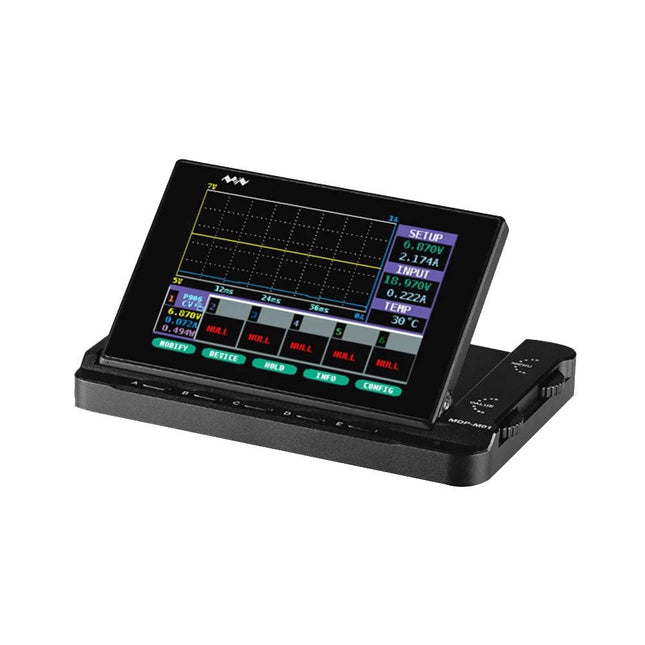
MDP-M01 is a display control module equipped with a 2.8-inch TFT display screen, the screen can be turned 90 degrees, which is convenient for users to view data and waveform. MDP-M01 can realize online display and control with MDP-P906 mini digital power supply modules and other modules of MDP system through 2.4 GHz wireless communication, and can control up to 6 sub-modules at the same time.
Specifications
Screen size
2.8" TFT
Screen resolution
240 x 320
Power
Micro USB power input, or taking power from sub-module via dedicated power cable
Input
DC 5 V/0.3 A
Other functions
Can control up to 6 sub-modulesUpgrade firmware through Micro USB
Dimensions
107 x 66 x 13.6 mm
Weight
133 g
Included
1x MDP-M01 Smart Digital Monitor
1x Cable (2.5 mm jack to Micro USB)
Downloads
User Manual v3.4
Firmware v1.32