The Siglent SSA3032X Plus spectrum analyzer is a powerful and flexible tool for RF signal and network analysis. With a frequency range of 3.2 GHz, the analyzer delivers reliable automatic measurements and multiple modes of operation: spectrum analyzer the base, optional functions include RF power measurement, vector signal modulation analysis, reflection measurement, and EMI test.
Applications include broadcast monitoring/evaluation, site surveying, S-parameter measurement, analog/digital modulation analysis, EMI pre-compliance test, research and development, education, production, and maintenance.
Features
Spectrum Analyzer Frequency Range from 9 kHz to 3.2 GHz
–161 dBm/Hz Displayed Average Noise Level (Typ.)
–98 dBc/Hz. @ 10 kHz Offset Phase Noise (1 GHz, Typ.)
Level Measurement Uncertainty <0.7 dB (Typ.)
1 Hz Minimum Resolution Bandwidth (RBW)
Preamplifier (Std.)
Tracking Generator (incl. free of charge)
Analog and Digital Signal Modulation Analysis Mode (opt.)
Reflection Measurement Kit (opt.)
EMI Filter and Quasi-Peak Detector Kit (opt.)
Advanced Measurement Kit (opt.)
10.1-inch Multi-Touch Screen , Mouse and Keyboard supported
Web Browser Remote Control on PC and Mobile Terminals and File Operation
Specifications
SSA3015X Plus
SSA3021X Plus
SSA3032X Plus
SSA3075X Plus
Frequency Range
9 kHz ~ 1.5 GHz
9 kHz ~ 2.1 GHz
9 kHz ~ 3.2 GHz
9 kHz ~ 7.5 GHz
Resolution Bandwidth
1 Hz ~ 1 MHz
1 Hz ~ 1 MHz
1 Hz ~ 1 MHz
1 Hz ~ 3 MHz
Phase Noise
<–99 dBc/Hz
<–98 dBc/Hz
<–98 dBc/Hz
<–98 dBc/Hz
Total Amplitude Accuracy
<1.2 dB
<0.7 dB
<0.7 dB
<0.7 dB
Display Average Noise Level
–156 dBm/Hz
–161 dBm/Hz
–161 dBm/Hz
–165 dBm/Hz
Included
Siglent SSA3032X Plus spectrum analyzer
USB cable
Power cord
Quick start guide
Downloads
Datasheet
Manual
Documentation
Firmware
The OWON SDS1102 is an affordable benchtop digital oscilloscope that combines solid performance with essential measurement features. This 2-channel oscilloscope offers a 100 MHz bandwidth, a 1 GS/s sampling rate, a 7-inch LCD display, and a 10 kpts memory depth, making it a practical choice for everyday electronics testing, troubleshooting, and education.
The SDS1102 features a simplified trigger system with level and edge triggering, making it easy to capture and analyze common signals. It is designed for applications that do not require deep memory or advanced trigger functions, offering a straightforward and cost-effective solution for basic signal analysis.
Features
Bandwidth: 100 MHz
2 channels
Sample rate: 1 GS/s
Ultra-thin body
7-inch high-res LCD
SCPI and LabVIEW supported
Specifications
Bandwidth
100 MHz
Horizontal Scale (s/div)
5 ns/div – 1000 s/div
Channel
2
Vertical Sensitivity
5 mV/div – 5 V/div (at input)
DC Gain Accuracy
3%
Vertical Resolution (A/D)
8 bits (2 channels simultaneously)
Input
Input Impedance
1 MΩ, 10 pF
Input Coupling
AC, DC, GND
Max Input Voltage
±400 V, CATI, CATII
Passive probes
х1; х10
Probe Attenuation Factor
х1; х10; х100; х1000
Trigger System
Trigger Mode
Auto, Normal, Single
Trigger Type
Edge, Video
Edge Trigger Source
CH1, CH2
Video Trigger
Sampling Type
Real-time
Sample Rate
1 GS/s
Equivalent Sample Rate
No
Wavelength
10K pts
Interpolation
sin(x)/x
Measurement and Mathematical Treatment System
Automatic Measurement
Vpp, Vavg, RMS, Frequency, Period, Vmax, Vmin, Vtop, Vbase, Width, Overshoot, Pre-shootRise time, Fall time, +Width, -Width, +Duty, -Duty, Delay A→B, Delay A→B, area, cycle area
Math Functions
Addition, Subtraction, Multiplication, Division, FFT
General Characteristics
Display type
7" color LCD
Display Resolution
800 x 480
Power
100-240 V, 45-440 Hz, <15 W
Dimensions
301 x 70 x 152 mm
Weight
1.1 kg
Included
1x OWON SDS1102 Oscilloscope
2x Oscilloscope probes
1x Probe adjust
1x Mains power cord
1x USB cable
1x CD-Rom
1x Quick guide
Downloads
Quick Guide
Manual
PC Software
SCPI Commands
The Seeed Studio RF Explorer 3G Combo is a handheld digital spectrum analyzer and an affordable tool for working across a wide range of popular frequency bands. It is based on a highly integrated frequency synthesizer and a double-balanced mixer, providing high performance, compact dimensions, low power consumption, and excellent value.
Designed for both indoor and outdoor use, the RF Explorer 3G Combo can also be connected to a PC via a standard Mini-USB 2.0 connector for additional functionality.
This model combines a WSUB1G base unit with an RFEMWSUB3G expansion module, supplied fully assembled and tested. It features two SMA connectors and includes two antennas: a dual-band 144/430 MHz telescopic antenna for sub-GHz frequencies and a helical whip antenna for the 2.4 GHz band. Additional frequency-specific antennas may be required for optimal performance in certain supported frequency ranges.
This combination provides the wide frequency coverage of the WSUB3G module together with the high sensitivity and fast response of the WSUB1G unit in the commonly used sub-1 GHz frequency range.
Features
Pocket size and light weight
Solid aluminum metal case
Includes a transport EVA carry case for RF Explorer
Spectrum Analyzer mode with Peak Max and Hold, Normal, Overwrite and Averaging modes
Lifetime free firmware upgrades available, open to community requested features
High capacity Lipo for 16+ hours of continuous run, rechargeable by USB
Windows PC client Open Source
Can be extended with internal Expansion Modules for additional band and functionality
Wide band coverage to all popular RF frequencies, starting at 15 MHz and going up to 2.7 GHz. This includes very interesting frequency areas such as 2 m HAM radio, all VHF and UHF, FM radio, GPS, WiFi and WiMax, Bluetooth, etc.
Firmware: RF Explorer 3G Combo is delivered with upgraded firmware v1.09. Note some of the features and operation accuracy will be improved in upcoming free firmware revisions.
Specifications
Battery
Lithium Cells / Batteries contained in equipment UN3481 - PI967
Frequency band
15-2700 MHz
Frequency span
112 KHz - 600 MHz
Graphics LCD
128 x 64 pixels, great visibility outdoors
PC Windows client
Supports Windows (32 and 64 bits)
Backlight
For great indoor visibility
2 standard SMA 50 ohms connector,
One for Sub-GHz wideband Nagoya NA-773 telescopic antenna included and another 2.4 GHz one for 15-2700 MHz band with helical antenna included.
Amplitude resolution
0.5 dBm
Dynamic range
Left SMA port (WSUB1G)
-115 dBm to 0 dBm
Right SMA port (WSUB3G)
-110 dBm to -10 dBm
Absolute Max input power
Left SMA port (WSUB1G)
+5 dBm
Right SMA port (WSUB3G)
+30 dBm
Average noise level (typical)
-110 dBm
Frequency stability and accuracy (typical)
±10 ppm
Amplitude stability and accuracy (typical)
±6 dBm
Frequency resolution
1 KHz
Resolution bandwidth (RBW)
Automatic 3 KHz to 600 KHz
Weight
185 g
Dimensions
113 x 70 x 25 mm
Included
Seeed Studio RF Explorer 3G Combo Spectrum Analyzer
Nagoya NA-773 wideband telescopic antenna
2.4 GHz band antenna
EVA Case
Documentation
For more info and to get started with your RF Explorer, visit the start page.
For questions and support, please visit https://support.rf-explorer.com
Der Autor zeigt in diesem Buch alle wichtigen Aspekte der Mikrocontroller-Programmierung, ohne den Leser mit unnötigen oder nebensächlichen Informationen zu überladen. Am Ende der Lektüre ist der Leser in der Lage, 8-Bit-Mikrocontroller zu verstehen und zu programmieren.
Die Einführung in die Mikrocontroller-Programmierung dekliniert der Autor an Mikrocontrollern aus der PIC-Familie durch. Der PIC mit seinem 8-Bit-Design ist nicht auf dem modernsten technischen Stand, aber dafür einfach zu verstehen. Er wird in einem DIP-Gehäuse angeboten, ist überall erhältlich und nicht besonders komplex. Das gesamte Datenblatt des PICs ist um Dekaden kürzer als die Architekturbeschreibung, die den Prozessor eines fortgeschrittenen Mikrocontrollers beschreibt. Die Einfachheit hat ihre Vorteile. Wer versteht, wie ein Mikrocontroller grundlegend funktioniert, kann sich später in fortgeschrittene Softcores einarbeiten.
Steht im ersten Teil des Buches Assembler als ausführende Programmiersprache im Vordergrund, so geht der Autor im zweiten Teil seines Buches vertiefend auf C ein. Quasi nebenbei entführt das Buch den Leser in die Tiefen der praktischen Arbeit mit Mikrocontrollern, erklärt interessante Messtechnik und zeigt Möglichkeiten zur Arbeitserleichterung und Fehlersuche.
Le téléchargement intégral de ce numéro est disponible pour nos membres GOLD et GREEN sur le site Elektor Magazine !
Pas encore membre ? Cliquez ici.
STM32 Wireless Innovation Design Contest Winners : les gagnants
LC mètre en circuitétude de prototype
AmpVolt : module de mesure de puissance (1)mesure de la puissance CC et de la consommation énergétique jusqu'à 50 V et 5 A
Embedded world 2024
réparation d'équipements électroniquesoutils, techniques et conseils
démarrer en électronique...plus de théorie sur les ampli-op
un générateur de signaux simplePure synthèse numérique directe
Sparkplug en un coup d'œilune spécification pour les données MQTT
contrôleur de tube cathodique
éclairage à commande radarcomment éclairer automatiquement un escalier en détectant une présence humaine
niveau à bulle électronique et disque stroboscopique actif pour platines vinylerégler votre platine vinyle avec cet outil tout-en-un
explorer les défis et la valeur commerciale de l’électronique open source
le connecteur circulaire codé Aune solution de choix pour les applications industrielles
The Arduino-Inside Measurement Labun instrument de test et de mesure 8 en 1 pour le labo d’électronique
analyseur de gain-phase avec une carte sonpour les fréquences de 100 Hz à 90 kHz
mesure du pH avec l'Arduino UNO R4vérifier la qualité de l'eau
sur le vifdouble détente
oscilloscope numérique FNIRSI 1014Dde bonnes performances pour des budgets serrés
2024 : l'odyssée de l'IAdétection d'objets
générateur de référence 10 MHztrès précis, avec distributeur et isolation galvanique
mise à jour #2 : compteur d'énergie basé sur l'ESP32quelques améliorations
projet 2.0corrections, Mises à jour, et Courrier des lecteurs
entretien avec Eben Upton, PDG de Raspberry PiRaspberry Pi 5 et au delà
Elektor GREEN en GOLD leden kunnen deze uitgave hier downloaden.
Nog geen lid? Klik hier om een lidmaatschap af te sluiten.
STM32 Wireless Innovation Design Contest: de winnaars
In-circuit LC-meteroverwegingen bij een prototype
AmpVolt: een modulaire DC-vermogensmeter (deel 1)meet gelijkstroom en energieverbruik tot 50 V en 5 A
embedded world 2024
Elektronische apparatuur reparerentools, technieken en tips
Alle begin... - NL TRANSLATION...gaat verder met de opamp-theorie
Eenvoudige DDS-signaalgeneratordirecte digitale synthese in zijn puurste vorm
Sparkplug bekekenspecificatie voor MQTT-data
De CRTCvreemde onderdelen
Radargestuurde verlichtingautomatische trapverlichting met personendetectie
Digitale waterpas en actieve stroboscoop voor draaitafelsregel je platenspeler perfect af met dit alles-in-één tool
Onderzoek naar de uitdagingen en commerciële waarde van open source-elektronica (2)
Ronde M12-connector met A-coderingvoorkeursoplossing voor industriële toepassingen
Het Arduino-Inside Measurement Labeen 8-in-1 test- en meetinstrument voor de elektronica-werkbank
Frequentie-, fase- en impedantieanalyse met een geluidskaartvoor frequenties van 100 Hz tot 90 kHz
Zuurgraad meten met de Arduino UNO R4controleer de waterkwaliteit
Uit het leven gegrepenpangpongbilletjes-lanceermachine
FNIRSI 1014D digitale geheugenoscilloscoopgoede prestaties voor weinig geld
2024: een AI-odysseeobjectdetectie aan de praat krijgen
10MHz-referentiegeneratorzeer nauwkeurig, met verdeler en galvanische isolatie
Project-update #2: ESP32-gebaseerde energiemeterenkele verbeteringen
Project 2.0correcties, updates en brieven van lezers
Een vraaggesprek met Eben Upton, CEO van Raspberry Pide Raspberry Pi 5 – en daarna
Elektor GREEN and GOLD members can download their digital edition here.
Not a member yet? Click here.
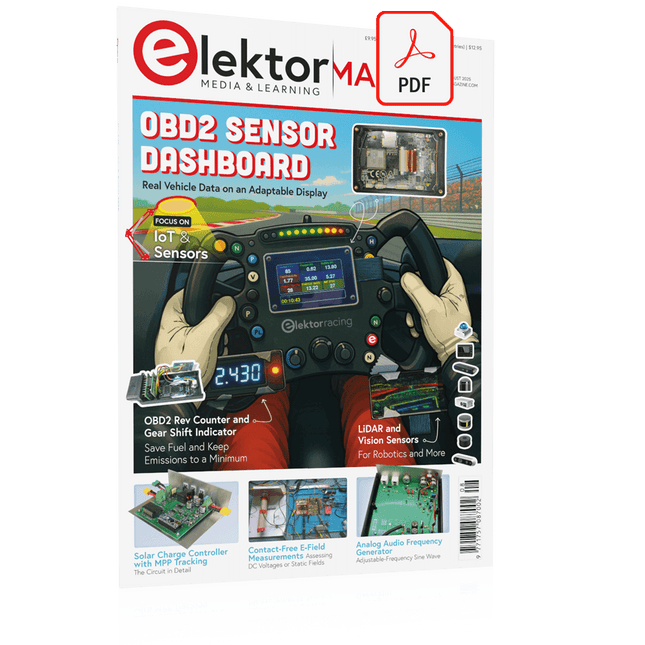
OBD2 Sensor DashboardOld Dials Sparked a Quest for Real Data
OBD2: Add a Rev Counter and Gear Shift Indicator to Your CarRetro, but Super Useful
LiDAR and Vision Sensors for Robotics
Sensor+Test 2025 and PCIM 2025
Contact-Free E-Field Measurements (1)A Vibrating Membrane for Assessing DC Voltages or Static Electric Fields
Wireless Mailbox NotifierFrom Optical Sensors to Radar, Exploring a Few Options
Elektor Mini-WheelieA Self-Balancing Robot
Solar CellsPeculiar Parts, the Series
Getting Started With a Modern Radar SensorIs an Accurate Measurement on Your Radar?
From Life’s ExperiencePaper Factory
CybersecurityTough Times for Hackers
Siglent Presents Next-Gen Multi-Channel OscilloscopesHigh-Performance Solutions for Modern Power and Embedded Systems
Bluetooth 6.0 Brings Enhanced Distance-Ranging ApplicationsNew Version Offers Improved Device Positioning and Location Services
Exploring Wireless Communication with BeagleY-AI
Err-lectronicsCorrections, Updates, and Readers’ Letters
Starting Out in Electronics……Concludes the Topic on Opamps
A Powerful AI Code AssistantSpeed Up Your Development with Continue and Visual Studio Code
Solar Charge Controller with MPPT (2)The Circuit
Ultrasonic Obstacle DetectorA Simple Project to Help Those with Impaired Vision
2025: An AI OdysseyMid-Year Review
Raspberry Pi Standalone MIDI Synthesizer (3)Making It Smarter and Adding a User Interface
Meshtastic: A Demo ProjectAn Intelligent Mesh of LoRa Radios
Analog Audio Frequency GeneratorHigh-Quality Adjustable Frequency Sine Wave Generator
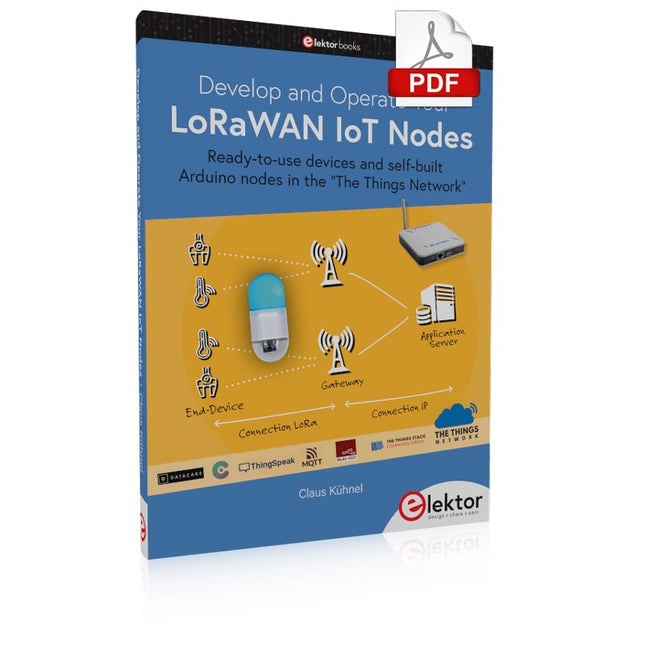
Ready-to-use devices and self-built Arduino nodes in the 'The Things Network'
LoRaWAN has developed excellently as a communication solution in the IoT. The Things Network (TTN) has contributed to this. The Things Network was upgraded to The Things Stack Community Edition (TTS (CE)). The TTN V2 clusters were closed towards the end of 2021.
This book shows you the necessary steps to operate LoRaWAN nodes using TTS (CE) and maybe extend the network of gateways with an own gateway. Meanwhile, there are even LoRaWAN gateways suitable for mobile use with which you can connect to the TTN server via your cell phone.
The author presents several commercial LoRaWAN nodes and new, low-cost and battery-powered hardware for building autonomous LoRaWAN nodes. Registering LoRaWAN nodes and gateways in the TTS (CE), providing the collected data via MQTT and visualization via Node-RED, Cayenne, Thingspeak, and Datacake enable complex IoT projects and completely new applications at very low cost.
This book will enable you to provide and visualize data collected with battery-powered sensors (LoRaWAN nodes) wirelessly on the Internet. You will learn the basics for smart city and IoT applications that enable, for example, the measurement of air quality, water levels, snow depths, the determination of free parking spaces (smart parking), and the intelligent control of street lighting (smart lighting), among others.
Le téléchargement intégral de ce numéro est disponible pour nos membres GOLD et GREEN sur le site Elektor Magazine !
Pas encore membre ? Cliquez ici.
tableau de bord OBD2Des cadrans anciens aux données en temps réel
OBD2 : ajoutez un compte-tours et un indicateur de changement de vitesse à votre voitureRétro, mais extrêmement utile
capteurs de vision et LiDAR pour la robotique
Sensor+Test 2025 et PCIM 2025
mesures sans contact du champ électrique (1)Membrane vibrante pour mesurer des tensions continues ou des champs électriques statiques
détecteur de courrier sans filCapteurs optiques, radars… quelques options à explorer
Elektor Mini-WheelieUn robot auto-équilibré
cellules solairesDrôles de composants, la série
premiers pas avec un capteur radar moderneUn capteur précis qui ne passe pas inaperçu
sur le vifUsine de papier
CybersécuritéDes temps difficiles pour les hackers
Infographie : IdO et capteurs
le Bluetooth 6.0 pour des applications de télémétrie amélioréesCette nouvelle version offre des fonctions de localisation améliorées
découvrez la communication sans fil avec BeagleY-AI
Projet 2.0Corrections, mises à jour et courrier des lecteurs
démarrer en électronique……Conclusion sur les ampli-op
un puissant assistant de codage de l'IAAccélérez votre développement avec Continue et Visual Studio Code
contrôleur de charge solaire avec MPPT (2)Le circuit
détecteur d'obstacles à ultrasonsUn projet simple pour aider les malvoyants
une odyssée de l'IABilan du premier semestre
synthétiseur MIDI autonome Raspberry Pi (3)plus intelligent avec une interface utilisateur
Meshtastic : un projet de démoUn réseau intelligent de noeuds LoRa
générateur analogique de fréquences audioGénérateur de signaux sinusoïdaux de haute qualité à fréquence réglable
Le téléchargement intégral de ce numéro est disponible pour nos membres GOLD et GREEN sur le site Elektor Magazine !
Pas encore membre ? Cliquez ici.
le Raspberry Pi 5une grande amélioration par rapport à son prédécesseur
l'IA dans les laboratoires d'électroniqueBard de Google et Flux Copilot mis en test
Générateur de formes d'ondes Arduino NanoNano + Code = Générateur de fonctions
guirlande de Noël solaire
détecteur de clé USB KillerMieux vaut prévenir que guérir
un boîtier simple créé par fraiseuse à commande numérique (CNC)avec Autodesk Fusion 360 en utilisation personnelle
production de cartes à faible quantitéavec et sans assemblage
simulation IdO simplifiée avec Wokwile développeur Uri Shaked parle de design, de logiciels et d'autres choses encore
guide de programmation Bare-Metal (3)en-têtes CMSIS, tests automatiques et serveur web
LoRa, un couteau suisse (1)le matériel et le logiciel
conception et construction de microphones MEMS
outils à tester avant de souderoutils de simulation et de modélisation 3D gratuits
nouveaux outils de Microchip!PICkit 5 et MPLAB ICD 5 sont disponibles maintenant !
prototypage rapide d'électronique souple et extensiblecomment la Voltera NOVA accélère l'innovation dans les systèmes électroniques portables
isolation galvaniqueutilisation d?optocouplers à phototransistor
la solution complexe ou la solution Anybus ?un Ethernet industriel embarqué réalisé en deux jours plutôt qu'en plusieurs mois
votre liste de contrôle DFM essentielle
filaments pour l?impression 3Dtypes, caractéristiques et utilisation dans le prototypage
spécialistes pour une analyse efficace des signaux des bandes ELF à EHFles derniers analyseurs de spectre en temps réel de la série SPECTRAN® V6 d?Aaronia
défis de l'analyse DFM pour les circuits flexibles et flexibles-rigides
définir une ligne SMT
infographie : prototypage et production
révolutionner le secteur de l?industriel'essor des robots mobiles autonomes (AMR)
prêt à relever encore plus de défisRohde & Schwarz étoffe sa famille d?oscilloscopes nouvelle génération avec le modèle 8 voies de la gamme R&S MXO 5
démarrer en électronique?Amplifying Differences
mini plaque de refusion'pour l'assemblage ou la réparation de petits circuits CMS
ne commencez pas avec un prototype, mais plutôt avec un « pretotype » !vérifiez qu'il existe un marché pour votre produit avant d'allumer votre fer à souder
2023 : l'Odyssée de l'IAassistance à la conception d'un projet matériel
Bruxelles et l?innovationsoutien aux technologies avancées
Elektor GREEN en GOLD leden kunnen deze uitgave hier downloaden.
Nog geen lid? Klik hier om een lidmaatschap af te sluiten.
De ESP-BLASTEen mini ESP32 raketdrone die ruim 100 km/u vliegt
STM32Cube Innovation-ChallengeDoe mee met je beste STM32C5-ontwerp
Wireless workshop (1)Radiomodules uitgelegd: 433 MHz CC1101 sub-GHz-transceiver
AM-zenderMet sinus- en blokgolfgenerator op Raspberry Pi Pico
AudiotronicaDe vervormingsfactor
CoffeeCallerOmroepsysteem met mesh-netwerk en Zephyr gebaseerde software
Elektor wordt 65Projecten uit voorgaande september- en oktobermaanden
Bluetooth Channel Sounding voor het volgen van objectenAfstandsmeting met centimeterprecisie voor het IoT van de volgende generatie
2026: Een AI-odysseeKwantumcomputing is geen volgende GPU
Om de cloud te beveiligen, is edge-beveiliging nodig
Eerste ervaringen met de HackRF ProPraktische tests met de nieuwe SDR-hardware
Modemupgrade van GPRS/2G naar LTE/4GEen draadloos alarmsysteem als voorbeeld
Lusvormige antenne met RF-bouwstenenDeel 1: Een zelfbouw kortegolfantenne met instelbare richtingsgevoeligheid
Internetradio naar AM-converterMet een ESP32-S3 als zender
Err-lectronics
Mioty, een overzichtFraunhofer's aanpak van LPWAN
WerkbankwijsheidPraktische tips van experts
Walter, de compacte IoT-moduleDeel 2: Toegang tot weer- en datadiensten
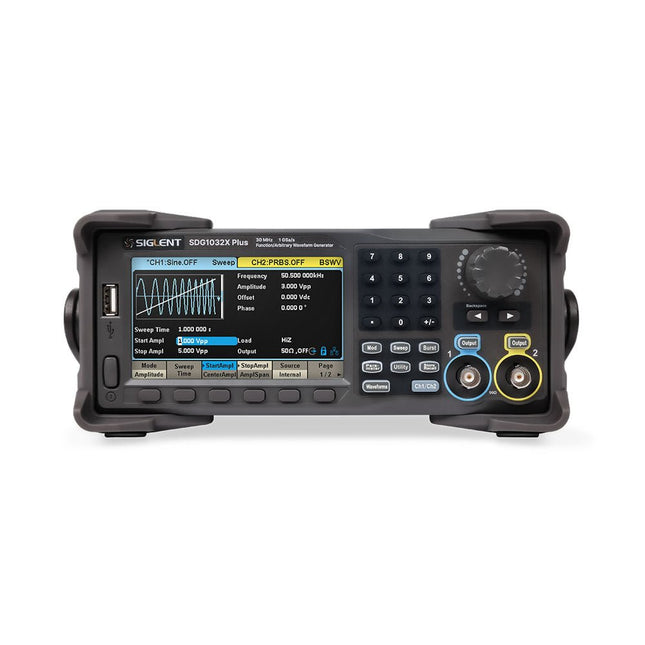
The Siglent SDG1032X Plus is a high-performance dual-channel function/arbitrary waveform generator with a 30 MHz max frequency, 16-bit resolution, and 1 GSa/s sampling rate for superior signal fidelity.
It features TrueArb for low-distortion waveforms, EasyPulse for jitter-free pulses, and robust sequence playback. With ±10 V amplitude, a 4.3" display, and versatile modulation, it's a reliable choice for engineers and researchers.
Features
Dual Channels: Independent output with maximum frequency of 30 MHz
High Sampling Rate: 1 GSa/s for precise waveform generation
High Vertical Resolution: 16-bit resolution for accurate signal reproduction
TrueArb Technology: Generates low-distortion arbitrary waveforms with high fidelity
EasyPulse Technology: Produces jitter-free square and pulse signals with fine control over rise/fall times
Arbitrary Waveform Length: Supports up to 8 Mpts per channel for complex waveform design
Wide Amplitude Range: ±10 V maximum output amplitude
Built-in Modulation Functions: AM, FM, PM, PWM, PSK, FSK, ASK, and more
Multi-Pulse Output: Enables measurement of power equipment switching parameters
PRBS Pattern Generation: Supports up to 40 Mbps for advanced testing needs
Sweep and Burst Modes: Flexible test capabilities with adjustable parameters
Sequence Playback Function: Stores and plays back complex waveforms efficiently
Frequency Counter: Measures frequencies up to 200 MHz with high precision
User-Friendly Display: 4.3" color LCD with a clear interface
Remote Control Support: Built-in WebServer for control via a web browser
Compact Design: Portable and space-saving form factor
Specifications
Bandwidth
30 MHz
Channels
2
Sampling rate
1 GSa/s (4x Interpolation)
Vertical resolution
16 bits (per channel)
Waveform length
8 Mpts
Max. amplitude
±10 V
Display
4.3" color TFT LCD (480 x 272)
Interfaces
USB Host, USB Device, LAN
Dimensions
260 x 107 x 296 mm
Weight
4.35 kg
Included
1x Siglent SDG1032X Plus Arbitrary Function Generator
1x Power Cord
1x USB Cable
1x Guarantee Card
1x Quick Start Guide
Downloads
Datasheet
User Manual
Programming Guide
Software