Sprachsteuerung von IoT-Projekten mit Amazon Alexa gibt dem Leser einen tiefen Einblick in die Technik der Sprachsteuerung am Beispiel von Amazon Alexa. Es erklärt detailliert Schritt für Schritt, wie man Raspberry Pi, ESP8266/32 und Arduino mit einem Sprachassistenten verbindet und steuert. Dieses geschieht anhand von Projekten aus den Bereichen Hausautomation und Robotik.
Der Leser erfährt, wie man Heizkessel, Roboter und Gartenhäuser mit dieser modernen Mensch-Maschine-Schnittstelle kommandieren kann. Der Autor Walter Trojan führt dabei den Leser in die vielschichtige Welt der Amazon Web Services ein, wo er neben dem Alexa Skills Kit weitere Module wie AWS Lambda und IoT Core kennenlernt.
Das erwartet den Leser:
Kapitel 1: Sprachassistenten setzen sich durch
Kapitel 2: Alexa intern
Kapitel 3: Der erste Alexa Skill
Kapitel 4: Alexa Skills für Fortgeschrittene
Kapitel 5: Erster Hardware-Skill auf Raspberry Pi
Kapitel 6: Auch Alexa liebt die Arduino-IDE
Kapitel 7: Hacks mit Schaltern
Kapitel 8: Alexa steuert ein Gartenhaus
Kapitel 9: Auch Roboter gehorchen Alexa
Kapitel 10: Alexa geht fremd
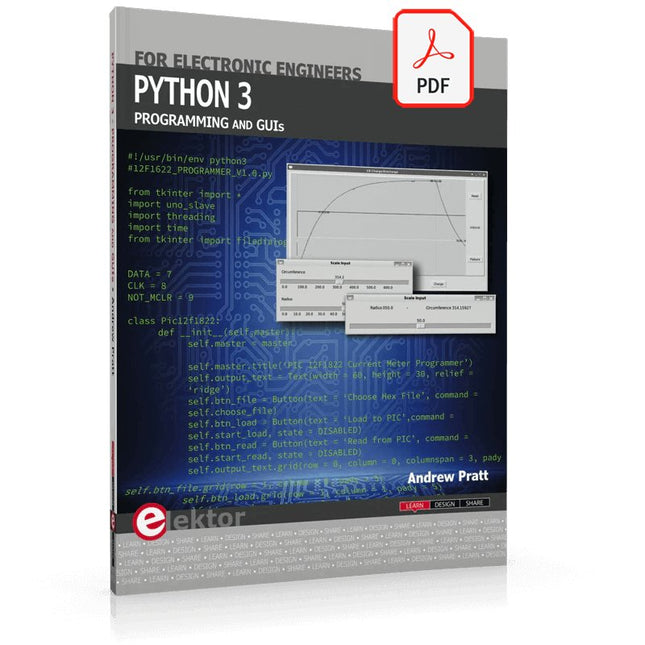
This is the second edition of a book aimed at engineers, scientists, and hobbyists who want to interface PCs with hardware projects using graphical user interfaces. Desktop and web-based applications are covered.
The programming language used is Python 3, which is one of the most popular languages around: speed of programming being a key feature. The book has been revised and updated with an emphasis on getting the user to produce practical designs with ease – a text editor is all that is required to produce Python programs.
Hardware interfacing is achieved using an Arduino Uno as a remote slave. A full description and source code of the communication interface is given in the book. The slave provides digital and analog input and outputs. Multiple Unos can be included in one project with all control code written in Python and running on a PC One project involves a PIC microcontroller with the code provided that can be loaded into the PIC using the Uno.
The web applications and server are all implemented in Python, allowing you to access your electronic hardware over the Internet. The Raspberry Pi computer can be used as your web server. An introductory chapter is provided to get you started with using Linux.
The book is written for use with Debian or variations including Mint or Ubuntu. All of the programs in the book are freely available, ready to use and experiment with by way of a download from Elektor.
Elektor GREEN en GOLD leden kunnen deze uitgave hier downloaden.
Nog geen lid? Klik hier om een lidmaatschap af te sluiten.
De open-source processorarchitectuur RISC-V16 boards en MCU's die je moet kennen
Een FPGA-gebaseerde audiospeler met equalizer (1)Digitaal audio mixen met een Arduino MKR Vidor 4000
Laserkop voor pico-gebaseerde zandklokTekenen met licht
Doe mee aan de STM32 Edge AI Contest
Een multi-sensor plantenmonitor-systeemdraadloze meting van watertoevoer en lichtomstandigheden
Maixduino AI-gestuurde automatische portiergezichtsdetectie met een camera
Embedded Electronics 2024AI gaat de industrie opnieuw vormgeven
Lading-gebaseerde in-Memory computing bij EnCharge AI
AI-Inferentie met 10 Keer Lager Energieverbruik en 20 Keer Lagere Kosten
Click board ondersteunt het ontwikkelen en trainen van ML-modellen voor trillingsanalyse
De Elektor Mini-WheelieEen kit voor een zelfbalancerende robot
MCU, ik zie jeMCUViewer: open-source multiplatform debugging-tool
USB 2.0-isolatorelektrisch geïsoleerde USB-aansluiting
Voorkomen is betervoorspellend onderhoud in de praktijk
SPoE – Elektromagnetische compatibiliteitSingle pair met Power-over-Ethernet door de ogen van EMC
Retro techEen nieuwe wereld met kleurentelevisie
ECG-monitorimplementatie met Hexabitz-modules en een STM32CubeMonitor
De strijd om AI aan de edge
Met HaLow Wi-Fi is een record afstand bereikt van 16 km op 900 MHz
Eerste CHERI RISC-V Embedded Chip en Early Access programma
Derde generatie bosbranddetectie maakt gebruik van satellietverbindingen
Uit het leven gegrepenkeuzestress
Alle begin......filtert verder en regelt tonen
Quasi-analoog uurwerkwedergeboorte van een Elektor-klassieker
Een modulaire sensortesterSensor-evaluatieboard met ESP32-S3
2025: Een AI-OdysseeDe opkomst van foundation modellen en hun rol in het democratiseren van AI
Raspberry Pi standalone MIDI-synthesizer (1)voorbereiding van een platform voor enkele edge-AI-experimenten
Err-lectronicsCorrecties, updates en brieven van lezers
Universele AI RISC-V processor doet ze allemaal - CPU, GPU, DSP, FPGA
Interview met de CEO: Ventiva's dunne en coole technologie
Dual-core programmeren met een Raspberry Pi Picoduik in de wereld van parallel programmeren
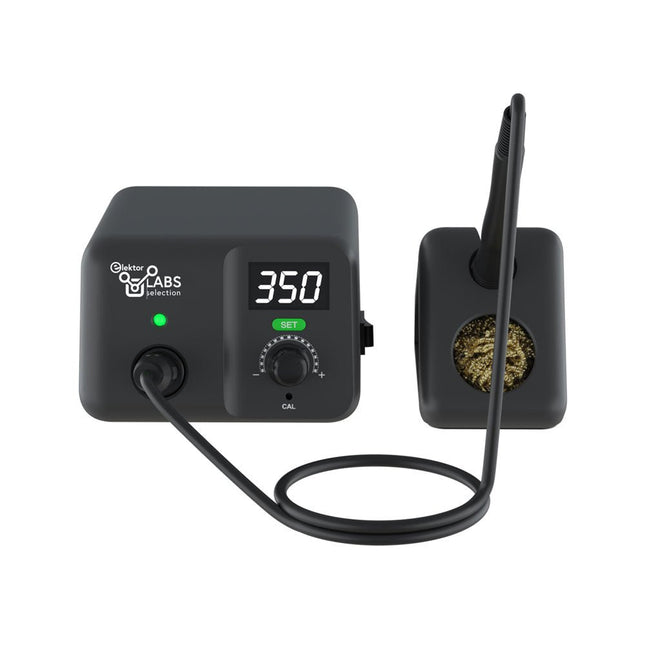
Soldering station for precision soldering with actively heated soldering tip
The AE970D soldering iron station is a 80 W high power tool to heat up to solder fastly. Its wide temperature range of 150-550°C (302-1022°F) could meet all your soldering needs. Thanks to its high performance plug-and-play integrated active tip, AE970D can reach melting point within 9 seconds. Patented close-loop automatic constant temperature control technology can ensure its soldering with high stability, excellent performance and precise accuracy.
Features
80 W high power to enable fast heating up
Wider temperature range of 150-550°C (302-1022°F) to meet all your soldering needs
High performance plug-and-play integrated active tip, can reach melting point within 9 seconds
Patented close-loop automatic constant temperature control technology to ensure high stability, excellent performance and precise accuracy
Specifications
Power
80 W
Input voltage
110 VAC / 230 VAC
Output voltage
25 VAC
Temperature range
150-550°C (302-1022°F)
Heating element
T80 series integrated active heater
Temperature stability
±1°C/±1.8°F (when temperature >200°C/400°F)
Tip to ground resistance
<2 Ω
Tip to ground voltage
<2 mV
Power cord length
1 m
Handle cable length
1.2 m
Dimensions
148 x 120 x 85 mm
Weight (main unit)
1.33 kg
Included
Main unit
Soldering iron incl. soldering tip T80-D12
Iron stand
Brass wool
Manual
Practical Projects and Programs
With Experimenting with Red Pitaya STEMlab Gen 2, Red Pitaya goes beyond a versatile board. It becomes a powerful laboratory instrument for precision measurement, analysis, and control.
From the fundamentals of electronic project development, monitoring, control, and design to testing, this book walks you step-by-step through everything you need to know to harness the full potential of Red Pitaya hardware and software.
The book presents real-time, FPGA-based projects that are developed on a PC using the Vivado environment, then transferred to the Red Pitaya for execution and testing.
You will learn about enhanced performance, expanded I/O capabilities, improved FPGA features, and advanced connectivity options that open up new frontiers for precision measurement, monitoring, and control in your embedded applications.
Inside the book you will discover:
A deep dive into Red Pitaya architecture and hardware design
Electronic experiments using Red Pitaya for measurement and monitoring
Hands-on projects using the Python programming language
Practical guidance for FPGA programming using Red Pitaya
Red Pitaya FPGA projects using the Verilog HDL under Vivado IDE
Practical design of electronic projects including measurement and testing
Step-by-step examples that bridge theory and real-world implementation
Whether you are designing your own electronic circuits, developing signal analysis tools, or creating real-time control or monitoring systems, this book provides you the knowledge and confidence you need to fully learn and customize the Red Pitaya platform.
Elektor GREEN and GOLD members can download their digital edition here.
Not a member yet? Click here.
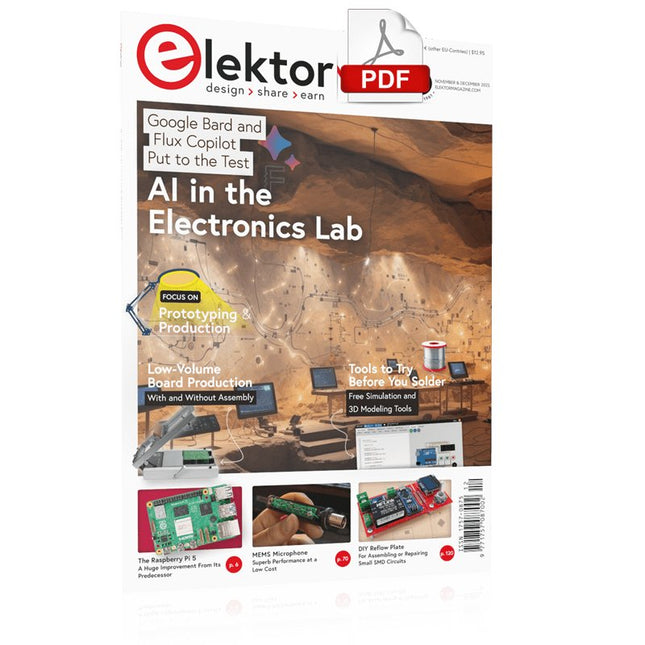
The Raspberry Pi 5A Huge Improvement From Its Predecessor
AI in the Electronics LabGoogle Bard and Flux Copilot Put to the Test
Arduino Nano Waveform GeneratorNano + Code = Function Generator
Solar-Powered Christmas GarlandAn Eco-Friendly Solution for Garnishing Your Balcony
USB Killer DetectorBetter Safe Than Sorry
A Simple CNCed EnclosureWith Autodesk Fusion 360 for Personal Use
Low-Volume Board ProductionWith and without Assembly
IoT Simulation Simplified with WokwiDeveloper Uri Shaked on Design, Software, and More
A Bare-Metal Programming Guide (Part 3)CMSIS Headers, Automatic Testing, and a Web Server
LoRa, a Swiss Army Knife (2)The Hardware and Software
MEMS Microphone Design and Construction
Tools to Try Before You SolderSimulation and 3D Modeling Tools That Can Be Used for Free
New Tools From Microchip!PICkit 5 and MPLAB ICD 5 Available Now!
Rapid Prototyping of Flexible, Stretchable ElectronicsHow the Voltera NOVA Speeds Up Innovation in Wearable Electronic Systems
Galvanic IsolationUsing Phototransistor Optocouplers Successfully
The Complex Solution or the Anybus Solution?Embedded Industrial Ethernet in 2 Days Rather Than Many Months
Your Essential DFM ChecklistHow to Start Designing for Manufacture
3D Printing FilamentsTypes, Features and Use in Prototyping
Specialists for Effective Signal Analysis from ELF to EHF BandAaronia’s latest real-time SPECTRAN® V6 series spectrum analyzers
Challenges of DFM Analysis for Flex and Rigid-Flex Design
Setting Up an SMT Line
The Right Combination for a Reliable Assembly
Revolutionizing IndustriesThe Rise of Autonomous Mobile Robots (AMRs)
Evolved for More ChallengesRohde & Schwarz Adds Eight-Channel R&S MXO 5 to Next-Generation Oscilloscopes
Starting Out in Electronics……Amplifying Differences
Mini Reflow PlateFor Assembling or Repairing Small SMD Circuits
Don’t Start with a Prototype – Start with a Pretotype!Check That a Market Exists for Your Product Before Warming Your Soldering Iron
2023: An AI OdysseyGetting Help Designing a Physical Project
Brussels Is InnovatingSupport for Deep Tech
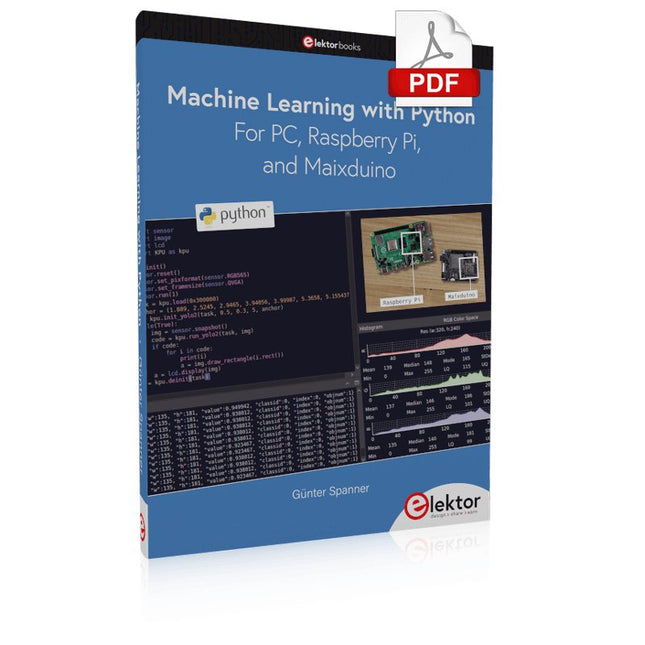
Most people are increasingly confronted with the applications of Artificial Intelligence (AI). Music or video ratings, navigation systems, shopping advice, etc. are based on methods that can be attributed to this field.
The term Artificial Intelligence was coined in 1956 at an international conference known as the Dartmouth Summer Research Project. One basic approach was to model the functioning of the human brain and to construct advanced computer systems based on this. Soon it should be clear how the human mind works. Transferring it to a machine was considered only a small step. This notion proved to be a bit too optimistic. Nevertheless, the progress of modern AI, or rather its subspecialty called Machine Learning (ML), can no longer be denied.
In this book, several different systems will be used to get to know the methods of machine learning in more detail. In addition to the PC, both the Raspberry Pi and the Maixduino will demonstrate their capabilities in the individual projects. In addition to applications such as object and facial recognition, practical systems such as bottle detectors, person counters, or a “talking eye” will also be created.
The latter is capable of acoustically describing objects or faces that are detected automatically. For example, if a vehicle is in the field of view of the connected camera, the information 'I see a car!' is output via electronically generated speech. Such devices are highly interesting examples of how, for example, blind or severely visually impaired people can also benefit from AI systems.
Le téléchargement intégral de ce numéro est disponible pour nos membres GOLD et GREEN sur le site Elektor Magazine !
Pas encore membre ? Cliquez ici.
Cloc 2.0le réveil-matin de vos rêves
PIO du RP2040 en pratiqueexpérimentation des E/S programmables du RP2040
Poor Man's ChipTweakerNous avons des moyens (abordables) de vous faire parler
générateur de nombres réellement aléatoires avec interface USBdeux PICs pour le prix d?un AVR
vitamines audio pour micro ramolloComment gonfler soi-même le niveau de sortie d'un microphone
FFT avec MaixduinoAcquisition de spectres de fréquences
sur le vifsans raison apparente
pilote de moteurs pas à pas UCN5804drôle de composant, la série
simulation de circuit avec Micro-Cappremiers pas dans un monde compliqué
PAUL Award 2022les jeunes talents de la technologie et leurs solutions créatives
ma première radio définie par logicielréalisée en moins de 15 minutes
la documentation des microcontrôleurs sans peine (1)la structure d?une fiche technique
quel avenir pour l'IA et les systèmes embarqués ?outils, plateformes et remplacement des rédacteurs
numériser une ferme verticale
Infographie : l?embarqué et l?IA d?aujourd?hui et demain
Présentation du TinyML
Casestudy KwickPOS
Hautes performances pour tousNormes Computer-on-Module
démarrer en électroniquecomposants actifs
communication I²C avec Node.js et Raspberry Piaffichez les données de vos capteurs dans un navigateur
sortie vidéo sur les microcontrôleurs (2)sortie VGA et DVI
le système d'exploitation temps réel Metronomun RTOS pour processeurs AVR
DVI sur le RP2040Entretien avec Luke Wren, développeur de composants chez Raspberry Pi
L?afficheur HAT Miniaffichez les prévisions météo sur Raspberry Pi !
WEEF 2022 Awards : célébrez les bonnes choses
Hexadoku
Elektor GREEN and GOLD members can download their digital edition here.
Not a member yet? Click here.
electronica fast forward 2022 Start- & Scale-Up AwardsPreparations Speeding Up!
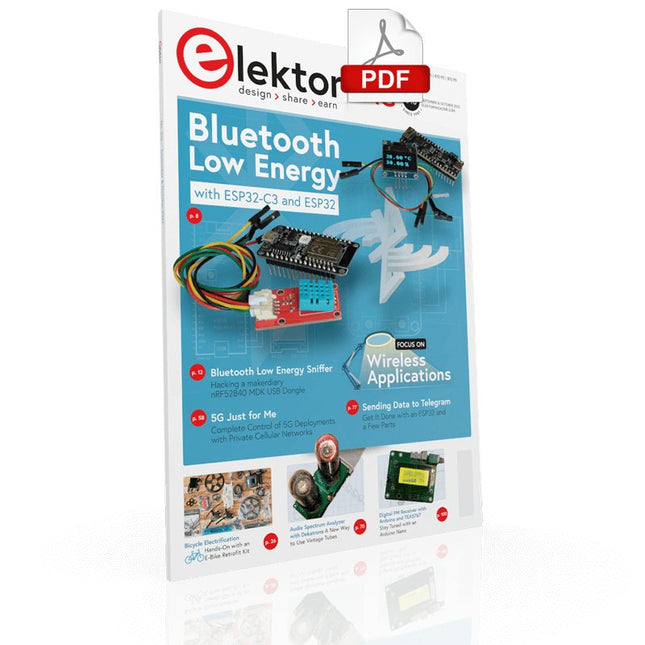
Bluetooth Low Energy with ESP32-C3 and ESP32You Don’t Always Need to Choose Wi-Fi!
Bluetooth Low Energy SnifferHacking a makerdiary nRF52840 MDK USB Dongle
Magic RGB LED CubeHardware Design Around an RP2040
Auto On/Off for Solder Paste Compressor
Elektor Video ContentLivestreams, Webinars, and Courses for Engineers and Pro Makers
Bicycle ElectrificationHands-On with an E-Bike Retrofit Kit
Starting Out in ElectronicsMultiplying Voltages
From Life’s ExperienceSidelines
Teensy 4.0Why Is This Board So Fast?
Audio Power Amplifier Simulation with TINAThe Try-Before-You-Build Approach
Develop and Operate Your LoRaWAN IoT NodesSample Chapter: Dragino LHT65, LDS01, and LDS02 LoRaWAN Modules
Err-lectronicsCorrections, Updates and Readers’ Letters
5G Just for MeGaining Complete Control of 5G Deployments with Private Cellular Networks
Infographics 7-8/2022
How Does My Device Learn to Transmit?Applications with Wi-Fi Interfaces
Smartphones are the Heart of the IoT
Audio Spectrum Analyzer with DekatronsA New Way to Use Vintage Tubes
Sending Data to TelegramGet It Done with an ESP32 and a Few Parts
A Fliege Notch Filter for Audio MeasurementsMake Better Measurements with a Notch Filter
CO2 Meter TeardownIs It Hackable for Your Projects?
PUT-ting It All TogetherThe Programmable Unijunction Transistor Explained
Round Touchscreen for Raspberry PiHyperPixel 2.1 Round from Pimoroni
Remote Sensing with Connection Loss DetectionUsing nRF24L01+ Modules
Digital FM Receiver with Arduino and TEA5767Stayed Tuned with an Arduino Nano
Changing an OLED Interface from SPI to I²C
HomeLab ToursA Hobby Does Not Retire
A Decade of Ethics in ElectronicsTessel Renzenbrink Reflects on the Digital Society and More
HexadokuThe Original Elektorized Sudoku
Diese Ausgabe steht allen GOLD- und GREEN-Mitgliedern auf der ElektorMagazine-Website zum Download bereit!
Sie sind noch kein Mitglied? Hier klicken!
DIY-SolarakkusÜber den Selbstbau von Energiespeichern für Solaranlagen
Solarmodul-SimulatorFür Test und Optimierung von MPP-Trackern und Invertern
Der STM32-Edge-KI-WettbewerbEntdecken Sie den neuen STM32N6 und nehmen Sie am Wettbewerb um 5.000 € teil!
Erweiterung der BandlückeWarum gibt es so viel Interesse an SiC und GaN?
Power-Bank für NotebooksVerlängern Sie das Leben Ihres alten Laptops!
Medizinische RoboterÜberwindung technischer und regulatorischer Hürden
Frostwächter für ObstpflanzenMit Temperatur-Datenlogger
Das analoge DingDer Arduino des Analog-Computings?
Sparsames NetzrelaisMit über 90% Leistungsreduzierung
Verbesserung der DC-Last ET5410A+Keep cool and be quiet!
electronica 2024 im Rückblick
Elektromagnetische VerträglichkeitEMV kurz und bündig!
Aller Anfang......muss nicht schwer sein: Aktive Filter
Verlustleistung reduzieren mit AbleitkondensatorenEin cleverer Einsatz von kapazitiver Reaktanz
Preiswerter 12-Bit-Digital-Analog-Wandler MCP4725Mit EEPROM-Feature für sicheres Einschaltverhalten
Fnirsi LCR-ST1, die intelligente LCR-SMD-Pinzette
Test- und Messlabor mit Raspberry PiDas Wichtigste zuerst: Der ADC
Elektronischer LastwiderstandEin Projekt aus der Kiste
2025: Eine Odyssee in die KIEinige Projekte für das neue Jahr
Projekt-Update: Modulares DC-Leistungsmessgerät AmpVolt v2.0100 Ampere und mehr!
Projekt 2.0
Ethische Transparenz sichtbar gemachtErgebnisse der Umfrage 2024 von Ethics in Electronics
Elektor Audio-DSP FX-Prozessor-BoardTeil 2: Anwendungen erstellen
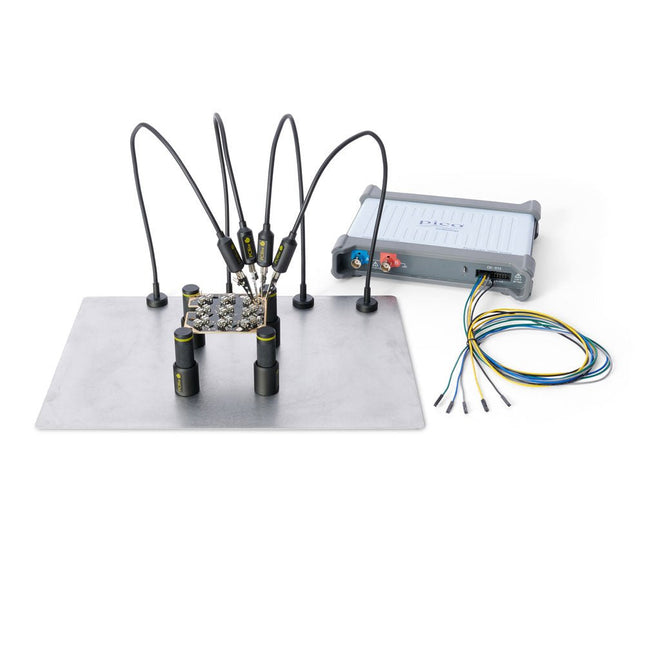
The minimalist design and the spring loaded test needle makes it possible to simultaneously measure on fine pitch components and nearby signals.
The probe is steady but yet flexible made for instant measurements or total hands-free operations together with your multimeter, logic analyzer or preferred tool.
The dual pin header connector fits directly on a 2.54 mm (0.100”) connector.
The SP10 comes with a powerful magnet in the base, as for all PCBite probes and holders which makes the probe easy to place and reposition.
Included
4x PCBite holder
1x Large base plate (A4)
4x PCBite probe with pin tipped test needle
4x Extra crown tipped test needle
1x Set of yellow insulation washers
5x Dupont to dupont test wire
2x Banana to dupont test wire
1x Microfiber cloth
Downloads
User Guide
Open-Source-Code mit Arduino IDE und PlatformIO
Autonomes Fahren: GPS, Accelerometer, Gyroskop
PS3-Controller
Mikrocontroller wie der Arduino und Einplatinenrechner wie der Raspberry Pi haben sich zu beliebten Komponenten entwickelt. Dritter im Bunde ist der ESP32 der Firma Espressif. Mikrocontroller dieser Baureihe zeichnen sich durch eine Vielzahl implementierter Funktionen aus, die bei einem Arduino konventioneller Prägung mit einem Atmel-AVR-Mikrocontroller erst mit weiterer Hardware möglich sind. Prominentes Beispiel sind hier die WiFi- und Bluetooth-Funktionalitäten. Gegenüber einem Raspberry Pi zeichnen sie sich durch einen deutlich geringeren Preis aus.
Allgemeine Informationen für die Realisierung eines Roboterauto-Projekts mit dem ESP32 sind leicht zu finden. Dabei handelt es sich aber oft nur um Ausführungen zu einem Teilaspekt, ohne inhaltliche oder funktionale Abstimmung. So ist nicht nur die Beschaffung der benötigten Informationen mühselig und zeitaufwändig, sie kann auch außerordentlich fehlerträchtig sein.
Ansatzpunkt dieses Buches ist, diese Lücke zu schließen. Es geht auf verschiedene Möglichkeiten eines Chassis ein, vermittelt nötige Kenntnisse und führt schrittweise von einer einfachen Motorsteuerung zu einem komplexen sensor- und sprachgesteuerten Roboterauto. Hacks rund um GPS und eine PlayStation 3 runden die Sache ab.
Inhalt
Bei der Reihenfolge der Kapitel wurde versucht – beginnend bei der Darstellung von grundlegenden Informationen – über die Lösung einfacher Aufgaben zu etwas anspruchsvolleren Techniken zu führen.
Der Mikrocontroller ESP32
Die Software erstellen
Die Stromversorgung
Rund um die Hardware
Das Chassis
Der Gleichstrommotor
Kabellose Steuerung über WiFi
Mit Sensoren Hindernisse erkennen
Eine eigene Roboterauto-App
Servo und Lichtsensor
GPS
Accelerometer / Gyroskop
PS3-Controller
Roboterauto-App
Hinweis zur Software
Die Dateien haben das Suffix (.cpp). Grund ist die Entwicklung mit PlatformIO. Mit Copy & Paste sollten sie auch in der Arduino-IDE verwendet werden können.