Mit RPi-basierten Tools und Messgeräten Amateurfunkstationen bauen und programmieren
Obwohl viele Funkamateure immer noch mit klassischer HF- und Mobilfunkausrüstung arbeiten, ist der Einsatz von Computern und digitalen Techniken inzwischen sehr beliebt. Heutzutage kann jeder für ca. 40 € einen Raspberry Pi-Computer kaufen und fast jede Amateurfunk-Software auf dem 'RPi' ausführen.
Die RTL-SDR-Geräte sind bei Funkamateuren sehr beliebt, weil sie sehr preiswert sind und viele Funktionen bieten. Ein Basissystem kann aus einem USB-basierten RTL-SDR-Dongle mit einer geeigneten Antenne, einem RPi-Computer, einem USB-basierten externen Audio-Eingangs-/ Ausgangsadapter und einer auf dem RPi installierten Software bestehen. Mit einer solch einfachen Einrichtung ist es möglich, Signale von etwa 24 MHz bis über 1,7 GHz zu empfangen.
Dieses Buch richtet sich an Funkamateure, die lernen wollen, wie man mit dem Raspberry Pi elektronische Projekte baut. Das Buch eignet sich für die gesamte Bandbreite von Anfängern bis hin zu alten Hasen im Amateurfunk. Die schrittweise Installation des Betriebssystems wird mit vielen Details zu den gängigsten Linux-Befehlen beschrieben. Einige Kenntnisse der Programmiersprache Python sind erforderlich, um die im Buch beschriebenen Projekte zu verstehen und zu bearbeiten. Zu den im Buch entwickelten Beispielprojekten gehören eine Stationsuhr, ein Signalgenerator, der Entwurf eines Transistorverstärkers, der Entwurf eines aktiven Filters, ein Morsezeichen-Übungsgerät, ein Frequenzzähler, ein HF-Meter und vieles mehr. Für jedes Projekt werden das Blockdiagramm, der Schaltplan und der vollständige Python-Quellcode angegeben, einschließlich der vollständigen Beschreibung der Projekte.
Neben der umfassenden Behandlung von RTL-SDR für Amateurfunk fasst das Buch auch die Installations- und Gebrauchsanweisungen der folgenden Amateurfunkprogramme zusammen, die Sie auf ihrem Raspberry Pi ausführen können: TWCLOCK, Klog, Gpredict, FLDIGI, DIRE WOLF, xcwcp, QSSTV, LinPsk, Ham Clock, CHIRP, xastir und CQRLOG.
Construisez votre contrôleur RISC-VDébuter sur le noyau logiciel RISC-V NEORV32 pour FPGA à faible coût
Tracer des graphiques avec ArduinoC?est facile avec le traceur sériel d'Arduino
Carte CLUE d'AdafruitUne solution intelligente pour les projets IoT
Carte tampon pour le Raspberry Pi 400Protection des entrées/sorties
Cartes Raspberry Pi RP2040 à gogo
Approche DIY de la sécurité et de l'espionnage électroniqueChauffez ou refroidissez la SRAM
Identification des composantsTrucs et astuces, bonnes pratiques et autres informations utiles
Interrupteur sans contact DIY
Démarrer en électronique? (12)Adaptation d?impédance et transformateurs
Quoi de neuf dans le développement de l'embarqué ?Rust et mises à jour des déploiements IoT
Infographie
Les bénéfices de la 5G pour l?industrie et l?automobile
Relais à bobine mobile
Visite à domicileChacun son tour
Voyage dans les réseaux neuronaux (4e partie)Les neurones embarqués
Lévitation magnétique : encore plus simpleTroisième version : la plus compacte
Programmation d'automates avec le Raspberry Pi et le projet OpenPLCVisualisation des programmes PLC avec AdvancedHMI
Sur le vifEmballé, c?est pesé
Sous votre radarDes microcontrôleurs que vous devriez connaître
Surveillance et débogage sans filUne solution pour Arduino, ESP32 et Cie
Station de mesure de température et d'humidité, au format de pocheUtilisation de modules prêts à l'emploi
Réparation des batteries au lithiumÉconomisez de l'argent et augmentez la puissance !
Création d?interfaces graphiques en PythonGénérateur de mèmes
Trois questions fondamentalesPourquoi, avec quoi, avec qui ?
Hexadoku
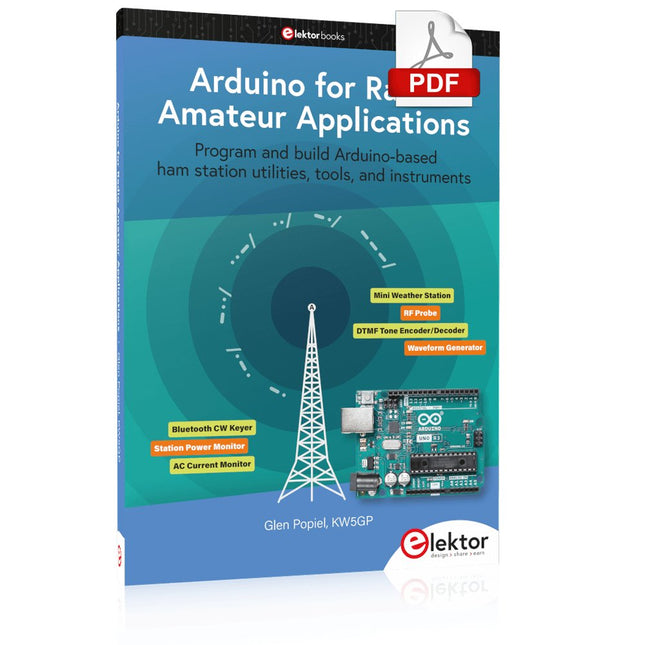
Program and build Arduino-based ham station utilities, tools, and instruments
In addition to a detailed introduction to the exciting world of the Arduino microcontroller and its many variants, this book introduces you to the shields, modules, and components you can connect to the Arduino. Many of these components are discussed in detail and used in the projects included in this book to help you understand how these components can be incorporated into your own Arduino projects. Emphasis has been placed on designing and creating a wide range of amateur radio-related projects that can easily be built in just a few days.
This book is written for ham radio operators and Arduino enthusiasts of all skill levels, and includes discussions about the tools, construction methods, and troubleshooting techniques used in creating amateur radio-related Arduino projects. The book teaches you how to create feature-rich Arduino-based projects, with the goal of helping you to advance beyond this book, and design and build your own ham radio Arduino projects.
In addition, this book describes in detail the design, construction, programming, and operation of the following projects:
CW Beacon and Foxhunt Keyer
Mini Weather Station
RF Probe with LED Bar Graph
DTMF Tone Encoder
DTMF Tone Decoder
Waveform Generator
Auto Power On/Off
Bluetooth CW Keyer
Station Power Monitor
AC Current Monitor
This book assumes a basic knowledge of electronics and circuit construction. Basic knowledge of how to program the Arduino using its IDE will also be beneficial.
Elektor GREEN and GOLD members can download their digital edition here.
Not a member yet? Click here.
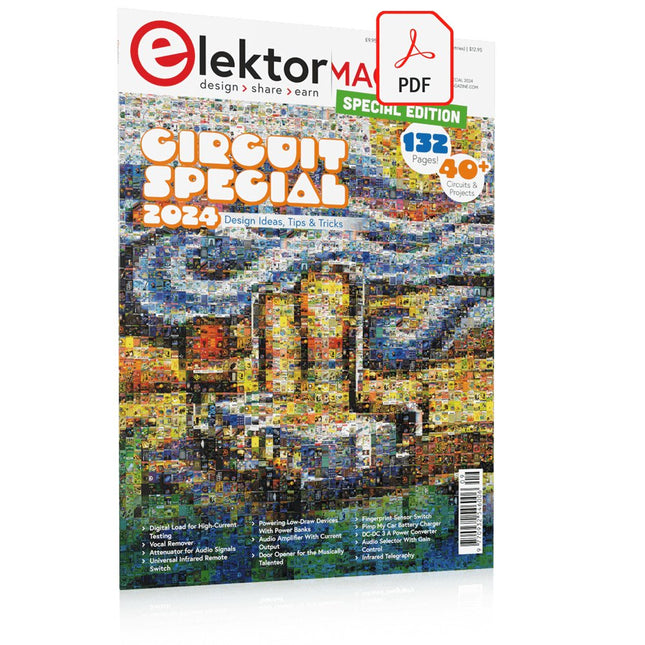
Digital Load for High-Current TestingFrom Necessity to Innovation
Vocal RemoverInstant Karaoke Circuit
Audio A/B Selector With Gain ControlSwitches from Microphone to Line Inputs
Better Charging for the LIR2032Be Kind to Your Coin Cells
Touch Sensing Made SimpleA DIY Guide for Any Microcontroller
Universal Infrared Remote SwitchA New Life for Old Remotes
Microcontroller-Powered Moo BoxMaking Playful Sounds With a Microcontroller
USB Battery Interface
Powering Low-Draw Devices With Power BanksA “Stay Alive” Solution
Small Class-A Audio Amplifier With Current OutputDrive Speakers with Current Instead of Voltage
Pseudo-Balanced ModuleHigh CMRR with Unbalanced Audio Links
Ni-MH Cells Automatic ChargerRefill All Your Battery Packs in One Go!
Thyristor-Based Power Supply Protection
Fingerprint Sensor SwitchA Useful Proof-of-Identity Device
DC-DC 3-A Power ConverterUpgrade Your Fixed-Voltage Sources
Remote Water Heater MonitorVoltage and Current Detection for AC Lines
Attenuators for Audio Signals (1)Adjustable Via Jumpers
Pimp My Car Battery Charger (Part 1)Don’t Throw It Away, Mod It!
A Board for the Blue OnePCB for Alps Motorized Potentiometer with Feedback
50-Hz Reference from 60-Hz Mains VoltageHow to Use 50-Hz Electronics in 60-Hz Environments
Digital IsolatorsRealizing Galvanic Isolation Easily
Compact 12-W Hi-Fi Mono AmplifierSmall But Powerful
LM386 Ramp Generator
Three-Phase GeneratorWith Raspberry Pi Pico
Door Opener for the Musically Talented
Elektor Classic: Surf SynthesizerOcean Watersports Background Sound Generator (OWBSG)
Pimp my Car Battery Charger (Part 2)Don’t Throw It Away, Mod It!
Lamp Current MonitorWith a Raspberry Pi Pico
Infrared Telegraphy
Fnirsi SWM-10Repair Battery Packs With This Portable Intelligent Spot Welding Machine
Stereo Audio Codec for the ESP32 and Co.No Need to Be Afraid of Audio Measurement Technology
Tin Soldering TechniquesMake Them Well Right Away!
Attenuators for Audio Signals (2)Switching Via Relays
USB-C PowerDrawing Power from USB-C Power Adapters
Three Circuits with Two and Three Counter ICs4017 ICs Working Together
Active Components – The Diode
A Timer For Ultra-Long DelaysSet It, and Forget It!
Jack In and Jack OutA Useful Insert Option for Audio Circuits
Power an ESP32 from a Single Li-ion Cell
Hexadoku
Elektor GREEN en GOLD leden kunnen deze uitgave hier downloaden.
Nog geen lid? Klik hier om een lidmaatschap af te sluiten.
PIO programmeren op de Raspberry Pi PicoNegen instructies, veel mogelijkheden
AI buiten de browser brengenAI-CLI's gebruiken voor het coderen, compileren en valideren van embedded projecten
De Scrutiny DebuggerDebuggen, visualiseren en testen van code in Embedded C/C++
Sigfox breakout board (1)Een zelfgebouwde radio BoB
Low-Noise voeding (2)Constructie, montage en praktische implementatie
Eenvoudige signaalgenerator met de RP2040Analoge en digitale signalen voor ongeveer €10
De toekomst van slimme huizen verkennen met Matter en Edge AIBieden de nieuwste updates van Matter en de opkomst van Edge AI technici eindelijk de tools om de intelligente, slimme huizen te bouwen die gebruikers zijn beloofd?
Differentiële druksensorenVoorspellend onderhoud in HVAC-systemen
Security by designTechnische basisprincipes beperken storingen
Embedded security is niet langer optioneel
CRA en PQC herzien prioriteiten voor embedded securityWaarom zelfs kleine IoT- en industriële bedrijven een upgradeplan nodig hebben
embedded world 2026Een interview met Benedikt Weyerer, Executive Director embedded world
Praktijkervaring met I3CGebruik van hardware van ST en Microchip
Het BLEnky-projectSnelle prototyping voor Bluetooth Low Energy toepassingen
Pulsbreedtemodulatievan een eenvoudige aan/uit-thermostaat naar een rimpelloos DC-signaal
AudiotronicaOorstrelende elektronica voor zelfbouw
Uit het leven gegrepenRead the f...ing manual!
ESP32 audio transceiver board (Deel 4)Afstemmen van de kloksignalen en een bekabelde versie
2026: An AI OdysseyDe kater van Vibe-Coding in 2025
Symmetrische DC-belastingStatische of dynamische en symmetrische gelijkstroombelasting
Gezichten tellen met MaixCAMEen eenvoudige methode om de omvang van het publiek vast te leggen
Elektor GREEN en GOLD leden kunnen deze uitgave hier downloaden.
Nog geen lid? Klik hier om een lidmaatschap af te sluiten.
PbMonitor v2.0 updateBatterijbewaking met verbeterd analoog ontwerp
Audio latency-metingEen tool om fouten en latency in audiotransmissie te checken
Blokgolf versus Bode-diagramDe prestaties van een audioapparaat controleren
embedded world 2026
Slim programmeren met AIAI in softwareontwikkeling voor elektronica-ontwikkelaars
QA403-audioanalysatorBetaalbare precisie voor audioprofessionals en hobbyisten
EasyGimbalAutonome cameratracking met AI, stappenmotoren en servomotoren
Sigfox breakoutboard (2)Berichten verzenden
CircuitbeschermingOverpanningspieken beheersen met TVS-diodes
Nieuwe methoden voor het testen van batterijenEen nieuw tijdperk van diagnostiek
AudiotronicaEen eerste voorversterker
CANopenTermEen open-source tool die CAN toegankelijk maakt voor makers en technici
Stabilisatie van operationele versterkersFeedbackinstabiliteit voorkomen
Err-lectronicsCorrecties, updates en lezersbrieven
SignaalconditioneringTips en tricks om spanningsbereiken aan te passen
TDR-opzetstuk voor oscilloscopenLengte, kortsluiting, mismatch: kabels meten met behulp van reflecties!
Uit het leven gegrepenLED it be
Luidsprekeroscillator en resonantietesterEen volledig experimenteel project voor uw luidsprekers
Visies van de Elektor-community op testen en meten
ESP32 Audio tranceiver board (Deel 5)Audioverwerking en afstandsbediening
2026: Een AI-OdysseeAI heeft een contextprobleem
Batterijopslag voor balkon-zonnepanelenKleine batterijen, grote impact
This book details the use of the ARM Cortex-M family of processors and the Arduino Uno in practical CAN bus based projects. Inside, it gives a detailed introduction to the architecture of the Cortex-M family whilst providing examples of popular hardware and software development kits. Using these kits helps to simplify the embedded design cycle considerably and makes it easier to develop, debug, and test a CAN bus based project. The architecture of the highly popular ARM Cortex-M processor STM32F407VGT6 is described at a high level by considering its various modules. In addition, the use of the mikroC Pro for ARM and Arduino Uno CAN bus library of functions are described in detail.
This book is written for students, for practising engineers, for hobbyists, and for everyone else who may need to learn more about the CAN bus and its applications. The book assumes that the reader has some knowledge of basic electronics. Knowledge of the C programming language will be useful in later chapters of the book, and familiarity with at least one microcontroller will be an advantage, especially if the reader intends to develop microcontroller based projects using CAN bus.
The book should be useful source of reference to anyone interested in finding an answer to one or more of the following questions:
What bus systems are available for the automotive industry?
What are the principles of the CAN bus?
What types of frames (or data packets) are available in a CAN bus system?
How can errors be detected in a CAN bus system and how reliable is a CAN bus system?
What types of CAN bus controllers are there?
What are the advantages of the ARM Cortex-M microcontrollers?
How can one create a CAN bus project using an ARM microcontroller?
How can one create a CAN bus project using an Arduino microcontroller?
How can one monitor data on the CAN bus?
The OWON SDS1102 is an affordable benchtop digital oscilloscope that combines solid performance with essential measurement features. This 2-channel oscilloscope offers a 100 MHz bandwidth, a 1 GS/s sampling rate, a 7-inch LCD display, and a 10 kpts memory depth, making it a practical choice for everyday electronics testing, troubleshooting, and education.
The SDS1102 features a simplified trigger system with level and edge triggering, making it easy to capture and analyze common signals. It is designed for applications that do not require deep memory or advanced trigger functions, offering a straightforward and cost-effective solution for basic signal analysis.
Features
Bandwidth: 100 MHz
2 channels
Sample rate: 1 GS/s
Ultra-thin body
7-inch high-res LCD
SCPI and LabVIEW supported
Specifications
Bandwidth
100 MHz
Horizontal Scale (s/div)
5 ns/div – 1000 s/div
Channel
2
Vertical Sensitivity
5 mV/div – 5 V/div (at input)
DC Gain Accuracy
3%
Vertical Resolution (A/D)
8 bits (2 channels simultaneously)
Input
Input Impedance
1 MΩ, 10 pF
Input Coupling
AC, DC, GND
Max Input Voltage
±400 V, CATI, CATII
Passive probes
х1; х10
Probe Attenuation Factor
х1; х10; х100; х1000
Trigger System
Trigger Mode
Auto, Normal, Single
Trigger Type
Edge, Video
Edge Trigger Source
CH1, CH2
Video Trigger
Sampling Type
Real-time
Sample Rate
1 GS/s
Equivalent Sample Rate
No
Wavelength
10K pts
Interpolation
sin(x)/x
Measurement and Mathematical Treatment System
Automatic Measurement
Vpp, Vavg, RMS, Frequency, Period, Vmax, Vmin, Vtop, Vbase, Width, Overshoot, Pre-shootRise time, Fall time, +Width, -Width, +Duty, -Duty, Delay A→B, Delay A→B, area, cycle area
Math Functions
Addition, Subtraction, Multiplication, Division, FFT
General Characteristics
Display type
7" color LCD
Display Resolution
800 x 480
Power
100-240 V, 45-440 Hz, <15 W
Dimensions
301 x 70 x 152 mm
Weight
1.1 kg
Included
1x OWON SDS1102 Oscilloscope
2x Oscilloscope probes
1x Probe adjust
1x Mains power cord
1x USB cable
1x CD-Rom
1x Quick guide
Downloads
Quick Guide
Manual
PC Software
SCPI Commands
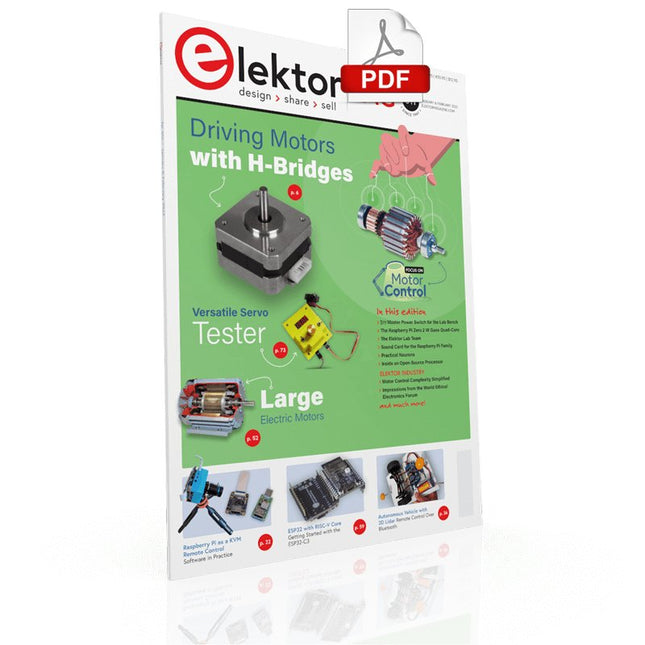
DRIVING MOTORS WITH H-BRIDGESAn Introduction to DC, Stepper, and Brushless Motors
THE ELEKTOR LAB TEAMOur Approach, Preferred Tools, and More
RASPBERRY PI AS A KVM REMOTE CONTROLPi-KVM Software Test
IQAUDIO CODEC ZEROA Sound Card for the Raspberry Pi Family
THE PIKVM PROJECT AND LESSONS LEARNEDInterview with Maxim Devaev (Developer, PiKVM)
AUTONOMOUS VEHICLE WITH 2D LIDARESP32 Pico Interprets Data from the Lidar Module THE RASPBERRY PI ZERO 2 W GOES QUAD-CORE NOTES FROM THE 2021 WORLD ETHICAL ELECTRONICS FORUM
MOTOR CONTROLHow the Complexity of Motor Control Is Simplified
LARGE ELECTRIC MOTORSBasic Principles and Useful Information GETTING STARTED WITH THE ESP32-C3 RISC-V MCU
PROTECT YOURSELF AND OTHERS!DIY Master Power Switch for the Lab Bench
CREATE GUIS WITH PYTHON (PART 2)Spy name chooser
PRODUCTRONICA FAST FORWARD 2021 WINNERSExciting Technologies and Creative Engineering Solutions
VERSATILE SERVO TESTERCheck Behavior When There’s No Datasheet
MODBUS OVER WLAN (PART 2)Software for the Modbus TCP WLAN Module
UNDERSTANDING THE NEURONS IN NEURAL NETWORKS (PART 3)Practical Neurons
INSIDE AN OPEN-SOURCE PROCESSORSample Chapter: Lattice and Xilinx FPGA Results
STARTING OUT IN ELECTRONICSWe Are Not Yet Done with the Coil
ERR-LECTRONICSCorrections, Updates and Readers’ Letters
COLOR TO SOUNDHow to Read Out a Color Sensor via I2C
BATTLAB-ONEMeasure and Optimize the Battery Life of IoT Devices
SIMPLE EARTH-LEAKAGE TRACERTesting Isolation of Mains Supply
POVERTY AND ELECTRONICSSustainable Development Goal 1
HEXADOKUThe Original Elektorized Sudoku
52 Volumes on USB – Now incl. Volume 2025!
NEW: For articles from the year 2000 onwards, there is now a separate download option for additional materials such as PCB layouts, Gerber files, and software!
This USB stick (64 GB) is loaded with all the Elektor magazine English editions (as PDFs) from 1974 to 2025. Elektor engineers, authors, and editors aim to inspire you to master electronics and computer technology by presenting professionally designed circuits that are easy to build.
We also cover the latest developments in electronics and information technology. With the Elektor Archive on a USB stick, you can browse our previous English editions at your convenience and learn about MCU-based projects, robotics, electronics testing, embedded programming, analog techniques, and much more.
All the Elektor magazine editions are stored as PDFs on a 32-GB USB stick (USB 3.0). The 10,000+ articles have been classified by date of publication (month/year), and a comprehensive index enables you to search the entire USB stick. Subject areas include:
Audio & video
Computers & microcontrollers
Radio, hobby & modelling
Home & garden
Power supplies & batteries
Test & measurement
Software
And everything else that doesn’t fit in one of these categories.
Elektor GPT
Elektor GPT is an AI-powered tool that helps users navigate through the decades-long Elektor archive. Using advanced search algorithms and natural language processing, Elektor GPT quickly finds articles, projects, and other resources from the archive.
Specifications
Storage
64 GB
Interfaces
1x USB-A1x USB-C
System requirements
PC with Adobe Reader 7.0 or higher
Web browser
Diese Ausgabe steht allen GOLD- und GREEN-Mitgliedern auf der ElektorMagazine-Website zum Download bereit!
Sie sind noch kein Mitglied? Hier klicken!
STM32 Wireless Innovation Design Contest – Die Gewinner stehen fest
In-Circuit LC-MeterEine Prototyp-Studie
Das modulare DC-Leistungsmessgerät AmpVoltTeil 1: Platine zur Messung von Strömen bis 5 A und Spannungen bis 50 V
embedded world 2024
Reparatur von elektronischen GerätenWerkzeuge, Techniken und Tipps
Aller Anfang ...muss nicht schwer sein: Wir setzen die Verstärkertheorie fort!
Ein einfacher DDS-SignalgeneratorDirekte Digitale Synthese in ihrer reinsten Form
Sparkplug im ÜberblickEine Spezifikation für MQTT-Daten
Bemerkenswerte BauteileZeile für Zeile: CRTCs
Radargesteuerte BeleuchtungAutomatisches Treppenhauslicht mit Anwesenheitsdetektion
Digitale Wasserwaage und aktive Stroboskop-Scheibe für PlattenspielerFeinabstimmung Ihres Plattenspielers mit nur einem Gerät
Open Source und seine Bedeutung für die Elektronikindustrie (2)
M12-Rundsteckverbinder mit A-KodierungErste Wahl für industrielle Anwendungen
Arduino-MesslaborEin 8-in-1-Test- und Messgerät für das heimische Elektroniklabor
Soundkarte als Betrag/Phase-Impedanz-AnalysatorFür Frequenzen von 100 Hz bis 90 kHz
pH-Wert-Messung mit dem Arduino UNO R4Überprüfen Sie die Qualität Ihres Wassers
Aus dem Leben gegriffenStartrampe für Pangpong-Popöchen
Digitales Speicheroszilloskop FNIRSI 1014DGute Leistung für knappe Budgets
2024: Eine Odyssee in die KIWie man die Objekterkennung zum Laufen bringt
10-MHz-ReferenzgeneratorHochgenau, mit Verteiler und galvanischer Trennung
Projekt-Update #2: Energiemessgerät mit ESP32Einige Weiterentwicklungen
Projekt 2.0Korrekturen, Updates und Leserbriefe
Ein Interview mit Eben Upton, Geschäftsführer von Raspberry PiDer Raspberry Pi 5 und darüber hinaus
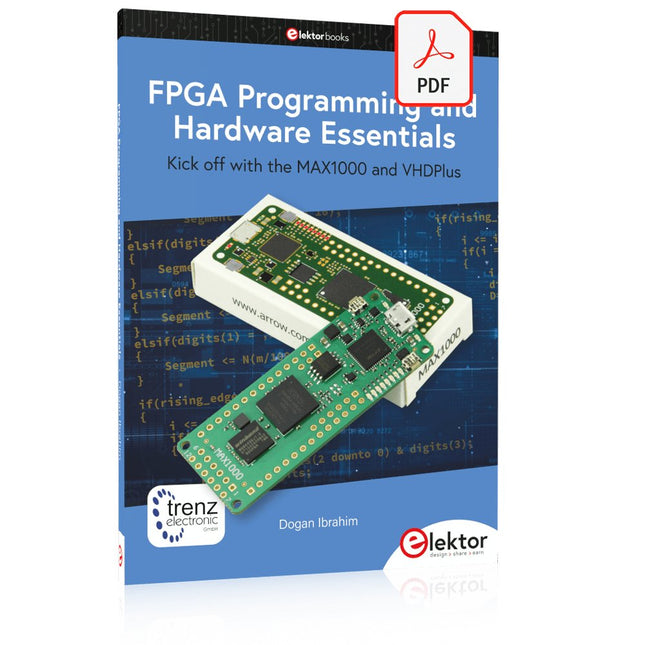
Kick off with the MAX1000 and VHDPlus
Ready to Master FPGA Programming? In this guide, we’re diving into the world of Field Programmable Gate Arrays (FPGAs) – a configurable integrated circuit that can be programmed after manufacturing. Imagine bringing your ideas to life, from simple projects to complete microcontroller systems!
Meet the MAX1000: a compact and budget-friendly FPGA development board packed with features like memory, user LEDs, push-buttons, and flexible I/O ports. It’s the ideal starting point for anyone wanting to learn about FPGAs and Hardware Description Languages (HDLs).
In this book, you’ll get hands-on with the VHDPlus programming language – a simpler version of VHDL. We’ll work on practical projects using the MAX1000, helping you gain the skills and confidence to unleash your creativity.
Get ready for an exciting journey! You’ll explore a variety of projects that highlight the true power of FPGAs. Let’s turn your ideas into reality and embark on your FPGA adventure – your journey starts now!
Exciting Projects You’ll Find in This Book
Arduino-Driven BCD to 7-Segment Display Decoder
Use an Arduino Uno R4 to supply BCD data to the decoder, counting from 0 to 9 with a one-second delay
Multiplexed 4-Digit Event Counter
Create an event counter that displays the total count on a 4-digit display, incrementing with each button press
PWM Waveform with Fixed Duty Cycle
Generate a PWM waveform at 1 kHz with a fixed duty cycle of 50%
Ultrasonic Distance Measurement
Measure distances using an ultrasonic sensor, displaying the results on a 4-digit 7-segment LED
Electronic Lock
Build a simple electronic lock using combinational logic gates with push buttons and an LED output
Temperature Sensor
Monitor ambient temperature with a TMP36 sensor and display the readings on a 7-segment LED
Downloads
Software