Diese Ausgabe steht allen GOLD- und GREEN-Mitgliedern auf der ElektorMagazine-Website zum Download bereit!
Sie sind noch kein Mitglied? Hier klicken!
STM32 Wireless Innovation Design Contest – Die Gewinner stehen fest
In-Circuit LC-MeterEine Prototyp-Studie
Das modulare DC-Leistungsmessgerät AmpVoltTeil 1: Platine zur Messung von Strömen bis 5 A und Spannungen bis 50 V
embedded world 2024
Reparatur von elektronischen GerätenWerkzeuge, Techniken und Tipps
Aller Anfang ...muss nicht schwer sein: Wir setzen die Verstärkertheorie fort!
Ein einfacher DDS-SignalgeneratorDirekte Digitale Synthese in ihrer reinsten Form
Sparkplug im ÜberblickEine Spezifikation für MQTT-Daten
Bemerkenswerte BauteileZeile für Zeile: CRTCs
Radargesteuerte BeleuchtungAutomatisches Treppenhauslicht mit Anwesenheitsdetektion
Digitale Wasserwaage und aktive Stroboskop-Scheibe für PlattenspielerFeinabstimmung Ihres Plattenspielers mit nur einem Gerät
Open Source und seine Bedeutung für die Elektronikindustrie (2)
M12-Rundsteckverbinder mit A-KodierungErste Wahl für industrielle Anwendungen
Arduino-MesslaborEin 8-in-1-Test- und Messgerät für das heimische Elektroniklabor
Soundkarte als Betrag/Phase-Impedanz-AnalysatorFür Frequenzen von 100 Hz bis 90 kHz
pH-Wert-Messung mit dem Arduino UNO R4Überprüfen Sie die Qualität Ihres Wassers
Aus dem Leben gegriffenStartrampe für Pangpong-Popöchen
Digitales Speicheroszilloskop FNIRSI 1014DGute Leistung für knappe Budgets
2024: Eine Odyssee in die KIWie man die Objekterkennung zum Laufen bringt
10-MHz-ReferenzgeneratorHochgenau, mit Verteiler und galvanischer Trennung
Projekt-Update #2: Energiemessgerät mit ESP32Einige Weiterentwicklungen
Projekt 2.0Korrekturen, Updates und Leserbriefe
Ein Interview mit Eben Upton, Geschäftsführer von Raspberry PiDer Raspberry Pi 5 und darüber hinaus
Diese Ausgabe steht allen GOLD- und GREEN-Mitgliedern auf der ElektorMagazine-Website zum Download bereit!
Sie sind noch kein Mitglied? Hier klicken!
MultiRF-EntwicklungsboardEine Plattform zur Evaluierung drahtloser Protokolle für kurze und lange Reichweiten
Elektor wird 65Elektronik im Wandel seit 1961
WLAN-basierte Personenerkennung mit dem ESP32Wenn der Router zum Bewegungsmelder wird
Drahtlose WaagenVier kleine Waagen = eine große Waage
Walter, das kompakte IoT-ModulESP32-S3-SoC, LTE-M/NB-IoT-5G-Modem und GNSS-Receiver
3- und 4-Draht-RTD-Sensoren konditionierenMit Vollbereichsabgleich und Kabelkompensation
Drei in einem: 2-Kanal-Oszilloskop/Generator/MultimeterEin Test des Fnirsi 2D15P
electronica Fast Forward 2026 für Start-ups und Industriepartner
EcologgingEine modulare IoT-Messstation für Umweltdaten
Drahtlos-Anbindung für MedizingeräteImmer am Puls mit Bluetooth LE
AudiotronicsBrummunterdrückung
Mehr Effizienz in der Landwirtschaft durch KI-Modelle und SensorenSteigerung der landwirtschaftlichen Produktivität
OPC UA – ein ÜberblickPlattformunabhängiger Datenaustausch
Redox-Meter
Instrumentenverstärker für Physik- und Engineering-Experimente
Aktive differentielle Audio-FilterFür professionelle Frequenzweichen und mehr
Elektor-Community-Tipps zu IoT und Sensoren
Telegram-gesteuerter WarmwasserbereiterEine Lösung mit ESP32 und Arduino-Software
2026: Eine KI-OdysseeWas wurde eigentlich aus der Fuzzy-Logik?
Projekt 2.0
Alarmsignalinjektor + PowerTools zum Suchen verdeckt verlegter Leitungen
Elektor GREEN and GOLD members can download their digital edition here.
Not a member yet? Click here.
PbMonitor v2.0 UpdateBattery Monitoring with Improved Analog Design
Audio Latency MeasurementA Standalone Tool for Evaluating Errors and Latency in Audio Transmission
Square Wave vs. Bode PlotChecking the Performances of an Audio Device
embedded world 2026
Clever Coding with AIAI in Software Development for Electronics Engineers
QA403 Audio AnalyzerAffordable Precision for Audio Professionals and Hobbyists
EasyGimbalAutonomous Camera Tracking with AI, Stepper and Servo Motors
Sigfox Breakout Board (2)Sending Messages
Circuit ProtectionControlling Overvoltages with TVS Diodes
Emerging Battery Testing ApproachesA New Era of Diagnostics
AudiotronicsA First Preamplifier
CANopenTermAn Open-Source Tool That Brings CAN to Makers and Engineers Alike
Stabilization of Operational AmplifiersAvoiding Feedback Instability
Err-lectronicsCorrections, Updates, and Readers’ Letters
Signal ConditioningTips and Tricks to Fit Voltage Ranges
TDR Attachment for OscilloscopesLength, Short Circuit, Mismatch: Measure Cables Using Reflections!
From Life's ExperienceLED It Be
Speaker Oscillator and Resonance TesterA Fully Experimental Project for Your Speakers
Elektor Community Perspectives on Test and Measurement
ESP32 Audio Transceiver Board (Part 5)Audio Processing and Remote Control
2026: An AI OdysseyAI Has a Context Problem
Battery Storage for Balcony Power PlantsSmall Batteries, Big Impact
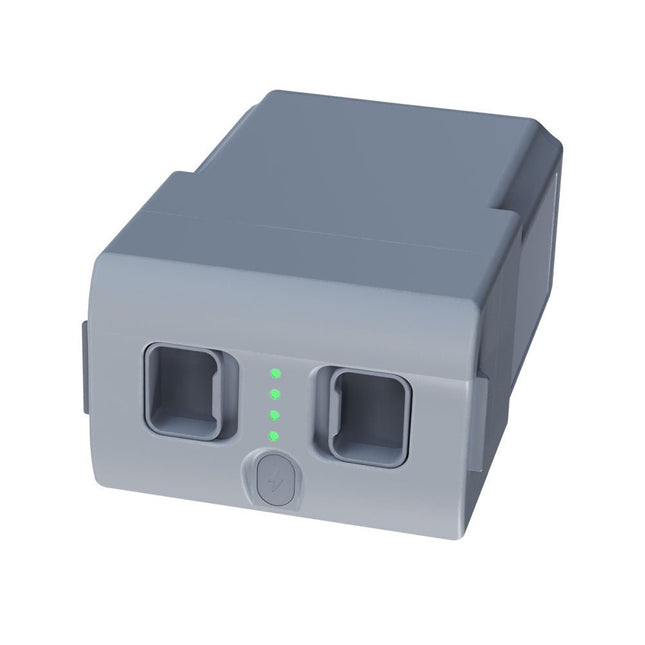
With a capacity of 15,000 mAh, the Unitree Go2 battery provides a robust power source that enables your robot to complete tasks with ease. Whether for complex exploration, research projects, or fun excursions, this powerful battery delivers the energy your robot needs.
The runtime of the Unitree Go2 battery varies depending on the application and usage. Based on the functions and activities employed, the battery can offer between 2 to 4 hours of operation. This flexibility allows you to customize the robot as needed, enabling longer exploration missions or more extensive projects.
The Unitree Go2 battery is a reliable companion for your robotics adventures. With its impressive capacity and adaptable runtime, it ensures your robot performs powerfully and with endurance, without frequent recharging.
Whether you need the Unitree Go2 battery as a replacement or an upgrade for your robot, this powerful energy storage solution provides the perfect balance of performance and reliability.
Specifications
Rated voltage: DC 28.8 V
Limited charging voltage: DC 33.6 V
Charging current: 9 A
Rated capacity: 15,000 mAh, 432 Wh
Standard: IS 16046 (Part 2) / IEC 62133-2
Self-developed battery management system (BMS)
Dimensions: 120 x 80 x 182 mm
Functions:
Power indicator
Self-discharge protection of battery storage
Equilibrium charge protection
Overcharge protection
Discharge protection
Short circuit protection
Battery charge detection protection
Elektor GREEN and GOLD members can download their digital edition here.
Not a member yet? Click here.
MultiRF Dev BoardA Platform for Evaluating Short- and Long-Range Wireless Protocols
Elektor at 65Disrupting Electronics Since 1961
Wi-Fi-Based Person Detection on an ESP32When Your Router Becomes a Motion Sensor
Wireless ScalesFour Small Scales = One Big Scale
Walter, the Compact IoT ModuleESP32-S3 SoC, LTE-M/NB-IoT 5G Modem, and GNSS Receiver
3- and 4-Wire RTD Sensors ConditioningWith Full-Scale Adjustment and Cable Compensation
3-in-1 2-Channel Oscilloscope/Generator/MultimeterA Review of The Fnirsi 2D15P
electronica Fast Forward 2026 Invites Startups and Industry Partners
EcologgingA Modular Environmental IoT Station for Field Research
Wireless Connectivity in Medical ApplicationsAlways on the Pulse with Bluetooth LE
AudiotronicsHum Reduction
Increasing Agricultural Efficiency with AI Modeling and SensorsBoosting Agricultural Productivity
OPC UA — An OverviewPlatform-Independent Data Exchange
Redox Meter
Instrumentation Amplifier for Physics and Engineering Experiments
Active Differential Audio FiltersFor Professional Crossovers and More
Elektor Community Perspectives on IoT & Sensors
Telegram-Controlled Water Heater Interface ModuleA Solution Based on an ESP32 and Arduino Software
2026: An AI OdysseyWhatever Happened to Fuzzy Logic?
Err-lectronics
Alarm Signal Injector Plus PowerTools for Finding Broken Wires
Elektor GREEN en GOLD leden kunnen deze uitgave hier downloaden.
Nog geen lid? Klik hier om een lidmaatschap af te sluiten.
Digitale belasting voor grote stromenvan noodzaak tot innovatie
Stemmenroverinstant karaoke-schakeling
Audio A/B-keuzeschakelaar met versterkingsregelingschakelt tussen microfoon- en lijningangen
Beter laden voor de LIR2032wees lief voor uw knoopcellen
Simpele aanraaksensorenmaak ze zelf – voor elke microcontroller
Universele infraroodschakelaartweede leven voor oude afstandsbedieningen
Microcontroller-gestuurde loeidoosspeelse geluiden met een microcontroller
USB-accu-interface
Low-power apparaten voeden met een powerbankanti-afschakel-schakeling
Kleine klasse-A audioversterker met stroomuitgangstuur luidsprekers aan met stroom in plaats van spanning
Pseudo-symmetrische modulehoge CMRR met asymmetrische audioverbindingen
Automatische NiMH-laderlaad al uw accu’s in één keer!
Thyristorgebaseerde voedingsbeveiliging
Schakelaar met vingerafdruk-sensornuttige identiteitscontrole
DC/DC-converter voor 3 Aeen upgrade voor vaste-spanningsbronnen
Bewaking voor een boilerspannings- en stroomdetectie voor AC-kabels
Verzwakkers voor audiosignalen (1)instelbaar met jumpers
Poets uw acculader op (1)niet weggooien maar ombouwen!
Een print voor ‘de Blauwe’print voor Alps-motorpotmeter met terugkoppeling
50Hz-referentie uit 60Hz-netspanningzo gebruikt u 50Hz-elektronica in 60Hz-landen
Digitale isolatoreneenvoudige realisatie van galvanische isolatie
Compacte 12W-hifi-monoversterkerklein maar krachtig
Zaagtandgenerator met LM386
Driefasen-generatormet Raspberry Pi Pico
Deuropener voor muzikaal getalenteerden
Elektor-klassieker: Surf Synthesizerzeewatersportachtergrondgeluidgenerator (zwsaggg)
Poets uw acculader op (2)niet weggooien maar ombouwen!
Lampstroom-monitormet Raspberry Pi Pico
Infrarood-telegrafie
Fnirsi SWM-10repareer zelf uw accupacks met dit intelligent draagbaar puntlasapparaat
Stereo audio-codec voor ESP32 en co.geen angst voor audio-meettechnologie
Soldeertechniekendoe het meteen goed!
Verzwakkers voor audiosignalen (2)geschakeld met relais
USB-C voedingstroom uit USB-C voedingsadapters
Drie schakelingen met twee en drie teller-IC’s4017’s werken samen
Actieve componenten – de diode
Timer voor extreem lange tijdeninstellen en vergeten!
Jack in en jack uiteen handige insert-optie voor audioschakelingen
ESP32 met één Li-ion-cel
Hexadoku
Nachdem in den Bänden LabVIEW 1: Einstieg in die Praxis und LabVIEW 2: Arrays und serielle Daten zur Einführung in LabVIEW ein breit gefächertes und solides Grundlagenwissen vermittelt wurde, stehen mit LabVIEW 3: Für den Praktiker fortgeschrittene Programmiertechniken auf dem Programm.
Die Entwicklung eigener Sub-VIs (Unterprogramme), das Arbeiten mit Schieberegistern und Zustandsautomaten und die Ereignisgesteuerte Programmierung stellen die Schwerpunkte des dritten Bandes dar.
Die Erweiterung der LabVIEW-Funktionalitäten durch die Entwicklung eigener Sub-VIs
Der Einsatz von Schieberegistern zur Erstellung leistungsfähiger Zustandsautomaten
Optimierte Ablaufstrukturen durch Anwendung der Ereignisgesteuerten Programmierung
Verwendung anspruchsvoller graphische Frontpanelelemente wie Signalverlaufsdiagramme, Signalverlaufsgraphen und XY-Graphen
Die verschiedenen Methoden zur Datenspeicherung in Dateien mit Hilfe der vorhandenen Datei-I/O-Funktionen und -VIs
Die Synchronisierung von unabhängig parallel ablaufenden Prozessen durch Semaphoren, Melder oder Queues
Abgerundet wird der Inhalt dieses Bandes durch Betrachtungen zu globalen Variablen. Alle im Buch entwickelten VIs sind frei vom Elektor-Server downloadbar. Ebenso steht dort ein Bonuskapitel zum freien Download zur Verfügung, in dem es um die komplette Steuerung von VIs über das Internet geht.
The X500 V2 ARF Kit is an affordable, lightweight, and robust carbon fiber professional drone kit that is easy to assemble (less than 15 minutes). It comes with the X500 V2 Frame Kit and motors, ESCs, power distribution boards and propellers preinstalled. It is perfectly compatible with various flight controllers such as the Holybro Pixhawk series, Durandal, Pix32 V5, etc. There are numerous improvements compared the previous model.
Specifications
Wheelbase: 500 mm
Motor mount pattern: 16x16 mm
Frame body: 144x144 mm, 2 mm thick
Landing gear height: 215 mm
Space between top and bottom plates: 28 mm
Weight: 610 g
Flight time: ~18 minutes hover with no additional payload. Tested with 5000 mAh battery.
Payload: 1500 g (without battery, 70% throttle)
Battery recommendation: 4S 3000-5000 mAh 20C+ with XT60 Lipo battery (not Included)
Included
X500 V2 Frame Kit
With Preinstalled Items:
4x Motors: Holybro 2216 KV920 Motor (4 pcs) with XT30 Plug
4x ESCs (BLHeli S ESC 20A)
6x 1045 Propellers
Power Distribution Board – XT60 plug for battery & XT30 plug for ESCs & peripherals
Note: Depth camera mount is sold separately.
Highlights
Output Frequency (Sine): 50 MHz
Output Frequency (Square): 15 MHz
Channels: 2
Arbitrary Waveform Length: 16 Mpts
Features
Unique SiFi II (Signal Fidelity II) technology: generate the arbitrary waveforms point by point; recover the signal without distortion; sample rate accurate and adjustable; jitter of all the output waveforms (including Sine, Pulse, etc.) as low as 200 ps
16 Mpts memory depth per channel for arbitrary waveforms
Standard dual-channel with the same performance, equivalent to two independent signal sources
High frequency stability: ±1 ppm; low phase noise: -105 dBc/Hz
Built-in high-order harmonic generator (at most 8-order harmonics)
Built-in 7 digits/s, 240 MHz bandwidth full featured frequency counter
Up to 160 built-in arbitrary waveforms, covering the common signals in engineering application, medical electronics, auto electronics, math processing, and other various fields
Sample rate up to 250 MSa/s, vertical resolution 16 bits
Arbitrary waveform sequence editing function available; arbitrary waveforms also can be generated through the PC software
Various analog and digital modulation functions: AM, FM, PM, ASK, FSK, PSK, and PWM.
Standard waveform combine function, capable of outputting specified waveforms combined with the basic waveforms
Standard channel tracking function, when enabled, all the parameters of both channels are updated based on users' configurations
Standard interface: USB Host&Device and LAN (LXI Core 2011 Device); USB-GPIB function supported
4.3'' TFT
Included
1x Rigol DG2052 Function/Arbitrary Waveform Generator
1x Power cord
1x USB cable
Complete ESP32 microcontroller learning course featuring a custom-designed MCU expansion board, hands-on projects, and a comprehensive online guide – perfect for learning hardware, programming, and connectivity step by step.
A Practical Introduction to Embedded Systems with the ESP32
This course is designed for readers who are new to embedded systems and looking for a structured, example-driven way to get started. If you’ve explored general-purpose electronics or Arduino-based materials but found them too broad or lacking in practical guidance, this course offers a more focused alternative.
Using the "ESP32 by Example Kit" (EEK) – a compact and affordable set of components featuring LEDs, sensors, an OLED display, and a motion processor – you’ll work with a consistent hardware setup throughout the course. Once assembled, the EEK stays mostly unchanged, allowing you to concentrate on learning and experimentation without constant reconfiguration.
Topics include:
Understanding and programming the ESP32 microcontroller
Writing and deploying code with the Arduino IDE
Exploring cyber-physical systems, culminating in basic drone control
No prior experience with Arduino or embedded development is required. Each section features hands-on examples and mini-projects designed to reinforce key concepts and inspire deeper exploration. By the end of the course, you’ll be able not only to reproduce the book’s examples but also to build on them with your own ideas and applications.
Whether you're interested in embedded programming, interactive systems, or introductory drone control, this course provides a clear and practical path to getting started.
What you'll learn?
Embedded programming with the ESP32 using the Arduino IDE
Real-time sensor input and control via buttons, LEDs, and displays
Gesture-based interaction using the MPU6050 motion sensor
Bluetooth gamepad integration and drone control simulation
Wi-Fi and UDP networking, local web servers, and NTP
MQTT communication with cloud platforms like AWS and Arduino IoT
How to build and deploy full-featured IoT systems
Perfect for
Students and self-learners exploring embedded systems
Makers and IoT enthusiasts looking to improve their hardware skills
Educators and trainers seeking ready-to-teach material
Developers moving beyond Raspberry Pi or Arduino basics
Support when you need it
Access to instructors via Elektor Academy
Helpful community forums and essential documentation
What's inside the Box (Course)?
New 384-page book: "ESP32 by Example" (valued at €45)
Elektor ESP32 by Example Kit (EEK): Microcontroller Extension Board with 6 LEDs and 6 Buttons installed + OLED Display, MPU6050 3-axis Accelerometer and Gyroscope Module (valued at €40)
Adafruit HUZZAH32 – ESP32 Feather MCU Board (valued at €30)
ESP32 Cheap Yellow Display Board (valued at €25)
DHT11 Humidity & Temperature Sensor
Breadboard
Jumper wires
USB-C cable
Access to the full course on the Elektor Academy Pro Learning Platform
Instructional videos
Downloadable Arduino project files for every module
Learning Material (of this Box/Course)
▶ Click here to open
Module 1 – Getting Started with the ESP32 & EEK
Module 2 – Digital Output – LEDs and GPIO
Module 3 – Switches and Input Handling
Module 4 – EEK and PWM
Module 5 – OLED and Display Output
Module 6 – Motion Sensing with the MPU6050
Module 7 – Capstone Project (EEK in Action)
Module 8 – WiFi and Web Control with ESP32
Module 9 – Cloud Concepts using EEK
Module 10 – Hands-on: Arduino IoT Cloud and EEK
Module 11 – BlueTooth and EEK GamePad Integration
Module 12 – Why Drones?
Module 13 – Drone Simulator Concepts
Module 14 – Simple Drone Flight Control
Module 15 – Real-Time Drone Flight Control
Module 16 – Drone Control Mini-Projects
Module 17 – Middleware and Python Scripting
Module 18 – Python Applications for Drone Control
Module 19 – Capstone EEK Control Project and Presentation
About the Author
Dr. Jim Solderitsch is an educator, software architect, systems developer, and cybersecurity researcher with a focus on cyber-physical systems. He currently serves as an Adjunct Professor in Computing Sciences at Villanova University in Pennsylvania.
What is Elektor Academy Pro?
Elektor Academy Pro delivers specialized learning solutions designed for professionals, engineering teams, and technical experts in the electronics and embedded systems industry. It enables individuals and organizations to expand their practical knowledge, enhance their skills, and stay ahead of the curve through high-quality resources and hands-on training tools.
From real-world projects and expert-led courses to in-depth technical insights, Elektor empowers engineers to tackle today’s electronics and embedded systems challenges. Our educational offerings include Academy Books, Pro Boxes, Webinars, Conferences, and industry-focused B2B magazines – all created with professional development in mind.
Whether you're an engineer, R&D specialist, or technical decision-maker, Elektor Academy Pro bridges the gap between theory and practice, helping you master emerging technologies and drive innovation within your organization.
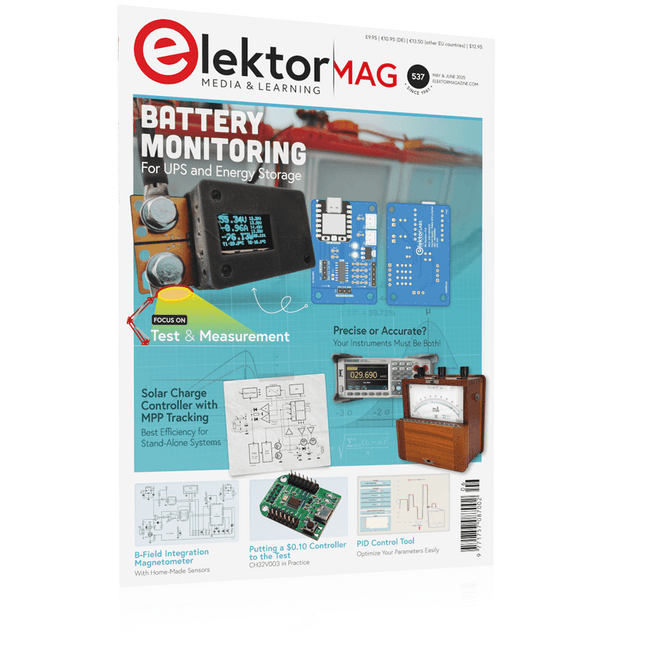
Elektor GREEN and GOLD members can download their digital edition here.
Not a member yet? Click here.
PbMonitor v1.0A Battery-Monitoring System for UPS and Energy Storage Applications
Solar Charge Controller with MPPT (1)Basic Principles of a Solar Controller for Stand-Alone Systems
B-Field Integration Magnetometer With Home-Made Sensors
Precise or Accurate?Your Instruments Need to Be Both!
AD7124 A Precision ADC in PracticeFeatures for Sensor Signal Conditioning
PID Control ToolOptimize Your Parameters Easily
embedded world 2025
Starting Out in Electronics……Continues with Tone Control
Academy Pro BoxBook + Online Course + Hardware
Milliohmmeter AdapterUses the Precision of Your Multimeter
The Next Leap in SemiconductorsOnward Toward 1.4 nm
Through-Hole Technology ConnectorsThe Best of Two Worlds: THR
Frequency CounterPortable and Auto-Calibrating Via GPS
Analog MetersPeculiar Parts, the Series
Stand-Alone Crystal TesterHow Accurate Is Your Clock Source?
Low-Cost I²C TesterConnect I²C Devices Directly to Your PC
From Life’s ExperienceWho Doesn’t Honor the Small Things?
2025: An AI OdysseyThe Transformative Impact on Software Development
Err-lectronicsCorrections, Updates, and Readers’ Letters
Raspberry Pi Standalone MIDI Synthesizer (2)Enhancing Our Setup with Intelligence
Nortonized Wien Bridge OscillatorSmall Changes Yield Significant Improvements
Putting a $0.10 Controller to the TestThe CH32V003 RISC-V Microcontroller and MounRiver Studio in Practice
An FPGA-Based Audio Player with Equalizer (2)Adding Volume Control, Advanced Mixing, and a Web Interface
Le téléchargement intégral de ce numéro est disponible pour nos membres GOLD et GREEN sur le site Elektor Magazine !
Pas encore membre ? Cliquez ici.
STM32 Wireless Innovation Design Contest Winners : les gagnants
LC mètre en circuitétude de prototype
AmpVolt : module de mesure de puissance (1)mesure de la puissance CC et de la consommation énergétique jusqu'à 50 V et 5 A
Embedded world 2024
réparation d'équipements électroniquesoutils, techniques et conseils
démarrer en électronique...plus de théorie sur les ampli-op
un générateur de signaux simplePure synthèse numérique directe
Sparkplug en un coup d'œilune spécification pour les données MQTT
contrôleur de tube cathodique
éclairage à commande radarcomment éclairer automatiquement un escalier en détectant une présence humaine
niveau à bulle électronique et disque stroboscopique actif pour platines vinylerégler votre platine vinyle avec cet outil tout-en-un
explorer les défis et la valeur commerciale de l’électronique open source
le connecteur circulaire codé Aune solution de choix pour les applications industrielles
The Arduino-Inside Measurement Labun instrument de test et de mesure 8 en 1 pour le labo d’électronique
analyseur de gain-phase avec une carte sonpour les fréquences de 100 Hz à 90 kHz
mesure du pH avec l'Arduino UNO R4vérifier la qualité de l'eau
sur le vifdouble détente
oscilloscope numérique FNIRSI 1014Dde bonnes performances pour des budgets serrés
2024 : l'odyssée de l'IAdétection d'objets
générateur de référence 10 MHztrès précis, avec distributeur et isolation galvanique
mise à jour #2 : compteur d'énergie basé sur l'ESP32quelques améliorations
projet 2.0corrections, Mises à jour, et Courrier des lecteurs
entretien avec Eben Upton, PDG de Raspberry PiRaspberry Pi 5 et au delà