
Search results for "elektor OR raspberry OR pi OR ruler"
-

Elektor Digital AVR (DE) | E-book
AVR neu (DE) | E-book
€ 32,80
Members: € 29,52
-

Elektor Digital Elektor Janvier/Février 2020 (PDF)
Elektor Janvier/Février 2020 PDF FR
€ 10,95
-

Elektor Digital Elektor 05-06/2021 als PDF (DE)
Elektor 05-06/2021 als PDF (DE)
€ 11,90
-
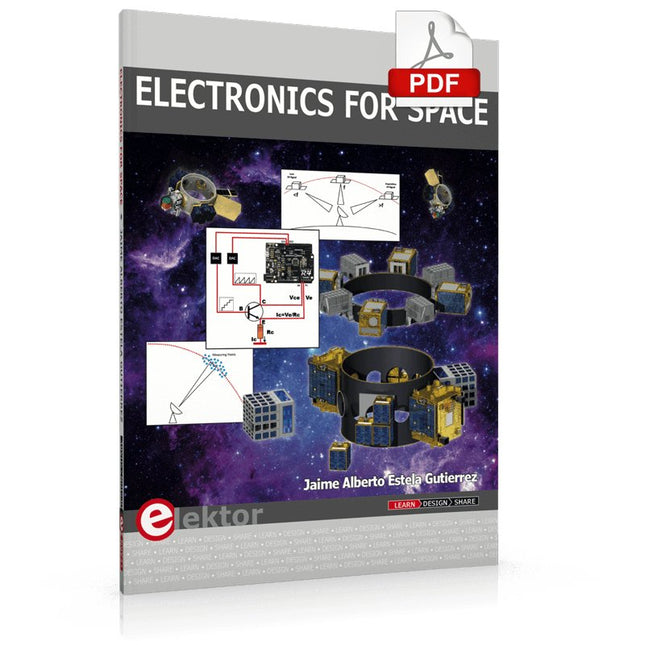
Elektor Digital Electronics for Space (E-book)
Space, the final frontier, will become more and more popular. The space industry is continually growing and new products and services will be required. Innovation is needed for the development of this industry. Today it is no longer possible to follow all the events in field of space. The space market is growing and activities are increasing, especially the market for small-satellites. This book wants to help close the gap and encourage electronic engineers to enter into the fascinating field of space electronics. One of the main difficulties is finding people with knowledge of space electronics design. Nowadays companies have to invest a lot of time and resources to instruct electronic engineers with no experience of space. Only a brief and basic introduction of this topic is typically achieved at university in space engineering lectures. Professionals with practical experience and the necessary theoretical knowledge are scarce. Companies from the space sector are searching for staff with knowledge of space electronics. This book will bring space closer aspiring to the space electronic hobbyists.
€ 24,95
Members: € 22,46
-

Elektor Digital Mastering Microcontrollers Helped by Arduino (3rd Edition) | E-book
Third, extended and revised edition with AVR Playground and Elektor Uno R4 Arduino boards have become hugely successful. They are simple to use and inexpensive. This book will not only familiarize you with the world of Arduino but it will also teach you how to program microcontrollers in general. In this book theory is put into practice on an Arduino board using the Arduino programming environment. Some hardware is developed too: a multi-purpose shield to build some of the experiments from the first 10 chapters on; the AVR Playground, a real Arduino-based microcontroller development board for comfortable application development, and the Elektor Uno R4, an Arduino Uno R3 on steroids. The author, an Elektor Expert, provides the reader with the basic theoretical knowledge necessary to program any microcontroller: inputs and outputs (analog and digital), interrupts, communication busses (RS-232, SPI, I²C, 1-wire, SMBus, etc.), timers, and much more. The programs and sketches presented in the book show how to use various common electronic components: matrix keyboards, displays (LED, alphanumeric and graphic color LCD), motors, sensors (temperature, pressure, humidity, sound, light, and infrared), rotary encoders, piezo buzzers, pushbuttons, relays, etc. This book will be your first book about microcontrollers with a happy ending! This book is for you if you are a beginner in microcontrollers, an Arduino user (hobbyist, tinkerer, artist, etc.) wishing to deepen your knowledge,an Electronics Graduate under Undergraduate student or a teacher looking for ideas. Thanks to Arduino the implementation of the presented concepts is simple and fun. Some of the proposed projects are very original: Money Game Misophone (a musical fork) Car GPS Scrambler Weather Station DCF77 Decoder Illegal Time Transmitter Infrared Remote Manipulator Annoying Sound Generator Italian Horn Alarm Overheating Detector PID Controller Data Logger SVG File Oscilloscope 6-Channel Voltmeter All projects and code examples in this book have been tried and tested on an Arduino Uno board. They should also work with the Arduino Mega and every other compatible board that exposes the Arduino shield extension connectors. Please note For this book, the author has designed a versatile printed circuit board that can be stacked on an Arduino board. The assembly can be used not only to try out many of the projects presented in this book but also allows for new exercises that in turn provide the opportunity to discover new techniques. Also available is a kit of parts including the PCB and all components. With this kit you can build most of the circuits described in the book and more. Datasheets Active Components Used (.PDF file): ATmega328 (Arduino Uno) ATmega2560 (Arduino Mega 2560) BC547 (bipolar transistor, chapters 7, 8, 9) BD139 (bipolar power transistor, chapter 10) BS170 (N-MOS transistor, chapter 8) DCF77 (receiver module, chapter 9) DS18B20 (temperature sensor, chapter 10) DS18S20 (temperature sensor, chapter 10) HP03S (pressure sensor, chapter 8) IRF630 (N-MOS power transistor, chapter 7) IRF9630 (P-MOS power transistor, chapter 7) LMC6464 (quad op-amp, chapter 7) MLX90614 (infrared sensor, chapter 10) SHT11 (humidity sensor, chapter 8) TS922 (dual op-amp, chapter 9) TSOP34836 (infrared receiver, chapter 9) TSOP1736 (infrared receiver, chapter 9) MPX4115 (analogue pressure sensor, chapter 11) MCCOG21605B6W-SPTLYI (I²C LCD, chapter 12) SST25VF016B (SPI EEPROM, chapter 13) About the author Clemens Valens, born in the Netherlands, lives in France since 1997. Manager at Elektor Labs and Webmaster of ElektorLabs, in love with electronics, he develops microcontroller systems for fun, and sometimes for his employer too. Polyglot—he is fluent in C, C++, PASCAL, BASIC and several assembler dialects—Clemens spends most of his time on his computer while his wife, their two children and two cats try to attract his attention (only the cats succeed). Visit the author’s website: www.polyvalens.com.Authentic testimony of Hervé M., one of the first readers of the book:'I almost cried with joy when this book made me understand things in only three sentences that seemed previously completely impenetrable.'
€ 34,95
Members: € 31,46
-

Elektor Digital Alimentation électrique autonome (PDF)
ÉLECTRICITÉ PHOTOVOLTAÏQUE = ÉLECTRICITÉ GRATUITE Nous sommes désormais plus qu'heureux de poursuivre nos recherches sur notre propre autonomie et de veiller à ce que notre production électrique photovoltaïque soit appropriée ! D'abord on en rêve, puis vient l'étape du calcul : comparer le coût du kilowattheure d'origine du nucléaire (environnement à partir de centimes d'euro) et le calcul du kilowattheure d'origine photovoltaïque (l'environnement de 22 centimes de l'euro*), et nous saurons où en sont nos motivations d'écocitoyens. Gérard Guihéneuf, l'auteur de ce nouveau livre, pense qu'il ne faut pas se contenter d'aligner chiffres et idées. La nouvelle approche du processus de création d'entreprise se base sur la compréhension et les dimensions des installations des bâtiments domestiques dans le domaine public en 2009 et sur l'actualité des techniques et pratiques de réponse aux questions qui se posent lors de l'électrification des le site isolé ! La conception de projets simples, comme un contexte domestique, et d'un commentaire électrique standard, comme un système d'énergie photovoltaïque, trois emplacements réguliers : un abri dans le jardin, un garage et un mobil-home. L'économie est spectaculaire lorsqu'il s'agit de composants électroniques et d'assemblages de certains constituants essentiels, car les régulateurs de charge, les onduleurs et les panneaux solaires ne suffisent pas à l'entretien autonome du site. Si vous souhaitez en savoir plus sur l'électrification professionnelle de votre chantier, vous pouvez en savoir plus sur les dimensions des éléments constitutifs sans sacrifier l'efficacité ! Vous pouvez également utiliser la copie du Gerber et du Sprint Layout pour les circuits imprimés de la livrée. *avec les batteries en cours de reconditionnement lors de la panne photovoltaïque en cours et dans les vingt-cinq
€ 24,95
Members: € 22,46
-

Elektor Digital Röhrenverstärker-Schaltungen (E-book)
Röhrenverstärker-Schaltungen (E-book)
€ 44,80
Members: € 40,32
-

Elektor Digital Röhren 7 (PDF)
Aus dem Inhalt Über ein Jahrhundert Triode Neues vom Röhrenmarkt Siebketten mit Drossel, Widerstand und Kondensatoren Inserentenverzeichnis Eintakt-A-Endstufe mit der Triode 833 Gegentakt-AB-Endstufe mit der 6C33 Gegentakt-Triodenstufe mit ECC 99 und ECC 832 Phonovorstufe in Röhrentechnik Mehrkanalverstärker High-End-Audio Digital-Analog-Converter (DAC) Röhrensound mit Halbleitern Leserbrief CD-Two MKII Röhrendaten mit Sockelschaltungen
€ 19,90
Members: € 17,91
-

Elektor Digital Verstärker in Röhrentechnik (E-book)
Selbst für so manchen an der Elektronik Interessierten ist die Röhrentechnologie ein technischer Anachronismus, Röhrenverstärkern könne doch allenfalls noch ein Ehrenplatz im Museum zugewiesen werden. Das ist einerseits durchaus richtig, Röhren haben eine fast hundertjährige Geschichte hinter sich. Seit der Erfindung des Transistors, der Öffentlichkeit vorgestellt am 23.12.1947, war das Ende der Röhrenära eingeläutet. Von da ab sollte es immerhin noch mehr als zwanzig Jahre dauern, bis die Röhren – von Sonderanwendungen abgesehen – aus dem Blickfeld des durchschnittlichen Elektronikgeräte-Konsumenten weitgehend verschwunden waren. So gesehen, sind Röhren tatsächlich veraltet, haben Röhren Museumcharakter. Niemand käme wohl heute auch mehr ernsthaft auf die Idee, sein leistungsfähiges Digitalmessinstrument gegen ein Röhrenvoltmeter auszutauschen; hochintegrierte Halbleiterchips können nun einmal bei eigentlich unvergleichlich geringerem Platz- und Energiebedarf mehr. Auf die Überlegenheit moderner Mikroprozessoren in Bezug auf Rechengeschwindigkeit und Speicherkapazität braucht man eigentlich gar nicht zu verweisen. Der erste programmgesteuerte Elektronikrechner Eniac im Jahre 1945 wog rund 30 Tonnen, enthielt neben insgesamt etwa 500.000 übrigen Bauteilen 18.000 Elektronenröhren und füllte eine mittlere Halle. In einem Bereich allerdings, im Bereich der Audio-Signalverarbeitung, haben Röhren bei Kennern und Musikliebhabern ihre Bedeutung bewahrt oder zurückerlangt: Für eine mittlerweile gestiegene Zahl kritischer Hi-Fi-Hörer steht "ihr" Röhrenverstärker im Zentrum der heimischen Anlage und für unzählige Musiker ist der Gitarrenröhrenverstärker nach wie vor ein Garant für guten Sound. Dieses Book spricht jeden an, der sich für Röhren aus den verschiedensten Gründen interessiert, den "Audiophilen" ebenso wie den aktiven Musiker und natürlich auch den, der einfach nur etwas über die Geschichte und die gegenwärtige Anwendbarkeit von Röhren wissen will. Aus diesem Grund hat der Autor sowohl Informationen über ein interessantes Stück Technikgeschichte als auch – praxisorientiert – Schaltungen und Selbstbauanleitungen zusammengetragen.
€ 32,80
Members: € 29,52
-

Elektor Digital Audio 3 (PDF)
Inhalt Röhrentechnik Entwicklung von DCMB-Verstärkern: Die Regeln der Kunst 50-W-Gegentaktverstärker mit EL34 und Autobias: Einmal und nie wieder – der Ruhestrom-Abgleich Kann ein Röhrenverstärker Mikrodetails wiedergeben: Bremst der Ausgangsübertrager die Auflösung Doppelter Röhrentester Comra BT0801: Testen und Selektieren in einem Rutsch 300B-Single-Ended Stereo-Verstärker: Kompromisslose Schaltungsauslegung mit der Triode schlechthin Lautsprecher Freedom von Monacor International: Gelungene Kombination aus Horn und Reflexsystem Symphonie von Visaton: Großer Auftritt der großen Kalotte Apollon von ASE: Das Flaggschiff mit Scan Speaks Illuminator-Bestückung TL-Sub von Quint-Audio: Der Subwoofer für reichlich Druck in der untersten Oktave Hans von Henkjan Olthuis: Zweiwege-Standbox mit Design-Qualität Avisio vom Lautsprechershop Strassacker: Der Einstand in die Home-Cinema-Riege XT612 von Ground Sound: Vollaktive Box, die selber messen kann Der Markt: Neues und Nützliches Halbleitertechnik DIY CD-Player von Tentlabs: Digitaltechnik und Röhrenschaltungen geschickt kombiniert SMPS 180 von Hypex: Das Schaltnetzteil zur Klasse-D-Technik UcD 2k von Hypex: Klasse-D-Technik für die PA im kW-Bereich
€ 16,90
Members: € 15,21
-

Elektor Digital Elektor 07-08/2020 als PDF (DE)
Elektor 07-08/2020 als PDF (DE)
€ 11,90
-

Elektor Digital Elektor 03-04/2021 als PDF (DE)
Elektor 03-04/2021 als PDF (DE)
€ 11,90


